Last updated: 30 September 2026. Planning ranges in this guide are for budgeting and specification, not factory quotations.
Short answer: six numbers. That’s the whole job. Where your site sits on the chloride scale. The alloy and how thick the tube wall is. Dry film thickness read at the edge, which is where it’s always thinnest. Salt spray hours, run on a coupon from your batch. The fastener grade. And whether water can get back out of the frame. A supplier who can put four of those six on paper has engineered the product. A supplier who answers with “marine grade” and “heavy duty” has written you a brochure. You can tell which one you’re talking to in about five minutes.
Take a hotel sitting 50 to 200 m from breaking surf. The six come out roughly like this:
- Site: ISO 9223 C5. Chloride lands at 300 to 600 mg/m² a day, which works out to 110 to 220 kg of chloride settling on a 1,000 m² terrace over a year.[1]
- Frame: 6063-T5 or T6 tube at 1.5 to 2.0 mm wall. Drop to 1.0 to 1.2 mm and the tube dents and cracks at the welds inside two seasons. “Aluminium frame” on a quotation will happily sell you that.
- Coating: 80 to 100 µm on the faces, 50 µm minimum at the edges, cured at 180 to 200 °C peak metal temperature for 8 to 12 minutes.
- Fasteners: A4-70 (316) with nylon isolators wherever stainless meets aluminium. The upgrade runs US$0.40 to 1.50 a chair.
- Evidence: 1,000 to 2,000 h neutral salt spray to ISO 9227, creep from the scribe 1 mm or less, and the coupons have to come from your production batch. A generic certificate won’t do.
- Money and time: +12 to 28% a unit, US$300 to 900 for the test pack, 30 to 50 days in production, then 12 to 40 days at sea.
Eight questions buyers ask first
| What buyers ask first | Straight answer | Number to plan on |
|---|---|---|
| How close to the sea does 316 stainless become necessary? | Within roughly 300 to 500 m of breaking surf, or anywhere salt film is visible on glass and cars each morning | A4/316 inside 500 m; A2/304 beyond 2 km with a monthly fresh water rinse |
| How thick should the powder coating be? | Cheapest thing to specify, easiest thing to fake on a report | 60 to 80 µm on aluminium, 80 to 120 µm on steel, 50 µm minimum at edges |
| How many salt spray hours do I ask for? | Enough to catch pinholes and thin edges, not enough to predict years | 500 to 1,000 h for inland, 1,000 to 2,000 h for C4 and C5 sites |
| Can a salt spray test tell me how many years it will last? | No. ISO 9227 states the method is not intended to rank materials or predict long-term resistance | 0 years of prediction; use it as a batch consistency check[2] |
| What does a coastal specification add to unit cost? | Heavier wall, primer plus topcoat, 316 hardware, capped tube ends, batch test pack | +12 to 28% per unit, plus US$300 to 900 for test reports |
| What minimum order will factories accept? | The MOQ is set by whether the factory has to mix a colour or cut a die | 20 to 50 pcs stock finish, 100 to 300 pcs custom weave, 300 to 500 pcs with a new extrusion die |
| How long does the first order take? | Add 10 to 20 days to production between September and November, and 2 to 4 weeks for Chinese New Year | 7 to 15 days sample, 30 to 50 days production, 12 to 40 days at sea |
| How often does the furniture need rinsing? | Salt film sitting on the surface starts the rust, not the age of the coating | Every 2 to 4 weeks in high season; weekly within 100 m of surf |
Start with the site, not the catalogue
Two hotels can order the same chair and get completely different results. Two km inland, the standard build lasts 5 to 8 years. On the sand, you see first rust in 6 to 18 months. Chloride is what does it: about 22 g per m² a year inland, 550 g on the sand.
ISO 9223 sorts atmospheric corrosivity by mass loss. It measures what a standard metal coupon loses in its first year. The scale runs from C1 (dry indoor) to CX (extreme marine and industrial). Three things set the number: time of wetness, sulphur dioxide, and airborne chloride.[1] Chloride is the one that splits two coastal sites sitting 200 m apart, and it’s the one number you will never find on a quotation.
You don’t need to commission your own testing programme to get a chloride figure you can work with. ISO 9225 sets out how chloride and sulphur dioxide deposition get measured. It also gives conversion factors between methods, so a port authority number can be set against a laboratory one.[3] Local airports, ports and desalination plants publish this stuff more often than buyers expect.
On a site visit, walk the staff car park before you walk the terrace. Look at the windward glass too. Salt film you can see before 09:00 means S2 or S3. And watch for the awkward properties: a seawater pool, a pool plant room, or a rooftop bar above the third floor. One project can easily need two specifications.
| Category | Carbon steel, year one | Zinc, year one | Chloride deposition | What it means for furniture |
|---|---|---|---|---|
| C1 | 1.3 µm or less | 0.1 µm or less | S0, 3 mg/m²·day or less | Interior only. Any finish survives. |
| C2 | 1.3 to 25 µm | 0.1 to 0.7 µm | S1, 3 to 60 | Inland city. Single-coat polyester powder at 60 µm is adequate. |
| C3 | 25 to 50 µm | 0.7 to 2.1 µm | S2, 60 to 300 | Coastal town 1 to 5 km from water. Seal tube ends, 60 to 80 µm, rinse seasonally. |
| C4 | 50 to 80 µm | 2.1 to 4.2 µm | S2 to S3 | Beachfront 0.3 to 2 km. 80 to 100 µm, 316 fasteners, duplex on any steel part. |
| C5 | 80 to 200 µm | 4.2 to 8.4 µm | S3, 300 to 1,500 | On the sand, pool plant rooms. 100 to 120 µm, PVDF topcoat, 316 throughout, written rinse regime. |
| CX | 200 to 700 µm | above 8.4 µm | above 1,500 | Warm, wet, salt-ponding sites. Engineered specification plus a planned repaint cycle. Do not buy catalogue furniture. |
Going from C3 to C4 takes first-year steel loss from 25 to 50 µm up to 50 to 80 µm, and that step usually lands within 2 km of the water. Which is why “we supplied a hotel in Spain” tells you nothing on its own. You need the distance: 300 m from the sea, or 30 km?
Distance bands a site faster than any measurement you’ll commission. On an open coast, with the prevailing wind coming onshore:
| Distance from breaking surf | Chloride deposition, mg/m²·day | Chloride per m² per year | ISO 9223 band | First rust, standard inland build | Minimum build worth specifying |
|---|---|---|---|---|---|
| 0 to 50 m | 600 to 1,500 or more | 220 to 550 g | C5 to CX | 6 to 18 months | 100 to 120 µm, 316 throughout, weekly rinse, PVDF on south faces |
| 50 to 200 m | 300 to 600 | 110 to 220 g | C5 | 12 to 24 months | 80 to 100 µm, 316 fasteners, sealed tube ends |
| 200 to 500 m | 150 to 300 | 55 to 110 g | C4 | 18 to 36 months | 80 µm, 316 fasteners, weep holes at every low point |
| 500 m to 2 km | 60 to 150 | 22 to 55 g | C3 to C4 | 3 to 5 years | 70 to 80 µm, 316 in exposed positions only |
| 2 to 10 km | 10 to 60 | 4 to 22 g | C2 to C3 | 5 to 8 years | 60 to 80 µm, 304 acceptable with a monthly rinse |
| Beyond 10 km | below 10 | below 4 g | C1 to C2 | 8 to 12 years | 60 µm standard polyester |
These are planning bands for an open coast. They aren’t site measurements. And they do move. A headland between you and the water, a sea wall, wind that mostly blows offshore. Any of those can drop a site a whole category. A seawater pool plant room pushes the other way. A courtyard 2 km inland can sit in C4.
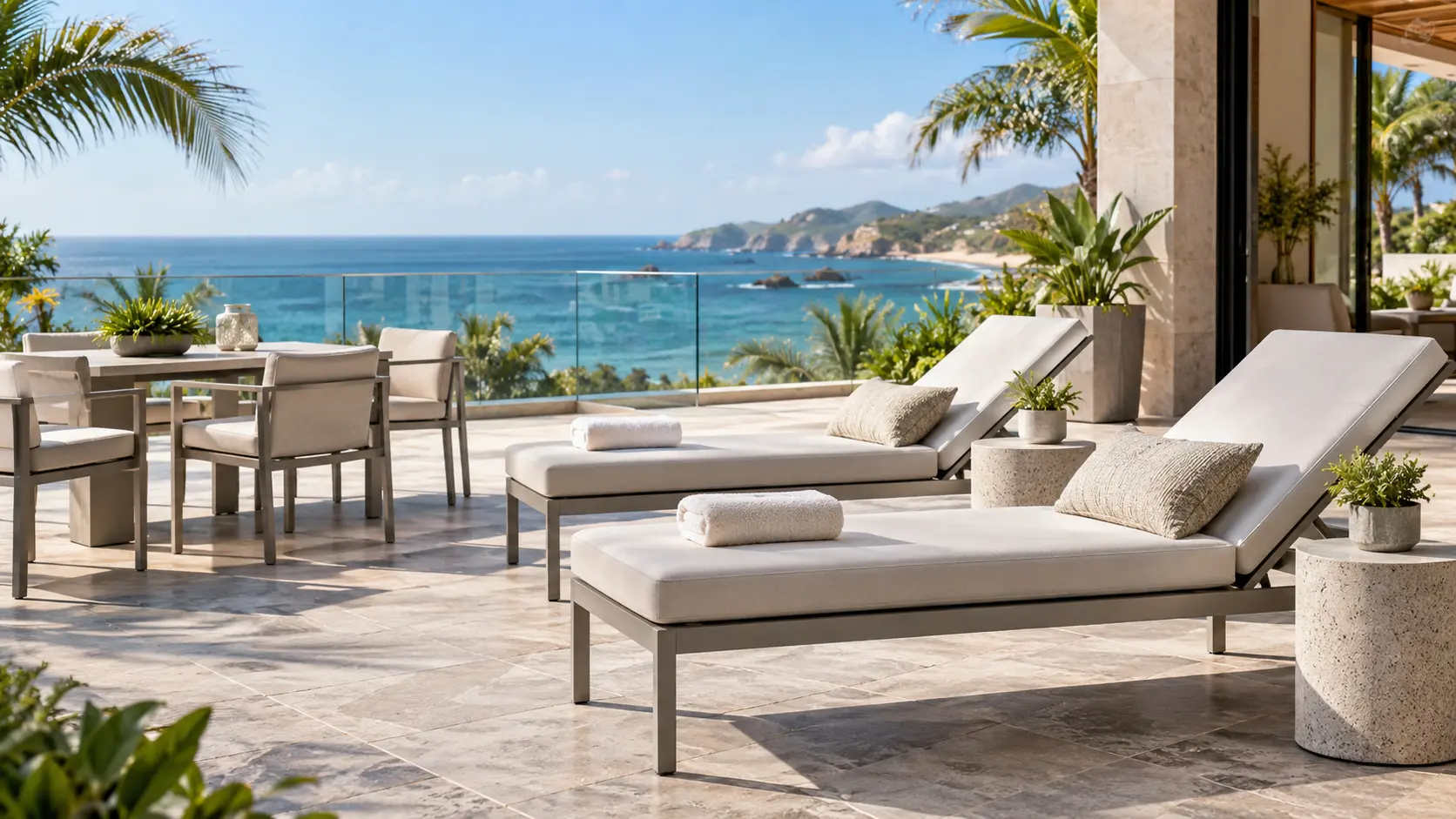
Not sure which corrosivity category your property sits in?
Send the address, the distance to the water and a photograph of the windward glass taken before 09:00. We return the ISO 9223 band, the chloride range to design against, and the coating thickness and fastener grade that band requires.
Which frame metal actually survives salt air
Compare frame metals at the places where they actually fail. Cut ends, welds, feet. That’s where your money goes.
| Frame | Working specification | Service life at C4 to C5 | How it fails | Cost index |
|---|---|---|---|---|
| 6063-T5/T6 aluminium tube | Wall 1.5 to 2.0 mm, powder or PVDF, sealed ends | 8 to 15 years | Pitting at cut ends and under feet, filiform corrosion under the film | 100 |
| 304 (A2) stainless | Tube or flat, brushed or electropolished | 3 to 8 years near surf | Tea staining, crevice corrosion under bolt heads | 145 |
| 316 (A4) stainless | 2 to 2.5% molybdenum, pickled and passivated | 10 to 20 years | Crevice corrosion in stagnant, low-oxygen joints | 190 |
| Hot-dip galvanised steel plus powder | 55 to 85 µm zinc to ISO 1461, then 60 to 80 µm powder | 12 to 25 years | Edge rust, weld spatter left under the zinc, transport damage | 110 |
| Mild steel, powder only | 60 to 80 µm single coat | 2 to 5 years | Underfilm rust creeping from every scratch and drilled hole | 70 |
| Teak, kiln dried | 8 to 12% moisture content, FSC chain of custody[4] | 15 to 30 years | Surface checking, grey weathering, mould in shaded corners | 220 |
| HDPE or synthetic wicker over aluminium | UV-stabilised PE or PVC weave, aluminium frame | 8 to 12 years | Chalking, weave splits at 3 to 5 years on south-facing elevations | 95 |
Aluminium doesn’t rust. It grows an oxide layer that slows the attack down. A woven aluminium lounger at 1.5 mm wall weighs 6 to 9 kg. Steel comes in at 11 to 16 kg, teak at 14 to 22 kg. That gap is the difference between a one-person carry and a two-person carry for staff putting out 200 pieces a day. Aluminium also fails politely: it pits locally at the cut ends instead of losing structure. So you fix it with sealing and drainage, not by buying a thicker tube.
When the frame has to be steel, hot-dip galvanising is your answer. ISO 1461 sets minimum coating thickness by section size. On 1.5 to 3 mm material that’s 45 µm local and 55 µm average. On 3 to 6 mm, 55 µm local and 70 µm average. On 6 mm and up, 70 µm local and 85 µm average.[5] Ask which band your frame falls into. A 1.2 mm tube sits in the lowest one.
What the steel looks like before it goes into the bath matters just as much. ISO 8501-1 gives you the rust grades and the preparation grades, which turns “blast to Sa 2.5” from an opinion into an instruction both sides can check.[6]
Galvanised steel under powder lasts 1.5 to 2.5 times longer than either layer on its own. The zinc sacrifices itself at a scratch. The paint slows the zinc down. Simple division of labour. But a frame that reaches the bath with weld spatter still hanging off it fails early. So write weld cleaning before galvanising into the spec. ISO 14713-1 covers the design principles and the corrosion resistance you can expect from zinc coatings across environments, and it’s the reference to quote when a supplier asks why a duplex system costs more.[7]
Steel carries one paperwork risk that aluminium doesn’t. China reinstated export licences covering roughly 300 steel product lines from 1 January 2026, and it’s the smaller exporters doing the queuing. Read the detail under China steel export licences in 2026 before you put a steel frame into a project with a fixed date.
Stainless is where most coastal projects overspend or under-specify. Often both in the same order. 316 carries 2 to 2.5% molybdenum. That lifts the pitting resistance equivalent number from about 19 to about 24. Within 300 to 500 m of breaking surf, 304 will tea stain in a single season. Beyond 2 km, with a monthly rinse, 304 is perfectly defensible. It costs about 25% less. Putting 316 on every screw out there is money on the floor. The same mismatch runs through architectural hardware sourcing, where a grade lands in a schedule the site never asked for.
Coating systems and the numbers that count
ISO 12944-6 covers laboratory test methods for protective paint systems on carbon steel across C2 to C5, and it says so in its own scope: the results help you choose a system rather than tell you exactly how long it will last.[8] ISO 12944-5 maps paint systems to environments and surface preparation grades. ISO 12944-1 defines the durability grades, low through very high, that your specification should name instead of “long lasting”.[9][10]
| System | Typical dry film thickness | Test level usually quoted | Where it fails | Premium over baseline |
|---|---|---|---|---|
| Single-coat polyester powder | 60 to 80 µm | 500 to 1,000 h neutral salt spray | Thin edges, welds, cut ends | Baseline |
| Primer plus polyester topcoat | 80 to 120 µm | 1,000 to 1,500 h | Poor pretreatment, which no thickness can fix | +8 to 15% |
| Fluoropolymer (PVDF or FEVE, AAMA 2605 class) | 25 µm individual minimum, 30 µm total minimum over 2 to 3 coats | 2,000 h cyclic, 4,000 h salt spray, 10 years Florida exposure | High cost, narrow colour range, needs a certified applicator | +25 to 60% |
| Duplex: hot-dip zinc plus powder | 55 to 85 µm zinc plus 60 to 80 µm powder | 1,000 to 2,000 h | Handling damage before installation | +12 to 25% |
| Anodising, architectural AA20 or AA25, specified to ISO 7599[11] | 20 to 25 µm oxide | 1,000 h plus seal quality test | Poor sealing, dye fading on dark colours | +10 to 20% |
| Electropolished 316 | No coating, passive layer | Chloride exposure and heat | Stagnant crevices, chlorinated pool water | +5 to 10% on 316 |
Four numbers decide whether the coating holds up. The rest of the conversation is colour charts.
- Minimum dry film thickness on visible faces: 80 µm on aluminium, 100 µm on steel, measured on flat faces well away from an edge.
- Minimum at edges and corners: 50 µm. Powder pulls back from a sharp edge while it flows during cure. So a 90 µm face can sit right next to a 35 µm edge. And an average-only report still reads as a pass at 40 µm. That edge is exactly where the first rust shows up.
- Oven cure: peak metal temperature of 180 to 200 °C, held 8 to 12 minutes for standard polyester. Under-cured powder looks perfect on the day. It loses adhesion inside a year. Over-cured powder goes brittle and chips at the welds.
- What the thickness really costs: 1 kg of polyester powder covers 8 to 12 m² of finished surface at 60 µm with normal overspray recovery. A lounger carries 1.6 to 2.6 m² of coated area. The material in one chair is 150 to 320 g, or US$1.00 to 3.50. Going from 60 to 90 µm adds roughly US$0.50 to 1.75 a chair. Thickness is the cheapest line in the specification. It’s also the one suppliers argue about hardest.
One free win while you’re at it. A dark bronze or black frame runs 15 to 25 °C hotter at midday than a light one. That heat, plus the thermal cycling, lands on the same film. On a south-facing pool deck, light silver or sand buys you years for no extra money.
The pretreatment layer nobody specifies
A multi-stage wash strips off drawing oils and extrusion die lubricant. Then a conversion layer gives the film something to grip. Neither one can be checked after the part leaves the booth, and that’s the whole problem with it.
Five items go into the order. It’s the same exercise as setting quality expectations with a sourcing team:
- Stage count: 5 to 9 stages for aluminium on a coastal programme, finishing with a deionised or reverse-osmosis rinse.
- Final rinse quality: conductivity below 50 µS/cm, checked and logged every shift. Salts left sitting on the surface before coating turn into blisters a year later.
- Conversion type: chrome-free zirconium or titanium, or a chromate process where your market allows it. Both work. The point is that there is one.
- Dry-off and time to coat: parts coated within 4 to 8 hours of pretreatment, or stored dry. Parts left overnight in a humid shed start oxidising before they ever reach the booth.
- Bath control: titration or conductivity records per shift. A photograph of a tank is not a record.
A salt spray certificate with no bath records behind it was bought, not earned. The pretreatment log is what predicts how the furniture behaves on the terrace, and only a factory running its own line can hand you one.
Design details that decide whether the coating survives
Most early rust is geometry, not chemistry. Salt water finds somewhere to sit. No organic film survives standing salt water forever. Weld through to crate, the whole chain is in the guide to preventing rust on outdoor furniture from China.
- Weep holes: 5 to 6 mm at every low point of a tube run. One hole per enclosed section, placed so it drains with the furniture standing in its normal position, not upside down in a crate.
- Tube ends: welded caps or pressed caps with sealant. An open tube end is a capillary. It pumps salt water the full length of the frame.
- Lap joints: sealed or gusseted on top, never shaped into a horizontal shelf. A flat 2 mm crevice holds water for hours after the rain has stopped.
- Fasteners: A4-70 (316) with nylon washers or bushings wherever stainless meets aluminium. The potential difference between the two drives galvanic attack onto the aluminium. And the aluminium is the part you can’t swap out.
- Feet and glides: nylon or polypropylene glides, plus stainless adjusters if the terrace is uneven. Bare aluminium feet on a wet deck is the single most common failure point on a lounger.
- Welds: ground smooth and cleaned before coating. Weld spatter leaves an uncoated micro-peak behind. Rust blooms out of it within 12 months.
- Sling and rope: textilene or solution-dyed acrylic with drainage gaps. A solid cushion sitting on a frame holds a wet pad against the finish for days.
Two tests you can run yourself. Ask for one assembled sample, turn it upside down, and pour a litre of water through it. Water still dripping from the same spot 10 minutes later means nobody ever designed the drainage. Then do it again on a sample that has been through the coating line twice, because the second pass is where powder bridges a 5 mm weep hole shut.
Rust shows up in six places
The shares below reflect what a first year of warranty claims looks like across beachfront properties. Treat them as priors to test against your own maintenance log, not as measurements. One unit can fail in more than one place, so the shares don’t add up to 100%.
| Failure point | Share of first-year finish claims | Time to visible rust, standard build | Cost to prevent at specification | Cost to repair after installation |
|---|---|---|---|---|
| Open or cut tube ends | 25 to 35% | 6 to 18 months | US$0.30 to 1.00 per unit | US$15 to 40 per unit, or a new frame |
| Fasteners and galvanic joints | 15 to 25% | 9 to 24 months | US$0.40 to 1.50 per unit | US$8 to 25 per unit plus labour |
| Thin edges, welds and drilled holes | 10 to 20% | 12 to 24 months | included in the coating specification | touch-up US$10 to 30 per unit, strip and re-coat US$40 to 90 |
| Feet and glides standing on wet decks | 10 to 20% | 6 to 12 months | US$0.20 to 0.80 per unit | US$5 to 15 per unit |
| Transport, handling and installation damage | 5 to 15% | on arrival | US$0.50 to 2.00 per unit in packing | US$20 to 60 per unit |
| Pretreatment failure, blistering under an intact film | 5 to 10% | 12 to 36 months | included in the wash specification | not repairable; replace |
Those six headings belong on an inspection report, so findings come back by failure type instead of one overall pass or fail. Around US$1.50 to 4.50 a unit, spent at the specification stage, removes 70 to 85% of the claim volume a beachfront property would otherwise carry in year one. Spend the same money on a thicker topcoat and you get almost nothing back. In four rows out of six, the coating was never the thing that failed.
How far each corrosion test actually goes
Every test below has a defined scope. The last column is what sits outside it.
| Test | Standard and conditions | Typical contract value | What it proves | What it does not prove |
|---|---|---|---|---|
| Neutral salt spray (NSS) | ISO 9227, 5% NaCl, 35 °C, pH 6.5 to 7.2 | 1,000 to 2,000 h, creep from scribe 1 mm or less | Film continuity: pinholes, thin edges, contamination | Service life. ISO 9227 explicitly excludes long-term prediction[2] |
| Acetic acid salt spray (AASS) and CASS | ISO 9227, pH 3.0 to 3.1, CASS at 50 °C | 250 to 1,000 h | Quality of anodic and decorative coatings on aluminium | Outdoor performance of a painted frame |
| Cyclic corrosion | ISO 11997-1, alternating wet, dry and humidity phases[12] | 25 to 60 cycles | Behaviour under wet and dry cycling, which is what a terrace actually does | UV resistance, mechanical wear |
| Humidity resistance | ISO 6270 or ASTM D2247, 38 °C at 100% RH | 1,000 to 4,000 h | Blistering and loss of adhesion without salt | Chloride attack |
| Accelerated weathering | ISO 16474-3, UVA-340, or xenon arc ISO 16474-2[13] | 1,000 to 2,000 h, gloss retention 50% or better | Chalking and colour drift | Corrosion |
| Dry film thickness | ISO 2808, eddy current gauge on non-magnetic metal | 8 to 12 readings per unit, report minimum and average | Whether the quoted thickness was applied | Whether it was cured or bonded[14] |
| Cross-cut adhesion | ISO 2409, 6 cuts each way, 1 mm spacing under 60 µm | Classification 0 or 1 | Bond between film and substrate, or between coats | Long-term wet adhesion; it is an empirical pass or fail, not an adhesion measurement[15] |
| Cure check | Solvent double rub, MEK or acetone | 50 double rubs without film softening | Whether the oven reached cure | UV stability or colour |
| Impact and bend | ISO 6272, often 2.5 to 5 N·m on furniture film | No cracking at the specified energy | Film flexibility after cure, catching over-baking | Adhesion under salt load |
The coupon has to come from the same batch as your order, coated the same day in the same booth. A report dated 2023, on a different alloy with a different powder batch, is a marketing document. Ask for the coupon. Don’t accept the PDF.
Start with the calendar. A 1,000 h neutral salt spray run parks a chamber for 42 days, and a 2,000 h run takes 83. So the evidence has to be commissioned before production starts. That is exactly what a pre-production inspection is meant to trigger. Per coupon set, budget US$120 to 350 for 1,000 h, US$200 to 600 for 2,000 h, and US$60 to 150 for a DFT, cross-cut and cure check. A full test pack on one finish lands at US$300 to 900, or 0.3 to 1.5% of a 40HQ order.
How to write rust protection into the RFQ
Nine lines, written so an engineer can be held to them. Same discipline behind any China RFQ:
| Specification line | Write this | Why it matters |
|---|---|---|
| Base metal | Alloy and temper, for example 6063-T5, minimum wall 1.5 mm, tube diameter 25 or 38 mm | “Aluminium frame” accepts recycled scrap with unknown magnesium and silicon content |
| Pretreatment | Multi-stage wash with chrome-free conversion, final rinse conductivity below 50 µS/cm, bath log per shift | Adhesion is created here. No thickness fixes a dirty surface. |
| Coating | Polyester powder, minimum 80 µm DFT on faces, 50 µm at edges, measured to ISO 2808 | Edges are where rust starts, and they are where powder is thinnest |
| Fasteners | A4-70 (316) stainless, nylon isolators at every aluminium joint | The galvanic couple eats the aluminium, not the screw |
| Drainage | Weep holes of 5 mm or more at all low points, tube ends welded or capped | Water trapped inside a tube evaporates and re-wets, concentrating chloride until the frame fails from the inside |
| Test evidence | 1,000 h NSS to ISO 9227 on coupons from the production batch, creep 1 mm or less, plus DFT and cross-cut reports | A batch coupon is evidence. A generic certificate is not. |
| Colour and gloss | RAL or Pantone reference, gloss at 60°, and a retained drawdown panel | Colour matching without a retained panel drifts between production runs |
| Packing | Non-woven wrap, edge protectors, no PVC tape in contact with the film | Adhesive tape lifts powder film during a 30-day container voyage |
| Spares | 2% spare glides and 1% spare fasteners, packed separately | First-season wear items are the fastest route to a guest complaint |
Send the RFQ with the site corrosivity category stated up front. A factory quoting C3 and a factory quoting C5 come back 15 to 30% apart on the same drawing. Written this way, the RFQ also doubles as the evidence trail for compliance with procurement and manufacturing standards, and that’s the file a claim lands on two seasons later.
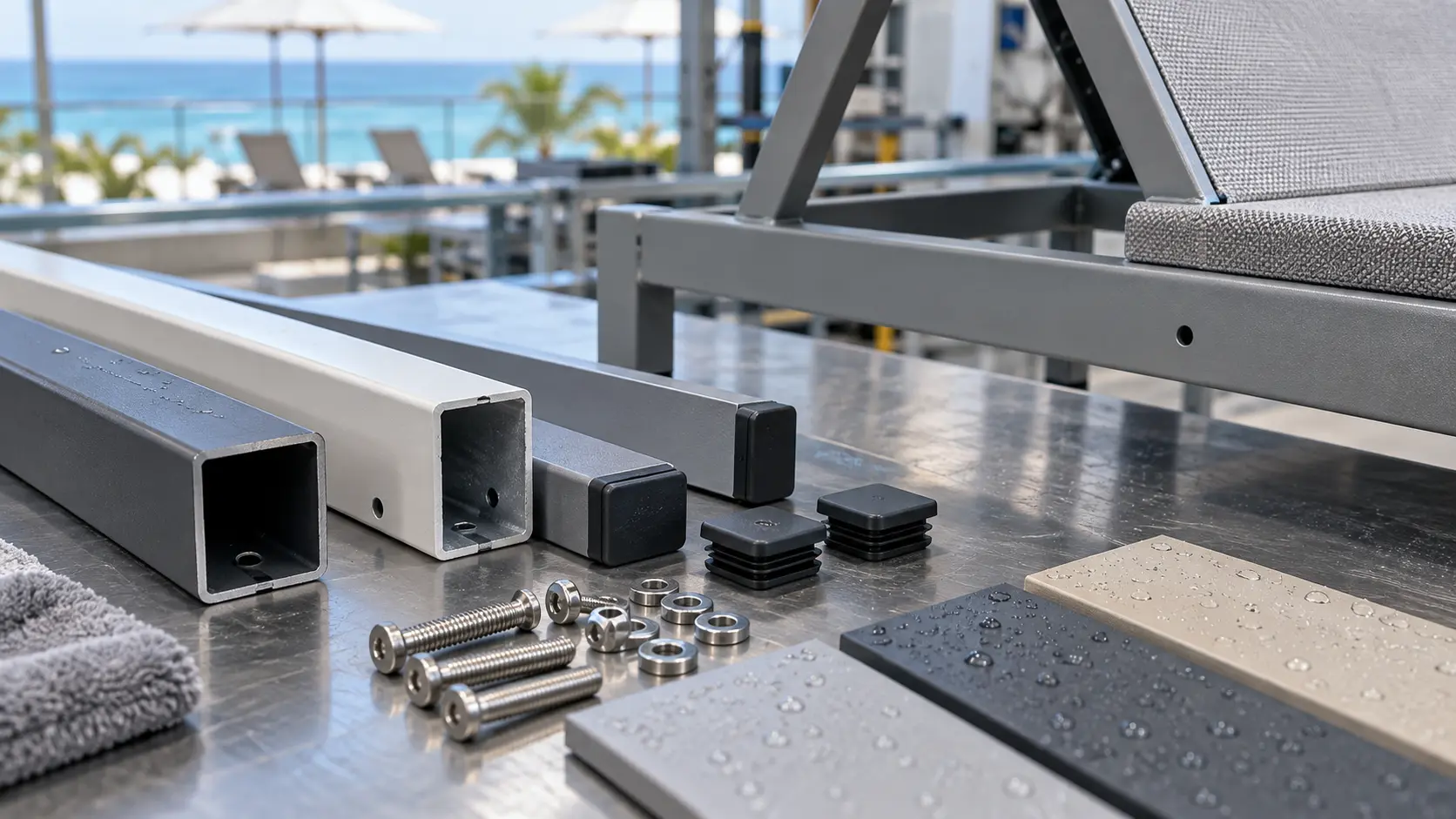
Factory checks that catch rust problems before shipment
Corrosion failures get made in the booth. So the checks have to run while the line is running. Sampling follows ISO 2859-1, and for furniture the usual plan is general inspection level II with an AQL of 2.5 for major defects and 4.0 for minor.[16] On a 3,200-piece batch, that plan draws 125 pieces.
| Stage | What to check | Sample | Tools |
|---|---|---|---|
| Pre-production | Alloy mill certificate, coating batch certificate, salt spray coupon from the same powder lot | 1 per batch | Document review |
| During production | Pretreatment bath titration log, final rinse conductivity, oven recorder chart, DFT on line, weld cleaning | 3 to 5 units per line per shift | DFT gauge, oven data logger, conductivity meter |
| Pre-shipment | Visual finish, DFT, cross-cut on a hidden area, assembly torque, drainage holes present, packing | AQL 2.5 major / 4.0 minor, ISO 2859-1 | Gauge, cross-cut cutter, camera |
| Loading | Container condition, dunnage, desiccant quantity, stack height, wrap integrity | Full supervision | Camera, moisture meter |
Outdoor furniture is bulky, so an inspector covers 150 to 500 pieces a day, not the 5,000 to 10,000 you might expect on small goods. Budget US$250 to 500 an inspector day, and make sure whoever stands on that line has read a coating specification before. That’s the first filter in choosing QC inspectors. A factory that refuses third-party access has already given you a finding. A product inspection turns the specification into signed evidence, and the write-up on a supplier who refuses inspection covers the pushback you’ll get.
Read DFT at 8 to 12 points per unit, two of them on an edge. Then take one cross-cut on the underside of a seat rail where nobody looks. Both take under 15 minutes and neither can be faked on the spot. A during-production inspection is the last point where the outcome can still change. The pre-shipment inspection is where the batch gets released or held.
Compliance, safety and duty paperwork
Rust isn’t the only thing that can stop a coastal furniture order at the border.
Forced labour screening. Aluminium and steel both sit on the UFLPA high-priority sector list. Aluminium went on in the July 2024 update, steel in the August 2025 update.[17] CBP’s public dashboard recorded 65,707 shipments processed and 24,215 denied under the Act between 21 June 2022 and 24 November 2025, with the goods valued at USD 3.91 billion.
An aluminium frame supplier needs a documented billet or extrusion source. A verbal assurance won’t do. That’s a finding a factory audit produces, not a form the supplier fills in. DHS publishes the strategy and the entity list behind the Act,[18] and the CBP guidance page sets out what importers are expected to hold on file.[19]
Get this wrong and the cost isn’t a fine. It’s a stalled project. A shipment held for admissibility review typically sits 30 to 90 days. Demurrage and storage after free time run US$150 to 400 a container a day. On one 40HQ of terrace furniture that’s US$4,500 to 36,000 before the goods are released, re-exported or abandoned.
Product safety in the EU. The General Product Safety Regulation (EU) 2023/988 sets the general safety duty for products made available to consumers.[20] Hotel operators usually add a layer of their own on top. EN 16139 covers strength and durability of non-domestic seating, and the EN 581 series covers outdoor furniture safety. Neither one removes the need for a risk assessment on frame geometry, tip-over behaviour and finger-trap gaps.
Fire performance of cushions. In the UK, upholstered items for hotel use are specified to BS 7176, at whatever hazard category your fire consultant sets. Testing uses BS 5852 ignition sources. Crib 5 is the usual requirement for medium hazard areas. The statutory baseline for domestic-facing furniture remains the Furniture and Furnishings (Fire) (Safety) Regulations 1988.[21] Quick-dry foam doesn’t remove the requirement. Outdoor cushions are in scope.
Duty. Aluminium and steel derivative coverage under US Section 232 has been extended several times and now reaches finished goods well beyond raw metal. Have your broker classify the exact HTS line before you lock the price. Treat any landed cost model that assumes zero duty on a metal frame as unfinished. Volumes, packing and freight behaviour are covered in the landed cost walkthrough.
Where these frames are actually made in China
Two clusters dominate export outdoor furniture, and they aren’t interchangeable. The wider map is in China manufacturing hubs by product category. Both names turn up across hotel furniture supply programmes and top hospitality supplier shortlists. Neither one answers the coating question.
Linhai, Taizhou, Zhejiang. Linhai was designated the national outdoor furniture and garden leisure products export base. The local industry passed 1,000 companies and CNY 30 billion in output value, shipping to more than 120 countries.[22] The cluster is strongest in parasols, woven sets, aluminium dining groups and sling furniture. Ningbo is the natural port. The local association published a standards system guide for outdoor leisure products in October 2023. Ask a supplier to produce it before you accept a quotation.
Foshan, Guangdong. Shunde and Longjiang carry the contract and hospitality side: casegoods, banquet and custom metal work, with extrusion, powder and hardware suppliers close by. Foshan is the better starting point when the outdoor order has to match an interior FF&E package, which is the normal situation on hotel FF&E programmes and across hospitality procurement. The finish is the line item that rarely gets audited when sourcing hospitality FF&E globally.
Coating capability varies more by factory than by city. Ask whether finishing runs in-house or gets subcontracted out. Get the subcontractor’s name, and put it through the same supplier evaluation for quality assurance you’d apply to any critical input. In-house lines with logged bath control and an oven recorder are the ones that reproduce a 1,000 hour result across 40 containers. A supplier audit settles it in a morning, and it’s worth doing before a sourcing specialist sends the first price back. Same question whether you source furniture from international vendors or buy direct from a cluster factory, and it belongs on the checklist for choosing a China supplier. The wider category sits on the garden and outdoor supply page, with more on finding furniture suppliers in China.
Cost and lead time on a coastal specification
A woven aluminium lounger, standard inland build against coastal build:
| Cost line | Standard inland build | Coastal build | Delta |
|---|---|---|---|
| Frame | 6063 at 1.2 mm wall | 6063 at 1.5 to 2.0 mm wall | +8 to 14% |
| Fasteners | A2-70 (304) | A4-70 (316) with isolators | +US$0.40 to 1.50 per chair |
| Powder | 60 µm single coat | 80 to 100 µm primer plus topcoat | +6 to 12% |
| Topcoat chemistry | Polyester | PVDF or FEVE fluoropolymer | +25 to 60% on the coating line |
| Design work | Open tube ends | Welded caps, 5 mm weep holes | +2 to 5% |
| Testing | None | NSS, DFT, cross-cut, cure | +US$300 to 900 per order |
| Total | Baseline | Coastal | +12 to 28% per unit, lines overlap |
Compare cost per seat-year instead of unit price. It’s the same shift behind mastering sourcing costs:
| Build | Unit cost | Service life at C5 | Units bought over 10 years, 200 seats | 10-year spend | Spend per seat-year | Still serviceable at year 10 |
|---|---|---|---|---|---|---|
| Standard inland build | US$180 to 320 | 4 to 5 years | 400 to 600 | US$72,000 to 192,000 | US$36 to 96 | 0% |
| Coastal build, no written rinse regime | US$215 to 410 | 8 to 12 years | 200 to 400 | US$43,000 to 164,000 | US$21.50 to 82 | 0 to 40% |
| Coastal build with a written rinse regime | US$215 to 410 | 12 to 18 years | 200 | US$43,000 to 82,000 | US$21.50 to 41 | 60 to 100% |
Take the midpoints. US$250 a unit bought 2.5 times over, against US$310 bought once. On a 200-seat deck, that gap is roughly US$63,000 across ten years. Every changeover adds installation labour at US$8 to 15 a piece, disposal at US$5 to 20 a piece, and a terrace or pool deck that’s closed while it happens.
Rinsing takes 5 to 10 L of fresh water per lounger. A full pass over 200 seats is 1,000 to 2,000 L, and it keeps two staff busy for 45 to 90 minutes. Every 2 to 4 weeks across a 30-week season, that’s 8 to 15 passes, 6 to 22 hours of labour and US$110 to 450 a season. It buys 4 to 6 extra years.
On volumes and timing, the planning ranges look like this:
- Minimum order: 20 to 50 pieces per model on a stock finish, 100 to 300 on a custom weave or colour, and 300 to 500 where a new extrusion die is needed. Dies run US$300 to 2,000 and take 7 to 15 days to cut. Moulded components run US$1,500 to 20,000. Both are rapid prototyping work. Pay for the tooling once and own it. Don’t leave it with the factory.
- Samples: 7 to 15 days on a stock finish, 20 to 35 days with a custom weave or extrusion. Sample cost is typically US$80 to 600 a piece, plus US$150 to 500 in air freight. The same timings apply to any sample development in China. Keep one as the golden sample and write the DFT readings on the tag.
- Production: 30 to 50 days for a 40HQ order, plus 10 to 20 days in the September to November peak. Chinese New Year stops lines for 2 to 4 weeks.
- Volume: a packed lounger runs 0.18 to 0.35 m³, a knock-down dining table 0.10 to 0.20 m³. Knock-down packing saves 30 to 50% of volume against assembled. A 40HQ holds 68 to 76 m³ with a weight ceiling of 21 to 28 tonnes. Below about 15 to 20 m³, LCL consolidation usually beats waiting to fill a box.
- Sea transit: 12 to 20 days to the US West Coast, 25 to 35 days to the US East Coast, 28 to 40 days to Northern Europe, with the routing detail covered under shipping from China. Freight on a 40HQ has moved by more than 50% inside a single year, so treat any rate as good for 7 to 14 days. Two routines catch a slipped sailing before it costs you a season: managing freight costs and shipping timelines, and tracking shipments out of the factory gate.
Three factories quoting the same drawing come back 20 to 40% apart. That’s normal in a dense cluster, and it’s room to negotiate with Chinese suppliers. It isn’t proof that the cheapest quote cut the coating. Ask each factory which of the nine lines it dropped. Same check on contract furniture sourcing, and on contract manufacturing in China when the frame needs a bespoke extrusion.
Packing is corrosion control, not logistics. A container leaving a humid port for a humid destination is a 30-day humidity chamber. Inside a box on a tropical leg, relative humidity sits at 85 to 95% and internal temperature reaches 55 to 65 °C in direct sun, with 0.5 to 2 L of condensation a day forming on the roof and walls. Across 30 days, that’s 15 to 60 L of water looking for the lowest point of your stack. Three cheap wins: non-woven wrap, silica or clay desiccant at 200 to 500 g per m³ of void (8 to 20 kg on a 40HQ), and no direct contact between PVC tape and powder film. Damage on arrival is covered in more depth in the guide to preventing shipping damage, and loading supervision is the cheapest way to prove the container was dry when it closed.
Want the coastal premium priced on your own drawing?
Send the specification, target quantity, destination port and required delivery window. We return comparable quotes from three factories with the coating line, test cost and packing volume broken out as separate lines, so you can see where the 12 to 28% is going.
Seven mistakes that put rust on a hotel terrace
- You specify the alloy and forget the temper and the wall. “Aluminium” happily accepts 1.0 mm wall and temper nobody checked. Write 6063-T5, 1.5 mm minimum.
- You accept average DFT instead of minimum. An 80 µm average can hide a 35 µm edge. And the edge is where rust starts.
- You put 304 fasteners on an aluminium frame, or leave the tube ends open. The aluminium corrodes to protect the screw, and capillary action pulls salt water the length of a frame that no outside coating reaches. Between them, the two carry 40 to 60% of first-year finish claims. Neither one is a coating defect.
- You reuse the first-order test report on a reorder. The powder batch changes, the bath chemistry changes, and the person running the booth changes. Coupons cost US$120 to 350 and 42 days of chamber time. Pull a new set on the first container of every repeat order.
- You order one specification for the whole property. A rooftop bar at C4 and a covered restaurant at C2 don’t need the same build, and the difference is 15 to 25% of unit cost.
- You skip the pretreatment audit. Pretreatment failure accounts for 5 to 10% of first-year finish claims. Not one of them is repairable. The record that matters is the bath log, and only audit and inspection will put it in front of you before the line starts.
- You forget to hand over the maintenance regime. Rinsing every 2 to 4 weeks costs two staff 45 to 90 minutes per 200 seats and US$110 to 450 a season, and it moves service life from 8 to 12 years into 12 to 18. It’s the single biggest lever in the whole specification. And it costs almost nothing.
Limits of this guidance
Accelerated corrosion tests rank consistency, not service life, and ISO 9227 says so in its own scope clause.[2] ISO 9224 publishes guiding corrosion values for exposures past the first year, out to 20 years. It’s the closest thing the series offers to a life estimate, and it’s still a guiding value rather than a warranty.[23] Site chloride data is usually regional, not measured on your terrace. Treat the category as a starting band and tighten it after one season of inspection photographs.
Duty rates, freight and forced labour enforcement lists all move while a project is running. Anything in this guide with a date attached should be re-checked against the primary source before it goes into a contract.
Frequently asked questions
What is the best frame material for a beachfront hotel?
Powder-coated 6063-T5 or T6 aluminium at 1.5 to 2.0 mm wall. It runs 8 to 15 years at C4 to C5, it’s the lightest of the options, and when it does go it pits locally instead of failing structurally. Teak reaches 15 to 30 years at roughly 2.2 times the aluminium cost index, and it brings its own maintenance programme with it.
Is 304 stainless steel good enough near the sea?
Not within 300 to 500 m of breaking surf. It’ll tea stain in a single season out there. Beyond 2 km, with a fresh water rinse every month, 304 is defensible and saves you about 25% against 316. Between 500 m and 2 km, the deciding factor is whether housekeeping will actually do the rinsing.
How thick should powder coating be on coastal outdoor furniture?
60 to 80 µm on aluminium and 80 to 120 µm on steel, measured on the faces, with a 50 µm floor at the edges. Take 8 to 12 readings per unit, at least two of them on an edge, and read the minimum rather than the average. An 80 µm average hides a 35 µm edge all day long.
Does a 1,000-hour salt spray certificate mean the furniture lasts 10 years?
No. ISO 9227 states that the method is not intended to rank materials against each other or to predict long-term resistance.[2] What a 1,000 hour result does establish is narrower. It’s still useful. The film on that batch was continuous, and the pretreatment worked. For service life, go back to the site category, the alloy and the measured thickness.
Does hot-dip galvanising beat powder coating?
Neither beats the other, because they do different jobs. ISO 1461 gives you 45 to 85 µm of zinc depending on section thickness. Powder over the top adds 60 to 80 µm. The combination lasts 1.5 to 2.5 times longer than either one alone. The zinc covers scratches in the paint, and the paint slows the zinc down.
How much does a coastal specification add to unit cost?
+12 to 28% a unit, plus US$300 to 900 for the test pack. On a 200-seat deck at C5, the coastal build costs roughly US$63,000 less over ten years than buying a standard build two or three times, and that’s before installation labour, disposal and deck closure.
Can I verify rust protection without flying to China?
Partly. Document review gets you the alloy mill certificate, the coating batch certificate and the coupon report. The overview of quality control and inspections in China sets out what remote review can’t see. Combine a pre-production inspection with a factory visit on the first order, then drop back to sampling only.
Bottom line
Six numbers decide whether the frame survives. One salt spray coupon from your own batch tells you whether the supplier actually applied them. On a 200-seat deck at C5, that discipline is worth roughly US$63,000 over ten years.
| Decision | Number to specify | What it costs to leave out |
|---|---|---|
| Site category | C5 inside 200 m, C4 at 200 to 500 m | A C3 quotation comes in 15 to 30% cheaper and fails in 18 to 36 months |
| Frame | 6063-T5, 1.5 to 2.0 mm wall, 6 to 9 kg per lounger | 1.0 to 1.2 mm wall dents and cracks at welds within two seasons |
| Coating | 80 to 100 µm on faces, 50 µm minimum at edges | 35 µm edges rust in 12 to 24 months while the faces still look new |
| Fasteners and tube ends | A4-70 (316) with nylon isolators at US$0.40 to 1.50 per chair, caps at US$0.30 to 1.00 | The frame fails around a screw that still looks new, and the frame is the part you cannot replace |
| Evidence | 1,000 to 2,000 h NSS on batch coupons, 42 to 83 days in the chamber | A generic certificate from another year proves nothing about your container |
| Maintenance | Rinse every 2 to 4 weeks, 5 to 10 L per piece, weekly inside 100 m | Service life drops by roughly a third |
All six are checkable on the factory floor in under two hours, with a thickness gauge, a cross-cut cutter and a camera. You don’t need a laboratory for any of it.
Have a container arriving and no test evidence on it?
Send the packing list and the factory’s coating data sheet. We run DFT, cross-cut, cure and a visual survey against AQL 2.5, and return a pass or hold recommendation with photographs before you release payment.
Sources: 1 ISO 9223:2012, corrosivity of atmospheres, classification, determination and estimation. 2 ISO 9227:2022, salt spray tests in artificial atmospheres (NSS, AASS, CASS). 3 ISO 9225:2012, measurement of environmental parameters affecting corrosivity of atmospheres. 4 Forest Stewardship Council, chain of custody certification. 5 ISO 1461:2022, hot dip galvanized coatings on fabricated iron and steel articles. 6 ISO 8501-1:2007, rust grades and preparation grades of steel substrates. 7 ISO 14713-1:2017, zinc coatings, general principles of design and corrosion resistance. 8 ISO 12944-6:2018, laboratory performance test methods for protective paint systems. 9 ISO 12944-5:2019, protective paint systems. 10 ISO 12944-1:2017, general introduction and durability grades for protective paint systems. 11 ISO 7599:2018, anodizing of aluminium and its alloys, specifying decorative and protective anodic oxidation coatings. 12 ISO 11997-1, determination of resistance to cyclic corrosion conditions, wet (salt fog)/dry/humid. 13 ISO 16474-3:2021, methods of exposure to laboratory light sources, fluorescent UV lamps. 14 ISO 2808:2019, paints and varnishes, determination of film thickness. 15 ISO 2409:2020, paints and varnishes, cross-cut test. 16 ISO 2859-1, sampling procedures for inspection by attributes, sampling schemes indexed by acceptance quality limit (AQL) for lot-by-lot inspection. 17 U.S. CBP, UFLPA enforcement statistics dashboard guide (high-priority sectors and enforcement counts). 18 U.S. Department of Homeland Security, Uyghur Forced Labor Prevention Act strategy and entity list. 19 U.S. Customs and Border Protection, Uyghur Forced Labor Prevention Act guidance for importers. 20 Regulation (EU) 2023/988 of the European Parliament and of the Council on general product safety. 21 The Furniture and Furnishings (Fire) (Safety) Regulations 1988. 22 Zhejiang provincial report on the Linhai outdoor leisure products industry cluster. 23 ISO 9224:2012, guiding values for the corrosivity categories.
How these numbers were produced: no paid placement, no supplier-supplied figures presented as independent data. Corrosivity categories, coating thickness requirements, galvanising thicknesses and test scopes come from the ISO standards cited above. Chloride deposition by distance from the water, the distribution of first-year finish claims, service-life ranges, replacement-cycle costs, powder consumption, container humidity, rinse volumes and detention holding costs are industry planning ranges drawn from hospitality and outdoor furniture programmes in Foshan and Linhai. They are priors to budget against, not measurements from a study. Replace them with your own warranty and maintenance records after one season. Verify every figure against your own drawing, volume and destination before it goes into a contract. No cluster market share percentages are stated in this article.