Almost everything you buy from China comes out of a handful of small towns. Most product categories are made in fewer than five of them, and plenty are made in just one or two. Electronics come out of Shenzhen and Dongguan, where parts, tooling and assembly lines all sit within an hour’s drive of each other. Lighting comes out of Guzhen. Tiles and toilets come out of Foshan. Small goods and gifts come out of Yiwu, where 70,000-plus booths will happily sell you a single carton. Shoes come out of Jinjiang. Hand tools come out of Yongkang. Ceramics come out of Chaozhou, Liling and Dehua. Get the town right and a sample that used to take three weeks comes back in three days. Your first order drops from a few thousand pieces to a few hundred.
Last updated: September 2026. Cost and lead-time figures below are planning ranges, not quotes.
How this map was put together: these are the hubs our own team keeps landing in. We screen factories and walk plant floors for clients in furniture, consumer goods, hardware, medical consumables and components. The category-to-cluster links below reflect where suppliers we actually work with run their lines. We cross-checked them against Chinese industry press. Nobody paid to be on this page, and it is not a ranking by city size or GDP. Treat the ranges as planning references, and check them against your own spec.
Hub by product category
| Product category | Go here first | Also worth checking | Why this hub leads |
|---|---|---|---|
| Consumer electronics, phone accessories, wearables, PCBA | Shenzhen (Bao’an, Longgang) | Dongguan (Chang’an), Kunshan, Suzhou | Components, tooling, SMT and assembly inside a 60-minute radius, so samples come back in days |
| Home and kitchen appliances | Shunde (Foshan) | Cixi (Ningbo), Qingdao, Hefei | Major OEMs plus a parts and motor base that can fill a 40HQ in one order |
| Lighting and LED fixtures | Guzhen (Zhongshan) | Jiangmen, Yuyao (Ningbo), Lin’an | Housing, driver, chip and carton suppliers in one town; 20–35 day production runs |
| Furniture | Lecong and Longjiang (Foshan), Houjie (Dongguan) | Nankang (Ganzhou), Anji (Huzhou), Zhangzhou | Guangdong for design-led work, Jiangxi for solid-wood volume at lower labour cost |
| Ceramic tiles and sanitary ware | Foshan (Nanzhuang) | Chaozhou, Tangshan, Kaiping and Shuikou for faucets | Kilns, glaze supply and export cartons in one district; a 40HQ loads 25–30 m³ of tile |
| Tableware, porcelain and glassware | Chaozhou | Liling, Dehua, Zibo, Jingdezhen | Chaozhou for daily-use volume, Dehua and Liling for gift and craft work |
| Apparel, knitwear and fabric | Guangzhou (Zhongda fabric market, Shisanhang, Baima) | Humen, Shishi, Puyuan, Zhili, Keqiao (Shaoxing) | Buy cloth and cut-and-sew in one city; fabric lead time, not sewing capacity, is the usual constraint |
| Home textiles and bedding | Nantong (Dieshiqiao) | Haining, Shaoxing, Gaoyang, Weifang | Yarn-to-finished chain; 300–800 pcs per colour is a normal starting MOQ |
| Footwear | Jinjiang (Quanzhou) | Putian, Wenzhou, Dongguan, Chengdu | Sports and casual shoes in Fujian, dress shoes in Zhejiang; 600–1,200 pairs per style per run |
| Bags, luggage and leather goods | Shiling (Guangzhou) | Baigou (Hebei), Xiamen, Wenzhou, Puning | Shiling for leather depth and hardware, Baigou for volume luggage at lower unit cost |
| Toys and children’s products | Chenghai (Shantou) | Dongguan, Yiwu, Yangzhou (plush), Pingxiang (kids’ bikes) | Mould-based toy manufacturing with local testing labs; budget US$2,000–8,000 for a small mould |
| Small commodities, gifts, party and seasonal items | Yiwu | Guangzhou, Linyi | 70,000+ booths, 1–10 cartons per SKU, mixed containers assembled the same week |
| Tools, hardware and hand tools | Yongkang | Wenzhou, Danyang, Tianjin, Xingtai | Mould shops and finishing next door; ODM designs already exist for most common tools |
| Fasteners, wire mesh, commodity metal parts | Yongnian (Handan), Anping (Hengshui) | Cangzhou, Ningbo, Foshan | Raw material access and high-volume cold forming; container-level minimums are normal |
| Moulds, plastic and rubber parts | Huangyan (Taizhou) | Yuyao (Ningbo), Dongguan, Shenzhen, Suzhou | Mould town next to China’s largest plastics market; 20–45 day tooling lead times |
| Auto and motorcycle parts | Ruian and Yuhuan (Zhejiang), Chongqing | Changzhou, Shiyan, Qingdao, Wuxi | Dense aftermarket chain; OE-grade work needs IATF 16949 and adds 4–8 weeks |
| Medical consumables and nonwovens | Changyuan (Henan), Xiantao (Hubei) | Jinxian (Jiangxi), Ningbo, Suzhou | Purpose-built parks for gloves, gowns and dressings; certification adds 3–6 months |
| Packaging and printing | Wenzhou, Longgang (Cangnan) | Dongguan, Yiwu, Foshan | Rigid boxes and print finishing; 5,000–10,000 pcs is a common run length |
| Stationery and office supplies | Ninghai (Ningbo) | Yiwu, Dongguan, Shantou | Pen, file and desk-supply capacity built around the school calendar |
| Outdoor furniture, parasols and garden | Linhai (Taizhou) | Ningbo, Foshan, Xiamen | Aluminium, fabric and powder coating in one cluster; 20–40 sets per 40HQ |
What the numbers usually look like
| What you are comparing | Typical range | What moves it |
|---|---|---|
| MOQ, factory direct | 500–3,000 units for small hard goods; 300–800 pcs per colour per style in apparel | Mould cost, material minimums, machine setup time |
| MOQ, wholesale market booth | 1–10 cartons per SKU | The booth holder stocks and consolidates for you |
| Sample lead time | 3–7 days with an existing mould or design; 15–30 days with new tooling | Mould shop queue, engineering load, material availability |
| Tooling investment | US$1,500–20,000 for most plastic parts; US$50,000+ for large appliance or automotive tools | Part size, steel grade, cavities, polishing and texturing |
| Production lead time | 25–45 days after deposit and approved sample | Peak season adds 5–15 days; fabric dyeing adds about a week |
| Inland transport to port | 1 day inside the Delta regions; 3–7 days from central and western provinces | Distance, truck versus rail, container availability |
| Cost of that inland leg | Roughly US$600–1,500 per 40ft container | Distance, route, whether a rail option exists |
| Price spread for identical spec inside one cluster | Often 20–40% between the lowest and highest quote | Process, material grade, factory tier, whether the seller is really a trader |
| Container capacity | 20ft: 28–33 m³. 40HQ: 68–76 m³, usually capped by road weight limits at 21–28 t | Carton shape, stackability, whether goods are palletised |
| Sea transit after loading | 12–20 days to US West Coast, 25–35 to US East Coast, 28–40 to North Europe | Routing, transshipment, peak season rollovers |
| Third-party inspection | US$250–500 per inspector-day, AQL 2.5 major / 4.0 minor as default sampling | Location, product complexity, urgent booking, travel |
| Payment terms, first order | 30% deposit, 70% against shipping documents | Relationship history, order size, who owns the tooling |
| Quality allowance for planning | 1–3% of order value | Product complexity, packaging quality, how far the goods travel |
Tell us the product and the annual volume.
We come back with the two or three clusters that can genuinely build it, the MOQ range to expect, and a lead time that fits your launch date. No obligation to order through us.
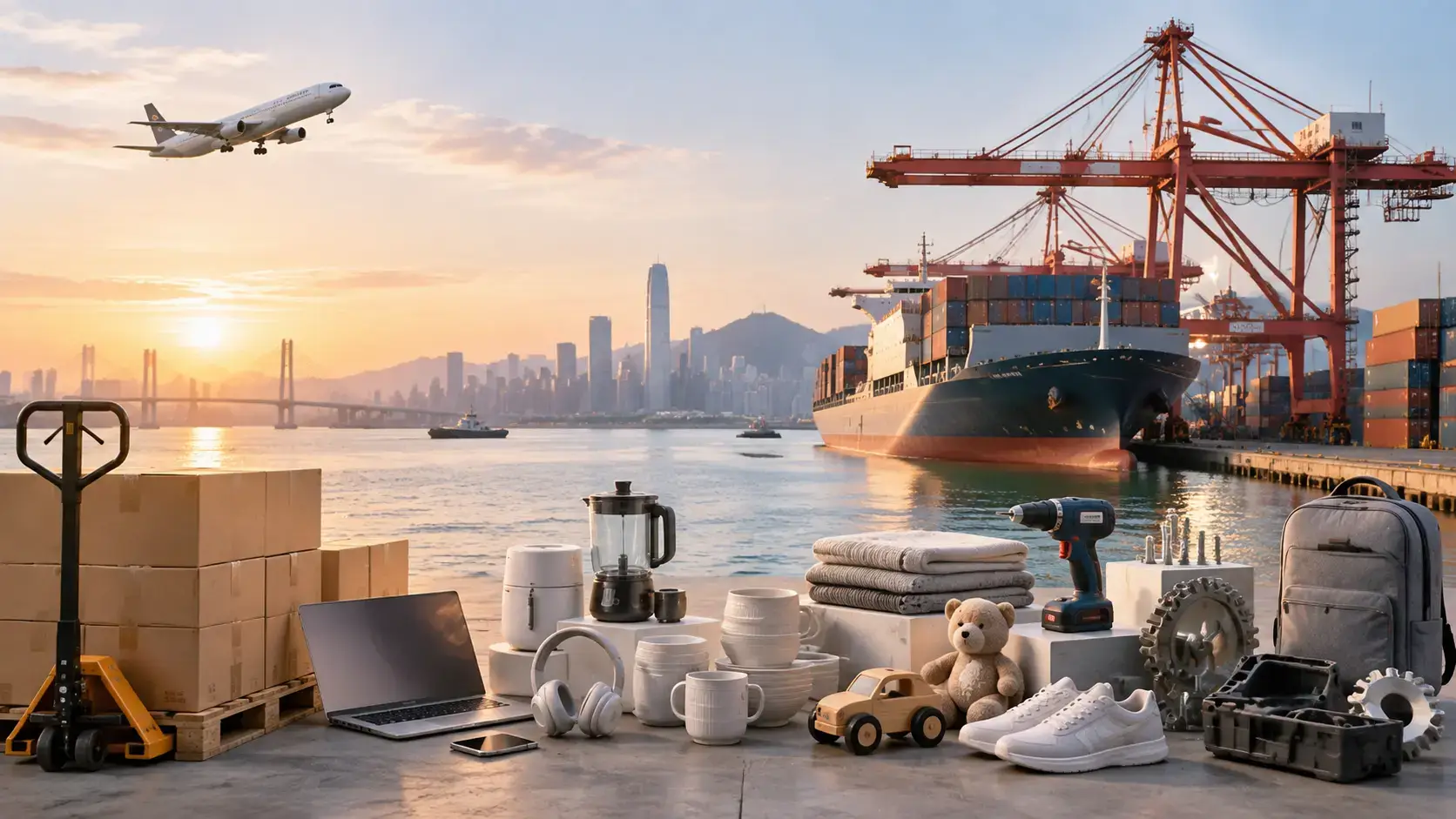
Why the map works: a 60-minute supply radius
A cluster is one industry stuffed into a few square kilometres. Factory, tool shop, plater, carton printer, buyer, worker, all on the same streets, all within shouting distance of each other.[1] Everyone in it gets faster at their job, because everyone else is standing right there. China pushed this further than anyone else did. Product sourcing in China is not one market. It is a hundred local ones, and they do not behave the same way.
Spend an afternoon in Guzhen and you can walk from a lamp housing supplier to a driver maker to a plating shop to the man printing your cartons. Change something on the sample and it is back with you in three days. Spread that same chain over 500 km and the three days turn into three weeks of couriers tagging parcels. Same product, same budget, completely different speed. This is the whole reason sample development in China feels instant to one buyer and endless to another.
Scale is the other half of it. The World Bank puts China’s manufacturing value added at roughly US$4.8 trillion in 2025, close to a quarter of everything made on earth,[2] with exports running around US$3.7 trillion a year.[3]
All that density holds the price down too. Any factory owner knows you can walk down the street and collect three more quotes before lunch. That said, quotes for the exact same spec inside one cluster still land 20–40% apart. The first number you get is a starting point, not the market. On anything design-led, own the mould and the artwork file. Unit price is the easiest thing in the deal to replace.
The regions, in numbers
Pearl River Delta (Guangdong)
Electronics, apparel, leather goods, lighting, ceramics, furniture, toys and cosmetics are all here. The whole list packs into a 150 km triangle drawn between Guangzhou, Shenzhen and Dongguan. Parts are what pull most buyers in first, and sourcing technology and electronics products almost always starts in this delta. An electronics project burns through three or four sample rounds here in the time one round takes somewhere else.
Shipping is easy. Shenzhen is the world’s fourth-busiest container port, Guangzhou the sixth,[4] and from most Delta factories a truck reaches either terminal in one to two hours.
The catch is cost. Wages sit above the national average and industrial land is expensive, so a 500-piece order does not get much attention from anyone. If your product is simple and the price decides the deal, Guangdong is often the wrong answer. Best supplier network in the country, wrong cost base.
Yangtze River Delta (Zhejiang, Jiangsu, Shanghai)
The range here is wider and the price sits in the middle. Yiwu does small commodities. Keqiao does fabric. Yongkang does hardware. Yuyao and Huangyan do plastics and moulds. Cixi does small appliances. Ninghai does stationery. Danyang does eyewear. Ruian does auto parts.
The ports are the best on the planet. Shanghai is number one by throughput, Ningbo-Zhoushan sits in the top three, and six of the ten busiest container ports in the world are in China.[4] Shanghai to Yiwu is two hours by train, and a container loaded in Yiwu can be sailing out of Ningbo the next day. That one short hop is what makes mixed-cargo shipping from China workable at all.
What it does badly is heavy industry and big machinery, anything that needs large castings in volume. Quality in the market towns also swings wide. Yiwu will sell you the same item at four different grades, and nobody volunteers which one you are looking at unless it is written into the spec. Give yourself a week to learn how to read Chinese wholesalers before you send money anywhere. White goods are the easiest thing to compare in this region. So are the outdoor and garden lines that fill a mixed container: home appliances, contract manufacturing, garden supply wholesale sourcing. It all comes from the same corner of the country.
Bohai Rim (Shandong, Hebei, Tianjin, Liaoning)
Home appliances, tyres, construction materials, fasteners, wire mesh, bicycles, food processing, chemicals and heavy equipment. Qingdao and Tianjin are the two main gateways, both inside the global top ten for container traffic, with Dalian handling the northeast.
Plants up here are big. MOQs are frequently a full container, and the sales teams are not built around small Western buyers. Samples take longer. English is thinner. Every engineering change eats more calendar days than it would in Guangdong.
So it is a bad fit for trend-driven consumer goods, small mixed orders, or anything that needs a fast design loop. What it is genuinely good at is hardware with real engineering in it. Bicycle and e-bike work leads that: frames, bicycle components and parts sourcing, pre-shipment frame checks. Same story for building material supply, where the price comes off tonnage, not units. One thing to watch: steel-linked categories now carry extra export paperwork on the Chinese side, and that costs you lead time more than money.
Central and western provinces (Henan, Hubei, Hunan, Jiangxi, Anhui, Sichuan, Chongqing)
Rising coastal costs pushed production inland, and whole categories went with it. Solid-wood furniture went to Nankang. Hair products went to Xuchang. Medical consumables went to Changyuan. Nonwovens went to Xiantao. Fireworks went to Liuyang. Porcelain went to Liling and Jingdezhen. Electronics assembly went to Zhengzhou, Chengdu and Chongqing. Motorcycles stayed in Chongqing.
Labour-heavy work here quotes 15–30% below coastal rates, and the newer plants are hungry for foreign customers. The problem is where they sit. You are three to seven days from a port, at roughly US$600–1,500 per 40ft container. Coastal quotes have already buried that cost inside the unit price you were comparing against. Documentation, testing and export paperwork are thinner too, so your inspection load goes up, not down. Medical consumables are the textbook case. The capacity is genuinely there, but sourcing medical supplies from manufacturers inland means you own the lot traceability yourself.
Fujian, in its own category
Footwear, sportswear, bags, plumbing and sanitary ware, stone and craft ceramics. Xiamen is in the world’s fifteen busiest container ports and consolidates a lot of footwear and apparel, with Fuzhou covering the north of the province. If your product is shoes or sportswear, start in Jinjiang. Most of the big Chinese sportswear brands were built there. Clothing and shoes often leave on the same Xiamen route, alongside personal hygiene and apparel-adjacent lines.
What changes when you move between hub types
| Hub type | MOQ reality | English on the floor | Price level | Main watch-out |
|---|---|---|---|---|
| Market-based hub (Yiwu, Linyi, Keqiao) | Carton level, 1–10 cartons per SKU | Limited, some English at booths | Low to mid | Reorders drift in quality; booths are often traders |
| Component-dense industrial cluster (Shenzhen, Dongguan, Ningbo) | 500–3,000 units, small-batch surcharge applies | Usually workable | Mid | Hidden subcontracting of plating, printing, packaging |
| Single-industry town (Guzhen, Chenghai, Yongkang, Datang) | 1,000–5,000 units or one container | Variable, rarely fluent | Low to mid | Narrow range; everyone competes on the same designs |
| Heavy industry base (Tangshan, Luoyang, Xuzhou, Qingdao) | Frequently container-level or 20 t minimums | Limited | Mid | Slow response, big batches, rigid tooling terms |
| Inland relocated cluster (Nankang, Xuchang, Changyuan, Xiantao) | 500–2,000 units, negotiable on a first order | Limited | Low, 15–30% under coastal | 3–7 days extra to port; newer export experience |
How to source from a hub you have never visited
Eight steps, in this order. It is the same sourcing process we run for clients who never set foot in the country.
1. Pick two hubs, not ten. A plastic houseware item is covered by Yiwu and Taizhou. Add Shenzhen and you have just burned two weeks on quotes you will never use. The screening part is covered properly in this guide to how to source products from China.
2. Use the fair calendar as a free filter. Canton Fair runs twice a year in Guangzhou, in three category phases. Autumn 2026: phase one 15–19 October for electronics, machinery, tools and vehicles; phase two 23–27 October for housewares, gifts, home decor, furniture and building materials; phase three 31 October to 4 November for textiles, apparel, footwear, bags, medical and toys. Call it 25,000–32,000 exhibitors across 1.5 million m², and the last session pulled 300,000-plus overseas buyers from more than 200 countries.[5] Four days on that floor lets you eyeball five suppliers per product in a single afternoon. Book the hotel six to eight weeks out. Pazhou rooms run two to three times normal during the fair.
3. Check whether the hub has a permanent market, not just a fair. Yiwu International Trade City trades all year: five districts, 70,000-plus booths, low minimums, mixed containers. Keqiao does the same thing for fabric. Lecong does it for furniture.
4. Ask for the production address, not the showroom address. This is the one that catches first-timers. Plenty of companies keep a sales office in the city centre and a plant two hours away in a town you have never heard of. Before you book a flight, get the business licence, the plant address and a short video of the line actually running your part. A documented remote factory verification or an on-site factory visit settles the question in about an hour.
5. Benchmark five to eight suppliers on one identical spec. Fix material, tolerance, packaging and volume in a single RFQ, then compare side by side. Under five quotes and what you are looking at is noise, not the market. For scale: identical-spec quotes inside one cluster land 20–40% apart.
6. Lock the sample before the tooling. In single-industry towns the mould shops are running jobs for half a dozen buyers at once. Get the approved golden sample signed and dated, and write down who owns the mould and the drawing files. If you want to iterate before committing to hard tooling, rapid prototyping in China is usually the cheaper route. Tooling on a typical plastic part runs US$1,500–20,000 over 20–45 days, and that signed paperwork is the only leverage you will have if it goes wrong.
7. Inspect where the goods are, not where the office is. A pre-shipment inspection is the floor, normally US$250–500 per inspector-day. Sampling follows accepted attribute-sampling practice, the ISO 28590 introduction to the ISO 2859 series, and AQL 2.5 major / 4.0 minor is the usual default for consumer goods.[6] If you are buying from several suppliers, everything has to stage at one warehouse, not five. That is where China inspection services earn their fee.
8. Plan around the calendar, and keep the documents in one place. Chinese New Year shuts most factories for two to four weeks, and the disruption starts a fortnight earlier while workers travel home. National Day week in early October and the May holiday add another 3–7 days. If your container has to sail before late November, production needs to wrap by end of September to leave 12–20 days to the US West Coast, or 28–40 to North Europe. And on fragile goods, treat the packaging as part of the product. A shipping damage claim costs more than the carton upgrade that would have stopped it.
Before you approve tooling money, see the plant.
An hour on site, or a recorded walk-through against a fixed checklist, tells you more about capacity, equipment and who really owns the machines than any showroom visit. We report what we see, including when the answer is “do not use this factory”.
Where compliance picks the hub, not the price
Three categories get decided by paperwork, not by labour cost. If the hub cannot test, document and trace, the cheapest quote on your list quietly becomes the most expensive line on it.
Toys and children’s products. Chenghai wins on moulds. The real reason to stay inside the cluster is testing. Toys sold in the EU have to satisfy Directive 2009/48/EC on toy safety,[7] and toys sold in the US have to meet ASTM F963 under CPSC rules, with children’s product certificates and tracking labels on the goods themselves.[8] Factories that test every week already price the sample rounds in. Factories that don’t will discover the requirement after your tooling is cut.
Medical consumables and nonwovens. Changyuan and Xiantao have the lines. The constraint is not capacity, it is the quality system and the registration. For a regulated buyer, ISO 13485 is the floor,[9] and destination registration adds three to six months before anything moves.
Food-contact ceramics and glassware. Glaze chemistry is where cheap quotes go wrong. Lead and cadmium leach limits differ between the US, the EU and Japan, and a failed test means re-firing, re-testing and a season you have missed. On tiles, moisture absorption class and packaging decide whether the breakage rate on arrival is something you can absorb. Our own Foshan tile sourcing guide covers the grading. Hotels and hospitality run on the same logic for lighting and FF&E, where half the job is documentation and half is purchasing. That is hospitality procurement sourcing.
If your category is regulated where it is going, price the compliance lead time into every hub you compare. A cluster that already holds the paperwork usually beats a cheaper one outright.
Six mistakes that cost buyers money
Treating the hub name as a quality label. “Made in Shenzhen” tells you nothing about the supplier you picked. Every hub has careful factories and careless ones, and the price spread inside a single town is usually wider than the spread between two towns. Choosing a China supplier is a different job from choosing a city.
Chasing the cheapest city. Inland labour is 15–30% cheaper. Then you pay 3–7 extra days to port at roughly US$600–1,500 per 40ft container, with weaker documentation on top. That can eat the whole saving before the goods even reach the ship. Compare real landed cost, not ex-works price.
Assuming everyone in a cluster is a manufacturer. Cluster towns are full of trading companies with a display room and a photo album. Some of them are genuinely useful when you want small mixed orders at carton-level MOQs. The different China sourcing models carry different costs and very different levels of factory visibility. Work out which one you are dealing with before you spend tooling money.
Working from an old map. Production keeps moving inland and offshore, and coastal wages climb every year.[10] Average pay in private urban manufacturing hit about 76,000 yuan in 2025, some 6,300 yuan a month, well above Vietnam and India. Labour-heavy work will keep moving, so re-verify locations instead of trusting a five-year-old address. Origin rules look at where the goods are actually made.
Buying from a town with a reputation problem in your category. A few clusters do legitimate OEM work and knock-offs side by side. In those categories, insist on original tooling, document every design-file handover, and walk out of any showroom displaying well-known brand marks. Counterfeits get seized at the border, and the liability outlives the order.
Ignoring the packaging distance. Cartons and inserts are bulky. Cheap per kilo, expensive to move. Source a 5,000–10,000 piece packaging run 1,000 km from the assembly line and you pay road freight twice for something that adds zero product value. Keep print and packing in the same cluster.
What changes from year to year
Coastal wages keep climbing. The town that was the obvious answer in 2016 is now the mid-price option, while the volume runs in a newer industrial park 800 km inland at 15–30% lower rates.
Trade policy does the rest. Duty is normally assessed on the transaction value of the goods, subject to prescribed adjustments,[11] so build that declared value differently and the same item gives you three different duty outcomes: inland factory, coastal factory, consolidator. Forced-labour rules add a second layer. Under the US Uyghur Forced Labor Prevention Act, goods made wholly or partly in Xinjiang, or by listed entities, face a rebuttable presumption of exclusion unless the importer can document the supply chain.[12] In the EU, the General Product Safety Regulation puts traceability and manufacturer-information duties on the importer for covered consumer products.[13] Cotton apparel, solar, aluminium and steel are the categories where documentation follows the goods most closely, so expect to produce records rather than accept assurances. The practical side sits in our guides to customs and import regulations when sourcing from China and to adapting to changing trade regulations.
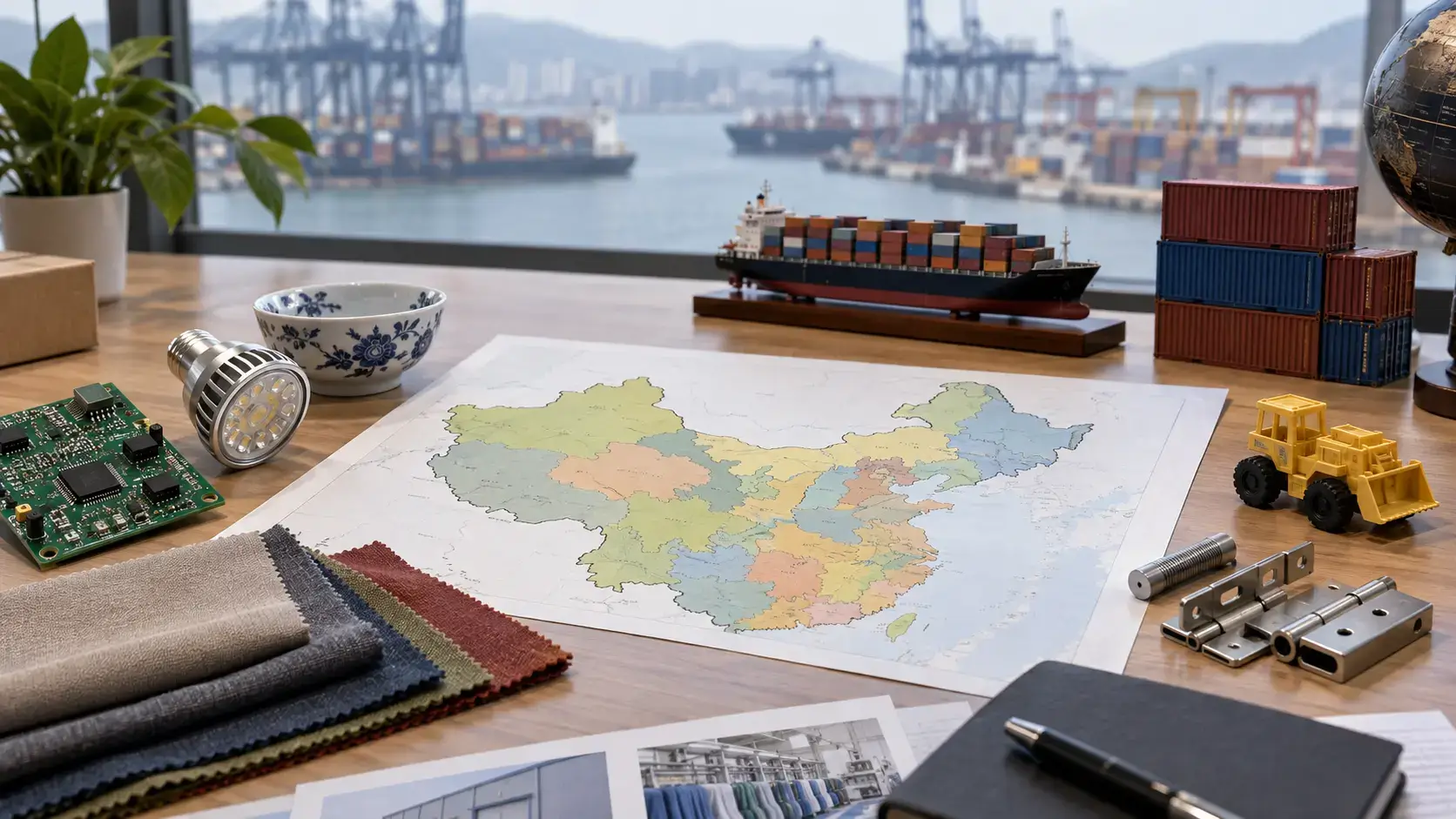
How to choose a hub in about thirty minutes
- What process does the product need? Injection moulding, sewing, casting, weaving, SMT, extrusion. Match the process to the cluster. Do not match the product to a city you happen to have heard of.
- How many units a year? Under about 5,000 units, carton minimums at a permanent market usually beat a factory. Above 20,000, cluster factories are cheaper even after tooling.
- How much customisation? A new mould, firmware or material means you need engineering depth. Budget three sample rounds and 20–45 days of tooling.
- How fragile or bulky is it? A 40HQ holds 68–76 m³ but usually gets capped by road weight at 21–28 t. Freight can outweigh a unit price gap, and inland clusters add both dollars and days.
- What compliance applies in your destination market? Certification-heavy products need clusters with local testing labs. At the medical and children’s end, testing plus registration adds 3–6 months.
- How fast do you need to iterate? If you expect four sample rounds, take the deepest cluster even at a higher unit price. A 3-day loop against a 3-week one saves you more than the unit price costs.
Write the answers down before you talk to anyone. Process, volume and compliance are your inputs, not the supplier’s. And when a hub change also means a new supplier, keep those two decisions apart. Match the process to the cluster first. Then verify the company, its licences and its real production site.
Send four details and we will tell you where it should be made.
Product and specification, annual volume, destination market, delivery date. That is enough to shortlist clusters, flag the compliance work and give you a realistic timeline before you commit budget.
FAQ
Which city in China is best for sourcing?
There is no single best city. Shenzhen and Dongguan for electronics. Yiwu for small goods and gifts. Foshan for furniture, tiles and appliances. Zhongshan for lighting. Jinjiang for footwear. Yongkang for hardware. Ningbo for plastics, appliances and export logistics. Pick by process, not by city size, and shortlist two hubs rather than ten.
Is Yiwu a manufacturing city or a trading city?
Both, trading first. The market has 70,000-plus booths across five districts, and a mixed container can be assembled at 1–10 cartons per SKU. Most booths are fed by factories in Zhejiang and the neighbouring provinces. Treat Yiwu as a gateway. If you plan to scale, or you need certification, verify the plant behind the booth.
Where are electronics manufactured in China?
The Pearl River Delta holds the largest share of consumer electronics, with Shenzhen and Dongguan at the core and component suppliers within a 60-minute drive. Kunshan and Suzhou handle precision electronics and notebooks. Zhengzhou, Chengdu and Chongqing have grown fast on high-value assembly, mostly on major-brand programmes.
Where should I source furniture from?
Guangdong for design-led and upholstered furniture around Lecong, Longjiang and Houjie, where more than 200 showrooms sit within a few kilometres of each other. Jiangxi for solid-wood volume, particularly Nankang near Ganzhou, where labour-heavy work quotes 15–30% below coastal rates. Anji in Zhejiang for office and seating. Expect 20–40 sets per 40HQ on bulky items, so container fill is part of the price. For panel-based lines, our particle board sourcing guide sets out the grades that decide the quote.
Where should I source auto and motorcycle parts?
Zhejiang for the densest aftermarket chain, especially Ruian and Yuhuan. Chongqing for motorcycle components and two-wheeler assembly. Aftermarket parts are available almost everywhere; OE-grade work needs IATF 16949 and adds four to eight weeks. Our notes on finding automotive parts suppliers cover what to check first.
Does the hub affect MOQ and lead time?
Yes, and usually more than the unit price does. Market hubs trade in cartons, in days. Factory clusters quote in hundreds or thousands of units: 25–45 days after deposit, plus 5–15 days in peak season. Inland clusters add 3–7 days to port on top.
Do I have to visit China to source from the right hub?
No. Programmes run remotely all the time with a local partner handling verification, sampling and inspection, usually at US$250–500 per inspector-day. Visit when you are developing a product, when you want to compare suppliers in one day, or when you need to see the real plant instead of a sales office.
Is the cheapest hub always the best option?
No. Gaps between hubs are usually smaller than the gap between a strong and a weak supplier inside one town, where identical-spec quotes vary by 20–40%. Compliance, iteration speed, inland freight and quality losses move total cost more than the unit price does. Compare sourcing costs and landed cost, not the quote.
Can one supplier cover several categories?
Rarely well. A trader can consolidate categories for you, but production still comes from different clusters. For mixed orders in one region, one consolidated container beats hunting for a factory that claims to make everything, and it removes duplicate freight, inspection and documentation.
Finally
Compare two hubs on four numbers: MOQ, days from deposit to loading, inland freight, landed cost per unit. Electronics at 3–7 day samples and 500–3,000 unit minimums is a different business from Yiwu cartons at market pricing. Pick the town whose process matches your product, verify the plant address, benchmark five to eight identical-spec quotes, and inspect before you ship.