Last updated: September 2026. Prices and lead times below are planning ranges for budgeting, not quotations.
Architectural hardware is one of those categories China makes both deep and cheap. Hinges alone: the country shipped more than 570,000 tonnes of base-metal hinges in 2024, worth about US$2.3 billion[1]. Locks, closers, exit devices, handles and sliding systems ship on top of that. The supply base sits in a handful of towns with names worth learning: Wenzhou for locks and hinges, Yongkang for doors and zinc parts, Xiaolan in Zhongshan for locks, Jieyang for stainless, Foshan and Ningbo for door control. And here’s something buyers learn fast. Get three quotes for the same hinge drawing inside one cluster and they’ll spread 20–40%. The gap is material grade, plating hours and test evidence. Not geography.
Costs: commodity lever handles run US$1.50–6.00 a set, ball-bearing hinge pairs US$0.60–2.00, Grade 1 closers US$12–25, panic bars US$20–60, all FOB planning figures. Standards: EU projects call for EN codes (EN 1935 hinges tested to 200,000 cycles, EN 1154 closers to 500,000). US projects call for ANSI/BHMA grades (a Grade 1 closer survives 2,000,000 cycles). Chinese datasheets print all of these; only some factories hold certificates that survive a phone call. Minimums: stock items run 500–3,000 pieces, custom finishes on existing tools 1,000–3,000, new tooling 3,000+ plus US$1,500–20,000. Timeline: 7–15 days to a stock sample, 20–45 days for tooling, 30–45 days production, 12–40 days on the water. Count 4–6 months from approved drawing to port on a custom program. Money: expect 30/70 payment terms on first orders, AQL 2.5/4.0 inspection at US$250–500 per man-day, and a 1–3% quality reserve kept on site.
Cross-check every quote against the table below, whether you source building materials wholesale or just hardware. On a 200-door office fit-out that’s a US$30,000–80,000 order, and it’s one of the last things finished before handover, usually when everything else is already late.
| What you are buying | Main clusters | Typical MOQ | Sample / production | What actually decides quality |
|---|---|---|---|---|
| Butt and ball-bearing hinges | Jieyang, Wenzhou, Ningbo | 1,000–5,000 pcs · US$0.60–2.00/pair FOB | 7–10 days / 30–40 days | Leaf thickness 2.5–4.0 mm, EN 1935 grade, real ball bearings vs plain journals |
| Lever handles on rose | Wenzhou, Gaoyao, Zhongshan | 500–2,000 pcs · US$1.50–6.00/set FOB | 10–15 days / 30–45 days | Solid brass vs zinc alloy, return spring quality, plating thickness in hours of salt spray |
| Mortise locks and cylinders | Wenzhou, Xiaolan (Zhongshan) | 500–1,000 pcs · US$4–12/set FOB | 10–15 days / 35–45 days | EN 12209 durability code, EN 1303 cylinder grade, key-system control |
| Door closers | Ningbo, Foshan | 200–500 pcs · US$4–25/pc FOB by grade | 10–15 days / 30–45 days | EN 1154 power size 2–7 or BHMA Grade 1, genuine test report, hydraulic seal life |
| Panic and exit devices | Foshan, Ningbo, Zhejiang | 200–500 pcs · US$20–60/pc FOB | 15–20 days / 40–45 days | EN 1125 (panic bar) vs EN 179 (emergency pad), UL 305 listing for US jobs |
| Sliding systems and glass fittings | Foshan, Ningbo | 100–300 sets · US$15–60/set FOB | 10–20 days / 35–45 days | Wheel bearing quality, tested load per roller, stainless grade near coasts |
Have a door schedule and no factory shortlist?
Send the schedule lines (category, quantity, finish, code status, destination port). You get a cluster-matched shortlist and the questions your spec is still missing.
What counts as architectural hardware, and what buyers forget
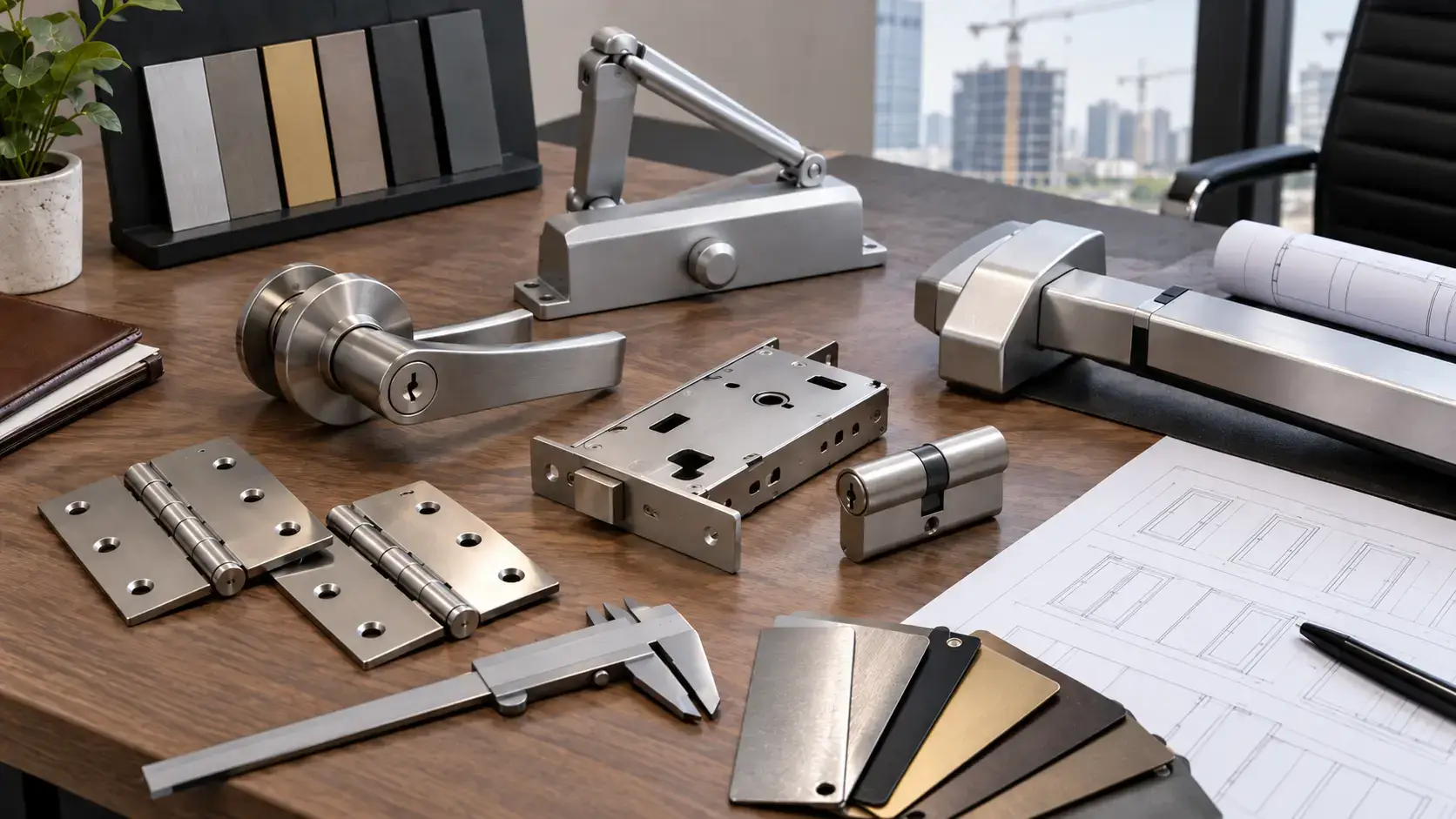
The category covers everything that hangs, latches, closes, slides and secures a building’s doors and windows: hinges, locks, cylinders, lever furniture, door closers, floor springs, panic and emergency exit devices, door stops and holders, sliding and folding track systems, glass patch fittings, pulls and kick plates. Customs files most of it under HS 8302, with padlocks and lock bodies under HS 8301. Scale matters here. A 200-key hotel schedules 300–500 openings, a mid-rise office tower 400–800, and each opening needs 4–8 separate items. You don’t buy hardware from a catalog; you buy it from a schedule.
Buyers get caught out by the same three things, time after time. Hardware is a scheduled trade first of all. A 400–800-opening office tower means 1,600–6,400 schedule lines, and your factory quote will only be as good as that schedule. Then there’s finish. Finishes carry BHMA codes (US26D satin chrome, US32 polished stainless), and 50 doors in slightly different stainless shades will fail a hotel handover. Nobody argues about it; the doors just get rejected. The third one is easy to miss: hardware is life-safety equipment on escape routes, and regulators test it accordingly. Hotels pull all three problems at once. That’s why hotel project procurement became its own discipline (see how hospitality procurement sourcing works).
The standards map: EN, ANSI/BHMA, UL, and what each number proves
European buyers live by EN classification codes. An EN 1935 hinge carries an 8-digit code, and it takes ten minutes to learn to read one. Digit 1 grades the duty from light (1) to severe (4). Digit 2 records test cycles from 10,000 up to 200,000. Digit 3 records the tested door mass, from 10 kg up to 160 kg. Later digits cover fire suitability and corrosion. Grade 14, the top combined rating, means 200,000 cycles against a 160 kg leaf. EN 1154 closers test to 500,000 cycles and come in power sizes 2–7. EN 1125 panic bars and EN 179 emergency pads carry two durability grades, 100,000 and 200,000 cycles, and they are different products for different doors. A shopping mall assembly hall needs the horizontal bar of EN 1125; a staff-only fire exit can often make do with the EN 179 pad. Corrosion sits under EN 1670, graded from 24 hours of salt spray (Grade 1) to 480 hours (Grade 5). Dry interior work usually specifies Grade 2–3. Coastal and exterior hardware sits at Grade 4–5, and Grade 4 alone is 240 hours in the salt chamber. Ten straight days.
US buyers live by ANSI/BHMA grades, the A156 series overseen by the American National Standards Institute [2]. Grade 1 is the top tier in every A156 product family, though the cycle counts differ from product to product. A Grade 1 door closer under A156.4 has to survive a minimum of 2,000,000 open-close cycles; lower grades accept less. Run the math on that. Cycled 100 times a day, a Grade 1 closer is a 55-year part. At 400 cycles a day it still lasts 14 years. That’s why corridor doors get Grade 1 as standard. Exit devices under A156.3 cycle-test to lower counts but add forced-entry and life-safety requirements. One warning here: don’t compare raw ANSI cycles to EN cycles. The two systems use different test doors, rates and pass criteria. A factory holding both an A156 Grade 1 report and a strong EN code is telling you something real. A factory holding neither but printing both logos is telling you something else.
| Standard | Covers | The number that matters | How weak suppliers fake it |
|---|---|---|---|
| EN 1935 | Single-axis hinges | Up to 200,000 cycles and 160 kg tested mass; 8-digit code | Prints “EN 1935” with no digit code and no certificate number |
| EN 1154 | Door closers | 500,000 cycles; power sizes 2–7 | Cites the standard, sends a report for a different model |
| EN 1125 / EN 179 | Panic bar / emergency exit | 100,000 or 200,000 cycles by grade; horizontal bar vs push pad | Sells the cheaper EN 179 where the code requires EN 1125 |
| EN 1670 | Corrosion resistance | Grade 4 = 240 h salt spray, Grade 5 = 480 h | Claims a grade without quoting tested hours |
| ANSI/BHMA A156 series | US performance grades | Grade 1 closer = 2,000,000 cycles minimum | Says “commercial grade” with no grade letter at all |
| UL 10C / UL 305 | US fire and panic listings | Fire listings run 20 min–3 h | Shows a fire label with no UL or Intertek file number |
For the EU, CE marking sits on top of all this. Hardware covered by a harmonised European standard and sold for regulated construction uses needs CE marking backed by a Declaration of Performance. The legal basis is Regulation (EU) No 305/2011, the Construction Products Regulation [3]. Ask for two documents: the DoP, and the certificate from the notified body. Then match the certificate number to the model on your purchase order, because certificate swapping between sister models is the oldest trick in this trade. The broader rules for sourcing construction products from China apply to hardware in full.
The US adds another layer for fire-rated openings. NFPA 80 governs fire door assemblies and their hardware [4], and it requires inspection at acceptance and then every year after that. Hardware on a rated opening must be listed for the assembly and must positive-latch. Mechanical hold-opens are out unless they release through the fire alarm system. If your project has even one rated stairwell door, this stops being paperwork: the door gets tagged at inspection.
Specifying for the EU or the US and not sure which codes apply?
Send the hardware schedule with the destination country and building type. You get a standards map: which EN codes, ANSI grades or UL listings to demand, and the certificate set to collect before the deposit.
Where the clusters are, and what each one is good at
China’s hardware supply base doesn’t spread across provinces. It packs into county-level towns. Jieyang alone holds hundreds of stainless workshops, Wenzhou and Yongkang each claim 1,000+ hardware manufacturers, and they all share the same local platers, die-casters, spring makers and carton printers. Getting containers out is the easy part: 6 of the world’s 10 busiest container ports are on the Chinese mainland, Ningbo-Zhoushan serves the Zhejiang towns, and Shenzhen and Guangzhou cover the Pearl River Delta.
| Cluster | Known for | Go here for | Watch out for |
|---|---|---|---|
| Wenzhou (Zhejiang) | Locks, hinges, handles; often called China’s lock capital | Zinc and brass die-casting depth, plating shops, fast sampling | Commodity grade dominates; premium closer engineering is rare |
| Yongkang (Zhejiang) | Doors and hardware; widely described as the hardware capital | Door-plus-hardware one-stop packages, security doors | Finish consistency drops on high-spec jobs |
| Jieyang (Guangdong) | Stainless steel hardware | Stainless hinges, pulls, glass fittings at scale | The 201-for-304 substitution risk is highest here; test material |
| Xiaolan, Zhongshan (Guangdong) | Locks and smart locks | Mortise locks, cylinders, electronic lock integration | Trading offices are thick; verify the plant address |
| Gaoyao, Zhaoqing (Guangdong) | Bathroom and door furniture | PVD and chrome finish work, handle programs | Structural hardware is a side business for many |
| Foshan (Guangdong) | Door control, glass fittings, sliding systems | Closers, floor springs, patch fittings, engineered sets | Prices sit above Wenzhou for the same commodity item |
| Ningbo / Cixi (Zhejiang) | Closers, hinges, export hardware | Export paperwork, port access, mixed-container loads | Many “factories” are assembly-plus-trading; audit the line |
The Canton Fair is still the one place where all these clusters exhibit under one roof. It runs 3 phases of 5 days, twice a year [5], and hardware, tools and building materials fill whole halls in phase one. Treat it as a shortlisting tool, not an ordering one. The fair tells you who is investing in a booth. It doesn’t tell you whose factory can hold a finish across 3,000 doors. If you go, base the week in Guangzhou: Foshan, Zhongshan and Gaoyao all sit inside a 2-hour drive, so one fair trip absorbs 6–8 factory visits. Then actually go and see. A trip that audits four Wenzhou lock plants and two Ningbo closer plants in five days will tell you more than forty email quotes, and a structured factory visit beats a hallway conversation every time.
What you’re actually paying for
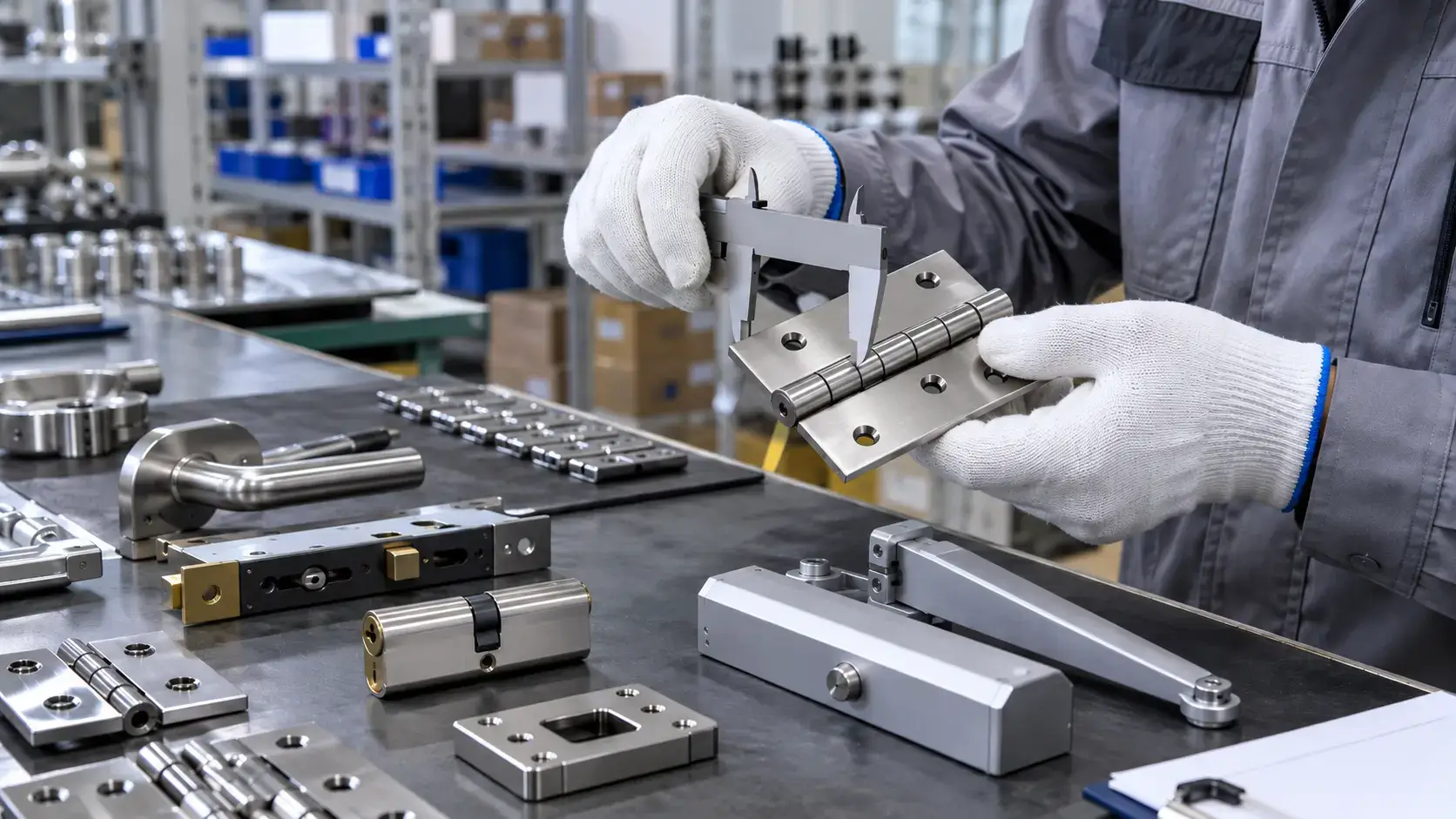
Take a lever handle quote apart and you find four layers: alloy, mechanism, finish and evidence. The alloy is the biggest swing. Solid brass, zinc alloy die-cast and stainless all look identical in a product photo, but brass runs two to three times zinc per kilogram on the metal market, and it weighs noticeably more in your hand. In stainless, the 201-for-304 swap is the most common cheat in the category; it gets its own section below. The mechanism is the spring and the latch. A handle that fails to return costs pennies less to make, and it fails within months. The finish is plating thickness and process: electroplated chrome, powder coat and PVD sit at different price and durability points, so specify salt-spray hours, not a color name. Evidence is the least visible line. Test reports, certificates and batch traceability all cost real money, and the cheapest quote almost never includes them. It’s a used car with no service history; you can buy it, but you’ll pay later.
Raw material prices move, and hardware prices follow. Copper, the base of brass, has swung 15–30% within single years. Nickel drives stainless pricing, zinc drives die-cast. Ask any factory quoting more than 60 days out how they handle alloy movement; if the answer is silence, neither of you planned for the risk. When audits trace a wide spread between quotes, it almost always comes back to the same short list: thinner leaf, lighter plating, no testing, or a trading office marking up a neighbor’s price.
As planning ranges for FOB unit prices on catalog goods: ball-bearing hinge pairs US$0.60–2.00, zinc lever handles US$1.50–4, stainless levers US$2–6, mortise lock bodies US$1.5–5 (complete sets with cylinder US$4–12), closers US$4–8 commodity and US$12–25 built and certified to Grade 1, panic bars US$20–60. A certified version of the same casting quotes 20–50% above the uncertified one. What you’re paying for is a real EN code or BHMA grade, and the report behind it.
The 201 vs 304 problem, in one place
Both grades look identical and both get called stainless. The chemistry is where they part ways. 304 carries roughly 8–10.5% nickel. 201 swaps most of that nickel for manganese (up to 7.5%) and carries only 3.5–5.5%. Nickel is the expensive element, so 201 sheet has run roughly 30–40% cheaper from Chinese mills. In salt-spray exposure, 304 hardware commonly passes 1,000 hours while 201 may show first rust inside 200–300. Think of it as the difference between a lobby that survives and a lobby that tea-stains before handover. To be fair, 201 has legitimate uses in dry interiors. It has no business on coastal exteriors, wet areas, or anything specified as 304. Three habits protect you. Require mill test certificates with each batch. Write the composition (“18/8”) into the purchase order rather than just the grade name. And run a handheld XRF scan on received goods. Don’t trust a magnet, by the way. Cold-worked 304 can read slightly magnetic and a polished 201 can read weakly non-magnetic, so the magnet test tells you nothing here.
Vetting: separating factories from trading offices
An ISO 9001 certificate tells you a factory has a quality management system [6]. It says nothing about which plant the certificate actually covers, so check the scope and address, not just the logo. Then ask when the last surveillance audit passed, since ISO 9001 runs on 3-year cycles with a yearly surveillance visit. Beyond paper, three things separate a hardware factory from an office with a catalog. Machines come first: die-casting cells, stamping presses, CNC polishing, and how busy they are. A plant running under 60% negotiates very differently from one at 95%. Then test equipment. An in-house salt-spray chamber and cycle rigs signal a factory that tests before you ask; their absence signals a factory that sells whatever the plater returns. Finally, people. A quality manager who can explain the EN code on their own datasheet beats one who only sends PDFs.
You can’t always travel. A structured video call plus document review catches most of what an audit would, and the method is the one in verifying a Chinese factory remotely. Budget 45–60 minutes on the call and a day of document chasing. Ask for a live walkthrough from gate to line, and make sure the business license and ISO scope match the plant address. Then make real-time requests: “Walk to the salt-spray chamber and show me the log book.” Where the order justifies it, a formal supplier audit scores the plant against a checklist at US$300–800 per audit day, on a 100-point scale you can compare across candidates. The standard playbook for choosing a China supplier matters more in hardware than in most categories. When it fails, it fails on a finished building.
Quality control that fits hardware
Hardware QC starts before production, with a sealed golden sample. The method is the one behind every golden sample: you and the factory sign off on finish plates, cycle behavior, torque feel and packaging. Seal two sets, one at the factory and one in your office, and reference them by date and batch. From then on, mass production gets measured against the sealed set, not against memory. At pre-production, check the first articles off the tooling for dimension and finish. During the run, a during-production check catches finish drift at the 20% mark, while it’s still cheap to fix.
At the end, a pre-shipment inspection runs to AQL 2.5 for major and 4.0 for minor defects under the ISO 28590 sampling framework [7]. Budget roughly US$250–500 per man-day. Under that framework a 5,000-piece lot draws a 125-piece sample, and at AQL 2.5 majors the acceptance ceiling is 7 defective pieces. Visual AQL won’t catch category-specific failures, so add three functional checks to the inspector’s scope. Cycle test a sample of closers and hinges on a jig. For scale: a full 500,000-cycle endurance claim means a rig ran nonstop for about a month, while an on-site jig can put 1,000–2,000 cycles on a hinge pair in one shift. That’s enough to expose play and spring fade. A hinge pair should complete its rated count without play; a closer should still latch from every opening angle. Weigh and measure too. Leaf thickness and product weight expose material substitution instantly against the golden sample. Then packaging. Hardware is dense and heavy, cartons stack and vibrate, and finishes bruise in transit. Cap carton weight at 20–25 kg so one worker can lift and stack it. The countermeasures in preventing shipping damage (individual bags, cell dividers, edge protection, tested stack heights) are what separate a clean installation from a re-polishing bill. Moisture is the quieter risk. A container crossing the equator can cycle through dew points that fog plated finishes and white-rust zinc castings, and the desiccant and packing discipline used for importing ceramic tiles from Foshan applies to a hardware container in full. At the port, loading supervision confirms the heavy cartons go in low and braced.
Third-party lab tests are a separate line item. Salt-spray hours, cycle counts and fire evidence are cheap to verify at an accredited lab against a retained sample. Figure US$150–500 per report and 2–4 weeks of calendar. The certificate then travels with your project file for handover.
First container of closers and exit devices about to ship?
Send the packing list and the inspection standard you hold the factory to. You get a man-day cost, an AQL plan and a checklist that covers the functional tests above.
Landed cost: from factory price to installed piece
Customs values your hardware on the transaction value under the WTO valuation rules [8], so the invoice price sets the duty base. Which duty rate applies then depends on the HS code (8301 vs 8302) and your destination’s tariff schedule for Chinese-origin goods. That schedule has been a moving target in the US in recent years, so confirm the current rate for your exact subheading in the US Harmonized Tariff Schedule [9] before you budget. Remember that hardware is dense. It often hits the 21–28 tonne weight cap of a 40-foot container before filling its 68–76 cubic metres. Inland trucking to port runs about US$600–1,500 per 40-foot container depending on cluster (one day from the deltas, 3–7 days from inland provinces). The ocean leg adds 12–20 days to the US West Coast, 25–35 to the East Coast, 28–40 to North Europe. The full build-up, with a worked example, is in this guide to calculating real landed cost from China, and container options are covered under shipping from China.
Here’s an illustrative example. A Grade 1-rated closer quoted at US$14.50 FOB Ningbo, shipped 500 pieces deep in a mixed 40HQ, lands near US$17–19 per piece on the US East Coast after duty and freight at recent rates. The same closer quoted at US$12.80 without test evidence lands at US$15–17, and then costs you two site failures and a re-order. Cheapest FOB isn’t a price. It’s a forecast.
FOB price in hand and the landed number still missing?
Send the FOB quotes, destination port and pieces per container. You get the full build-up back: duty by subheading, inland and ocean legs, and the per-piece landed cost to plan against.
Timeline: from schedule to installation
Hardware programs fail on calendar more often than on price. A 4–6 month custom program that starts late lands in either the Q3–Q4 peak or a rushed inspection, so backward-plan from the installation date:
- Week 0: Freeze the ironmongery schedule and issue your RFQ. The fields a factory needs (codes, finishes, quantities per opening type, destination) are the ones in a complete China RFQ.
- Weeks 1–3: Quotes come back. Audit the top two or three, not the cheapest one.
- Weeks 2–4: Stock-tooling samples take 7–15 days. Custom samples need the development loop described for developing samples in China, and genuinely new part shapes go through product development with tooling drawings first.
- Weeks 4–10: Custom tooling costs US$1,500–20,000 and takes 20–45 days for handles and zinc castings; rapid prototypes come in 7–14 days if you just need something to hold (rapid prototyping in China).
- Weeks 8–14: Production runs 30–45 days, plus 5–15 in the Q3–Q4 peak.
- Weeks 14–20: Booking, loading, and 12–40 days on the water depending on destination.
Two calendar traps are unique to this trade. Spring Festival closes the hardware clusters for 2–4 weeks in January or February, and National Day and May Day each idle factories for 3–7 days. Any order placed six weeks before either holiday is effectively ordered after it. Phased projects bring a different headache. Towers hand over floor by floor, so finishes have to match across orders placed months apart. You buy that consistency with locked batches: reserve extra quantity up front, typically a 1–3% overage held at the factory under your batch number. The same buffer covers site damage and additions.
Seven mistakes that cost project buyers the most
1. Accepting “stainless” without a composition. The culprit is the 201-for-304 swap quantified above. Mill certificates and an XRF scan on arrival (US$20–50 per scan point) close the hole.
2. Trusting logos over certificates. EN codes, CE marks and UL labels all get photocopied. Match the certificate number to the model and the notified body, and check the DoP against your purchase order. Written into a supplier due diligence checklist, this becomes a five-minute document check instead of a handover dispute.
3. Buying EN 179 where the code says EN 1125. The emergency pad is cheaper than the panic bar, and inspectors know the difference even when the subcontractor doesn’t.
4. Sizing closers by price instead of traffic. A Grade 1 closer is built for exactly the 400-cycles-a-day corridor door. A light-duty unit on it is a two-year complaint.
5. Ignoring packaging until the claim. Hardware ships dense, and the cartons at the bottom of a stack take the whole load. Specify cell dividers, bag each piece, cap stack heights, and photograph loading.
6. Letting the sample factory win the production order by default. Bait samples happen in every cluster. Production tooling must match the golden sample, which is what sealing one is for.
7. Skipping the batch lock on phased jobs. Finishes drift between orders placed six months apart, even from the same plating line. Lock batches and hold the 1–3% reserve at the factory, under your label.
Three quotes in hand, 30% apart, and no idea which one is real?
Send two or three of them (with the schedule lines they cover). You get the spreadsheets that show where each quote differs: alloy, plating hours, testing, tooling amortization.
What is changing in 2026, and what this guide cannot tell you
Four things are moving. Input costs first: alloy prices set hardware FOB prices more than labor does, and the 15–30% annual swings in copper show up in brass items within two or three quarters. Most factories hold an alloy-linked FOB quote for just 15–30 days. The EU rulebook is second. The Construction Products Regulation is in a multi-year revision. On top of that, the General Product Safety Regulation (EU) 2023/988 has applied to consumer-facing hardware sold in the EU since 13 December 2024 [10], adding traceability and responsible-person duties. Third, US duty treatment of Chinese goods keeps changing by subheading; verify the rate at order time, not at planning time. Freight is the fourth. Container rates have moved by a factor of 2–4 inside single years since 2020, so a landed-cost model built on one quarter’s rates ages fast.
One thing this guide can’t do: replace your specifier’s code review. Which EN digits or ANSI grades apply depends on the building, the opening and the local authority, and no factory can make that call for you. The numbers here are planning ranges drawn from published trade statistics, factory quotations and certificate reviews across these categories. They won’t match your drawing exactly, and they aren’t a quotation. Treat a quote far outside these ranges as a question, not a bargain.
How many pieces before a factory will talk to me?
Stock catalog items: 500–3,000 pieces for locks and handles, 1,000–5,000 for hinges, 200–500 for closers and exit devices. Custom finishes on existing tools often run 1,000–3,000 pieces. New tooling means 3,000 pieces or more, plus US$1,500–20,000 for the molds. Factories running white-label manufacturing programs sometimes go lower on existing castings, since only the badge and finish change. Plenty of factories will accept smaller counts, but they are either trading offices or plants with idle capacity. Both are workable, as long as you know which one you’re dealing with and price accordingly.
How do I verify CE, EN or fire claims before paying a deposit?
Ask for three documents: the test report (with the model number visible), the certificate (with the notified body or lab listed), and the Declaration of Performance for EU-bound regulated hardware. Match all three to the exact model on the purchase order, then verify independently. The EU’s NANDO database of notified bodies and the listing directories at UL and Intertek confirm a certificate number in under 10 minutes each [11]. A factory that resents the check is answering it. Keep the sequence anyway: certificates first, deposit second. Under 30/70 terms the check costs 10 minutes, and the deposit costs 30% of the order.
Can Chinese hardware go on fire-rated doors in the US or EU?
Yes, with evidence. On US projects, hardware listed under UL 10C (fire) and UL 305 (panic) is used on rated assemblies across North America, with fire listings running from 20 minutes up to 3 hours. The assembly must satisfy NFPA 80, including positive latching and annual inspection [4]. On EU projects, fire suitability is a digit in the EN product code, tested to EN 1634 as part of a doorset, commonly to 120 or 180 minutes. The trap is the words “fire-rated” on a datasheet with no file number. The certificate is the product.
How long does a custom handle or closer program take?
Count 4–6 months drawing to port for a new zinc die-cast handle with custom finish: development and drawings 2–3 weeks, tooling 20–45 days and US$1,500–20,000, samples and revisions 2–4 weeks, production 30–45 days, ocean 12–40. Programs that compress this usually cut sample revisions, and that’s exactly where the defects get approved. Closers are slower to engineer than handles because the hydraulic performance has to be certified, not just the shape.
Should I buy direct from a factory or through a trader?
Direct buys you price and accountability, if you can audit and manage the factory yourself. Traders earn their margin on small mixed orders, multi-cluster consolidation and translation, and a good one discloses the plant without being asked. Consolidating three factories into one container also saves a second inland leg, US$600–1,500 a truck. The failure mode is the undisclosed trader adding 10–15% with no service attached. If you run many categories at once, compare the options in China sourcing models, or look at how dedicated category sourcing specialists split the difference: factory relationships with your inspection standard on top.
What should a hardware inspection actually check?
Five layers. Visual AQL 2.5/4.0 against the golden sample. Functional sampling: cycle jigs for hinges and closers, latch tests for locks, force checks on panic devices. Material verification through mill certificates and XRF spot scans. Packaging: bag, divider, stack test, carton drop. And documents: test reports matched to batch codes. One man-day covers roughly 5,000–10,000 pieces at US$250–500. A closer or panic device order justifies the full man-day every time; 3,000 hinge pairs on a repeat order with a sealed sample can go lighter.
Finally, the numbers to hold in your head when the quotes arrive. Costs: a 20–40% spread between factories on the same drawing, explained by alloy, plating hours and evidence. Minimums: 200–5,000 pieces by category, tooling at US$1,500–20,000. Unit prices: hinge pairs US$0.60–2.00, zinc levers US$1.50–4, closers US$4–8 commodity or US$12–25 Grade 1, panic bars US$20–60 FOB, certified versions 20–50% more. Service life: a Grade 1 closer runs 55 years at 100 cycles a day, 14 years at 400. Timeline: 7–15 days to a sample, 20–45 days tooling, 30–45 days production, 4–6 months drawing to port on custom programs. Money: 30/70 terms, US$250–500 per inspection man-day, a 1–3% batch reserve on phased jobs. Container: weight caps out at 21–28 tonnes before 68–76 cubic metres, inland US$600–1,500, ocean 12–40 days. Verification: EN 1935 at 200,000 cycles, EN 1154 at 500,000, BHMA Grade 1 closers at 2,000,000, EN 1670 Grade 4 at 240 salt-spray hours, 304 with 8–10.5% nickel versus 201 with 3.5–5.5%. The factory that can show you those numbers on its own reports is the one to hand your schedule to.
How these numbers were produced: trade figures come from the World Bank’s WITS database (UN Comtrade data, HS 830210, 2024). Standards test values come from the published EN and ANSI/BHMA frameworks cited above. MOQ, price and lead-time ranges are planning figures compiled from factory quotations and project experience across the clusters listed. This page carries no paid placements, and no cluster ranking is implied. Confirm current standards editions, duty rates and live quotes before committing a purchase order.
Sources:
1. World Bank WITS, China exports of HS 830210 (hinges of base metal), 2024 — wits.worldbank.org
2. American National Standards Institute (ANSI), overseer of the US standards and conformity assessment system — ansi.org
3. Regulation (EU) No 305/2011 (Construction Products Regulation), EUR-Lex — eur-lex.europa.eu
4. NFPA 80: Standard for Fire Doors and Other Opening Protectives, National Fire Protection Association — nfpa.org
5. China Import and Export Fair (Canton Fair), official site — cantonfair.org.cn
6. ISO 9001 quality management systems, International Organization for Standardization — iso.org
7. ISO 28590, Sampling procedures for inspection by attributes, International Organization for Standardization — iso.org
8. WTO Agreement on Customs Valuation (transaction value), World Trade Organization — wto.org
9. Harmonized Tariff Schedule of the United States, US International Trade Commission — hts.usitc.gov
10. Regulation (EU) 2023/988 (General Product Safety Regulation), EUR-Lex — eur-lex.europa.eu
11. NANDO information system of notified bodies, European Commission — webgate.ec.europa.eu