A first spare parts order can look reassuring on paper when, say, your chair supplier includes a bag of free castors. A few weeks after sales begin, customers start reporting that their chairs slowly sink during use. The spare castors are still in their box, because the component that needs attention is the gas lift. You are now discussing returns, repairs and who will pay for them, while the chairs you were so pleased to sell are coming back. This is why spare parts planning starts with the failures your business may have to handle, rather than the extras a factory happens to offer.
Spare parts, attic stock and replacement units: what are you buying?
A spare gas lift repairs a chair. Another complete chair replaces it. A spare parts order needs to preserve that distinction when a supplier groups both under ‘spares’ in a quotation.
| Term | What you are buying | Purpose |
|---|---|---|
| Spare parts / replacement parts | Replaceable components of a product, such as a castor, switch, gas lift or approved electronic module. | Maintain or restore the product’s functioning after sale through component replacement. |
| Attic stock | Additional identical products ordered with a project batch, such as complete hotel lighting fixtures or repeated guestroom chairs. | Cover transport-to-site damage, installation defects and later failures during the project’s intended operating period. |
| Replacement units | Additional complete products kept for direct exchange, including for online sales, bespoke orders and pre-sold projects. | Replace a returned or failed product without waiting for component repair. |
These are the working distinctions used here. Project specifications sometimes use “attic stock” more broadly for extra materials, so the actual contents of an order still need to be named.
A medical-device distributor selling throughout the year needs support for an evolving population of products in use. A hotel purchaser may need identical finished fixtures to remain available until renovation or refitting. A construction-equipment importer might use service parts for repairs and complete units for temporary exchange. The industry matters, but so does the way the product is sold, installed and supported.
For brands and importers, a well-planned spare parts order supports their responsibility to customers after the sale. The supplier’s support arrangements, the seller’s customer commitments and the destination market’s requirements need to work together; a free bag of components settles only a small part of that discussion.
Which components are likely to need replacing?
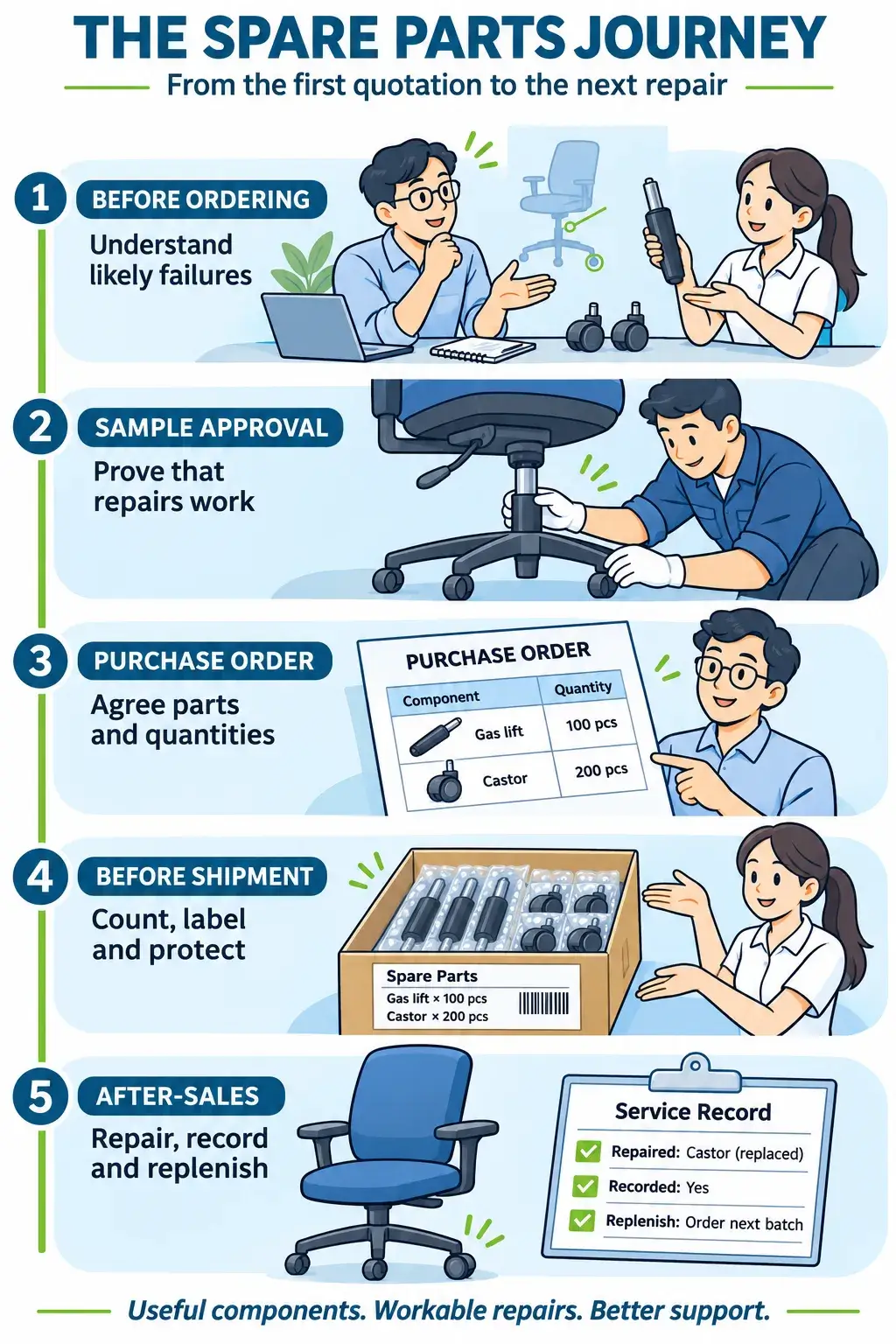
Back to our chairs. Learning that gas lifts are replaceable is useful. Learning why they might fail is more useful still. A recurring component problem could change the sample approval, specification or supplier decision before the first batch leaves China.
The supplier’s service-parts list is a starting point for your spare parts order.. It should identify the product model, production revision, part number, and the position of each part in the assembly. A description such as “filter” or “control board” is not enough when several versions look similar.
Two kinds of demand deserve separate attention. Scheduled maintenance uses consumables at defined intervals. Repairs replace components after a fault, damage or wear. Both can require stock, but a service schedule and a failure estimate are different grounds for buying it.
| Component | Reason for early purchasing | Information behind the decision |
|---|---|---|
| Filters, belts and seals | The first scheduled service falls before replenishment can arrive. | Service interval, quantity per product, revision and shelf life. |
| Handles, covers and connectors | Damage or loss could prevent installation or normal use. | Damage history, mounting details and the repair method. |
| Custom controllers and motors | A fault stops operation and overseas replenishment takes longer than customers can wait. | Failure records, compatibility, firmware, technician access and approved alternatives. |
| Visible trim and fittings | A later component may fit but fail to match the original product. | Finish reference, dimensions, batch consistency and storage protection. |
For any failure or repair figures supplied by the factory, the useful context is which model and production period they cover, how many units were in service, how long they were used, and how failures were recorded. A percentage without that background tells you very little about how to size your spare parts order.
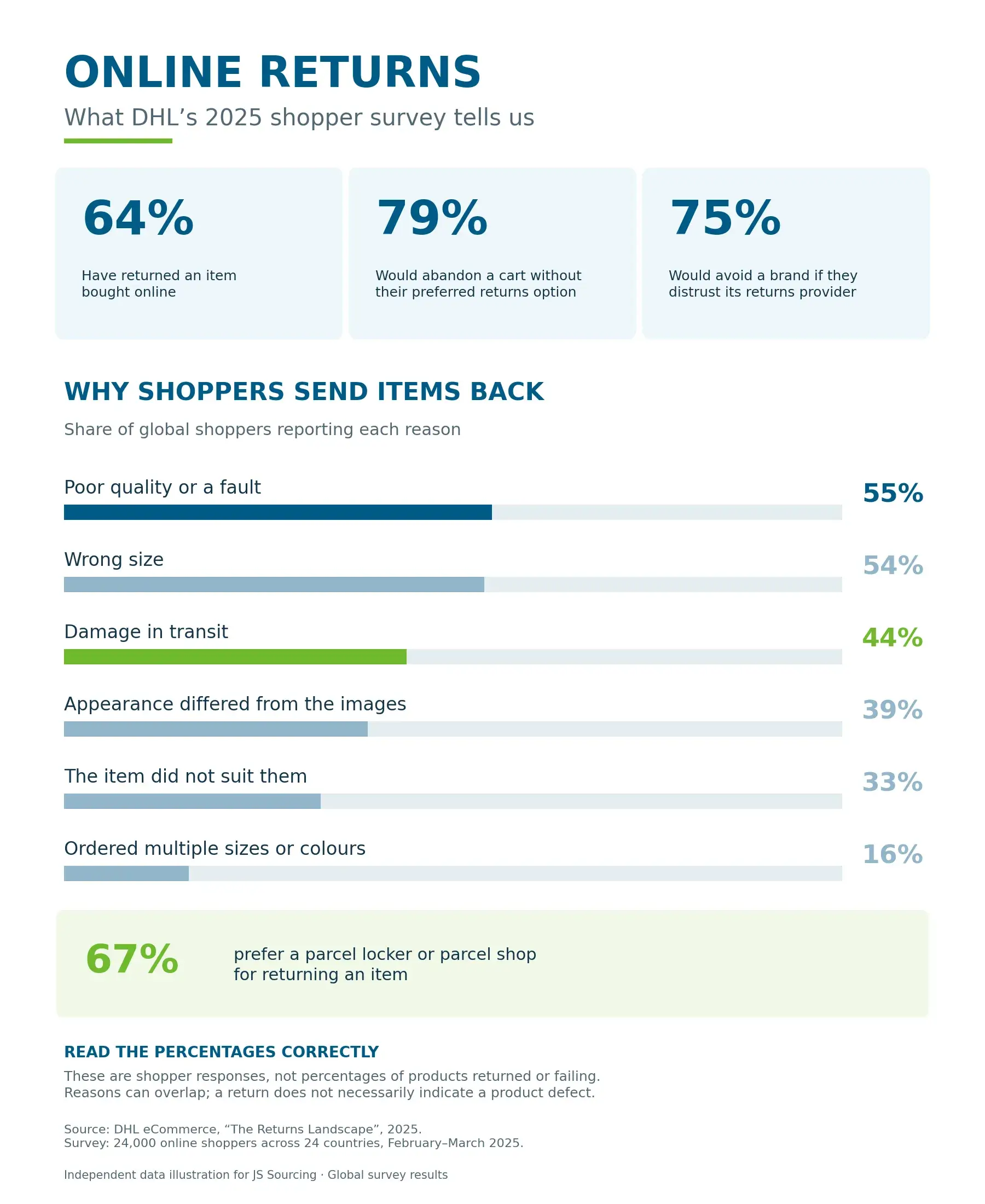
Factory rejection rates are not a substitute for failures after customer use. Incoming inspection defects, warranty claims, accidental damage and normal wear describe different sources of demand. A high return rate also deserves investigation before it becomes a larger spare parts order: stock may keep repairs moving while a product problem remains unresolved.
Can the product be repaired where it is sold?
Having the component is only half the repair. Someone still needs to identify the fault, reach the part, fit it and confirm that the product works afterwards. That can be straightforward for a replaceable furniture fitting. A medical-device module or vehicle controller involves a different discussion.
If a machine must be repaired within two days but its controller takes 30 days to arrive, the standard overseas supply route cannot meet the repair deadline. A spare parts order delivered to local stock before a failure occurs is one option; a manufacturer-approved substitute, a service exchange or a backup machine may also be needed.. Diagnosis, approval, installation and functional testing all consume time before the customer has a working product again.
A sample repair before confirming your spare parts order makes that discussion concrete. The supplier or qualified technician can demonstrate a replacement on the approved sample, showing the tools, instructions, skills, access and testing involved.
A trial replacement on the approved sample can reveal missing tools, inaccessible fixings or software requirements before you commit money to stock.
Compatibility is more than a familiar-looking part
The references on a proposed spare parts order can be compared with the product bill of materials, exploded-view drawing or service manual. The quantity used per product also matters, as does whether a component is replaced individually or within a complete assembly.
| Check | Evidence to retain |
|---|---|
| Part identity | Part number, revision, supplier, and compatible product model or batch. |
| Physical fit | Relevant dimensions, mounting points, connector type and installation photographs. |
| Functional fit | Functional test result, firmware or pairing status, and calibration record where applicable. |
| Replacement procedure | Approved instructions, technician requirements, tools and post-repair checks. |
Vehicle manufacturers show why identification needs that detail. Polaris’s parts-identification guide uses vehicle configuration or VIN and assembly diagrams to find the correct reference. It also explains that some repairs require trained technicians and special tools. It is a useful example of linking the part, the exact vehicle and the service procedure.
For medical devices, the FDA distinguishes servicing from remanufacturing: restoring original specifications differs from significantly changing performance, safety specifications or intended use. That US distinction reinforces the need for model-specific service instructions and appropriate technical review when selecting replacement components.
For machinery, safe maintenance and control of stored energy are part of the repair arrangements too. OSHA’s hazardous-energy guidance explains the issue in the US workplace context. A parts stock cannot replace the required competence, equipment and procedures.
How much stock belongs in your spare parts order?
Once we know which components are useful and how repairs will happen, quantities for the spare parts order become easier to discuss. The coverage period might run until the next planned shipment or the first scheduled service. Expected use is estimated for each part, with a buffer for a stated reason.
Basic order calculation: order quantity = expected use during the coverage period + justified buffer − usable stock − confirmed incoming stock available in time.
Incoming stock that arrives after the repair or maintenance date cannot cover that need. The calculation belongs to each part number and revision. These examples are hypothetical calculations, not industry failure rates or recommended stocking percentages.
Scheduled maintenance demand
If you are buying 40 machines and each needs two filters at its first service, the initial requirement is 40 × 2 = 80 filters. Matching filters already available reduce the quantity on your spare parts order. Including them with the machines makes sense if a later shipment cannot arrive before that service.
Operating hours matter when the manufacturer specifies an hourly service interval. Shelf life matters before buying several service cycles of age-sensitive items such as seals, adhesives or batteries. An oversized spare parts order can create waste if parts degrade before use.
Repair demand for products sold repeatedly
Suppose 500 products will all be in service during a six-month period. If comparable records show that 2% need one switch replacement during that period, expected demand is 500 × 2% = 10 switches.
A provisional buffer of five switches gives a target of 15. If four usable switches are already in stock and no other incoming quantity will arrive in time, the initial spare parts order would be 15 − 4 = 11 switches, subject to pack sizes and minimum order quantities.
The 2% figure is useful only when the records relate to a comparable model, operating period, usage pattern and environment. The buffer may cover variable shipping time or uncertain demand, but it does not guarantee a particular service level. Repeat repairs count separately, and products entering service gradually change the exposure.
A first order without repair history
This is where curiosity earns its keep. A supplier’s recommendation becomes more informative when the buyer asks why those components were selected, what faults occurred on comparable products and whether improvements have already been made. An honest explanation of a limitation can be more useful than a confident “no problem”.
The first spare parts order can then reflect scheduled needs, expected repair demand, the cost of interruption and how quickly stock can be replenished. After products enter service, actual part usage improves the estimate. A practical reorder trigger is expected demand during replenishment lead time plus the chosen safety stock, reviewed as the installed product base and supplier performance change.
Will the supplier support a small order later?
A factory may be happy to sell 1,000 finished products and much less enthusiastic about supplying three spare controllers. The component could come from a subcontractor with its own minimum order, or the factory may need another production run to obtain it. A small spare parts order can therefore involve minimum quantities and production delays that never arose in the main purchase.
A separate quotation makes the cost of your spare parts order visible. Items described as free of charge still need identification, quantities and confirmation of inclusion. An “accessory kit” needs its contents listed, so two suppliers’ offers can actually be compared.
| Quote field | Required details |
|---|---|
| Identification | Part number, revision, photograph, and compatible product model or batch. |
| Commercial terms | Quantity, unit price, minimum order quantity, pack size and small-order charges. |
| Availability | In-stock or made-to-order status, production lead time and dispatch time. |
| Repair requirements | Instructions, tools, software access, pairing, calibration and technician requirements. |
| Storage | Shelf life and temperature, moisture, electrostatic or battery-care requirements. |
| Ongoing supply | Support period, change notification, replacement availability and discontinuation arrangements. |
A supplier’s quotation for a small standalone replacement-parts order can expose MOQ and handling costs that remain invisible in the main product quotation.
Your spare parts order (easy to wear components) could ship with the original batch, join a later repeat order, or be drawn from identified stock reserved at the supplier. Supplier-held stock needs agreed ownership, storage, availability and release terms. “We can supply it later” leaves all of those questions open.
When a later revision changes the answer
A new connector, firmware version or sub-supplier can make an apparently familiar part unsuitable for products already sold. Written change notification and an old-to-new part reference make the discussion traceable. A substitute proposed for your next spare parts order still needs the appropriate compatibility confirmation and sample checks.
Long-term support promises also need a starting point. “Five years of availability” could mean five years from your shipment or five years from the model’s launch. The covered parts, the route for placing a spare parts order and the discontinuation notice are equally relevant. A last-time-buy option can help, provided the remaining parts will stay usable and suitable.
The agreed schedule agreed for your spare parts order can become an attachment to the purchase order. Where several component suppliers are involved, China-side manufacturing coordination can help connect their quantities, revisions and production timing.
Who pays when a component fails?

“The part is free” can be reassuring until the invoice for freight and local labour arrives. Your spare parts order and warranty terms need to account for that cost.
Included components may be starter stock, paid extras or an allowance against future warranty claims. The agreement should explain whether the supplier replenishes stock after an approved claim and whether replacement dispatch happens immediately or waits for the next product order.
The financial and operational questions are specific:
- The evidence needed for a claim: photographs, serial numbers, diagnosis or a returned component.
- Responsibility for the component, international freight, import charges, diagnosis and local repair labour.
- The conditions under which a qualified local technician can perform the repair.
- The time allowed for claim approval, followed by the time allowed for dispatch.
- Replenishment of spare stock used for an approved warranty repair.
For example, two business days to approve a complete claim followed by five business days to dispatch means seven business days before transit starts. Transport and customs clearance add more time. The customer-facing promise needs to reflect that whole period.
Planning attic stock and complete replacement units
Sometimes a component repair is impractical or cannot restore the required appearance. This is where additional finished products enter the discussion, with their quantities kept separate from component stock.
Attic stock for hospitality and other project purchases
Imagine a hotel receiving its approved lighting order. One complete fixture is damaged on the journey to site, another reveals a critical defect at installation, and a later failure needs an identical replacement. Extra finished fixtures ordered with the project batch can address those situations. A box of drivers alone cannot cover every one of them.
For a hospitality purchasing project, the operating horizon may extend to renovation or refitting. Quantities depend on repeated items, foreseeable damage and failures, the ability to obtain identical products later, available storage and project requirements. That intended horizon is a planning requirement to discuss with the supplier, rather than an automatic lifespan guarantee.
Installed quantities and attic-stock quantities need separate order lines. Then a shortfall at installation cannot quietly consume the entire reserve without anyone knowing what remains. Brand, design and operator requirements belong in the hotel FF&E sourcing plan while the original batch can still be adjusted.
Replacement units for direct customer exchanges
For an online seller, sending a complete replacement may resolve a complaint faster than arranging a component repair. For inexpensive products, the full repair cost may also exceed the cost of replacement, especially when specialist labour or testing is unavailable locally.
The trade-off deserves a proper calculation. It includes the replacement product, delivery, handling of the returned unit and the stock held for exchanges. When an otherwise repairable product is discarded, that approach also creates avoidable waste. “Replace everything” may simplify one transaction while concealing a product-quality or repairability problem across many sales.
Replacement units used for customer exchanges also need their own balance. They cannot be counted simultaneously as new-sale inventory and as guaranteed exchange stock.
From the supplier’s carton to the service team
Once your spare parts order is agreed, it still has to arrive correctly. Separately labelled cartons or clearly separated inner packs make components easier to count and locate. Each packing-list entry should connect the part number, revision, quantity and carton location; protective packaging needs to suit the component.
Spare-part counts, labels, packaging and agreed fit or function checks can be included in the pre-shipment inspection scope. Specialist tests need separate arrangements when they require equipment or expertise beyond a routine inspection. Free-of-charge items also need suitable invoice descriptions and valuation confirmed with the customs broker.
Planned freight versus emergency shipments
What does sending a spare parts order with the main shipment actually save? The following comparison uses assumed component and freight prices for illustration only.
| Cost | Ten parts with the main order | Ten separate emergency shipments |
|---|---|---|
| Parts at $6 each | $60 | $60 |
| Additional freight | $20 | $280 |
| Total if all ten are purchased or shipped | $80 | $340 |
If all ten parts are needed, planned purchasing costs $80 compared with $340 for ten separate emergency shipments, a difference of $260. If only two are needed, two emergency shipments would cost $12 for the parts plus $56 freight, or $68. Buying all ten upfront then costs $12 more before downtime, storage, import charges, working capital or obsolete stock are considered. Actual supplier and freight quotes are needed for the real decision.
Courier and air-freight quotations for spare parts order from China also need comparable scope: pickup, handling, clearance and final delivery can change the total. Battery components deserve particular attention. The US PHMSA shipping guide distinguishes battery types and shipping configurations; the forwarder needs to confirm the current requirements for the actual shipment and route.
Who receives and controls the stock?
Service parts need to reach the repair team; hotel attic stock needs to reach the operator’s agreed store. Each has a different destination and stock record. Neither is useful when its location is “probably in one of the installation cartons”.
Agreeing who receives each category of stock and where it will be stored helps prevent paid components or attic stock from disappearing among installation materials.
Penn State’s published construction closeout requirements describe stock being lost or forgotten and make requested stock subject to receiving and storage arrangements. Its definitions and rules are specific to that institution, but the operational lesson is relevant: receiving a reserve needs an accountable handover.
After delivery, a useful repair record connects the component used, product batch, time in service, fault and repair result. Physical stock checks establish what remains usable. Together, these records help the next order reflect what happened in service instead of repeating the first estimate.
Spare parts planning starts before the first complaint
The free castors were a welcome gesture. They simply could not solve the problem those customers experienced. Before confirming your first spare parts order, a supplier’s free allowance deserves a closer look: which components are included, why were they selected, and do the quantities reflect how frequently they fail? Those answers help establish whether the offer will actually support your customers after the sale.
Your own curiosity matters just as much. Asking why a component fails, what the product struggles with, or how a repair works can reveal limitations while there is still time to improve the specification, test the sample, or reconsider the purchase. There is nothing embarrassing about those questions. They may save you some much less comfortable conversations with customers later.
Useful spare parts, suitable attic stock, and complete replacement units each have their place. Your ability to prevent problems and reduce risks remains essential, connecting this planning with sample approval, supplier selection, and quality control before shipment.
Questions from buyers
Our supplier includes free spare parts. What could still be missing?
It’s a good sign. It suggests that the supplier understands why brands need to support their customers after the sale. Before agreeing the spare parts order, the important questions are whether these are the components that fail most frequently, and whether the quantities offered reflect their failure rates. That conversation could reveal opportunities to reduce returns and complete-product replacements, especially if your business currently replaces a high proportion of products.
Our vendor accepted our order and delivered as promised. But we’re seeing a 2.7% return rate after only a few weeks of use. We contacted the Chinese vendor to order spare parts, but they no longer answer our emails. What should we do?
That leaves you handling customer complaints while the company best placed to explain the product has gone quiet. The return reasons and examination of affected units should first establish whether a recurring component fault is involved; the percentage alone cannot identify which spare parts would solve it. Meanwhile, the purchase records, agreed support terms, and failure evidence provide a basis for escalating through other company contacts and seeking a documented response. JS Sourcing can help investigate the supplier situation and coordinate technical assessment or alternative sourcing, although a replacement component still needs confirmation of compatibility and suitability.
Does JS Sourcing take spare parts or attic stock into account when serving as a buying agent for importers and brands?
Yes. These requirements belong in the original purchasing discussion. For brands and importers, that means planning the spare parts order around likely component failures, available parts, and the intended repair or replacement arrangements. For hospitality projects, it means agreeing which additional identical products should accompany the main order. JS Sourcing can coordinate supplier proposals, quotations, agreed checks, and shipment consolidation around those requirements.
How long should a manufacturer provide replacement parts?
The support period needs to reflect the product, its expected use, the seller’s commitments and applicable market requirements. The agreement should state the duration, starting date, covered parts and ordering terms, including what happens if a component is discontinued. A general promise of availability gives little help without a workable way to place and receive a spare parts order.
Include after-sales needs in your China sourcing project
Tell us what you are buying, the quantities involved, and how you expect to handle damaged or failed products. JS Sourcing can help clarify supplier support and coordinate your spare parts order, attic stock, or replacement units with the main purchase.
Technical source links reviewed on 20 November 2026. Calculations and purchasing situations are illustrative. Planning quantities should be reviewed against the actual product, project and service records.