When I started working on hospitality projects, I found case goods surprisingly confusing, and felt a little embarrassed about it. I could recognize a wardrobe perfectly well, so why was I struggling with a furniture list? After comparing a few clients’ FF&E schedules, I felt better: they did not all group the furniture in the same way, and some suppliers made no distinction between casegoods and upholstery. That was a relief, although I still needed to understand what each client expected us to supply. If you are having the same “surely I should know this?” moment, let me help.
What Are Case Goods? The Short Answer
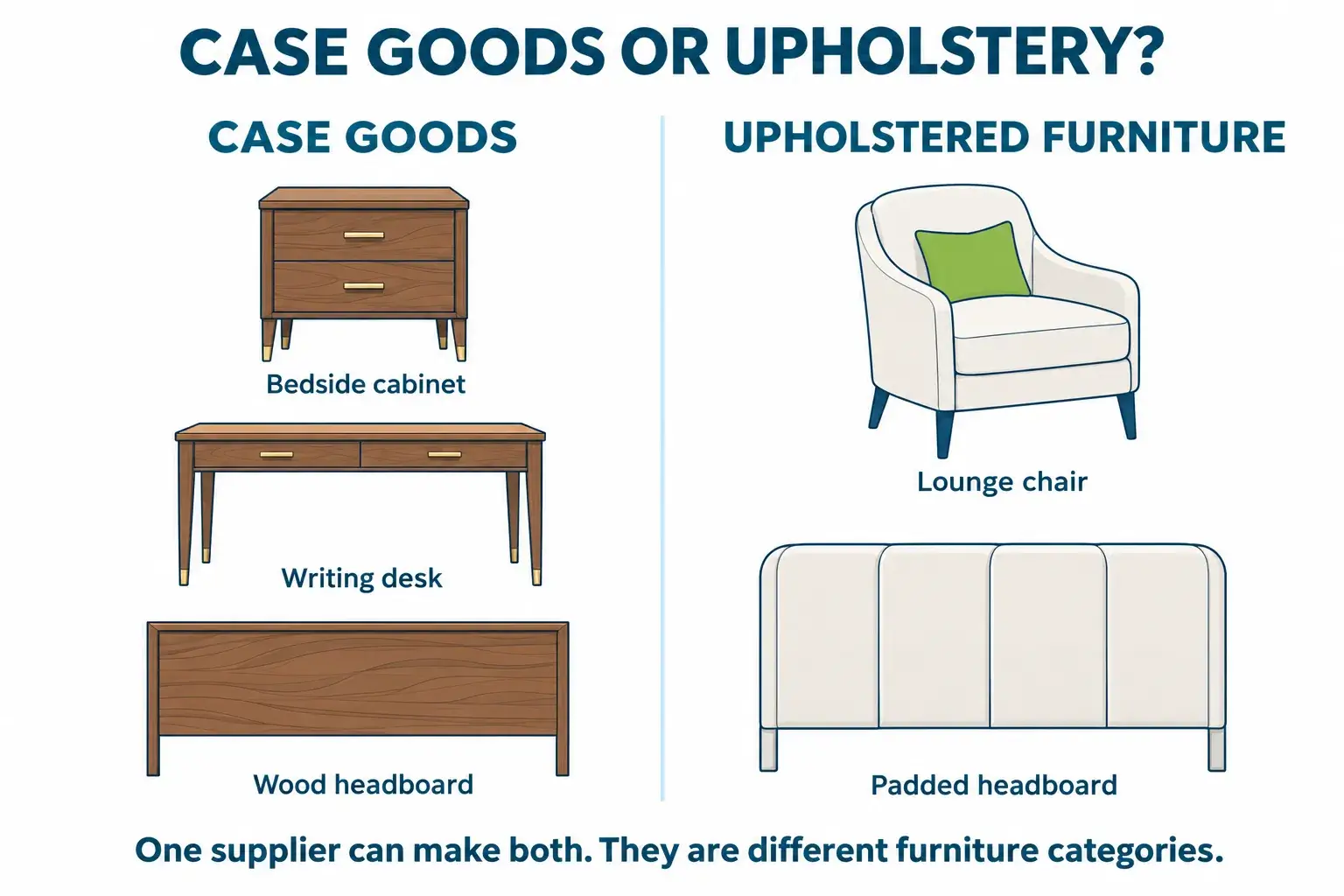
Case goods are non-upholstered furniture, especially cabinets and related pieces used for storage, display or supporting everyday activities. In hospitality, the category commonly includes wardrobes, dressers, nightstands, desks, media units and minibar cabinets, alongside items such as non-upholstered headboards.
The name suggests a box, but hotel casegoods do not all need drawers, doors or an enclosed body. A writing desk or veneered headboard can belong to the category. A padded, fabric-covered headboard belongs to upholstered furniture.
Now, if your supplier has put a sofa under a “casegoods” heading, I understand the confusion. Their quotation may simply group all the guestroom furniture together. The sofa and padded headboard are still upholstered furniture, even when the factory supplies everything for the room. You have not misunderstood the furniture; the quotation is using a convenient heading.
Case Goods in Common Usage and in Hospitality
The dictionary definition and the hotel definition
The dictionary definition of case goods emphasizes furniture with interior storage, while also recognizing bedroom and dining-room furniture sold as sets. A chest of drawers is an easy example: its outer body, often called the case or carcass, contains the storage.
In hospitality, we use the term more broadly for related non-upholstered furniture. So if you have read the dictionary definition and wondered what a writing desk with no drawers is doing on your casegoods schedule, you have spotted a real difference in usage. The hotel definition includes more than storage.
| Usage | Main emphasis | Typical examples |
|---|---|---|
| General furniture usage | Storage furniture, with broader usage for bedroom and dining-room sets. | Wardrobes, bookcases, dressers and sideboards. |
| Hospitality usage | Storage and related non-upholstered furniture used throughout a property. | Those same cabinets, plus writing desks, media units and non-upholstered headboards. |
There is another distinction that confused me at first: fixed or freestanding. A wardrobe can stand on its own or fit into a recess; neither arrangement changes the fact that it is non-upholstered furniture. On some projects, fitted cabinetry belongs to the millwork contractor, the team supplying the fitted woodwork. That helps explain why two clients can send you different furniture lists for rooms that look quite similar.
And if FF&E is another unfamiliar abbreviation, it means furniture, fixtures and equipment. Case goods are one furniture category within it. Nobody arrives on their first hospitality project knowing every term, so I would rather explain it here than leave you guessing.
Case goods or casegoods?
Both spellings are used. Case goods and casegoods are plural forms, so I would write “a piece of casegoods” for one item. In a conversation with a factory, “the nightstand” is usually clearer anyway. There are enough opportunities for confusion without turning one bedside cabinet into a grammar lesson.
Why old references mention milk
Here is a detail I rather like: historical searches for “case goods” can turn up evaporated milk. The Federal Reserve Bank of St. Louis hosts evaporated-milk production records labelled “case goods” covering 1918–1955. In that commercial context, the term referred to packaged merchandise, rather than furniture.
Furniture usage also predates the 1970s. A 1925 furniture-industry report already uses “case goods” for furniture. These records show that the two meanings overlapped; they do not establish that the furniture term came from the milk trade. It is an interesting bit of history, but we still cannot name the first person who applied it to a cabinet.
Common case goods materials
Before we get into materials, a word for anyone new to buying hotel furniture, or too busy to have spent much time on the details: case goods do not have to be made throughout from the material you see on the outside. This may sound basic to experienced purchasers. Even so, it deserves a little space here, because it makes a real difference when you compare prices.
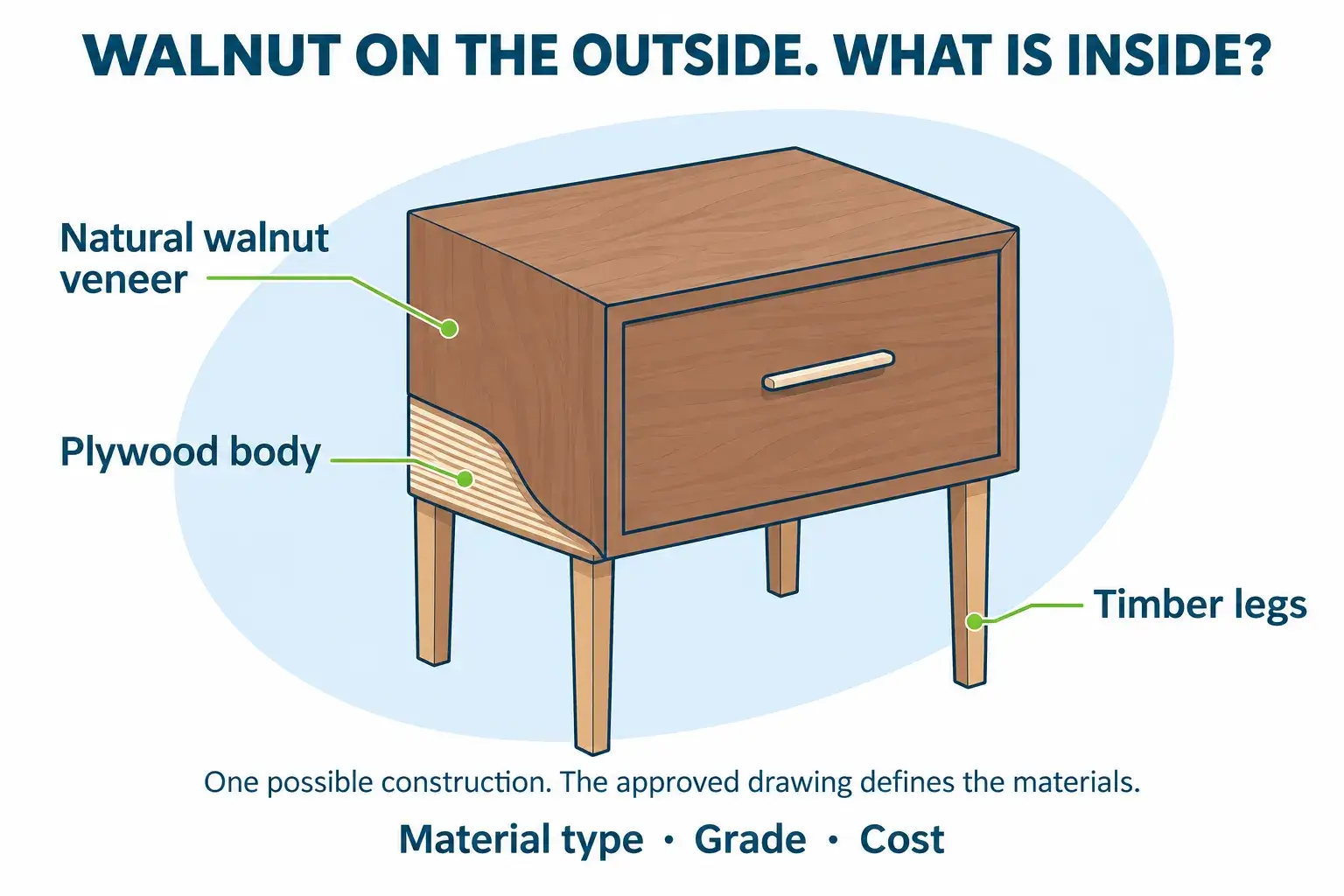
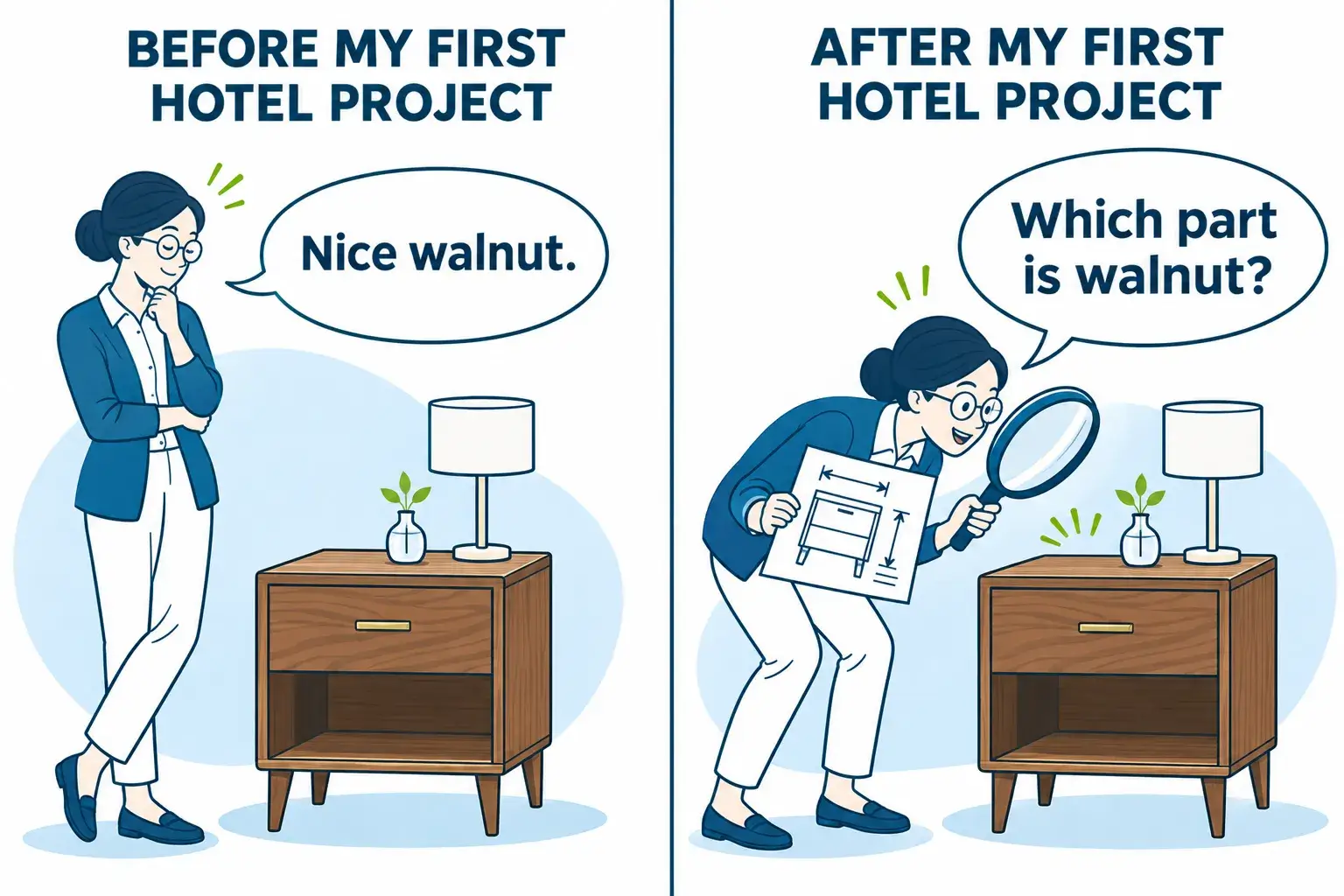
Imagine a hotel bedside table with beautiful, smooth walnut grain. Lovely, yes. Solid walnut? Not necessarily. Its carcass, the main body of the cabinet, could be plywood or MDF covered with walnut veneer. If “body” is easier to remember than “carcass,” that is absolutely fine; we are discussing a bedside table, after all.
Natural wood veneer is real wood, applied as a thin layer over another material. You can think of it as the furniture’s outer skin. A plywood body with walnut veneer can cost less than solid-walnut construction while still giving the designer a natural walnut surface. Even the legs could use another timber under walnut veneer, if that is what the approved workshop drawings specify.
That is a perfectly possible combination. The important part for costing is knowing which materials and grades the quotation actually includes, right down to the veneer. I would not expect a young purchaser to recognize all of that from a photograph. It becomes much easier to appreciate once you start comparing drawings, samples and factory quotations together.
| Material | Typical use in case goods |
|---|---|
| Solid timber | Legs, frames, shaped components, timber edging and selected panels. |
| Plywood | Layered-veneer panels for cabinet bodies, drawer components and other structural parts. |
| MDF (medium-density fibreboard) | Panels made from wood fibres, often used for painted, shaped or veneered components. |
| Particleboard | Panels made from wood particles, used in cabinet bodies, shelves and surfaced components. |
| Veneer, HPL or TFL | Decorative surfaces applied to a supporting board, using different manufacturing methods. |
| Metal, stone and glass | Bases, frames, tops, shelves, doors, trims and decorative details. |
If you would like to understand what those boards contain, the USDA guide to wood-based composite materials explains how they are made. I am quite happy to see engineered panels in case goods when they suit the design. The useful discussion is about the grade, dimensions, connections and intended use, rather than assuming that every component would be better in solid wood.
A cabinet’s decorative surface and the board beneath it are separate specifications; “walnut finish” tells you very little about its construction.
What hotel casegoods need to accommodate
A hotel wardrobe may contain a safe, luggage shelf, hanging rail and drawers within a surprisingly small space. It is doing quite a lot for something most guests barely notice. A desk may need sockets and a discreet cable opening too. Once you start considering these details, it is easier to understand why an attractive showroom piece may need considerable adaptation for a hotel.
Take the minibar cabinet. I can understand the satisfaction of finding a fridge that fits neatly into the opening, especially in a small room. But the appliance also needs its specified ventilation clearances. If the cabinet does not allow enough airflow, that neat fit can become an operating problem. There is more to this little drinks cupboard than its door finish.
Case goods also appear beyond the guestrooms: restaurant sideboards, host stands, display cabinets and service stations all have jobs to do. Their dimensions and construction depend on how staff and guests will use them.
How Case Goods Are Made
One thing I enjoy about sourcing is seeing how a drawing becomes an actual piece of furniture. The cabinet that looked simple on a screen turns out to involve quite a few people, machines and decisions. If you are wondering why two similar-looking case goods quotations differ so much, following the manufacturing work helps explain where some of that difference comes from.
Preparing the timber and panels
Solid timber needs suitable drying and conditioning before fabrication. Manufactured panels need appropriate storage too. Wood exchanges moisture with the surrounding air, and changes in moisture can change its dimensions. The USDA’s guidance on wood moisture content and dimensional changes explains why the conditions in production and in the finished hotel both matter.
The factory then works from a cutting list: the dimensions and quantities of the parts needed for each piece. There are visual decisions here too. Think of a chest with walnut grain that appears to continue across three drawer fronts. It is a lovely detail, but it does not happen by accident. The material for those fronts has to be selected and arranged together, which can affect material yield and cost.
Cutting, drilling and shaping the parts
Panels are cut to size, then machined for details such as shelf holes, drawer grooves, hinges and connectors. Solid timber may also be planed, shaped or turned. Computer-controlled (CNC) machines and jigs, which guide repeated operations, help produce consistent parts across an order. The programme, setup and tooling still need to be right.
You do not need to operate a CNC machine to understand why accuracy matters. Imagine opening a drawer that rubs every time it moves. Runners fitted at different heights on opposite sides could be the cause. Some adjustment may be possible, but I would much rather see the parts made and fitted correctly than leave the hotel installer to struggle with them.
Applying veneer, laminates and edging
Remember the walnut bedside table? Its natural wood veneer needs to be selected, arranged and bonded to the supporting material, also called the substrate. How the veneer is cut and arranged changes the grain pattern you see. Two samples can therefore use the same wood species and still look quite different. That is worth knowing before “walnut” becomes the whole finish description.
The laminate names take a little getting used to as well. High-pressure laminate, or HPL, is made separately as a sheet and then bonded to a board. With thermally fused laminate, or TFL, resin-impregnated decorative paper is pressed directly onto the board. A factory can buy TFL panels already surfaced. So although all three options can provide a decorative face, they involve different materials and production work.
The exposed edges need attention too. Depending on the design, they may receive ABS or PVC plastic edging, veneer or solid timber. The adhesive bond, trimming and corners all affect the result. You will notice a rough corner quite quickly when your hand catches it; an expensive edging material is little comfort then.
For veneered case goods, a sample showing the intended grain arrangement is more informative than a timber species and stain colour alone.
Assembling the furniture
The body, back, shelves and base are joined using the construction specified for the design. That may involve dowels, adhesives, screws, connectors or other joints. Even a part you rarely see can be important: a properly designed and fixed back panel can help keep a cabinet square. I would be cautious about treating it as an easy place to save money without understanding its role.
Most furniture we help source for high-end hospitality projects is factory assembled, sometimes with detachable parts where appropriate. Knock-down furniture uses a different assembly arrangement. There is more on that topic in our comparison of KD furniture vs assembled hospitality furniture.
Sanding, staining and finishing
Timber and veneered surfaces may be sanded, filled, stained, sealed and topcoated. The steps depend on the finish system, and some components are finished before assembly. A lacquered cabinet and a TFL cabinet will not follow an identical route through the factory.
A finish sample is most useful when it includes the proposed substrate, decorative face and edge detail, because each can affect the finished appearance.
The skills involved in bespoke furniture manufacturing include preparing and applying finishes as well as making the components. This work deserves credit. Sanding scratches, dust trapped in a coating or uneven stain can spoil a piece whose construction is otherwise sound. When a quotation promises “luxury finishing,” I want to see the sample: the phrase alone leaves far too much to the imagination.
What Affects Casegoods Quality?
Once you have spent time comparing furniture, it is difficult to be satisfied with photographs alone. You want to open the drawers, feel the edges and understand what is holding everything together. For anyone starting out, I would concentrate first on a few differences that help explain how case goods perform in use.
Panel stability and moisture
A wardrobe door that starts to bow after installation is frustrating, particularly when the sample looked perfectly flat. One possible cause is unequal stresses in the materials bonded to its two faces as moisture conditions change. The Composite Panel Association’s guidance on balanced panel construction and warping explains why those surfaces, material conditioning and service conditions matter.
This is why I also want to understand the back of a door, although the front gets most of the design attention. Painting the back does not automatically balance every laminate on the front. Similarly, “moisture-resistant” sounds reassuring, but it does not mean waterproof. A purchaser should be able to discuss these differences without needing to become a wood scientist.
The materials on both faces of a panel, and the conditions it experiences, can affect whether a cabinet door stays flat.
Shelf strength and support
Imagine the wardrobe designer has allowed a shelf for folded shirts. Later, someone proposes putting the room safe there instead. It may fit beautifully, but I would not be comfortable assuming that the shelf can carry it. The new use changes what the shelf and its supports need to do.
The material, thickness, weight and supports all matter, along with the unsupported span, meaning the distance between supports. The Composite Panel Association’s shelf loading and support guidance explains the relationships. For another commonly used board material, our guide to plywood specifications goes into more detail. An 18 mm shelf may sound reassuringly familiar, but I would still want to know its span and what it has to carry.
The actual safe or appliance model gives the furniture designer usable dimensions and loading information that a label such as “safe space” cannot provide.
Hardware, fixings and finish
I admit it: a drawer that closes softly is pleasing. It is tempting to take that smooth movement as proof of good furniture. But the runners also need to suit the load, the drawer needs sound joints and a suitable bottom, and the fixings need to hold in the chosen board. There is quite a bit behind that satisfying little movement.
Now picture the bedside top after a guest puts down a water glass, phone and keys. It gets a different kind of contact from the wardrobe front. Its coating needs to suit that use, as well as look right. And although natural veneer can be an excellent choice, I would be careful about promising that scratches can always be sanded out. The veneer is thin; its thickness and condition limit how much can be removed.
The Architectural Woodwork Institute’s factory-finishing quality criteria offer useful terms for defects such as runs, blotching and sanding scratches. They help make a discussion more precise than “the finish does not look premium.” That architectural woodwork guidance is a reference, rather than an automatic specification for every hotel furniture order.
The sample is approved, but the factory wants to change the board for production. Is the same colour enough?
I would want to understand the proposed change before agreeing. A different board can affect machining, fixings, stability and the finished result, even when the colour matches. JS Sourcing’s furniture quality inspection services can check the agreed materials and construction at an appropriate stage, while there is still time to address a discrepancy.
If you are new to furniture purchasing, that may already feel like quite a lot to remember. You do not need to identify every possible defect on day one. Understanding how the board, joints, hardware and finish work together is a useful start, and it makes discussions with the designer or factory much easier.
Bespoke Case Goods and the Guest Experience
Most case goods we help source for high-end hospitality projects are bespoke. The furniture needs to fit the rooms and the design concept, so dimensions and details are developed for that property. This is a part of the work I particularly enjoy. The client cares about how the room will feel, the designer cares about the details, and we help work out how the factory can make the furniture they have in mind.
Bespoke furniture can be made for a hundred rooms
If “bespoke” makes you picture a craftsperson making a single cabinet, you are not alone. A hotel can order a hundred identical nightstands designed specifically for its guestrooms. Shared internal parts, repeated dimensions and common hardware can make that order more practical to produce. The furniture is still bespoke because the design was developed for the project.
Catalogue furniture offers an existing design. A modified version adapts it, perhaps in size or finish. Fully bespoke furniture is developed around the project brief. Any of these approaches can produce good furniture; the label alone does not guarantee it.
Bespoke case goods are designed for the project, and the same design can be manufactured repeatedly across the hotel.
When a favourite design is beyond the budget
Sometimes a client brings a reference piece with a lovely curved front or an unusual timber-and-metal combination. I can see why they like it. Then its price is multiplied by a hundred rooms, and the enthusiasm becomes a little harder to sustain. Nobody wants to tell the designer that the feature they love is beyond reach.
This is where a more specific conversation helps. What do they love about it: the proportions, the curve, the grain or the contrast between materials? With that understood, the manufacturer and design team can develop an original proposal and explore alternatives. A simpler internal component may have little visual effect. Replacing the curved front with a flat one could remove the very reason the client chose the reference. I would rather understand that before we spend time costing the wrong alternative.
For a little browsing, this collection of case goods design inspiration in 2026 shows how much character cabinets and related pieces can bring to an interior. Inspiration is a starting point for developing the property’s own furniture.
A reference image gives the factory a better starting point when the brief explains which proportions, materials or details matter most to the designer.
How the furniture works in the room
Think about reaching for your phone from bed. If the bedside top is too low, too far away or covered by the lamp base, you notice immediately. A beautifully made nightstand can still be inconvenient. The same goes for a wardrobe door that opens freely in the workshop but meets a chair in the finished room.
I find this a useful reminder of whom all that work is for. Guests want to put away their belongings, charge a phone and get comfortable. Seeing the proposed pieces together helps us understand whether they can. It also gives the designer a chance to compare the stone, metal and veneer together, instead of judging each finish from a separate sample.
The client loves the reference design, but its price will not work across the hotel. What can we offer?
A preliminary costing based on the reference, room quantities and dimensions can help identify where alternatives are needed. Through custom furniture development, JS Sourcing can coordinate manufacturer proposals for your design team to assess. Our hospitality sourcing support helps connect the project with suitable manufacturers in China.
An affordable proposal is much easier for the client to approve when it still has the proportions, curved front or material combination that attracted them in the first place.
Getting Comfortable with Casegoods
I wish someone had explained all this when I first sat down with those furniture schedules. It would have saved me some second-guessing. Clients and suppliers will still use different headings, but you can now recognize the non-upholstered pieces, understand the difference between a walnut surface and a cabinet’s construction, and see why a drawing or sample deserves a closer look.
That is a good foundation for buying case goods. The materials affect costing, the manufacturing affects the result, and the furniture needs to work in the actual hotel room. Bespoke production lets those choices suit the property, even when the same design is made for a hundred guestrooms.
For me, seeing the furniture together is one of the most rewarding parts. A hotel mock-up room approval brings those drawings and samples into a room you can walk through. You can finally sit at the desk, reach for the bedside table and find out whether everything works as comfortably as it looked on paper.
About the author: Cynthia Wu is a sourcing specialist at JS Sourcing.
Reviewed 20 November 2026. This article is reviewed when relevant technical guidance changes; project-specific materials and construction still depend on the intended use.