Last updated: 30 September 2026. The prices and duty rates below are planning ranges, not offers. Rates move during the year, so ask your broker to confirm the current stack before you sign a PO.
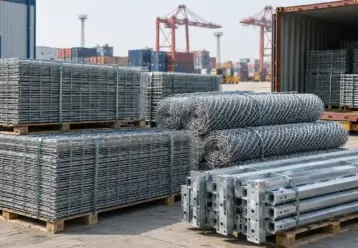
Welded wire mesh fencing from China runs US$1.2–3.0 per m² FOB Tianjin. Chain link is US$2–6 per m². A 2.5 × 2.5 m 358 anti-climb panel quotes at US$55–130 FOB. The working minimum is one 40HQ, and that holds 900–1,400 panels. From deposit to vessel, plan on 30–45 days. More than 13,000 companies in Anping County, Hebei work the same wire, and the county’s woven mesh covers over 80% of national output and exports.[1] A standard 2.5 × 2.0 m panel in 4 mm wire, galvanized and powder coated, quotes US$6–14 FOB. At US$9.50 FOB that same panel lands in the United States at US$20–24 once the steel duties stack up. And the coating mass is the number that decides whether it lasts 6 years or 20.
Costs: US$1.2–3.0 per m² for a plain welded panel, US$9–21 per m² for 358 anti-climb mesh, US$2–6 per m² for galvanized chain link fabric. Minimums: 300–500 panels per size if you use stock tooling, 800–1,500 for a size of your own, one 20GP or 40HQ per shipment. Timeline: 2–5 days for a quote, 5–18 days for samples, 20–35 days for production, 15–40 days at sea. Compliance: the US AD/CVD case on temporary steel fencing has run since 13 May 2026, at 129.70% to 184.27% on the antidumping side[2]. Permanent welded mesh panels sit outside that case, but the steel duties still land on them. Where: Anping and the Hebei counties around it for mesh, Tianjin for export handling, Foshan for stainless and architectural mesh.
What buyers ask first
| What buyers ask first | Straight answer | Number to plan on |
|---|---|---|
| Which type do I need? | Welded panels for permanent perimeters, chain link for long low-cost runs, 358 mesh where climbing or cutting matters, temporary panels for sites | 4 main families, 8 common SKUs |
| What does it cost? | FOB Tianjin per m² or per panel; coating is the biggest swing factor after wire diameter | US$1.2–21 per m² depending on type |
| What is the MOQ? | One container, or 300–500 panels per size from stock tooling | 1 × 20GP = 28–33 m³ |
| How long does it take? | Quote, sample, production, inland haul, ocean leg | 30–45 days deposit to vessel |
| Will I pay duty? | Yes. Steel duties apply to the full customs value from April 2026, and temporary fence panels carry separate trade-remedy deposits | 25–50% steel duty, plus trade remedy where it applies |
| How do I check quality? | Wire gauge, mesh opening, coating mass, weld shear, then a pre-shipment inspection | AQL 2.5/4.0, one inspector-day per 800–1,200 panels |
| How much fits in a container? | Weight bites before cube on most mesh products | 900–1,400 panels per 40HQ, 21–28 t payload cap |
The four families of wire mesh fencing, and what each one is for
Start with how the wire is joined. That one choice sets the strength, the price, and which of the 8 types a factory can even quote you. Those 8 run from US$0.8 to US$21 per m², so the join method is where the price spread begins.
| Type | How it is made | Typical spec | Where it goes | What to watch |
|---|---|---|---|---|
| Welded mesh panel (flat or 3D bent) | Resistance-welded at every intersection | 3.0–5.0 mm wire, 50 × 200 mm or 50 × 100 mm openings, panel 2.0–3.0 m wide by 1.2–2.5 m high | Industrial and residential perimeters | Weld points must be coated after welding, not before |
| 358 anti-climb mesh | Dense welded mesh, small apertures | 4.0 mm wire, 76.2 × 12.7 mm openings, panel 2.0–3.0 m wide | Prisons, utilities, data centres | Weight per panel 45–70 kg; needs heavier posts and more freight per metre |
| Chain link fabric (woven diamond) | Woven spirals, knuckled or barbed selvage | 2.0–4.0 mm wire, 50/60/75 mm mesh, rolls of 10–30 m | Sports grounds, utilities, long runs | Fabric weight per m² drives price more than roll length does |
| Temporary fence panel | Welded tube frame with mesh infill | 25–32 mm OD tube at 1.2–2.0 mm wall, 2.1 × 2.4 m panel, 12–22 kg | Construction sites and events | In scope of the 2026 US trade case; check the panel weight test |
| Field and farm fence | Hinged or fixed-knot woven wire | 1.8–2.5 mm wire, 0.8–1.5 m high, rolls of 50–200 m | Livestock, orchards | Knot type changes breaking strength by 20–40% |
| Hexagonal netting | Twisted hex weave | 0.5–1.2 mm wire, 13–50 mm openings, rolls of 10–50 m | Gardens, poultry | Easiest product to under-spec; check wire diameter before coating |
| Gabion box | Welded or woven box, filled on site | 3.0–5.0 mm wire, 60 × 80 or 80 × 100 mm openings | Retaining walls, erosion control | Ships empty, so cube is the limit, not weight |
| Expanded metal mesh | Slit and stretched sheet | 1.0–3.0 mm sheet, strand 5–20 mm | Screening, walkways | Different supply chain, usually sheet metal shops rather than wire drawers |
Wire diameter comes first. Going from 3.5 mm to 4.5 mm puts about 60% more steel in a panel and 35–55% on the FOB price. Aperture comes second. At the same gauge, 50 × 200 mm uses about 17% less wire per m² than 50 × 100 mm. The same thinking runs through a wider outdoor range: sourcing garden supply wholesale from China.
Where Chinese wire mesh fencing is actually made
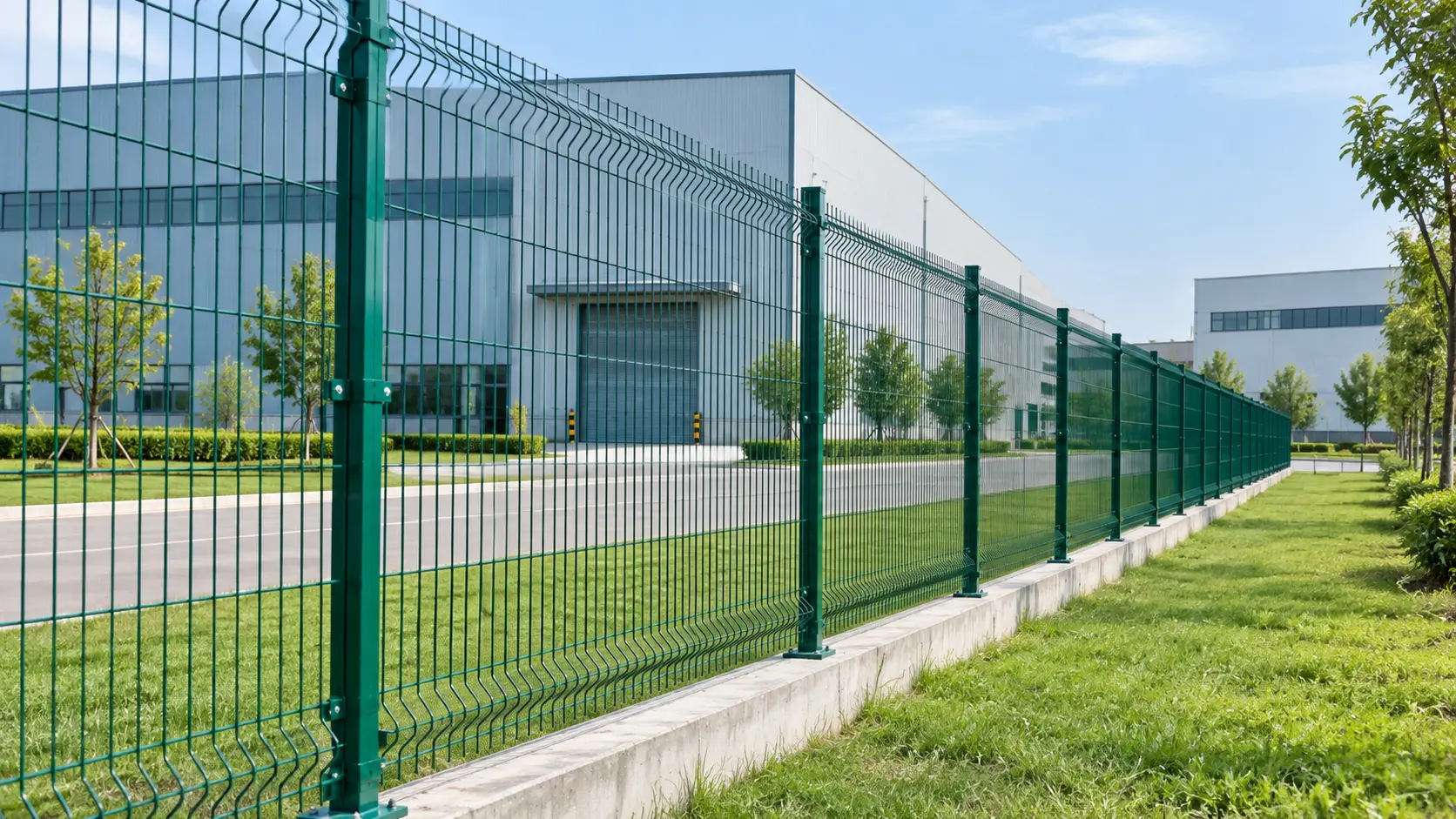
Anping sits in Hengshui, Hebei, 250 km from Tianjin port. That is 1 day by truck and US$300–700 per 40HQ in inland freight, and it puts the county 2–3 days ahead of a Guangdong plant when you book a vessel. County government figures put the industry at more than 13,000 companies across 6 series, 400-plus varieties and 6,000-plus specifications. Output value hit RMB 100.6 billion in 2023 and RMB 106.7 billion in 2024.[1] The same county also draws 3,200-mesh stainless filter cloth, so if your spec is unusual, somebody inside it can usually make it.
| Cluster | What it is strong at | Port | Why it matters to you |
|---|---|---|---|
| Anping County, Hengshui, Hebei | Woven and welded mesh of every kind, wire drawing, filter cloth | Tianjin (Xingang), 1 day inland | Deepest supplier density anywhere; 10 plants will quote one drawing inside a week |
| Raoyang and Shenzhou, Hebei | Welded fence panels, hardware, farm fence | Tianjin | Same labour pool as Anping, often 5–10% cheaper on simple panels |
| Huanghua and Cangzhou, Hebei | Temporary fence panels, stands, clamps | Tianjin | Most named respondents in the US trade case sit here, which tells you where the volume went |
| Tianjin municipality | Export handling, trading houses, some manufacturing | Tianjin | Fastest booking and consolidation; expect a 5–12% trader margin if there is no plant |
| Foshan and Guangdong | Stainless mesh, aluminium mesh, architectural mesh | Shenzhen, Guangzhou | Better finishing and higher wages, 15–30% above Hebei on comparable spec |
| Yongkang and Zhejiang | Light garden fencing, hardware, gate fittings | Ningbo | Best for mixed containers where mesh is one of six product lines |
Mesh runs through three trades at once: drawing, welding and coating. That is the argument for a specialist rather than a generalist desk. Send one drawing to 10 plants inside the county and 3–8 usable quotes come back in 5 working days, all within 20–40% of each other. A sourcing Chinese manufacturers desk compresses that spread inside a week. A quote sitting 30–50% under the pack usually means 0.25–0.5 mm less wire or half the zinc, and either one quietly takes 8–12% of the steel you paid for. For how Chinese clusters divide by product nationwide: where different product categories are made.
Factory or trading company: settle it before you negotiate
Wire drawing, welding and galvanizing are often 3 separate companies. Ask which of the three actually sits inside the company quoting you. A real plant answers in output per machine, and 200–1,200 panels a day is a normal answer. A desk with no machines adds 5–15% and will not tell you who made the panels. On site, that is a factory audit run with a sourcing agent. There you measure the kettle length and count the machines yourself.
| Check | Question to ask | What a real plant answers |
|---|---|---|
| Wire drawing | Which rod grade do you draw, and how many tonnes a day per line? | Names Q195 or Q235 rod and gives tonnes per line per shift, usually 5–30 t |
| Welding | How many mesh welding machines, and what is the output per machine? | Machine count, usually 2–8, plus panels per hour, 40–120 per machine |
| Galvanizing | Is the zinc bath yours? | Kettle length in metres, usually 6–12 m, and bath temperature near 450 °C, or the subcontractor name and its distance in km |
| Business licence | Send the licence and the plant address | Registered address and plant address inside the same county, an 18-digit unified social credit code, and a licence scope that includes manufacturing |
| Power and headcount | How many staff on the mesh lines? | Shift numbers and headcount, often 20–300 on the mesh lines, not “we have many workers” |
| Coating records | Send last month’s coating mass test sheet | A dated sheet with 10 readings per batch in g/m² or µm, not a certificate photo |
“We can do anything” means nothing is running. “1,200 panels a day at 14 operators, galvanizing is at a partner 6 km away” is a business. Cannot visit? Verifying a Chinese factory by video call covers what to make them show on camera. Refused access is the answer. A plant that hides its galvanizing line cannot prove coating mass. Past that, you are choosing between an independent lab test and a new supplier. A supplier refuses third-party inspection covers what to do next. A formal supplier audit costs US$600–1,500 and takes 2–3 days on site, against a rejected shipment that costs 3–5 times the order value to put right. How to choose a China supplier runs the same checks across the whole business, not just one line. A China sourcing company has usually walked the plant already.
Specification fields that decide your quote
A one-line enquiry like “2.5 × 2.0 m welded panel, quote” gets you 3 prices spread 40–60% apart, because all 3 factories guessed at the coating. Fill in the 12 fields below and the same request comes back within 5–12%, because now all three are pricing the same fence.
| Field | What to state | Why it moves the price |
|---|---|---|
| Wire diameter | Before coating, with tolerance, e.g. 4.00 mm ±0.05 | 0.5 mm of gauge is 20–30% of steel weight |
| Aperture | 50 × 200 mm ±2 mm | Sets wire length per m² |
| Panel or roll size | Width, height, and whether 2 or 3 V-bends | Bends add a forming step, 8–15% on labour |
| Coating | Type plus mass in g/m² or thickness in µm | The largest variable after gauge |
| Steel grade and tensile | Q235, tensile 370–500 MPa | Grade drift is invisible and cheap to fake |
| Weld shear strength | Minimum force in newtons, tested per batch | Separates a real weld from a tacked one |
| Post and fitting spec | OD, wall thickness, coating, cap type | Posts are 25–40% of a system’s value, not an accessory |
| Quantity per SKU | Panels or rolls, plus annual estimate | Sets setup amortisation |
| Packing | Palletised, strapped, or loose; panels per bundle | Changes container count and damage rate |
| Incoterm and port | FOB Tianjin or EXW, under the ICC Incoterms rules[3] | Shifts 1–3% of value |
| Test requirement | Salt spray hours, coating mass method, report language | Third-party testing adds US$150–600 per report |
| Validity | How long the price holds | Rod price moves make 15–30 days the norm |
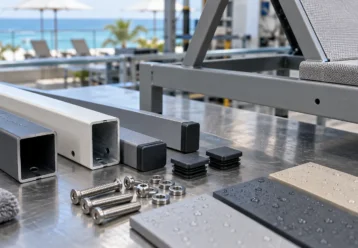
Put posts, caps and clips in the same RFQ, not in a second email a week later. Project buyers treat them like architectural hardware: one finish across the whole site beats a cheap unit price.
No drawing yet? Start with product development in China. Writing these 12 fields takes 3–5 hours and saves you 2–3 weeks of clarification email. What a China RFQ should include walks through the same fields.
Not sure which of these 12 fields your drawing is missing?
Send the panel size, wire gauge, coating requirement, quantity per size and destination port. We return a completed specification sheet plus comparable quotes from 3 Hebei plants, with coating quoted in g/m² as its own line rather than as a finish name.
Coating is where the money is
Two panels can look identical on a video call and differ by 3× in service life. Zinc mass and the weld points are what separate them, and going from 40 to 600 g/m² is 15× the zinc on the same wire. Zinc does not sit on the surface the way paint does. It corrodes first and spends itself to protect the steel underneath, so roughly twice the zinc buys you roughly twice the time.
| Finish | Typical coating | How to test | Planning note |
|---|---|---|---|
| Electro-galvanized wire, welded, then powder coated | Zinc 20–60 g/m², powder 60–80 µm | Magnetic gauge plus cross-cut adhesion | Cheapest option that survives outdoors; weld points rely on the powder film |
| Hot-dip galvanized after welding | 45–85 µm, roughly 320–600 g/m² | Weigh-strip-weigh or magnetic gauge on 10 points | Best corrosion performance; adds US$0.8–2.5 per m² |
| Pre-galvanized wire, welded, uncoated | Zinc 40–120 g/m² | Coating mass by dissolution | Weld points are bare steel; rust starts there in 12–36 months |
| Galfan (zinc-5% aluminium) | 200–300 g/m² | Coating mass | 1.5–2.5× the life of plain zinc per micron; costs 10–20% more |
| PVC coated over a galvanized core | 0.4–0.6 mm polymer | Thickness gauge, bend test at −10 °C | Adds 30–60% to chain link fabric cost; colour is the point |
| Salt spray verification | 480 h or 1,000 h to first red rust | ISO 9227 neutral salt spray[4] | US$180–500 per panel type at a third-party lab |
Verify the coating mass at pre-production inspection, before the run starts. Ask for the coating mass on the wire, not the finish name. “Galvanized” tells you nothing between 40 g/m² and 600 g/m². On chain link, the wire itself is specified to ASTM A817, which covers metallic-coated wire for fabric and tension wire.[5] Batch hot-dip galvanizing after welding is specified to ISO 1461.[6] That one excludes continuously galvanized wire and mesh, so write the coating mass rather than the standard name.
Service life then depends on where the fence stands. ISO 9223 sorts atmospheres into six corrosivity classes, C1 to CX, by first-year corrosion loss.[7] A coastal or industrial site sits two to three classes above a dry inland one, and that gap is what turns 20 years into 6. The bath, drain and quench steps are in galvanizing knowledge for tubular steel.
Standards a real factory can quote back
You do not need to cite all 12. But a supplier who cannot name the class numbers is not selling into regulated projects, and the gap is not academic. Class 1 against Class 2 is 244 g/m² of extra zinc on the same fabric, 366 against 610. Put the class number on the order. That is what a quality inspection report measures against. Naming a standard is cheap. Verifying quality standards when sourcing from China separates a live certificate from a photocopy.
| Standard | Covers | Number to quote |
|---|---|---|
| ASTM A392 | Zinc-coated steel chain link fabric | Class 1 at 366 g/m², Class 2 at 610 g/m²[8] |
| ASTM A491 | Aluminium-coated chain link fabric | Class 1 and Class 2 coating mass |
| ASTM F668 | PVC-coated chain link fabric | Class 2b for polymer over metallic-coated wire |
| ASTM F1083 | Hot-dip galvanized welded steel pipe for fence structures | Schedule 40, common OD 48 mm, 60 mm, 73 mm[9] |
| ASTM F1043 | Strength requirements for steel framework | SS20 light duty, SS40 heavy duty[10] |
| ASTM F626 | Fence fittings | Tension bands, brace bands, post caps |
| ASTM F567 | Installation practice | Post spacing 2.4–3.0 m, fabric tensioning |
| ASTM A641 | Zinc-coated carbon steel wire | Core wire before fabrication |
| EN 10223 series | Steel wire and wire products for fences | Separate parts for chain link, welded mesh and hexagonal mesh |
| EN 10244-2 | Zinc and zinc alloy coatings on steel wire | Coating mass classes by wire diameter |
| ISO 9227 | Neutral salt spray corrosion testing | Hours to first red rust[4] |
| ISO 28590 | Acceptance sampling by attributes | AQL 2.5 / 4.0, general inspection level II[11] |
What bulk pricing looks like
These are planning ranges, FOB Tianjin, at 1–3 container quantities. Steel is 55–70% of the FOB cost of a plain welded panel, so a 10% move in wire rod moves your panel price 6–8%. Two plants 20–40% apart on the same drawing are usually quoting different wire, not different margins. Negotiating with Chinese suppliers only works once you have split the quote into gauge, coating and packing.
| Product | Planning range | Unit | What pushes it to the top |
|---|---|---|---|
| Welded mesh roll, pre-galvanized, 2.0–2.5 mm | US$0.8–2.0 | per m² | Small aperture, tighter gauge tolerance |
| Welded fence panel, 4 mm, galvanized and powder coated | US$1.2–3.0 | per m² | Post-weld hot-dip instead of pre-galvanized wire |
| 3D curved panel with 2 or 3 bends | +8–15% | on the panel | Forming step and extra packing volume |
| 358 anti-climb panel, 4 mm, 2.5 × 2.5 m | US$55–130 | per panel | Panel weight 45–70 kg drives both steel and freight |
| Chain link fabric, 9 gauge galvanized | US$2–6 | per m² | Class 2 coating at 610 g/m² |
| Chain link with PVC coating | +30–60% | on the fabric | Coating thickness above 0.5 mm, custom colour |
| Temporary fence panel, 2.1 × 2.4 m | US$18–45 | per panel | Heavier tube wall, welded stand included |
| Fence post, 60 mm OD × 2.0 mm × 2.4 m | US$4–12 | each | Hot-dip after fabrication, thick wall |
| Post caps, clips, tension bands | US$0.30–1.50 | each | Stainless rather than galvanized |
A landed-cost example, worked through
One worked example, for illustration only. One 40HQ of welded panels: 900 panels at US$9.50 FOB, 2.5 × 2.0 m, 4 mm wire, powder coated.
- FOB Tianjin value: US$8,550
- Inland haul Anping to Tianjin, plus port and documentation: US$700–1,100
- Ocean freight Tianjin to Los Angeles: US$1,600–3,400
- Marine insurance at 0.3–0.5% of insured value: about US$30–50
- Steel duty at 50% of customs value, before any trade remedy: US$4,275
- Section 301 layer at 25%: US$2,138
- MPF at 0.3464% and HMF at 0.125%, plus broker and drayage: US$900–1,600
That puts the panel at roughly US$20–24 landed against US$9.50 FOB, so the duty costs more than the factory does. Ship temporary fence panels instead and you are inside the trade case: add deposits of 129.68% and 49.19%, and duty alone runs past 2.5 times the customs value.[2]
Run the same structure on your own volumes with calculating landed cost from factory price to your door. Then read how suppliers build a price before you push back on a quote sitting 20–40% above the pack.
Compliance: the 2026 duty stack you cannot ignore
The US stack moved three times between April 2025 and September 2026. One wrong 8-digit code costs you 25–50% of customs value, or 129.70% plus 49.19% if the goods fall in the trade case. Classification runs off the Harmonized System maintained by the World Customs Organization,[12] and most importing countries share the first 6 digits. Get the classification right before you send a deposit.
| Programme | What it covers | Number to plan on | Where to confirm |
|---|---|---|---|
| US AD/CVD, temporary steel fencing from China | Framed steel fence panels and stands, HTS 7308.90.9590, also entered under 7326.90.8688 and 7323.99.9080 | AD 129.70% for separate-rate respondents, 184.27% China-wide; CVD 49.19% all others, 178.97% for non-responders[2] | Orders issued 13 May 2026 after the ITC’s affirmative injury vote[13]; scope wording in the Federal Register notice[14] |
| US Section 232 steel | Steel articles and derivatives, applied to full customs value since 6 April 2026 | 50% for articles wholly or almost wholly of steel, 25% for other covered derivatives; the 15% metal-content carve-out does not help goods classified in Chapter 73 | Chapter 99 subchapter III lines and the current HTS[15] |
| US Section 301 on Chinese goods | List coverage by HTS code | Budget 7.5–25% depending on your list | Check the current list for your 8-digit code[15] |
| UFLPA | Forced-labour enforcement; metals are a priority sector | Detention means weeks of delay and storage, not a fine | CBP guidance and the entity list[16] |
| EU antidumping on welded steel mesh | Grill, mesh, netting and fencing welded at the intersection, CN 7314 20 90, 7314 31 00, 7314 39 00 | Investigation opened 3 June 2026; the complaint alleged dumping margins of 26–73% for China[17] | Registration regulation published 11 September 2026, so duties can be collected retroactively on registered imports[18]; the Commission lists every open proceeding and its stage on its trade defence pages[19] |
| EU carbon border mechanism | Goods on the Annex I list | Not a cash duty yet for downstream fence goods in most cases | Check the current Annex I list against your CN code |
First, the US temporary fencing case is defined by physical criteria, not by the wording on your invoice. A welded tube frame with mesh or chain link infill is in scope when the panel has over 7.5 square feet of surface, weighs over 4 lb, and comes in under 1.92 lb per square foot.[14] Finishing or assembling it in a third country does not get it out. Second, permanent welded mesh panels and chain link fabric sit outside that case. They are still steel goods in Chapter 73, so the metals duty applies to the full customs value. Third, rates move with administrative reviews. A company nobody has reviewed keeps the all-others rate, so check the current order list before you price.[20] Antidumping and countervailing duties are themselves remedies permitted under WTO rules.[21]
Export licensing came back for around 300 steel products from 1 January 2026, under a joint announcement from the Ministry of Commerce and the General Administration of Customs.[22] Ask the factory whether your code needs a licence, and build the extra days into the plan (China steel export licences in 2026). The wider paperwork set is in handling customs and import regulations.
EU registration imposes no duty today. What it does is let the Commission collect definitive duties later, on imports registered from 12 September 2026.[18] An order you book now can still be charged a rate that does not exist yet.
Not sure whether your panels fall inside the trade case?
Send the panel drawing with tube dimensions, panel weight and surface area, plus your target HTS or CN code. We map it against the 3-part scope test and the current order list, then tell you which duty lines apply and what the deposit does to your unit cost.
Samples, golden sample, and what to lock
Budget US$30–150 for the sample and US$60–180 to air-freight a 20 kg panel. Allow 1–2 rounds before sign-off, and expect 7–15 days from approval to your first production panels. Standard sizes ship in 5–10 days. A size of your own needs a welding fixture, 3–7 days to build at US$200–1,200, then 10–18 days for the sample including the coating.
- Approve one physical panel and keep it as the reference for the run.
- Record wire diameter at 10 points, not one. A factory can hold 4.00 mm on the sample and drift to 3.75 mm on the run, which is 12% less steel and 8–10% less for them to make.
- Weigh the sample panel. Weight is the fastest proxy for gauge, and a bathroom scale at destination is enough.
- Photograph the weld, the coating at the weld, and the panel edge alongside a ruler.
- Get the coating mass test sheet with the sample, not with the shipment.
Without it, a 900-panel batch drifts away from what you approved and you find out at destination. That discipline is the golden sample guide. The sequence around it is in developing samples in China.
What to inspect before you release the container
Mesh defects come in patterns rather than one-offs, so sampling works. On a 3,200-piece batch, 125 pieces tells you as much as counting all of them. Book one inspector-day per 800–1,200 panels at US$250–500 a day, and put the gauge and coating readings on the report rather than a pass or fail.
| Check | Method | Typical acceptance |
|---|---|---|
| Wire diameter | Caliper on 10 points across 3 panels | Within the tolerance on your drawing, commonly ±0.05 mm |
| Aperture | Measure 10 openings in both directions | ±2 mm |
| Coating thickness | Magnetic gauge, 10 readings per panel | Average and minimum both stated on the order |
| Weld integrity | Shear or peel test on 5 welds | Wire breaks before the weld does |
| Panel squareness | Diagonal measurement | Difference under 3 mm on a 2.5 m panel |
| Surface | Visual at 1 m under good light, on 20 panels per batch | No bare steel at welds, no coating runs, no sharp burrs |
| Count and packing | Count bundles, weigh 1 bundle in every 10 | Bundle count matches the packing list |
That day buys you a report, not a verdict. What an inspection report should include is what makes it usable, because a pass/fail stamp with no gauge readings gives you nothing to claim against. On a first order, timing matters more than sample size. A pre-shipment inspection runs after the panels are welded and coated, so any drift it finds is already built into all 900 units.
Sample to AQL 2.5 for major defects and 4.0 for minor, under ISO 28590 at general inspection level II.[11] First orders from a new plant run 3–8% defective, against 1–2% on a mature line, and fixing a rejected shipment costs 3–5 times the order value. A pre-shipment inspection catches coating and gauge drift. During-production QC catches it early enough to fix. Loading supervision is what stops 900 panels arriving with the bottom 2 courses crushed. The full menu is under inspection services in China.
Packing, cube and container maths
Most mesh products hit the 21–28 t weight cap before they fill 68–76 m³. You run out of payload long before you run out of room, which is the opposite of most imports, so plan by weight.
| Product | Packed volume each | Units per 40HQ | Note |
|---|---|---|---|
| Welded panel 2.5 × 2.0 m, bundled | 0.03–0.05 m³ | 900–1,400 panels | Weight-limited at 12–20 kg per panel |
| 358 panel 2.5 × 2.5 m | 0.06–0.10 m³ | 350–500 panels | Weight, not cube, sets the count: about 400 panels at 70 kg, about 620 at 45 kg |
| Chain link roll 2.0 m × 20 m | 0.25–0.40 m³ | 170–300 rolls | Cube-limited rather than weight-limited |
| Temporary fence panel 2.1 × 2.4 m | 0.10–0.15 m³ | 400–500 panels | Stands ship nested, 800–1,200 per container |
| Post 60 mm × 2.4 m | 0.02–0.03 m³ | 800–1,400 posts | Bundle in 10s with spacers at both ends |
| Gabion box, folded flat | 0.05–0.12 m³ | 500–600 boxes | Light, so cube is the limit |
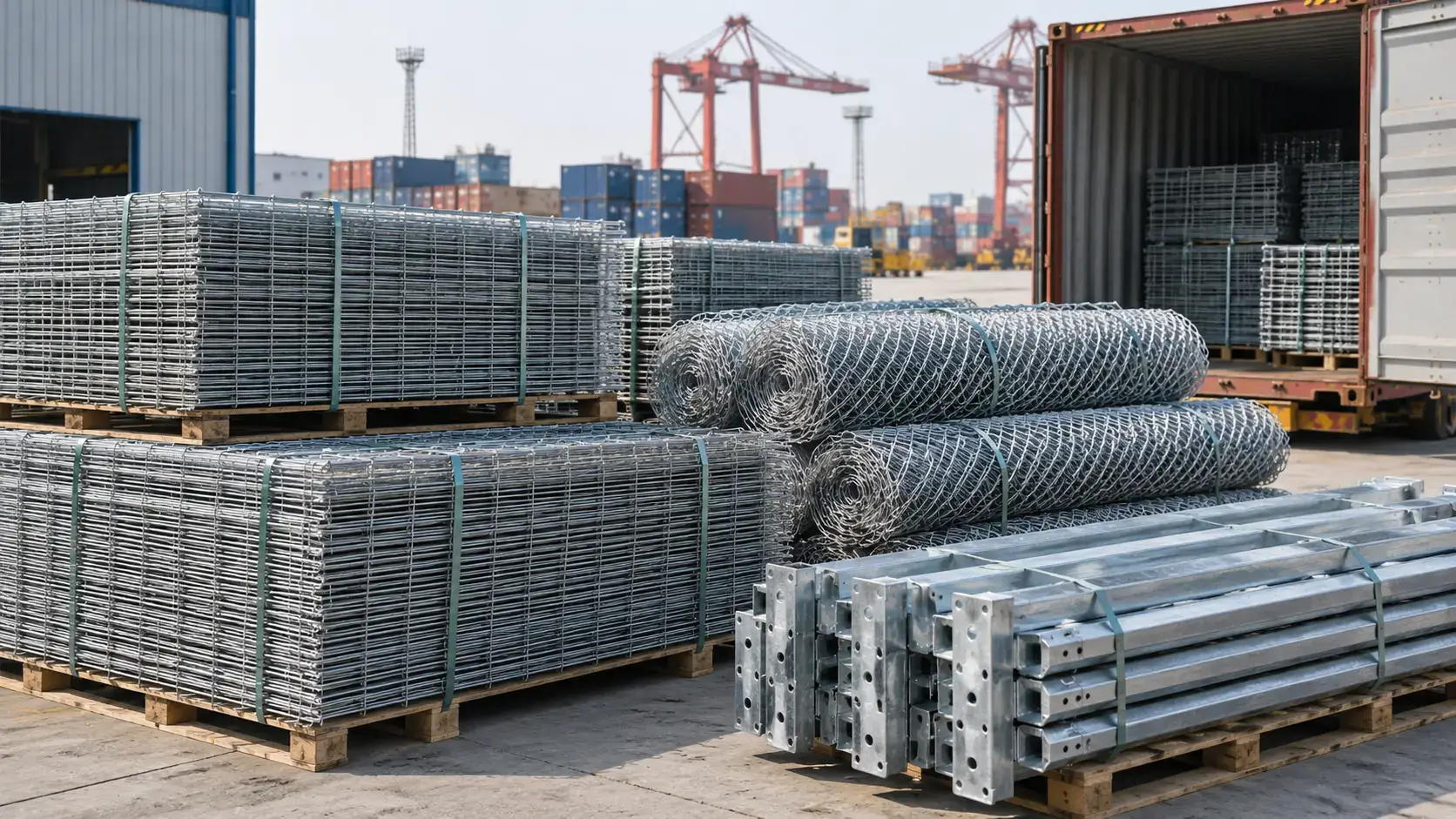
A 40HQ gives you 68–76 m³ and a payload cap of 21–28 t, depending on the carrier and the route. The ratings themselves are set by ISO 668.[23] Ask for a loading plan before production starts, not after the goods are packed. If mesh is one line inside a wider building material order, or you are mixing panel sizes, consolidate in Tianjin: a shipping from China consolidation there costs less than 3 part containers. The packing detail in preventing shipping damage applies directly to bent bottom courses. Cannot fill a 40HQ at all? The LCL route works for posts and fittings and badly for panels, because LCL consolidation breaks the bundles that panels need to travel in.
Lead times and the calendar
| Stage | Days | What stretches it |
|---|---|---|
| Quotation | 2–5 | Incomplete drawing, or rod price held for confirmation |
| Welding fixture for a new size | 3–7 | US$200–1,200, usually refunded or amortised at volume |
| Sample, standard size | 5–10 | Coating subcontract queue |
| Sample, custom size | 10–18 | Fixture build plus coating |
| Production, one 40HQ | 20–35 | Add 5–12 days in March to June and September to November |
| Galvanizing subcontract | +3–8 | Bath queue in peak season |
| Inland haul to Tianjin and booking | 6–14 | Space shortage in the two weeks before a holiday |
| Ocean to US West Coast | 15–25 | Transhipment via Busan adds 5–10 days |
| Ocean to US East Coast or North Europe | 30–40 | Panama or Suez routing |
The slip patterns behind these numbers are in how to prevent production delays. The freight side of the same calendar is in managing freight cost and shipping timelines. Chinese New Year stops production for 2–4 weeks, and the queue in front of it costs more than the shutdown does. National Day in early October and Labour Day in early May each take 3–7 days. Both fall inside the peak windows, when production already runs 5–12 days longer. If your date is fixed, place the deposit so production finishes at least 15 days before the holiday.
Payment and contract terms
30% deposit with 70% against the bill of lading copy is the default on a first order. The split moves to 20/80 after roughly 3 clean shipments. A letter of credit at sight adds US$150–400 in bank charges and 5–10 days of document handling. Hold 5–10% retention until the inspection passes on a first order. It is the cheapest leverage you have. Fix the price validity at 15–30 days in writing. Wire rod moves faster than that in a volatile quarter. The paperwork set is in the China sourcing documents guide.
Nine mistakes that cost buyers money
- Quoting without a coating mass. A quote 30% under the pack usually sits at the bottom of the range, and a 20-year fence costs 25–40% more per m² than a 6-year one.
- Specifying wire diameter after coating. A 4.0 mm coated wire can be 3.6 mm of steel, which is 19% less section. Always specify before coating, with tolerance.
- Ignoring the weld. Bare weld points rust first, and on pre-galvanized wire that shows up in 12–36 months. Require post-weld galvanizing at 45–85 µm, or a documented powder film over the weld. Bare welds fail first on most outdoor steel goods out of China. Preventing rust on outdoor steel goods starts at the drawing, not the packing line.
- Ordering temporary panels without checking the trade case. Deposits of 129.68% plus 49.19% add US$53.66 of duty to a US$30 panel, before steel duties and freight on top.[2]
- Skipping the factory question. A trading company quoting a galvanizing subcontractor it does not control cannot guarantee coating mass. Check the plant, or work through China manufacturer sourcing.
- Packing loose to save US$1 per panel. Pallets add US$0.30–0.80 per panel, against a 3–8% damage rate on panels shipped loose, and you cannot straighten a bent panel on site.
- Filling the container by cube. Mesh hits 21–28 t before it hits 76 m³. Plan by weight.
- Assuming the sample equals the run. Record the sample weight and check it again at destination. Gauge drift of 0.25 mm is 12% less steel.
- Ordering in December for a February site date. Production stops 2–4 weeks for Chinese New Year, and the queue before it runs 10–15 days longer. A deposit placed after 10 December rarely makes a February date.
The same nine, for products that are not mesh, are in mistakes to avoid when sourcing from China.
FAQ
What is the minimum order for wire mesh fencing from China?
One container is the practical floor. With stock tooling, 300–500 panels per size is common. A size of your own needs 800–1,500 panels to pay for the fixture. Roll products are quoted by weight, often 5–10 tonnes minimum.
How much does wire mesh fencing cost per metre from China?
Plan US$1.2–3.0 per m² for a welded panel and US$2–6 per m² for galvanized chain link, FOB Tianjin. A 2.5 m panel at US$9 works out at about US$1.80 per linear metre of fence line, before posts.
Is it still worth importing temporary fencing from China after the 2026 order?
For the US market, rarely. AD at 129.70% plus CVD at 49.19% for separate-rate respondents adds roughly 179% to the customs value.[2] At those rates the duty alone is close to twice the customs value. So the comparison moves to permanent welded panels, which sit outside the case but still carry steel duties.
Welded mesh or chain link: which should I choose?
Welded panels look better on a commercial perimeter, and a welded system runs 1.5–2.5× a chain link system per metre of fence line once posts and fittings are counted. Chain link takes slope and corners without cutting, and it needs lighter posts. Go welded where appearance or anti-climb matters, chain link where the length is the problem.
How do I check the coating is real?
Ask for the coating mass in g/m² or µm on the quotation, then measure it at inspection with a magnetic gauge at 10 points per panel. On chain link, ASTM A392 Class 1 is 366 g/m² and Class 2 is 610 g/m². Cross-check with a salt spray report to ISO 9227 at 480 or 1,000 hours.[4]
Can I mix panel sizes in one container?
Yes, and most first orders do. Keep to 2–3 sizes so the loading plan stays simple, and remember that weight, not cube, decides how much you can ship. A mixed 40HQ usually lands at 700–1,200 panels plus posts.
What HS code does wire mesh fencing use?
Welded fencing of wire generally falls in heading 7314, with zinc-coated woven or welded fencing commonly at 7314.31 in the United States. Temporary steel fence panels have been entered under 7308.90.9590, and also 7326.90.8688 and 7323.99.9080. Confirm your code against the current tariff before you price. Duty follows the code.[15]
How long from order to arrival?
50–80 days door to door is a normal planning figure. Allow 2–5 days to quote, 10–18 for a custom sample, 20–35 for production, 6–14 for inland and booking, then 15–40 at sea.
Do I need a factory audit for a first order?
For anything above US$30,000, or any project with a coating warranty, yes. An audit costs US$600–1,500 and takes 2–3 days on site, against a rejected shipment that costs 3–5 times the order value to put right. See supplier audit, the wider supplier due diligence range, or arrange a factory visit. The full sequence from enquiry to shipment is in our sourcing process.
The numbers to compare before you commit
Order basics: US$18–45 per temporary panel · US$4–12 per post · 5–10 t minimum on rolls · 50–80 days door to door. Steel content: 55–70% of FOB · 4.0 mm wire is 0.0986 kg per metre · 0.5 mm of gauge is 20–30% of panel weight. Coating: 40–120 g/m² pre-galvanized · 320–600 g/m² hot-dip after welding · 366 g/m² ASTM A392 Class 1 · 610 g/m² Class 2 · 480 or 1,000 salt spray hours. Container: 40HQ 68–76 m³ · 21–28 t cap · 900–1,400 panels · 170–300 chain link rolls · US$300–700 inland to Tianjin · US$1,600–3,400 ocean to the US West Coast. Landed: US$9.50 FOB becomes US$20–24 landed per panel. Money: 30/70 on a first order, 20/80 after 3 clean shipments, 5–10% retention until inspection passes. Duty: 25–50% steel on full customs value from 6 April 2026 · 7.5–25% Section 301 · 129.70% plus 49.19% on temporary fence panels · EU registration from 12 September 2026 with 26–73% alleged. Verification: AQL 2.5/4.0 · one inspector-day per 800–1,200 panels · US$250–500 per day · 3–8% defect rate on a first run against 1–2% mature. Get the coating mass in writing before you compare two quotations. At 40 against 600 g/m², the difference is 15 times the zinc and about 14 years of service life.
Ready to shortlist plants and lock the spec?
Send your drawing, quantity per size, coating requirement and destination port. We return a shortlist of 3 verified Hebei plants, with coating broken out as a separate line. It comes with a packing and loading plan using real cube and weight figures, plus an inspection plan tied to your AQL.
Request a Specification-Based Quote See China Sourcing Services
Sources: 1. Anping County People’s Government, industry profile, September 2026. 2. US Department of Commerce, final affirmative AD and CVD determinations, temporary steel fencing from China, 11 March 2026. 3. International Chamber of Commerce, Incoterms rules. 4. ISO 9227, corrosion tests in artificial atmospheres, salt spray testing. 5. ASTM A817, metallic-coated steel wire for chain-link fence fabric and marcelled tension wire. 6. ISO 1461:2022, hot dip galvanized coatings on fabricated iron and steel articles, specifications and test methods. 7. ISO 9223:2012, corrosion of metals and alloys, corrosivity of atmospheres, classification and estimation. 8. ASTM A392/A392M, zinc-coated steel chain-link fence fabric (Class 1 and Class 2 coating mass). 9. ASTM F1083, hot-dip galvanized welded steel pipe for fence structures. 10. ASTM F1043, strength requirements for steel fence framework (SS20, SS40). 11. ISO 28590, sampling procedures for inspection by attributes. 12. World Customs Organization, the Harmonized System nomenclature. 13. US International Trade Commission, final injury determination, April 2026. 14. Federal Register, scope of the temporary steel fencing investigations, 11 September 2025. 15. USITC Harmonized Tariff Schedule. 16. US Customs and Border Protection, Uyghur Forced Labor Prevention Act. 17. Official Journal of the European Union, notice of initiation of an antidumping proceeding on welded steel mesh from China and Turkiye, 3 June 2026. 18. Commission Implementing Regulation (EU) 2026/2022 making imports subject to registration, 11 September 2026. 19. European Commission, trade defence instruments. 20. US Department of Commerce, AD and CVD proceedings list. 21. World Trade Organization, anti-dumping measures. 22. Ministry of Commerce of China and General Administration of Customs, Announcement No. 79 of 2025, export licensing for certain steel products, effective 1 January 2026. 23. ISO 668:2020, series 1 freight containers, classification, dimensions and ratings.
How these numbers were produced: the price, lead-time, packing and defect ranges come from ordinary buying practice in the Hebei wire mesh cluster. Budgeting only. Nothing here is a quotation, and no manufacturer paid to be mentioned. The duty and trade-remedy figures come from the government sources listed. They were right at publication, and they change through reviews and new notices, so have a licensed customs broker confirm the current rate for your classification before you order.