
I have nothing against abbreviations, until they start doing the job of an explanation. Plywood specifications can squeeze “BB/CC,” “MUF” and “18 mm” onto one line, then leave a buyer with three pages’ worth of questions. Why does one panel make a stiffer shelf, another take a better finish, and a third cost less to produce? Those questions become much more interesting when the answers connect to something you can see, cut or assemble. Let’s get inside the sheet and work out what its veneers, bonding, grades and dimensions mean for your next bulk order from China.
In this article: Core materials and construction · Adhesives and bond quality · Face and back grades · Dimensions and tolerances · Material changes
This is the technical companion to our plywood buying guide for bulk orders from China. That guide covers the wider purchasing process; here, the focus is what happens inside the panel and on your production line.
Plywood specifications start with the core and its construction
Poplar, eucalyptus, birch, pine and mixed hardwood are familiar options on Chinese supplier quotations. Species gives the discussion a starting point. Veneer thickness, grain direction, internal gaps and layer arrangement explain much more about how the finished sheet behaves.
| Core material | Common purchasing interest | What makes the comparison meaningful |
|---|---|---|
| Poplar | Lightweight furniture, cabinet backs and packaging | Finished weight, internal gaps and performance in the intended component |
| Eucalyptus | Denser panels, furniture frames and shelving | Actual species, density, veneer quality and directional bending results |
| Birch | CNC furniture and exposed edges | Birch throughout the panel or birch faces over another core |
| Pine | Construction, packaging and general-purpose panels | Knot distribution, veneer quality and the relevant product standard |
| Mixed hardwood | Cost-sensitive commercial orders | Named species and their positions within the construction |
Poplar vs. eucalyptus: weight is only part of the story
Poplar is often chosen when handling weight matters. Eucalyptus is generally denser, which can make it attractive for heavier furniture components. Neither name guarantees a finished-panel density or a particular shelf performance: the species, veneer quality and manufacturing process still matter.
There is also a useful distinction between strength and stiffness. Bending strength concerns resistance to failure. Stiffness concerns resistance to deflection. A shelf can remain intact while sagging enough to disappoint everyone who has to look at it. A bending report may provide both properties, but the figures answer different questions.
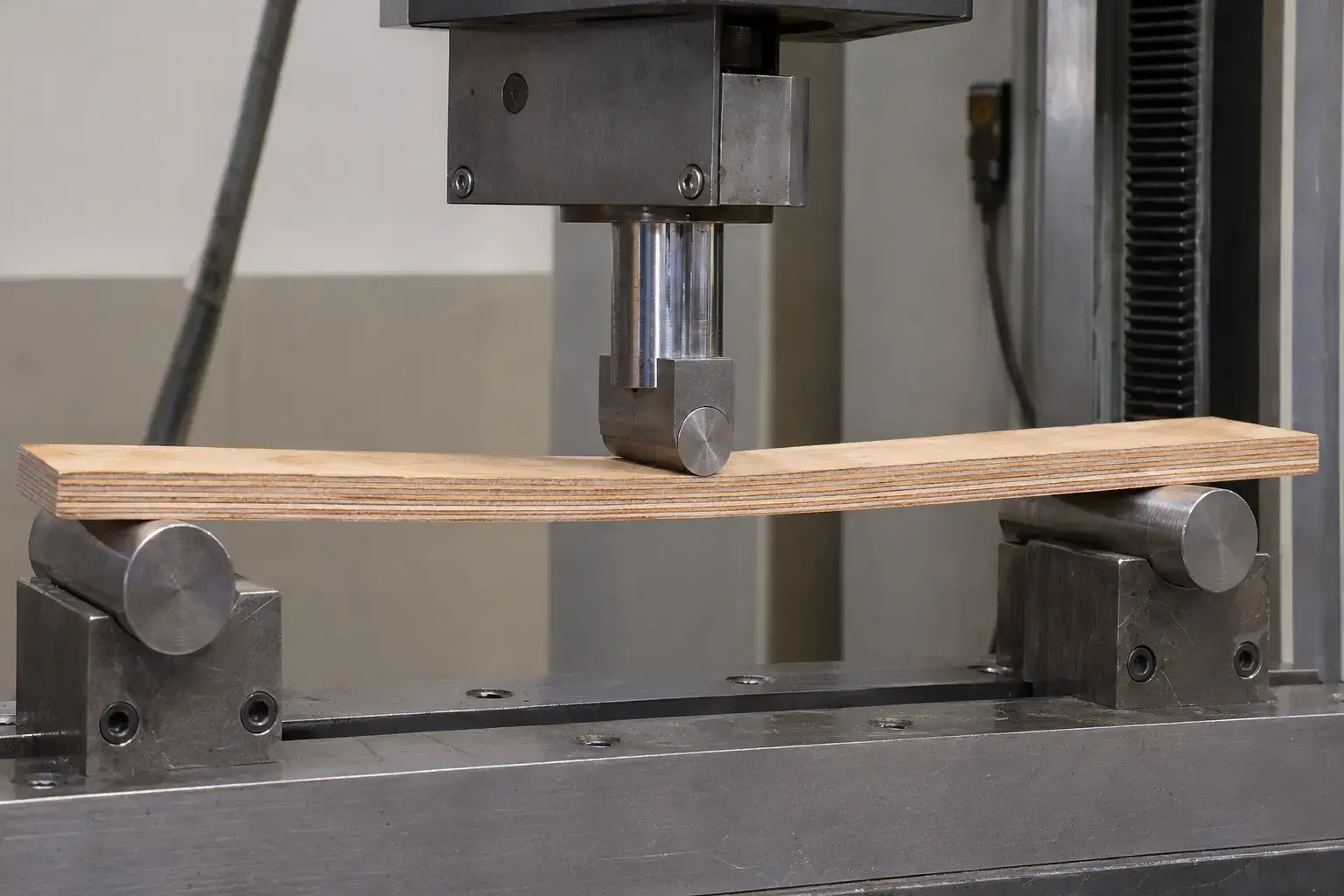
Bending strength and stiffness answer different questions: resistance to failure versus resistance to deflection.
The grain direction can change the cutting layout
Plywood reduces the directional differences found in solid wood, yet it does not erase them. Face-grain direction and the arrangement of the other veneers affect bending performance along each panel axis. Rotating rectangular shelf parts to squeeze more pieces onto a sheet can therefore change how those parts behave under load.
The Handbook of Finnish Plywood reports properties by direction and construction. Its figures describe the products covered by that handbook; they are not performance guarantees for a Chinese panel carrying a similar species name. For plywood specifications used in loaded components, direction belongs alongside the test result.

A humorous reminder: a more efficient cutting layout still needs to respect the specified grain direction.
Plywood remains directional: rotating a component in the cutting layout can change its bending performance even when its dimensions stay the same.
A grain-direction arrow on the component drawing gives the factory a clearer reference than sheet dimensions alone.
Birch-faced, all-birch and mixed-core plywood
Birch-faced plywood can have birch on the outside and poplar or another material inside. All-birch plywood uses birch veneers throughout. The distinction matters when the edge becomes part of the design, but also when a buyer expects a particular construction behind the attractive face.
Layer position matters because bending stresses are greater toward the outer surfaces. Changing the outer veneers can therefore have a different effect from changing veneers near the centre. A 2020 study of birch, alder and aspen plywood constructions illustrates how species placement and lay-up affect directional performance. It supports the principle, rather than a universal recipe for poplar/eucalyptus plywood.
Nor does a ply count describe the whole arrangement. As the USDA’s Wood-Based Composite Materials chapter explains, a ply is an individual veneer; adjacent veneers can sometimes run in the same direction and form one grain-direction layer. “Thirteen plies” leaves their thicknesses, species and orientations unanswered. A cross-section explains the stack; a construction drawing adds the information the eye cannot reliably identify.
Veneer position matters alongside species because bending does not stress every layer equally.
Core quality becomes visible during machining
Voids and overlaps may stay hidden until a router exposes them. A gap that scarcely affects the visible face can interrupt an exposed edge or coincide with a fixing position. Meanwhile, a thin face leaves less room for sanding before the next veneer appears.
That is where plywood specifications become product-specific. A routed cabinet door, a concealed back and an exposed-edge desk do not need identical appearance allowances. A sample processed with the intended tooling and finish helps distinguish an economical construction from one that creates filling, sorting or rework. JS Sourcing’s product sourcing service can help compare those supplier proposals and coordinate the sample review.
Adhesive names and plywood bond quality answer different questions
UF, MUF and PF identify adhesive families. They help explain the factory’s proposal, but plywood specifications also need evidence of the finished bond’s performance. A resin name cannot describe every formulation, veneer surface or pressing cycle.
| Adhesive | Typical role | Important qualification |
|---|---|---|
| UF: urea-formaldehyde | Dry interior furniture and panels | Limited resistance to prolonged moisture exposure |
| MUF: melamine-urea-formaldehyde | Moisture-resistant panels; suitable formulations can achieve exterior performance | Formulation and demonstrated bond performance matter |
| PF: phenol-formaldehyde | Exterior and structural plywood applications | Durable bonds depend on correct manufacture; dark glue lines can affect appearance |
Why more glue is not automatically better
The USDA’s Wood Adhesives: Bond Formation and Performance explains bonding as a relationship between wood surfaces, adhesive and processing. Veneer moisture, roughness, density and surface condition influence wetting and penetration. Pressing conditions influence contact and cure. Excessive penetration or pressure can leave an inadequate bond line; extra adhesive alone cannot cure poor preparation.
In commercial terms, a delaminating batch needs a process explanation. “We will add more glue next time” offers little reassurance if the problem was poor contact, unsuitable veneer moisture or an incorrect cure. The cause determines whether the proposed correction is credible.
Bonding classes, WBP and test evidence
Under EN 314-2, bonding classes distinguish dry, humid and exterior conditions. ISO 12466-2 also defines plywood bonding-quality requirements, used with the associated test methods. The standard and edition belong in the plywood specifications because the test pretreatment and acceptance rules give the result its meaning.
“WBP” is a commercial description rather than a complete test specification. A boiling demonstration can expose a problem, but it does not establish compliance with all requirements of a named bonding class. Conversely, passing an exterior bond test does not make the wood immune to decay or remove the need for an appropriate coating and edge detail.
Bond-test reports bring together shear strength and apparent cohesive wood failure under the relevant conditions. Wood failure describes how much of the fractured area failed through wood rather than along the adhesive interface. Its acceptance requirement depends on the applicable standard and strength range. A single impressive MPa figure, detached from the construction and test procedure, is an incomplete answer.
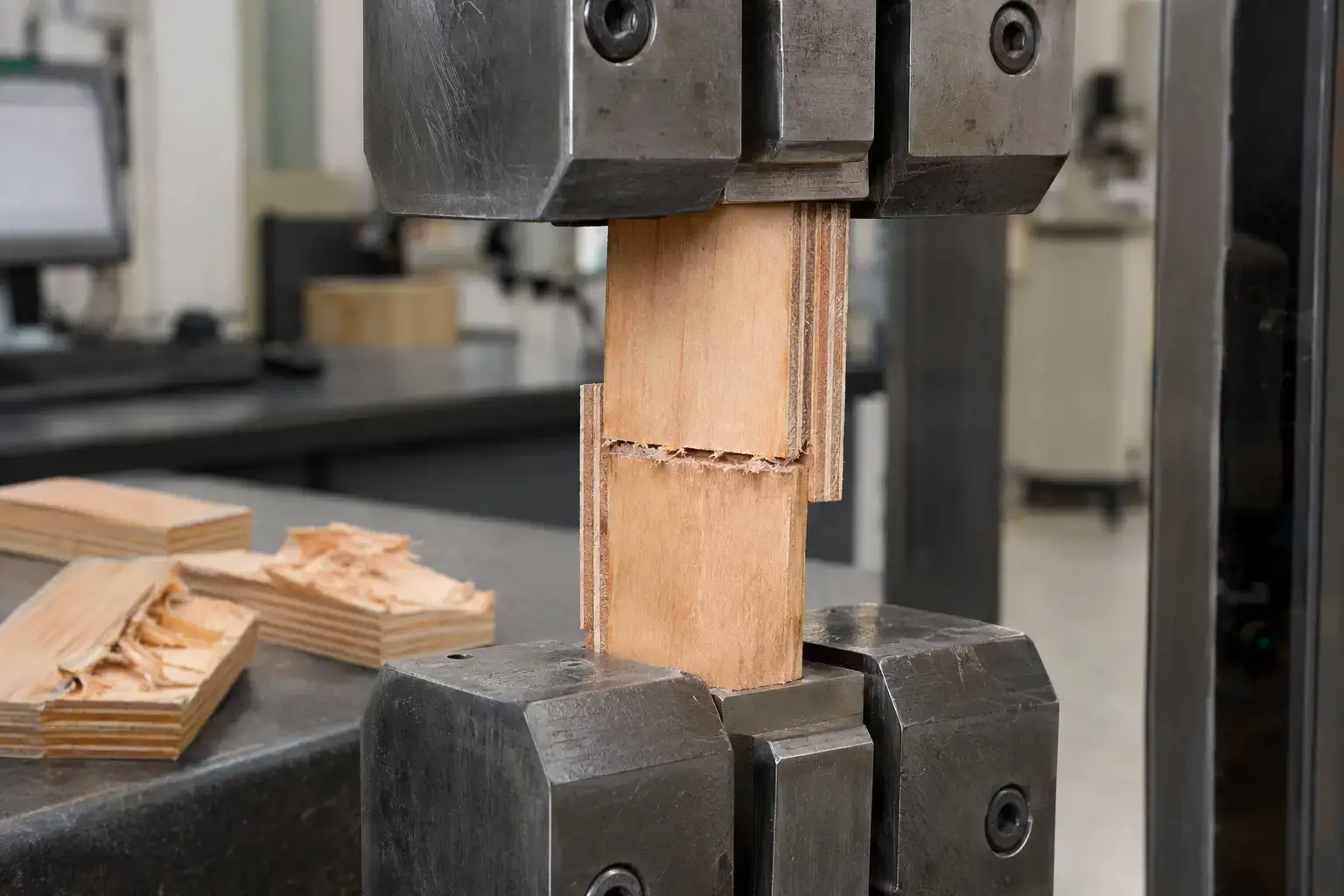
Bond-test results need both strength data and an assessment of the fractured area under the applicable test procedure.
The decorative face may have a different bond
A panel can be manufactured as a core and receive a thin decorative face later. The Wood Panel Industries Federation’s plywood guidance highlights this distinction, including imported products with additional faces. The adhesive attaching that veneer may differ from the adhesive inside the core.
For a decorative panel intended for humid conditions, that creates two questions: how the structural stack is bonded, and how the finishing veneer is attached. Plywood specifications that describe only the core adhesive can leave the visible surface outside the evidence supplied.
A moisture-resistant core bond does not automatically establish the durability of a separately applied decorative face.
Formaldehyde emissions are another separate property. Neither a light glue line nor a PF or MUF label replaces the applicable emissions evidence for the product and destination. Our buying guide covers the wider import requirements; this article keeps emissions distinct from moisture resistance so the two claims do not get mixed together.
Plywood grades make more sense when the finish is known
Chinese suppliers commonly quote B/BB, BB/BB, BB/CC and other face/back descriptions. Their meaning depends on the grading rules being used. They do not, by themselves, establish core construction, bond durability or dimensional accuracy. Plywood specifications become clearer when the grade is connected to an identified standard or a written appearance agreement.
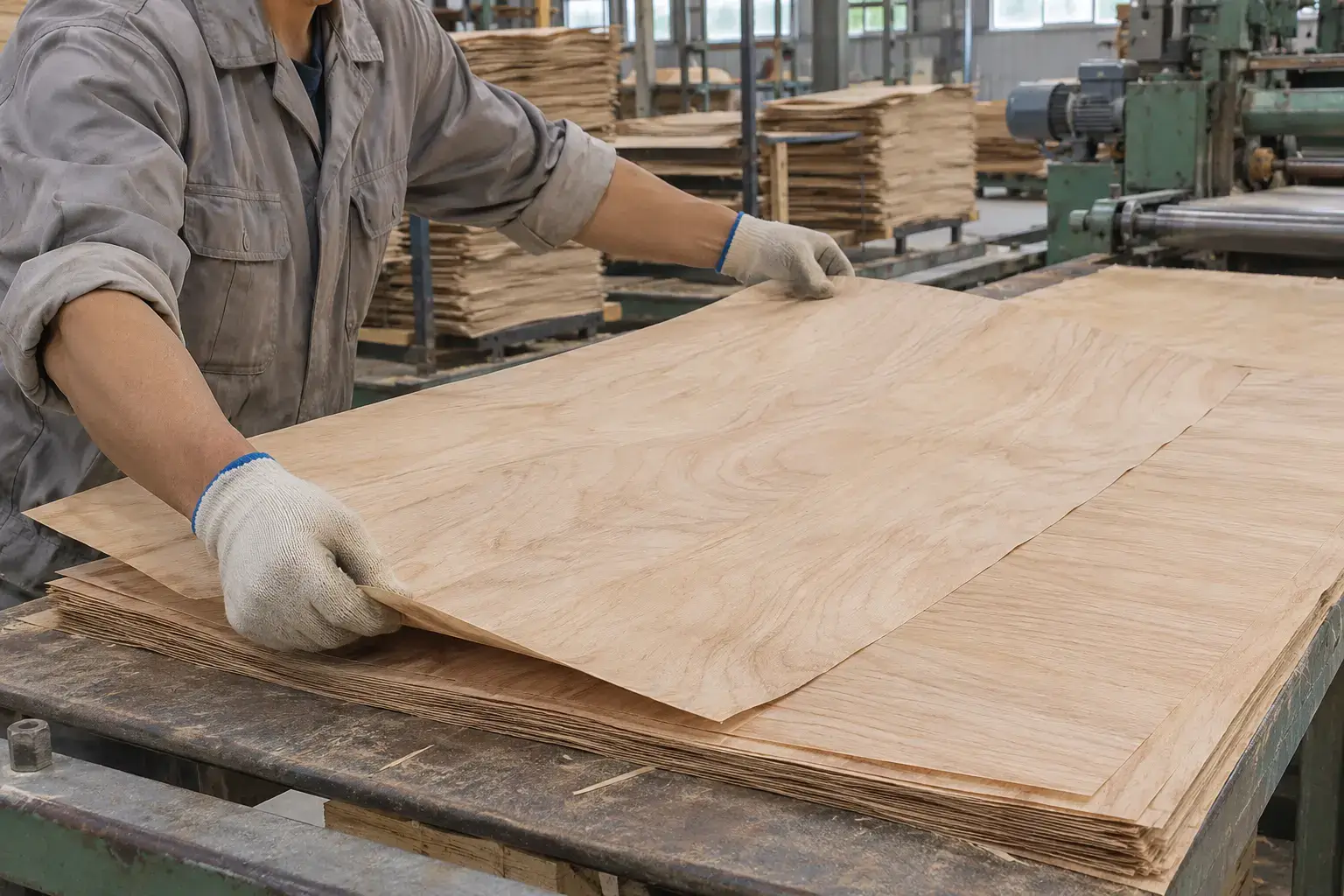
Face veneer appearance requirements should reflect the intended finish and an agreed set of grading rules.
An A face is not necessarily a clear-finish face
North American structural plywood provides a useful example. In NIST’s PS 1-22 Structural Plywood standard, A veneer is suitable for painting and permits specified repairs. Grade N addresses natural-finish applications. A buyer expecting untouched decorative veneer from the letter A could therefore be disappointed by a compliant repaired surface.
This is an illustration of how grading works within one standard, not a conversion chart for Chinese BB/CC. Structural plywood standards and decorative plywood standards have different purposes. A cross-market grade comparison needs the actual defect allowances and intended application.
| Intended finish | A commercially useful distinction |
|---|---|
| Opaque paint | Repairs may be acceptable if they remain stable and the prepared surface achieves the required finish |
| Clear coating or stain | Patch shape, colour variation and veneer matching remain visible |
| Laminate or another facing | Surface flatness, preparation and compatibility with the facing process matter |
| Exposed plywood edge | Core gaps, veneer thickness variation and glue-line colour become appearance features |
A repaired face is not automatically a poor purchase. Paying for a decorative veneer that disappears beneath opaque paint can waste budget. The opposite mismatch is just as expensive: a lower-priced repaired face may need extensive sorting when every clear-coated component is visible.
A surface graded for painting can legitimately contain repairs that remain distracting beneath a clear finish.
An exposed-edge sample with the intended finish helps reveal whether glue-line colour and veneer repairs suit the finished design.
Your preferred plywood construction pushes the order over budget?
There may be room to adjust veneer construction or appearance requirements while preserving the properties your product needs. JS Sourcing can help compare supplier alternatives and coordinate sample reviews, so the saving relates to a clearly identified change.
Plywood thickness tolerances need a measurement context
Nominal thickness names the product. It does not describe every permissible measurement. EN 315:2000 distinguishes sanded and unsanded plywood. The Finnish handbook reproduces general standard ranges alongside tighter manufacturer values, a useful reminder that those are different levels of commitment.
For 18 mm sanded panels, the handbook gives a rounded EN 315 range of 17.1–18.7 mm, alongside 17.1–18.1 mm for the Finnish products it describes. These figures illustrate the distinction between a standard allowance and a manufacturer’s tighter range; they are not a current offer from a Chinese mill. The handbook states dimensions at 10 ± 2% moisture content.
Useful plywood specifications identify the applicable range, the finished condition and how acceptance is measured. A tight machining requirement can legitimately be narrower than a general product-standard allowance, provided the supplier agrees it can manufacture to it.
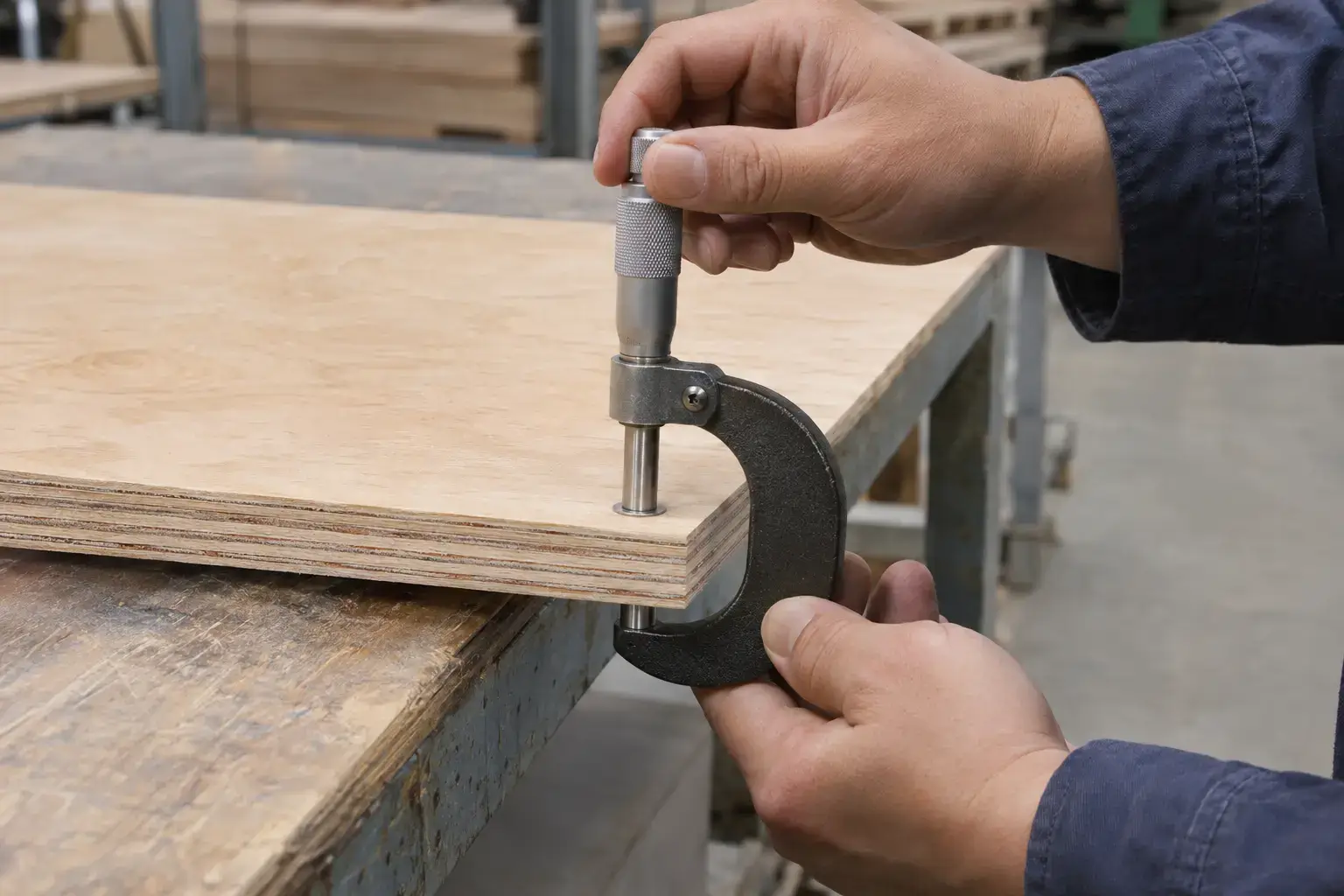
Thickness readings are comparable only when the finished condition, conditioning and measurement method are agreed.
Two measurements can disagree without either instrument being broken
Wood exchanges moisture with its surroundings. The WPIF guidance gives an approximate plywood thickness change of 0.3–0.4% for each percentage-point change in moisture content. On an 18 mm panel, a two-percentage-point increase would correspond to roughly 0.11–0.14 mm of thickness change. This is a guidance-based illustration, not a correction factor for every construction.
That movement can matter when machining clearances are small. A factory measurement immediately after manufacture and a buyer measurement after storage may describe different material conditions. An unexplained difference can quickly become a dispute about sanding accuracy when moisture is part of the explanation.
Measurement procedures also differ between standards. PS 1-22, for example, specifies moisture conditions, instrument contact details and measurement positions for its thickness determination. A handheld caliper reading at one convenient edge is not automatically comparable to a standard result. For contractual plywood specifications, the stated method matters as much as the number.
| Measurement context | Why it changes the discussion |
|---|---|
| Finished condition | A raw core, sanded panel and faced panel are different measurement stages |
| Conditioning and moisture | Different storage conditions can change dimensions before measurement |
| Instrument and positions | Contact area and measurement locations affect comparability |
| Acceptance basis | A mean, a minimum/maximum range and within-panel variation describe different things |
| Length, width, squareness and flatness | A thickness-compliant sheet can still create cutting or assembly problems |
An acceptable average can conceal a local high spot that prevents a component entering its groove. A dimensional record is more informative when the individual readings remain visible. For a bulk order, the agreed measurements can form part of a pre-shipment inspection; they do not replace separate laboratory evidence of bond or bending performance.
Dimensional comparisons need an agreed finished condition, conditioning procedure and measurement method.
A thickness record showing conditioning and individual measurement points gives both parties a stronger basis for resolving a machining-fit dispute.
When a supplier changes the plywood specifications
A substitute species may help a supplier meet the price or delivery date. Its consequences can reach beyond the material name. Density and compressibility affect how veneers respond to pressing, while different veneer thicknesses change the number of bond lines needed to build a panel.
A 2022 study of birch substitution with aspen and black alder examined these interactions. Its experimental constructions showed changes in thickness, adhesive use and directional mechanical properties. The results relate to those species and laboratory conditions; they do not establish a fixed saving or an interchangeable substitute for Chinese commercial plywood.
The commercial lesson is more useful than a borrowed percentage. “Same thickness, cheaper core” may conceal a different lay-up and pressing response. A revised proposal can still be attractive, but its value depends on the finished properties and manufacturing fit. JS Sourcing’s building-material sourcing work includes comparing supplier options against the project requirements, rather than treating every sheet with the same nominal dimensions as equivalent.
A species substitution can change final thickness, adhesive consumption and directional stiffness together.
Your supplier proposes a different core to meet the shipping deadline?
A material change needs a clearer explanation than “equivalent quality.” JS Sourcing can help document the proposed construction, compare available evidence and coordinate the agreed checks before the revised order is released.
From abbreviations to a panel that works
Those abbreviations can stay on the quotation. By now, they should stand for something you can picture: veneers arranged for the job, bonds suited to the intended conditions, a surface prepared for its finish, and dimensions that work in production.
The commercial advantage comes from understanding which changes your product can accommodate. A different veneer arrangement, adhesive system or surface requirement may free up budget. Another change may simply move the cost into machining, finishing or rejected parts. Knowing the difference makes discussions with Chinese suppliers more specific, and much more productive.
Once a construction is selected, the next challenge is preserving that agreement through production and repeat orders. Our golden sample guide explains how physical references and written specifications work together when a product moves from approval to bulk manufacturing.