
Plywood edges have somehow become a design feature. You see those neat stripes on café tables, shelving and furniture that proudly leaves its construction on display. Elsewhere, the same material disappears beneath paint, laminate or upholstery. The buyer’s job changes with each application. Paying for a beautiful face makes little sense when it will be covered; a clean-looking sheet tells you little about how a routed joint will turn out.
That is where a plywood buying guide becomes useful. When ordering bulk plywood from China, buyers can choose among different combinations of veneers, cores, adhesives and finishes, with plenty of room to adjust cost. The useful question is which combination gives your business the right result. This guide explains how those choices affect supplier quotations, sample approval and the usable material that reaches your production line or warehouse.
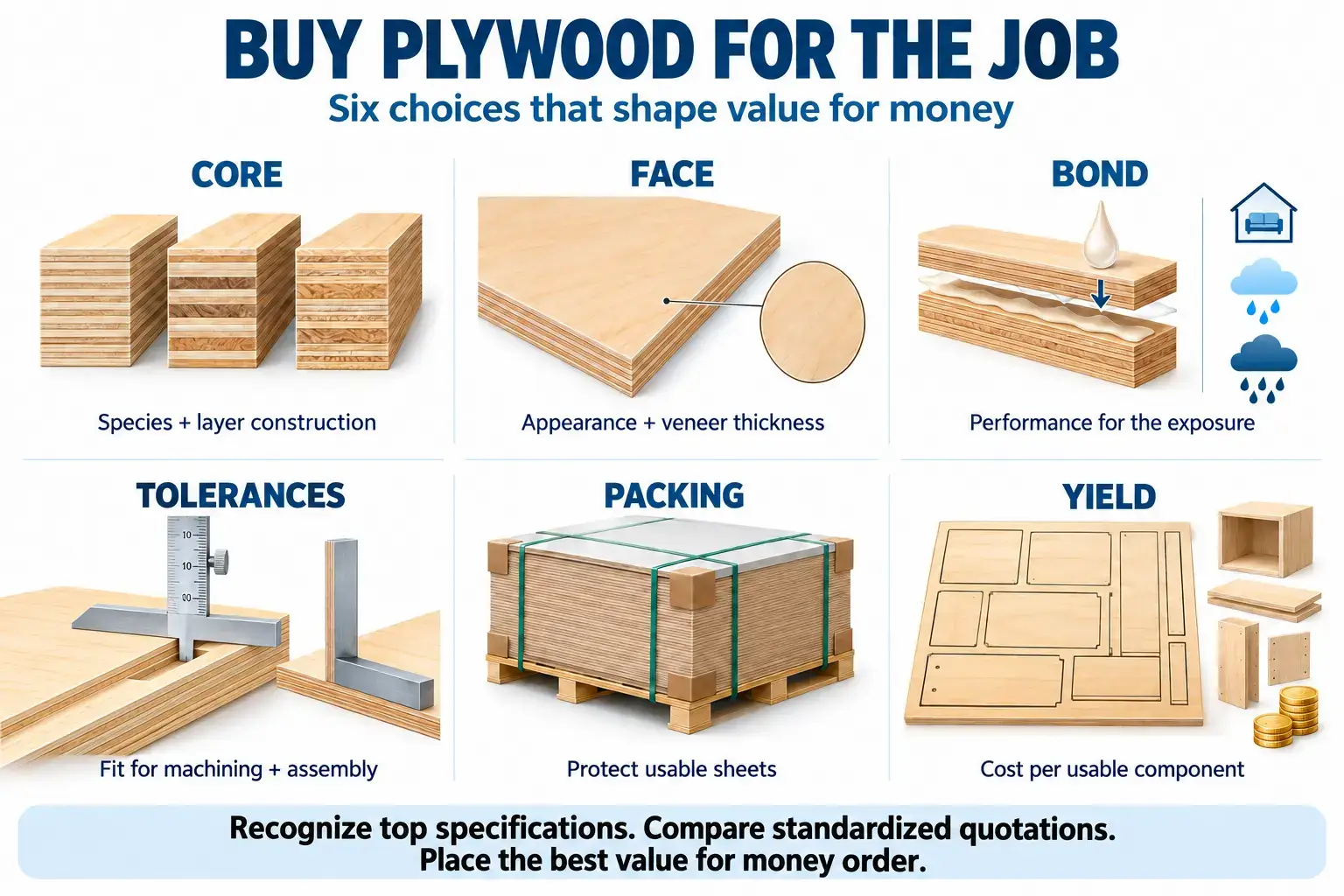
The Best Value Starts with the Finished Product
A sheet that works well for a cabinet back might not suit a loaded shelf. Furniture, packaging and outdoor construction put different demands on a panel. Explaining the finished product helps suppliers propose a suitable construction without adding features you will never use.
| Application | Buying priority | What could go wrong |
|---|---|---|
| Cabinet backs and decorative panels | Surface repairs, flatness, weight, and interior bond quality | Visible patches, uneven surfaces, or panels that won’t sit flat |
| Shelves and furniture frames | Bending strength, shelf span, and screw holding | Sagging shelves or loose joints |
| CNC-cut furniture components | Thickness consistency, core gaps, and cut-edge quality | Loose-fitting grooves or exposed gaps after cutting |
| Formwork and exterior construction | Structural properties, bond durability, and exposure conditions | Insufficient load capacity or early panel deterioration |
For load-bearing applications, the relevant structural grade and tested design properties belong in the specification. EN 636 covers plywood for dry, humid and exterior conditions, with requirements for general-purpose and structural products. An exterior designation alone does not establish suitability for structural work; its product classification values are also not a substitute for structural design values.
Poplar, Eucalyptus, Birch, or Mixed Core: What’s the Difference?
Chinese plywood suppliers offer several core materials. Each has its advantages, but the species name only tells part of the story. Veneer quality, layer arrangement, glue, and pressing also affect the finished sheet.
| Core material | Where it makes sense | Basis for comparison |
|---|---|---|
| Poplar | Lightweight furniture, cabinet backs, and non-structural interior panels | Core gaps, bending performance, and screw holding |
| Eucalyptus | Furniture components where a denser core may be useful | Actual density, stiffness, moisture, and bond quality |
| All-birch | CNC-cut furniture, shelves, and panels with visible edges | Species in every layer, machining results, and edge appearance |
| Poplar/eucalyptus mixed core | General furniture and cabinets where cost and weight both matter | Species mix, veneer arrangement, and consistency between batches |
Poplar Core: A Lighter Option for Interior Products
Poplar is often used in cabinet backs, decorative panels, and lightweight furniture. Its relatively low density can make finished products easier to handle.
The trade-off shows up when the panel has to carry weight or hold screws. A lightweight core may not provide the stiffness or fastener performance needed for a long shelf or a heavily loaded joint. Realistic component trials help establish whether it suits the job.
Eucalyptus Core: Worth Checking for Heavier-Duty Parts
Eucalyptus plywood is often denser than poplar plywood. That can be useful for furniture components that need more stiffness.
But eucalyptus is not one fixed grade of wood. Species, veneer thickness, moisture and manufacturing methods all affect the result. Test data from the actual plywood construction is more useful than a species name when the finished part will carry weight.
Birch Core: What Is Behind the Face Veneer?
All-birch plywood is often chosen for furniture with exposed plywood edges or parts that need clean, repeatable CNC cuts.
Here’s a common point of confusion: birch-faced plywood isn’t necessarily all-birch plywood. One supplier may use birch on the outside and poplar inside. Another may use birch throughout.
The specification can identify the species in every layer, alongside ply count and veneer thickness. A labelled cross-section retained with the approved sample gives both parties a physical reference; a photograph of the finished face cannot describe the core.
Mixed Core: A Useful Balance When the Construction Stays Consistent
A poplar/eucalyptus mixed core can offer a useful balance of weight, cost, and performance for ordinary furniture applications.
A mixed core is easier to buy repeatedly when the approved species and layer sequence appear in the purchase specification. If the factory proposes a different arrangement, written approval allows the buyer to assess its effect on machining, weight and cost before production changes.
How Much Does Panel Density Affect Sheet Weight?
A 1220 × 2440 × 18 mm sheet has a calculated volume of 0.0535824 m³.
At an assumed finished-panel density of 500 kg/m³, the sheet weighs about 26.8 kg. At 650 kg/m³, it weighs about 34.8 kg.
That’s roughly 8 kg more per sheet. Across 1,000 sheets, the difference comes to around 8 tonnes.
These are calculations using assumed densities, not standard weights for specific wood species. Use the factory’s measured weights when planning shipping from China. Pallets and protective packaging add more weight.
A birch face, an all-birch construction and a mixed core are different purchasing options, even when the finished sheets look similar.
Glue Names, Bond Classes and What You Are Paying For
Bond quality depends on the adhesive, veneer condition and manufacturing process working together. Moisture, uneven glue application or unsuitable pressing conditions can weaken the finished bond, even when the chosen resin is appropriate. The USDA Wood Handbook chapter on adhesives explains this relationship.
The useful purchasing question is which bond class the finished panel meets and how that performance was tested.
Understanding EN 314-2 Bond Classes
| Bond class | Intended conditions | Typical applications |
|---|---|---|
| Class 1 | Dry conditions | Interior furniture and cabinets |
| Class 2 | Humid conditions | Humid interiors and protected exterior applications |
| Class 3 | Exterior conditions | Outdoor applications where the complete panel is also suitable for the exposure |
EN 314-2 sets the bonding requirements, while EN 314-1 covers the test procedures.[1] ISO 12466-1 also describes shear-testing methods for plywood bonded with thermosetting resins.[2]
Useful evidence identifies the tested panel construction, conditioning procedure, actual results and report date. A test on one construction does not automatically cover a different core or adhesive system.
Does WBP Mean the Plywood Is Waterproof?
Not by itself. WBP stands for weather and boil proof, but the term alone doesn’t confirm a recognized bond classification.
You may see UF (urea-formaldehyde), MUF (melamine-urea-formaldehyde) or PF (phenol-formaldehyde) in quotations. These identify adhesive families, not a finished-panel performance guarantee. Agreeing on the required bond class lets suppliers price a defined outcome.
A quick boiling-water demonstration can show obvious bonding problems. It can’t replace a standardized test. And even a strong exterior glue bond won’t prevent unsuitable wood veneers from deteriorating outdoors.
Adhesive names help describe construction, while a defined bond class and relevant test evidence establish the performance being purchased.
Different Plywood Prices, but No Clear Basis for Choosing?
JS Sourcing can help align competing offers around the intended product, panel construction, quality requirements and commercial terms, so the price comparison reflects what each supplier will actually deliver.
What Do Plywood Grades Really Tell You?
Labels such as BB/BB, BB/CC, and B/BB usually describe the appearance of the face and back veneers. They don’t tell you whether the core has gaps, whether the glue bond will last, or whether the sheet meets your thickness requirements.
One supplier might accept several visible patches under BB grade. Another may use tighter appearance rules. Unless both suppliers work to the same written grading criteria, their quotations aren’t directly comparable.
EN 635 provides a framework for surface appearance, with EN 635-2 covering hardwood plywood other than overlaid panels. The required classification and defect limits make offers more comparable than an unexplained BB or CC label. See the EN 635-2 scope.
Surface Repairs: Acceptable Where, and Under Which Finish?
Knots, filled holes, splits and sanding marks matter because of how the final finish will look.
A filled knot may be acceptable on a hidden cabinet back. The same repair could show through a decorative finish on a cabinet door.
Separate front- and back-face criteria can avoid paying for two decorative faces when only one will be visible. Approved limit samples make the agreement easier to interpret during production and inspection.
A labelled sample showing the agreed limit for a patch or colour variation can settle an appearance question faster than another exchange about “BB grade.”
Face-Veneer Thickness: Leave Room for the Finish
Surface grade describes appearance, but face-veneer thickness also matters. A thin decorative face may suit a ready-to-use panel and leave little allowance for further sanding. Sanding through it exposes the layer beneath.
For stained furniture or a product needing additional surface preparation, the quotation can state the minimum face thickness remaining after factory sanding. Trying the intended finishing process on a sample helps establish a workable requirement before paying for thicker veneers across the whole order.
A face grade becomes commercially useful when both parties agree which repairs and appearance differences are acceptable.
What Routing Reveals About the Core
A smooth face does not reveal the full construction. Representative cut sections can expose core gaps, overlapping veneers, loose layers or uneven construction.
Imagine routing a groove for a cabinet joint, only to find a large gap exactly where the screw needs to hold. The surface grade wouldn’t have warned you about that.
Core-gap limits reflect where panels will be cut and how parts will be assembled; no single gap size suits every application.
How Accurate Should Plywood Thickness Be?
An 18 mm plywood sheet isn’t guaranteed to measure exactly 18.0 mm. That’s normal. The question is whether the actual thickness works for your product.
EN 315 Tolerances vs. Furniture Manufacturing
Under EN 315:2000, a nominal 18 mm panel sanded on both sides has a calculated nominal-thickness range of approximately 17.1–18.7 mm. The maximum thickness difference within one panel in this category is 0.6 mm.[3]
Panda Panels’ EN 315 tolerance table reproduces this example for plywood sanded on both sides; it is a general tolerance reference, not a recommended CNC joint clearance.
Now think about a CNC-cut cabinet. If the groove is designed for a much tighter fit, a sheet that meets the general standard may still be too thick or too thin for the joint.
You might specify 18.0 ± 0.3 mm, giving an acceptable range of 17.7–18.3 mm. That’s an example of a buyer-selected requirement, not a universal plywood standard. The factory needs to confirm it can achieve that range consistently.
During inspection, measurements at several positions across each selected sheet reveal the highest and lowest readings. A good average does not make panels outside the agreed limits acceptable.
Are 48 × 96 Inch Sheets the Same as 1220 × 2440 mm?
Almost, but not exactly.
A 48 × 96 inch sheet converts to 1219.2 × 2438.4 mm. The differences from 1220 × 2440 mm are just 0.8 mm in width and 1.6 mm in length.
Those differences may fall within the allowed dimensional tolerance. Still, use one set of nominal dimensions and agreed tolerances in the purchase order and cutting drawings. That prevents confusion when panels reach the machining line.
Moisture and Flatness Affect the Next Operation
Wood responds to changes in humidity. A plywood panel can bow, cup, or twist as its moisture level changes. The USDA Wood Handbook explains how moisture affects the dimensions and stability of wood products.[4]
Moisture and flatness limits work best when they suit the finished product and destination environment, with a defined measurement method. One moisture percentage is not the right target for every plywood order.
A panel can meet a general thickness standard and still fall outside the range needed for your machining or assembly.
A Sample That Becomes a Finished Component
A small square can show colour and construction. A representative panel run through the intended process answers more useful questions: does the routed groove stay clean, does the specified screw hold, and does the chosen finish cover repairs as expected?
A component trial helps distinguish material suitability from tooling or process issues. Its panel specification, sample identification and processing conditions become the reference for bulk production.
Running candidate panels through the same cutting, routing, fastening and finishing operations makes supplier sample comparisons much more useful.
How Do You Check Plywood Quality Before Shipment?
For buyers comparing plywood manufacturers in China, the production site and the party coordinating the order both matter. A factory or trading company can be a suitable partner when responsibilities and the source of the panels are clear.
During manufacturer sourcing, identifying who controls veneer preparation, pressing and sanding helps assess repeatability. A supplier audit can examine storage, glue handling, press controls, equipment, records and subcontracted work against the project requirements.
Different Production Stages Answer Different Questions
| Inspection stage | Buying priority | What to keep on record |
|---|---|---|
| Before production | Approved samples, veneer species, layer arrangement, glue requirements, and test plan | Signed specification and labeled reference samples |
| During production | Core construction, thickness consistency, visible bond problems, and process changes | Production measurements, photographs, and batch records |
| Before shipment | Dimensions, surface defects, flatness, packaging, and lot identification | Inspection findings, defect photographs, and identified lot numbers |
An inspection plan needs access to different parts of the production lot, rather than only the top sheets or supplier-selected pieces. Agreed destructive samples can support core examination and testing.
Agreeing how bundles will be opened, sampled and repacked before the inspection helps avoid spending the visit negotiating access to the sheets.
How Many Sheets Should Be Inspected?
ISO 2859-1:2026 provides AQL-indexed sampling schemes for inspection by attributes. Lot size and inspection level identify the sample-size code; the selected plan and AQL establish acceptance rules. See the ISO standard overview.
An AQL of 2.5 is a sampling-plan parameter, not permission to ship a fixed 2.5% of defective sheets in every order.
A serious failure triggers the agreed hold and investigation procedure for the affected lot. Batch identification helps define the scope of sorting, rework or further testing; replacing one failed sample alone does not resolve the lot decision.
Visual inspection cannot establish formaldehyde emissions or structural strength; these require the relevant tests.
Sample trials establish whether a plywood construction suits the product, while production inspection assesses the selected batch against agreed requirements.
Common Quality Problems: From Observation to Resolution
A symptom helps direct the investigation, but rarely proves a single cause. The useful next step is to connect the finding with the affected batch and the agreed product requirement.
| Observation | Possible explanation | Practical sourcing response |
|---|---|---|
| Panels outside the agreed thickness range | Construction or sanding settings differ from the target | Map readings by batch; agree sorting or rework and reinspection costs |
| Voids exposed during routing | Gaps in the veneer layup | Compare representative cut sections with core limits and component-trial results |
| Layers separating | Adhesive, pressing or moisture conditions need investigation | Hold the affected lot and arrange the specified bond assessment |
| Warping or inconsistent flatness | Moisture imbalance, construction or storage conditions | Review moisture records, conditioning and the agreed flatness method |
| Repairs visible through the finish | Face criteria or finishing allowance do not suit the product | Compare with finish trials and approved appearance limits |
| Damaged corners or strap marks | Insufficient packing protection or handling damage | Document damage and revise pallet support and protective packing |
Your Sample Worked. What Will Shipment Inspection Establish?
An inspection planned around the approved specification can assess sampled production panels for dimensions, appearance, accessible construction details and packing, with laboratory testing coordinated separately where needed.
What Import Rules Apply to Plywood from China?
Import requirements depend on where the plywood is going and how it will be used. Furniture panels and qualifying structural panels can fall under different rules, even when both are sold as plywood.
United States: Formaldehyde Emissions
Under TSCA Title VI, covered hardwood plywood with veneer or composite cores must meet a formaldehyde emission limit of 0.05 ppm.
Applicable products are subject to testing, third-party certification, labeling, and recordkeeping rules. Qualifying structural plywood made to specified PS 1 or PS 2 standards is excluded. Calling a product structural plywood on the invoice doesn’t establish that exemption.[5]
For shipments covered by Lacey Act declaration requirements, importers may also need the scientific names of the wood species and the countries where the timber was harvested.
APHIS explains that plywood made with thin solid-wood veneers doesn’t automatically qualify for the special composite-material designation simply because the veneers are glued together.[6]
European Union: Formaldehyde Requirements
Since 6 August 2026, the EU REACH restriction introduced by Regulation 2023/1464 applies a formaldehyde release limit of 0.062 mg/m³ to covered furniture and wood-based articles, subject to its test conditions and exemptions.
A supplier may describe plywood as E0 or E1. That label alone doesn’t establish compliance with the newer restriction. Ask which standard was used, which product was tested, and whether the results address the applicable legal limit.
EUDR: You May Need Origin Details for the Core, Too
Plywood classified under HS 4412 is among the wood products listed under the EU Deforestation Regulation, subject to its scope and applicability rules.
The current application dates are 30 December 2026 for large and medium operators and certain smaller operators already covered by the EU Timber Regulation, and 30 June 2027 for other micro and small operators.[7]
Here’s where plywood gets tricky: the face veneers and core may come from different sources.
European Commission guidance includes a plywood example where the origin of the face veneers is known, but the required location information for the poplar core is missing. That gap prevents the stated due-diligence requirements from being completed.[8]
For mixed-core plywood in an affected EU supply chain, obtaining required species and origin information before production makes the sourcing exercise more workable. A finished sheet cannot reveal where its timber was harvested.
For an FSC-certified order, check the supplier’s certificate scope and the FSC claim on the transaction documents. A factory with a valid FSC certificate can also sell non-certified plywood.[9]
Tariff classification, applicable duties and trade measures need confirmation with the importing party or customs broker before committing to an order. They can change whether a technically suitable quotation offers value at destination.
Destination-market documentation belongs in supplier selection and costing because a suitable panel still needs a workable route to market.
Plywood Buying Guide: Comparing Supplier Quotations
Two suppliers may quote the same sheet size but offer different cores, bond performance or thickness tolerances. Matching the specifications first gives the price comparison meaning.
The next step in this plywood buying guide is to compare costs at two levels: accepted sheets and usable cut components.
Cost per Accepted Sheet
When sheets are rejected, the usable material can become more expensive. The calculation should account for any refunds or salvage recovery.
Landed cost per accepted sheet = (purchase cost + freight + duties + inspection and sorting costs − refunds and salvage recovery) ÷ number of accepted sheets.
Cost per Usable Cut Component
Material cost per usable cut component = material cost allocated to the cutting run ÷ number of accepted cut components.
A cheaper sheet may produce fewer usable parts if it contains internal gaps, inconsistent thickness, or other defects that affect machining.
Actual cutting records and inspection results make the calculation useful. Rejection rates need evidence, and the same cost should not be counted twice.
For illustration, 100 sheets at USD 30 cost USD 3,000. If the run yields 500 accepted components, material costs USD 6 per component. Another panel at USD 32 produces 550 accepted components from 100 sheets: USD 3,200 ÷ 550 = approximately USD 5.82 each. These are hypothetical results, excluding processing and logistics; a trial run establishes whether a yield advantage exists.
Manufacturers buy usable components and wholesalers buy saleable stock, so both benefit from comparing the yield behind the sheet price.
Packing Is Part of the Value You Receive
For a plywood wholesale order, damaged corners or strap marks can turn otherwise suitable panels into discounted stock. Pallet support, top and side protection, corner guards and suitable wrapping therefore belong in the quotation.
For manufacturing, sheet dimensions also affect the cutting layout. A different format may improve yield, but only if the supplier’s MOQ, transport cost and handling requirements make the change worthwhile. Measured packed weights, container payload and destination transport limits determine the loading plan.
Packing and loading decisions protect the usable quantities on which the original price comparison was based.
An RFQ That Makes Negotiation Easier
A shared specification gives factories a common basis for quoting a nominal 1220 × 2440 × 18 mm interior panel. It also makes negotiations more specific: a price reduction can be discussed against construction, volume, finish and packing.
The following details belong in a China RFQ for bulk plywood:
| Specification | Details to provide |
|---|---|
| Intended use | Finished product, indoor or outdoor conditions, expected loads, CNC work, and fastening requirements |
| Panel dimensions | Nominal length, width, and thickness, using clearly stated units |
| Dimensional tolerances | Acceptable thickness range, within-panel variation, squareness, flatness, and measurement method |
| Core construction | Face and back species, core species, ply count, veneer arrangement, and substitution rules |
| Surface quality | Face and back grading criteria, permitted repairs, knots, splits, and visible defects |
| Internal defects | Limits for core gaps, overlaps, and delamination, including defect locations |
| Bond quality | Required bond class, applicable test method, and supporting test evidence |
| Moisture and mechanical properties | Agreed moisture and performance requirements, with test methods where needed |
| Compliance documents | Applicable emissions reports, timber origin information, and certification claims |
| Supply and quotation basis | MOQ per thickness or construction, volume pricing, confirmed production lead time, quote validity, sheets per pack and packed weights |
| Commercial terms | Order quantity, Incoterm and named place, packaging, delivery requirements, inspection plan, and rejection rules |
Drawings, approved sample references and revision numbers keep the order specification traceable. Agreed rejection procedures clarify who coordinates sorting, replacement and reinspection.
Quotations for the same construction at two realistic volumes, with packing and proposed substitutions listed separately, make a volume discount easier to distinguish from a cheaper specification.
Frequently Asked Questions
Is Plywood with More Layers Always Stronger?
No. More plies do not automatically mean a stronger panel. Veneer species, layer thickness, orientation, internal defects and bonding all affect performance. Tested bending properties are more useful for loaded applications than ply count alone.
Can I Use the Same Test Report for Repeat Orders?
Possibly, if the report still applies to the same product and meets the relevant testing or certification rules. Changes in core species, glue, manufacturing process, or production site may require another assessment or test.
Should I Reject an Entire Shipment if One Sample Fails?
Not automatically. The agreed sampling plan and defect rules determine the lot decision. A serious failure calls for a hold and investigation of the affected material; replacing one failed sheet does not establish whether the remaining shipment is acceptable.
Is Birch Plywood Always Better Than Poplar Plywood?
No. Birch may be a better fit for precision machining, exposed edges, or components that need higher stiffness. Poplar often makes more sense for lightweight, non-structural interior products. Choose based on tested performance and the finished product, not the species name alone.
Getting Value from Every Layer
Those plywood stripes might be part of the finished design, or they might never see daylight. Either way, the buying decision reaches well beyond the face veneer. Core construction, bond performance, thickness consistency and packing all influence how much of an order becomes usable material.
A well-prepared bulk order connects these details to the product being made and gives suppliers a clear basis for pricing and production. From there, the next conversation may be about improving cutting yield, sourcing finished plywood components, or managing repeat orders as volumes grow.