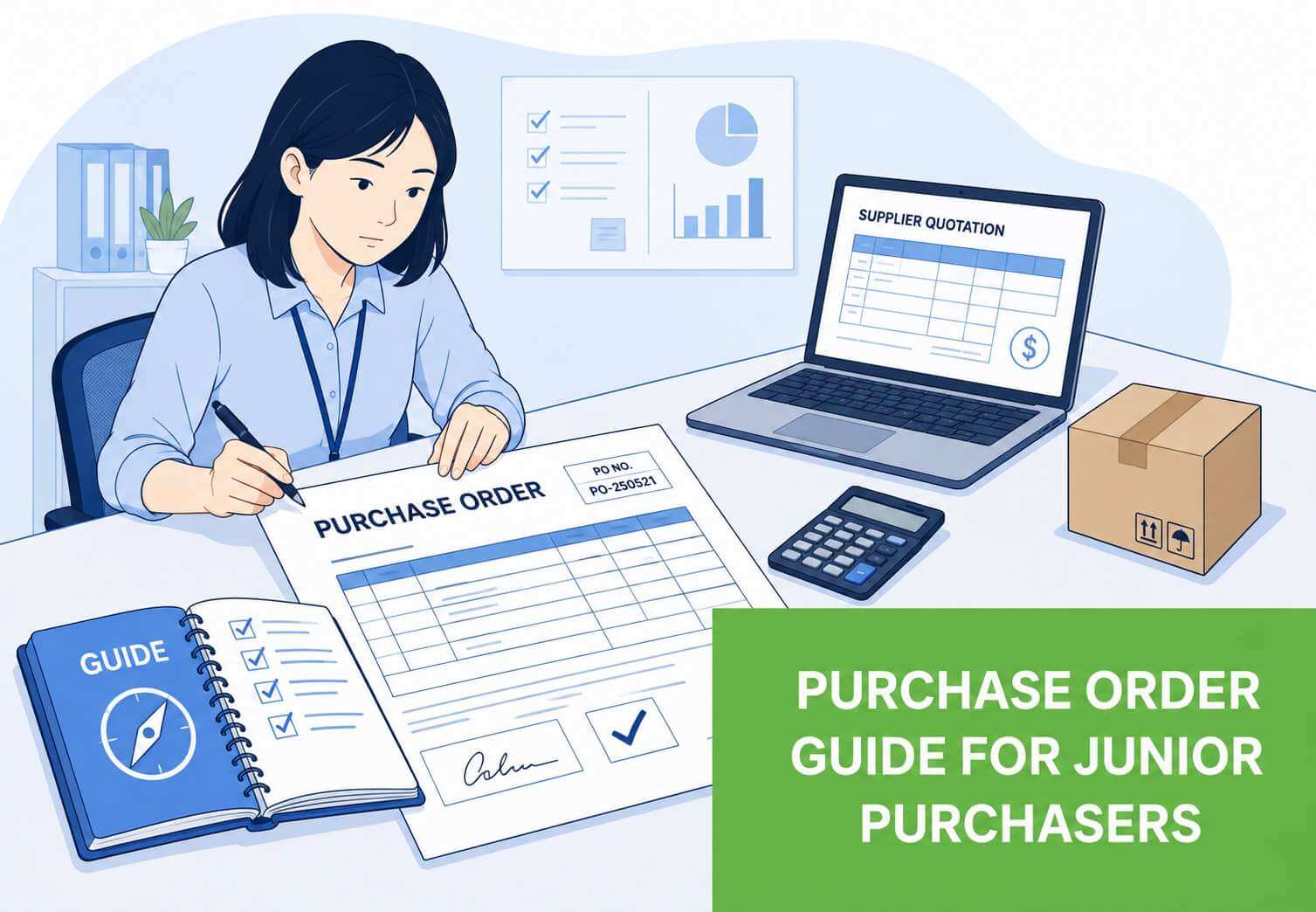
A practical purchase order format does not need to turn a routine order into a miniature purchasing system or manufacturing contract. It needs to tell the supplier what is being ordered, which approved product version applies, how much will be paid, and when the goods should be ready.
Prepare the purchase order after the supplier’s quotation or proforma invoice (PI), product specifications, quantity, price, payment terms and delivery basis have been agreed. Send it before paying the production deposit. The PO then becomes the buyer’s record of the order and gives the supplier one document to accept.
This guide explains the purchase order process in the order a buyer normally follows it. We have also included a Free Purchase Order Template download for free later in the post. The spreadsheet provides a purchase order format in Excel that can be adapted to a first order or a repeat order.
Many purchase order templates are designed for general domestic buying. This version focuses on an overseas buyer placing a manufacturing order with a Chinese supplier.
| Before issuing the PO | What should already be confirmed |
|---|---|
| Supplier | Contracting company and approved manufacturing location |
| Product | Product version, specification and approved sample, when used |
| Commercial terms | Quantity, price, currency, payment arrangement and delivery basis |
| Supporting files | Current drawing, artwork, packaging and QC references |
Purchase Order (or PO) Basics
What Is a Purchase Order?
A purchase order is a document issued by the buyer for one order. It records the products, quantities, prices, quality references, payment terms and delivery requirements that the buyer is placing with the supplier.
The PO normally comes after the quotation or PI. The quotation shows what the supplier offered. The PI is usually the supplier’s request for payment and summary of the order. The PO records what the buyer is ordering. A later order confirmation shows whether the supplier accepts it or proposes a change.
| Document | Normally issued by | Main purpose |
|---|---|---|
| Quotation | Supplier | Offers a price, quantity, lead time and commercial assumptions |
| Proforma invoice | Supplier | Requests payment and summarizes the supplier’s understanding of the order |
| Purchase order | Buyer | Records the buyer’s final order and the documents incorporated into it |
| Order confirmation | Supplier | Accepts the order or identifies a proposed change |
| Commercial invoice | Supplier | Invoices the accepted order and should quote the PO number |
The wider sequence from supplier selection to shipment is explained in the process for buying wholesale products from China.
Why Is It Important in Global Sourcing?
International orders pass through several hands. The buyer, sales contact, factory manager, quality team, accounts staff and logistics team may work in different locations and may not share the same first language. A clear PO gives them one accepted reference for the order.
This matters in China sourcing because most overseas buyers are not present at the factory every day. The PO does not create visibility by itself, but it gives the buyer’s own staff or a third-party company something precise to check against during production and inspection.
A PO controls one order. It is not the best place for every continuing obligation. Tooling ownership, intellectual property, long-term supply, detailed warranty terms and liability may require a separate manufacturing agreement. Orders involving several component factories and final assembly may also need a more structured contract manufacturing process.
Do You Always Need a Purchase Order to Buy from China?
No. A detailed PI may be sufficient for a low-risk sample, a simple stock item or a small one-off purchase. In those cases, another document may add little if the product, quantity, price, payment and delivery terms are already clear.
A PO becomes more useful when the order involves custom products, several SKUs, buyer artwork, special packaging requirements, inspections, a fixed delivery date or repeat production. It also helps when several people inside the buyer’s and supplier’s organizations need to work from the same instructions.
The decision is therefore practical. Use a PO when it makes the order clearer and easier to manage. Do not add one only to create paperwork.
Purchase Order Checklist: Everything You Need to Check in a PO
Before filling in the PO template, confirm the supplier’s contracting entity, approved quotation, product version, quantity, price, payment arrangement and delivery basis. These are inputs to the PO. They should not be discovered while the form is being completed.
PO Template Breakdown 1/4: Header and Parties
The header identifies the order and the companies involved. It also makes later revisions easier to trace. Include the buyer’s company header, a unique PO number, issue date, revision number and page number.
| Header field | What to enter | Example |
|---|---|---|
| PO number | Unique buyer-created reference | PO-2026-0042 |
| Issue date | Date this version is sent | 6 August 2026 |
| Revision | Current PO version | Rev 0 |
| Quotation or PI reference | Supplier document used to prepare the order | PI-SX-260731 Rev 2 |
| Supplier confirmation due | Date by which the supplier should accept or respond | 8 August 2026 |
Add the buyer and supplier details, including their legal names, addresses and contacts. Separate the supplier’s registered address, the approved manufacturing location, the Ship To address and the Bill To or invoice instructions. These locations are not interchangeable.
For a Chinese supplier, use the registered Chinese company name rather than relying only on an English trading name. The National Enterprise Credit Information Publicity System provides public company-registration information.[1] Registration confirms the company’s identity, not its manufacturing ability. A new supplier’s machinery, workforce, quality system, subcontracting and capacity can be examined through a factory audit in China.
Bank-beneficiary verification is important, but it is an internal pre-payment control. It does not need to become a field in the PO sent to the supplier. If a bank account changes, pause payment and verify the change through contact details that were already known.
Do not overwrite an issued PO. Keep the previous file, mark it as superseded and change the revision number. This simple version control prevents the factory, buyer and inspector from working from different files.
PO Template Breakdown 2/4: Products, Quantities and Prices
Each product line should identify one product or one clear variant. If sizes, colors or versions have different quantities or prices, give them separate lines.
| Product-line field | What it should show |
|---|---|
| SKU | Buyer SKU and supplier model, when available |
| Product description | Product name, size, color, material or version |
| Specification reference | Approved drawing revision, product specification or sample reference |
| Quantity and UOM | Number ordered and unit of measure, such as pcs, sets, kg or meters |
| Unit price | Price per stated UOM and currency |
| Line total | Quantity multiplied by unit price |
Avoid descriptions such as “black plastic box” or “same as last order.” A clearer line would read: “Buyer SKU BX-120-BK, black ABS enclosure, 120 × 80 × 35 mm, manufactured to Drawing BX-120 Rev D and Material Specification MS-ABS-03 Rev B, 5,000 pcs.”
State whether overproduction or underproduction is allowed. A percentage tolerance may suit some mass-produced items, but it is not a standard rule. Serialized goods, matched components and project quantities may require zero tolerance. Also state whether partial shipments are allowed and which accepted quantity controls the final invoice.
Use a currency code such as USD, EUR, GBP or CNY. List the product subtotal, other agreed charges, discount and order total separately. Tooling, testing, certification, custom packaging, samples or freight should not be hidden inside an unexplained unit price.
| Purchase order example | Amount |
|---|---|
| 5,000 products × USD 3.70 | USD 18,500 |
| Tooling | USD 2,800 |
| Packaging setup | USD 350 |
| Discount | −USD 500 |
| Total PO value | USD 21,150 |
The PO total is not the same as the buyer’s landed cost. Inspection, inland transport, export handling, freight, duty and local delivery belong in the wider sourcing cost calculation.
PO Template Breakdown 3/4: Quality Requirements
The PO should identify the approved quality documents without copying every technical detail into the order form. Use a compact reference box for the product specification, drawing, approved sample, artwork, packaging file and QC checklist. Include the revision number or approval date so there is no doubt about which version applies.
| Controlled document | Example reference |
|---|---|
| Drawing | DWG-1842 Rev C, dated 1 August 2026 |
| Product specification | SPEC-1842 Rev B, dated 28 July 2026 |
| Approved sample | Golden Sample GS-1842-02, approved 3 August 2026 |
| Artwork | ART-BOX-1842 Rev D |
| Quality checklist | QC-1842 Rev A |
| Packaging instruction | PKG-1842 Rev B |
If the product is still being designed, complete the necessary product development before calling a drawing or sample final. A rapid prototype can help confirm dimensions, fit and assembly before production tooling is completed.
Do not use a sample to control points that cannot be checked from the sample. The golden sample may control appearance, color and assembly fit, while drawings and specifications control dimensions, materials and performance. If an approval is still pending, state that mass production cannot begin until the named document or sample receives written approval.
Keep packaging requirements practical. The PO can state the number of products per carton, packaging or artwork reference, labeling, carton marks and any important weight limit. Detailed packaging construction, artwork files and packing tests should stay in their supporting documents.
If acceptance sampling is used, reference the agreed sampling standard, inspection level, defect classifications and AQL values in the QC document. ISO 2859-1 provides sampling plans indexed by acceptance quality limit for inspection by attributes.[5] A sampling plan does not prove that every unit is defect-free, and critical safety or legal checks may require a different method.
PO Template Breakdown 4/4: Delivery & Payment Terms
Delivery and payment terms should tell the factory what event is expected and tell the buyer what evidence will be available before payment or shipment release.
Write the Incoterm with the exact named place or port and the applicable edition. “FCA China” is incomplete. “FCA Supplier Factory, 88 Example Road, Dongguan, Guangdong, China, Incoterms® 2020” identifies the actual handover point.
Incoterms® 2020 contains 11 ICC rules that allocate stated delivery, cost and risk duties between seller and buyer.[6] FCA may suit containerized goods handed to a carrier before vessel loading, while FOB is intended for sea or inland-waterway transport and uses delivery on board the vessel at the named port.[7] Under C terms, the supplier may pay freight to a destination even though risk transfers earlier.[8]
Keep the goods-ready date, latest shipment or carrier-handover date, and required delivery date separate when they are different. For example, a factory may finish production on 14 September, present the goods for final quality check on 15 September and hand them to the carrier on 20 September.
A payment term should identify the trigger, not only the percentage. For example:
30% deposit after supplier acceptance of the PO and issue of the agreed PI.
70% balance after production is complete, the required inspection is accepted and the buyer gives written shipment release.
The percentages above are examples, not a required China payment structure. Repeat stock orders, tooling projects, large custom orders and credit accounts may use different payment points. Keep bank verification as an internal control and keep detailed penalties, damages and legal remedies outside a routine PO unless the order genuinely requires them.
Sending and Accepting the PO
Once the PO is complete, the next task is to make sure the supplier receives one final version, reviews it and clearly accepts it. Sending several spreadsheets, messages and attachments without a clear final package makes later disagreements harder to resolve.
Complete the Final Check Before Sending
Check the PO against the quotation or PI used to prepare it. Confirm the supplier entity, product revision, quantities, prices, currency, payment arrangement and delivery basis. Resolve any known difference before sending the final version.
Also confirm that every referenced drawing, approved sample, artwork file, packaging instruction and inspection document is available. A document number on the PO is not useful if the supplier and buyer do not hold the same revision.
Send a Controlled Copy and Obtain Acceptance
Send a dated PDF with a clear filename, such as PO-2026-0042_Rev0_2026-08-06.pdf. Ask the supplier to sign and return the PO, apply its company chop when used, or provide a formal written order confirmation. The acceptance should identify the signer, date, PO revision and incorporated attachments.
Under the PRC Civil Code, contracts may be made in writing, orally or in another form. Retrievable data messages may qualify as written form, and a contract may be formed through offer and acceptance.[2] China’s Electronic Signature Law also provides that a reliable electronic signature can have the same legal effect as a handwritten signature or company chop when the statutory conditions are met.[3]
The CISG may apply to some international sales involving China. China is a contracting state and has made a declaration concerning written-form requirements under Articles 12 and 96.[4] These points support the use of clear written records, but a beginner’s PO guide should not imply that a signature or company chop automatically settles every legal question.
Please sign and return the PO by [date]. If any term cannot be accepted, list each proposed change in the reply. Mass production must not begin until the differences are resolved in writing.
Reconcile the Accepted PO with the PI
This is usually unnecessary because the PO is already based on the supplier’s quotation or PI. Recheck only if the supplier responds to a repeat-order PO with revised prices or terms. The next routine reconciliation normally comes after the final quality check (FQC), when the confirmed quantity available for shipment may require the PI or balance amount to be adjusted.
Manage Changes After Acceptance
Keep the original accepted PO. If the product, quantity, price, packaging, payment or delivery changes, issue a revised PO or a written amendment. Do not edit the original file and make it look as though the first requirement never existed.
State the old value, new value, reason and effect on price or schedule. Send the accepted revision to the supplier’s production, quality, accounts and logistics contacts. Chat messages may start a discussion, but they should not become the only order record.
When Does the PO End?
The active PO cycle does not necessarily end when the supplier ships the goods. It normally closes after the goods and required documents are accepted, payments are settled, and open shortages, defects or claims are resolved. A continuing warranty or obligation in a manufacturing agreement may survive after the order itself is closed.
Keep the accepted PO, revisions, specifications, approvals, PI, payment records, inspection reports and shipping documents for the period required by the applicable tax, customs, warranty, customer and internal rules.
What Happens When Requirements Are Not Met
A buyer can only act on a difference after it becomes visible. The buyer’s own employee or a third-party company onsite can compare production with the PO and pass information back while work is in progress. Without onsite follow-up, the supplier may not disclose a difference. The buyer may only discover it during a pre-shipment inspection or after receiving the goods if no inspection was arranged.
During Production, If Someone Is Onsite
The buyer’s representative can compare materials, approved samples, work in progress, quantities and packaging with the PO and its attachments. A during-production inspection can reveal material changes, workmanship problems and delays before the full order is completed.
If a difference is found, record the affected quantity and evidence. Agree on the correction before work continues. The supplier should not choose between conflicting files or substitute a material, component, factory or process without written buyer approval.
At Pre-Shipment Inspection
For an offsite buyer, a pre-shipment inspection is normally the last practical opportunity to compare the finished goods, quantity, labels and packaging with the PO before release.
| Inspection result | Possible next action |
|---|---|
| Repairable defects | Rework followed by re-inspection |
| Mixed conforming and nonconforming goods | Sorting and confirmation of the accepted quantity |
| Missing or unusable units | Replacement production or an agreed quantity adjustment |
| Limited acceptable deviation | Written concession for this order only |
Finished-goods inspection does not prove that the approved cartons were loaded. For consolidated or high-value shipments, loading supervision can check carton quantity, container condition, loading and seal details.
After Receipt, If No Inspection Was Arranged
Without onsite follow-up or a pre-shipment inspection, the buyer may only discover shortages, wrong products, incorrect packaging or visible defects when the shipment arrives. Hidden defects may appear later during use.
Preserve photos, videos, carton counts, warehouse records, test results and correspondence. Compare the findings with the accepted PO and its incorporated documents. Notify the supplier promptly and state the affected quantity rather than sending a general complaint.
Record the Resolution
The written record should show the original requirement, what was found and what both parties agreed to do next. Depending on the problem, the resolution may involve rework, sorting, replacement, a price reduction, credit, refund, expedited replacement shipment or agreed inspection costs.
Do not revise the PO simply to erase the original failure. Record any accepted deviation as applying to the named order only. If the order is cancelled or a claim remains unresolved, keep that status with the PO records.
A good PO template gives the buyer a clear reference, but it cannot replace communication, onsite information or inspection. Used properly, it records what was ordered, what the supplier accepted, what changed and what remains open before the order can close.