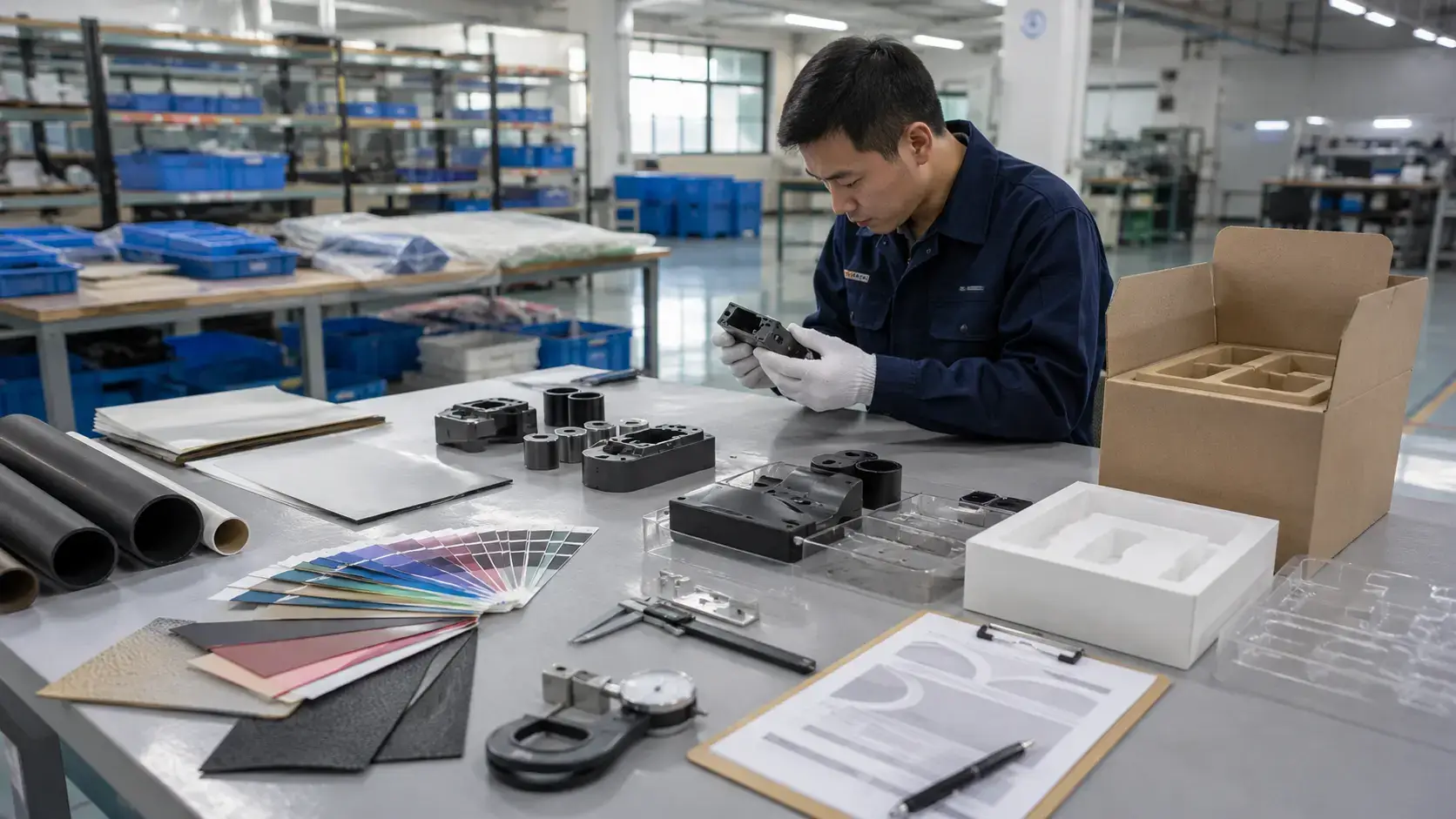
Pre-production inspection, or PPI, is a factory check completed before mass production starts. It confirms whether the factory has the correct materials, components, documents, tooling, equipment, packaging, and quality controls for a specific order.
The aim is to find problems before they affect the full order. Separating the wrong fabric before cutting is much easier than sorting or remaking 20,000 finished garments.
PPI checks production readiness, not finished shipment quality. Depending on the order risk, buyers may also need a during-production inspection and a pre-shipment inspection.
When PPI Is Needed
PPI is most useful when one early mistake could affect hundreds or thousands of units.
Consider arranging one when:
- You are working with a new supplier.
- The product is new, customized, or technically complex.
- A new mold, die, jig, fixture, program, or production line will be used.
- Materials must meet a specific grade, composition, brand, or model.
- Safety-related parts must come from approved suppliers.
- The supplier has previously changed materials or components without approval.
- The product uses detailed drawings or tight tolerances.
- Packaging, warnings, labels, manuals, or barcodes are market-specific.
- The order value is high.
- The delivery schedule leaves little time for rework.
- Important work will be subcontracted.
- A defect becomes expensive after cutting, molding, machining, printing, coating, soldering, filling, or assembly.
A stable repeat order may need a smaller inspection scope when the supplier, product, material, tooling, packaging, and production line have not changed. The buyer should still confirm that there is no new component source, engineering change, material substitution, or subcontractor.
For new products, PPI should connect with the earlier product development process. Production must follow the approved design, not an early prototype or an outdated drawing.
What PPI Checks
The inspection scope should reflect the product, order value, destination market, supplier history, previous defects, and possible consequences of failure.
| Area | Main Question | Useful Evidence |
|---|---|---|
| Documents | Is the factory using the latest approved requirements? | Revision numbers, dates, approval records, controlled copies |
| Materials | Are the correct raw materials physically available? | Labels, batch numbers, certificates, receiving records |
| Components | Do actual parts match the approved bill of materials? | Part markings, model numbers, ratings, invoices |
| Samples | Is the correct physical reference available where needed? | Signed sample, approval date, model identification |
| Tooling | Are molds, dies, jigs, fixtures, and gauges ready? | Trial parts, measurements, maintenance records |
| Equipment | Can the factory make and test the product correctly? | Machine records, calibration records, test demonstrations |
| Capacity | Can the assigned line meet the delivery schedule? | Output records, staffing plan, production schedule |
| Quality control | Are inspection points and failure actions defined? | Control plan, inspection forms, work instructions |
| Packaging | Are boxes, labels, manuals, and barcodes correct? | Approved artwork, samples, scans, packing trial |
| Traceability | Can materials be linked to the products made? | Lot numbers, work orders, batch cards, serial numbers |
The inspection should not rely only on factory statements. Important findings should be supported by photographs, measurements, records, batch numbers, or certificates linked to the actual material found at the factory.
PPI and Other Inspections
PPI checks the readiness of one order. It does not replace a factory audit or an inspection of finished products.
| Control | Main Purpose | Normal Timing |
|---|---|---|
| Factory audit | Check the supplier’s general capability, equipment, systems, and management | Before approval or at planned intervals |
| Pre-production inspection | Check order-specific materials, documents, tooling, and preparation | Before irreversible production work |
| First-article inspection | Check the first unit made under intended production conditions | At trial production or line start |
| During-production inspection | Check semi-finished goods, recurring defects, and progress | After part of the order has been produced |
| Pre-shipment inspection | Check finished quantity, workmanship, function, and packaging | When enough finished goods are available |
| Loading supervision | Check cargo quantity, container condition, loading, and sealing | During container loading |
A factory audit may show that the supplier has suitable machines and a quality system. It does not prove that the correct material has arrived for the current purchase order.
PPI and first-article inspection can happen during the same visit when a representative unit has been produced with the intended material, tooling, settings, workers, and line. If no unit exists, the inspector can review the first-article plan but cannot approve a product that has not been made.
Best Inspection Timing
The best time is after the critical materials, components, documents, tooling, and packaging are available but before they enter an expensive or irreversible process.
| Product | Useful Inspection Point |
|---|---|
| Garments | Before bulk fabric cutting |
| Printed packaging | Before bulk printing or lamination |
| Plastic products | Before full-scale molding |
| Metal products | Before bulk cutting, casting, machining, welding, or heat treatment |
| Electronics | Before bulk PCB assembly, soldering, programming, or final assembly |
| Furniture | Before board cutting, drilling, coating, and bulk assembly |
| Chemical products | Before approved materials are mixed, filled, or packed |
Before booking the visit, ask the supplier for:
- Photos showing material labels and quantities
- Material receiving records
- Component inventory records
- Packaging photographs
- Mold or tooling trial results
- Photos of the approved sample where applicable
- The current production schedule
- Evidence that required test equipment is available
A supplier saying “everything is ready” is not enough.
A buyer may set an internal booking rule requiring 100% of safety-critical materials and at least 80% of general materials to be physically available before a full PPI. This is a planning rule, not a universal inspection standard.
If garment fabric is ready for cutting but retail boxes have not arrived, the buyer can inspect the fabric first and leave packaging open for a later check. The report must clearly list every unavailable item.
Subcontracted Processes
Plating, painting, heat treatment, printing, testing, molding, sewing, software loading, or assembly may be completed at another factory.
The PPI should record:
- The subcontractor’s name and location
- The process completed outside the main factory
- The quantity involved
- The planned production dates
- The inspection method
- The traceability method
- Whether the buyer approved the subcontractor
- Whether the supplier may change the subcontractor without written approval
An unknown subcontractor can affect material control, capacity, workmanship, confidentiality, and compliance.
Required Documents
The inspector needs a clear product baseline. Provide the documents that apply to the order:
- Purchase order
- Product specification
- Technical drawings
- Bill of materials
- Approved sample where applicable
- Material requirements
- Approved component list
- Color references
- Size charts
- Performance requirements
- Inspection and test methods
- Packaging specification
- Approved artwork
- Label files
- Barcode data
- Instruction manual
- Delivery schedule
- Engineering changes
- Approved deviations or substitutions
Each controlled document should have a revision number, issue date, or another clear version identifier. Production, purchasing, quality control, packaging, and subcontractors should all use the same approved version.
Document control problems can affect a large share of production. If a factory has four workstations and one still uses an old drawing, 25% of the production points may be working from the wrong revision.
Measurable Requirements
Instructions should give the factory and inspector a clear pass or fail limit.
| Unclear Instruction | Better Requirement |
|---|---|
| Use good-quality material | Use the grade, composition, supplier, or part number listed in the specification |
| Make the color accurate | Match the signed color reference under the agreed lighting condition |
| The cable should be long enough | Cable length: 1,500 ± 20 mm |
| Packaging must be strong | Use the specified carton grade, dimensions, inserts, and sealing method |
| The product must not leak | No visible leakage at the stated pressure, medium, temperature, and test time |
| Dimensions should be close | Housing thickness: 2.0 ± 0.1 mm |
Test instructions should include:
- Sample quantity
- Test equipment
- Test method
- Pressure, load, voltage, temperature, or other operating condition
- Test duration
- Acceptance limit
- Required record
“No leakage” is incomplete when the pressure, test medium, duration, and acceptance method are not stated.
For a dimension of 50.0 ± 0.5 mm, readings of 49.8, 50.0, 50.1, 50.2, and 50.3 mm show the actual result spread. Five checkmarks only show that someone completed the form.
Document Conflicts
There is no single document-priority order suitable for every purchase contract. The buyer should state which requirement controls when a drawing, specification, bill of materials, sample, purchase order, or approved change conflicts.
A color sample may control color without controlling dimensions or materials. A temporary deviation may apply to one order but not future orders. A new sample does not automatically approve an unrecorded material change.
The inspector should report unresolved conflicts and request a written buyer decision instead of guessing which requirement is more important.
Material Checks
Material problems can affect strength, safety, appearance, electrical performance, chemical resistance, service life, and legal compliance.
Check four points:
- Material identity
- Available quantity
- Physical condition
- Batch traceability
| Product Type | Common Checks |
|---|---|
| Textiles | Fiber composition, weight, width, color, dye lot, shrinkage records, roll quantity |
| Metal products | Grade, thickness, heat number, coating, hardness records, material certificate |
| Plastic products | Resin grade, recycled-content requirement, additives, masterbatch, moisture, batch number |
| Wood products | Species, board type, thickness, moisture, defects, treatment, storage condition |
| Electronics | PCB version, chips, batteries, fuses, connectors, cables, motors, sensors, power supplies |
A package label alone may not prove material identity. Compare it with the purchase record, receiving record, certificate, and actual batch or heat number.
A certificate that cannot be linked to the stock found in the factory is weak evidence. Visual inspection also has limits. An inspector may measure metal thickness, but exact alloy composition may require laboratory testing.
Material Status and Storage
Material in the warehouse may be:
- Released for production
- Waiting for incoming inspection
- Quarantined
- Rejected
- Expired
- Returned by another customer
- Held because its certificate is missing
Only material with the correct identity, acceptable condition, and approved status should be counted as ready.
Storage checks may include:
- Temperature and humidity
- Moisture protection
- Rust prevention
- Sunlight or ultraviolet exposure
- Separation of incompatible chemicals
- Shelf life and expiry dates
- First-in, first-out control
- Identification after packages are opened
- Control of partly used containers
Material Quantity
Compare the available stock with the expected production need.
Net material requirement = order quantity × net material used per unit
For 10,000 units using 0.42 kg per unit:
10,000 × 0.42 kg = 4,200 kg
If the factory adds a 5% purchasing allowance:
4,200 × 1.05 = 4,410 kg
If 5% means that 5% of the total input will be lost, expected production yield is 95%:
4,200 ÷ 0.95 ≈ 4,421 kg
The buyer should define whether “5% loss” means an added purchasing allowance or a 95% process yield. These calculations are not the same.
If the planned requirement is 4,410 kg but only 3,900 kg is available, the shortage is 510 kg. That is about 11.6% of the planned requirement and should be shown clearly in the report.
Component Checks
A low-cost component can cause a high-cost failure. Examples include an underrated fuse, weak zipper, wrong bearing, unapproved battery cell, thin cable, low-grade seal, incorrect fastener, weak adhesive, or different chip.
| Check | Possible Evidence |
|---|---|
| Manufacturer | Original label, packaging, invoice, approved vendor record |
| Full model number | Part marking, data sheet, purchase record |
| Material | Specification, certificate, test report |
| Rating | Label, approved data sheet, certificate |
| Dimensions | Measurement |
| Quantity | Physical count and inventory record |
| Batch | Lot number and receiving record |
| Approval | Approved component list or written buyer approval |
A substitute part may have the same shape and size but a different voltage rating, temperature limit, load capacity, chemical resistance, fire rating, service life, or safety approval.
When a substitution is found, record:
- The originally approved part
- The substitute part
- The difference
- The affected quantity
- The factory’s explanation
- The possible product risk
- The required buyer decision
The factory should not use a substitute material or component without written approval.
Approved Samples
An approved sample is a controlled physical reference for specific features such as color, appearance, construction, function, or workmanship.
Where a sample is required, confirm that it is:
- Available at the factory
- Clearly marked as approved
- Dated or signed
- Linked to the correct model and order
- Protected from damage or replacement
- Consistent with the latest documents
- Available to production and quality staff
An unmarked sample should not automatically be treated as approved.
| Sample Type | Normal Use |
|---|---|
| Prototype | Check the design direction before production tooling is complete |
| Pre-production sample | Check intended materials, construction, function, and packaging |
| Golden sample | Act as the final physical reference for agreed features |
| Color sample | Control color unless other features are clearly approved |
| Limit sample | Show the boundary between acceptable and unacceptable appearance |
| First article | Confirm the first unit made under intended production conditions |
A handmade prototype does not prove that a production mold or automated line can repeat the same result. For new products, rapid prototyping should be followed by checks using the final material, tooling, process, and drawings.
Tooling Checks
Inspect the molds, dies, jigs, fixtures, sewing guides, cutting tools, printing plates, gauges, and test fixtures needed for the order.
Confirm that:
- The tool is physically available.
- It matches the current product version.
- Trial production has been completed where required.
- Known trial problems have been corrected.
- The tool is not visibly damaged.
- Required maintenance has been completed.
- The tool can control important dimensions.
- The tool is available for the buyer’s production schedule.
A statement that a mold “will be ready tomorrow” means it was not ready at the time of inspection.
For multi-cavity molds or repeated fixtures, check:
- Tool identification number
- Number of cavities or positions
- Cavity marks on trial parts
- Measurements from each cavity
- Repair and maintenance history
- Approved machine settings
- Spare inserts or wear parts
- Whether the tool is shared with another order
For an 8-cavity mold, checking one trial part from only one cavity covers just 12.5% of the production positions. Where practical, inspect at least one identified part from each cavity.
If parts cannot be linked to individual cavities, a defect from one cavity may be mixed across the full production lot.
Equipment Checks
The factory should have the machines, environmental controls, measuring tools, and test equipment required by the specification.
Check:
- Machine type and condition
- Available capacity
- Process settings
- Maintenance status
- Required safety controls
- Temperature, humidity, dust, or cleanliness controls
- Measuring tools
- Test equipment
- Calibration records
The measurement system must be suitable for the product tolerance. Suitability includes resolution, accuracy, repeatability, method, fixture, operator skill, and measurement uncertainty.
- A ruler may be suitable for a carton dimension.
- A caliper may be suitable for many general mechanical dimensions.
- A micrometer may be needed for thin sheet or a tight thickness tolerance.
- A coating-thickness gauge may be needed for plated or painted parts.
- A torque tester may be needed for closures or fasteners.
- An electrical safety tester may be required for powered products.
A ruler marked in 1 mm steps cannot reliably decide whether a part meets a ±0.1 mm tolerance.
ISO/IEC 17025 sets competence requirements for testing and calibration laboratories. When a report or calibration certificate is important to the order, check whether the laboratory’s accredited scope covers the actual test or calibration used.[1]
Production Capacity
Compare the assigned line capacity with the order quantity and delivery date.
If an order contains 30,000 units and the assigned line produces 2,000 accepted units per day, at least 15 production days are needed. This does not include setup, maintenance, testing, rework, packing, material shortages, or unexpected stoppages.
Adding a 10% schedule buffer increases the plan from 15 days to 16.5 days. A 20% buffer increases it to 18 days. The suitable buffer depends on the product, supplier history, and delivery risk.
Clarify whether the supplier’s output figure is:
- Per hour or per day
- Per line or for the whole factory
- Based on one shift or several shifts
- Gross output or accepted output
- Based on records or an estimate
Accepted daily output = gross daily output × first-pass yield
If gross output is 2,000 units and first-pass yield is 90%, accepted output is about 1,800 units before downtime or packing limits are considered.
For a 10,000-unit order, a 98% first-pass yield leaves about 200 units for rework or review. At 90%, that number increases to about 1,000 units.
Find the real bottleneck. A molding machine may make 5,000 parts per day, but the order can still be late if assembly handles 2,500 units or packaging handles only 2,000.
For multi-supplier or technically complex orders, contract manufacturing management can connect material arrival, tooling approval, pilot production, subcontracted work, inspections, packing, and shipping in one schedule.
Quality Control Plan
The factory should have a product-specific control plan before production starts.
The plan should answer:
- Who approves the first unit?
- Which features are checked?
- How often are checks completed?
- Which tools and methods are used?
- Where are results recorded?
- What happens after a failure?
- Who can hold the process?
- How are rejected products separated?
- How is rework controlled?
The first completed unit should normally be checked before the line runs at full speed. Checks may include dimensions, materials, component identity, appearance, assembly, function, firmware, labels, and packaging fit.
In-process checks should focus on features that can change during production:
- Cutting size
- Sewing position
- Mold temperature or cycle settings
- Product weight
- Fastener torque
- Welding condition
- Coating thickness
- Electrical output
- Leak performance
- Print position
Actual values provide more useful evidence than checkmarks. They also make it easier to see whether results are moving toward a specification limit before products fail.
Failure and Rework Controls
When a result is outside the approved limit, the factory should:
- Stop or hold the affected process.
- Separate suspect products.
- Identify the last accepted check.
- Find the cause.
- Correct the machine, material, tool, or method.
- Check the first corrected units.
- Inspect products made since the last accepted check.
- Record the action and release decision.
Reworked products need:
- An approved rework method
- Quantity identification
- Separation from accepted stock
- Defined reinspection
- A final release record
Repeated soldering, reheating, coating, bending, disassembly, or repair may create new damage even after the original defect has been removed.
Packaging Checks
Packaging should be checked before bulk printing or packing creates a large loss.
| Risk | What to Check |
|---|---|
| Product errors | Name, model, brand, color, size, quantity, image, accessory list |
| Compliance errors | Warnings, importer details, age grading, instructions, required markings |
| Identification errors | Barcode data, SKU, batch code, date code, shipping marks |
| Transport risks | Carton strength, inserts, cushioning, sealing, moisture protection, internal movement |
A barcode may look correct but contain the wrong number or fail to scan. GS1 guidance explains that barcode verification should check both print quality and the integrity of the encoded data.[2]
As a practical check, the inspector may scan 10 labels selected from different print sheets, cartons, or warehouse positions. Ten successful scans do not prove the whole lot is correct, but they can reveal wrong data or inconsistent printing before bulk use.
A practical packing trial may use 3–5 complete retail packs and at least one full master carton. The actual quantity should reflect product risk, packaging type, and available samples.
The packing trial should confirm:
- Product fit
- Protection
- Packing sequence
- Carton quantity
- Gross weight
- Barcode position
- Shipping marks
- Handling risks
A visual packaging check does not replace formal drop, vibration, compression, or other transport tests when those tests are required.
Traceability Checks
The factory should be able to link products to:
- Material batch
- Component batch
- Production date
- Production line
- Work order
- Shift
- Test record
- Rework record
Useful controls include lot numbers, serial numbers, date codes, work-order labels, batch cards, cavity marks, and electronic records.
Traceability often fails after material is removed from its original packaging. Common examples include:
- Electronic parts moved from labeled reels into unmarked trays
- Fabric cut without recording roll numbers
- Metal sheets separated from heat-number records
- Chemicals poured into unmarked containers
- Components from different batches mixed together
- Reworked products returned to the line without identification
A useful check is to select one warehouse batch and ask which work orders will use it. Then select one pilot unit and trace it back to its materials, components, line, date, shift, and test record.
A buyer may use 15–30 minutes as an internal trace exercise target. This is not a universal legal limit, but a system that needs several hours to find one batch may be too slow during an urgent complaint or recall.
Compliance and Testing
PPI can check whether required reports, labels, records, and certificates are available and match the order. It cannot prove full legal compliance through visual inspection alone.
Properties that may need controlled laboratory testing include:
- Chemical content
- Flammability
- Electrical safety
- Electromagnetic compatibility
- Food-contact safety
- Mechanical strength
- Pressure resistance
- Battery safety
- Durability
- Microbiological safety
For U.S. children’s products subject to applicable CPSC safety rules, third-party testing by a CPSC-accepted laboratory and a Children’s Product Certificate are generally required. For imported products, the importer issues the certificate based on applicable passing test results; the laboratory does not issue the CPC.[3]
CPSC certificate eFiling took effect on July 8, 2026 for general imported products subject to CPSC certification. Products entered from a foreign trade zone have an effective date of January 8, 2027.[4]
CE marking is required only for products covered by applicable EU harmonization rules. It is not required for every product and should not be placed on products outside its legal scope.[5]
EU importers must check that applicable conformity steps have been completed and that required technical documents can be obtained before placing a covered product on the market.[6]
For consumer products covered by the EU General Product Safety Regulation, there must be a responsible economic operator in the EU, such as an EU manufacturer, importer, authorized representative, or fulfillment service provider.[7]
During PPI, check whether:
- The required reports are available.
- The reports cover the correct model.
- Model numbers and suffixes match.
- Tested materials match production materials.
- The tested factory matches the production factory where relevant.
- Product changes have affected the report’s validity.
- Required labels and instructions are ready.
- Traceability details are consistent.
A report for a similar model, material, component, or factory may not support the current order.
Sampling Rules
PPI sampling depends on what is physically available. The inspector may sample raw materials, components, packaging, labels, pilot units, or first articles.
ISO 2859-1:2026 is the current third edition of the international standard for AQL-indexed lot-by-lot sampling by attributes.[8]
AQL is not a promise that a fixed percentage of defects is acceptable in every shipment. The sampling decision depends on the lot size, inspection level, sample size, acceptance number, rejection number, and chosen plan. ISO 28590 gives general guidance on selecting sampling systems in the ISO 2859 series.[9]
Formal AQL sampling is useful only when a defined lot exists and enough units are available.
Checking five pilot units from a planned 20,000-unit order covers only 0.025% of the future order. Those five units may help approve the setup or first article, but they cannot predict the defect rate of goods that have not yet been produced.
| Item | Practical Approach |
|---|---|
| Safety-critical available part | Check all available units or use a buyer-approved risk plan |
| Large packaging lot | Sample across pallets, cartons, dates, and print batches |
| Raw material | Sample by batch, roll, heat, coil, reel, or delivery lot |
| Small pilot run | Check all available units where practical |
| Material certificates | Review each applicable production batch |
| Color or appearance | Select samples from different locations and batches |
The inspector should select samples independently where practical. Preselected display samples may hide variation in the actual stock.
The report should state:
- Total available quantity
- Quantity checked
- Selection method
- Batches represented
- Tests completed
- Defects found
- Items not checked
- Restrictions that prevented random selection
How PPI Works
Before the visit:
- Confirm product models and order quantities.
- Collect the latest drawings, specifications, BOM, artwork, and samples.
- List previous defects and high-risk features.
- Prepare a product-specific checklist.
- Confirm which tests can be completed at the factory.
- Ask for readiness evidence.
- Confirm whether subcontractors are involved.
At the factory:
- Confirm the factory, order, product, and production status.
- Check document versions.
- Inspect materials, components, packaging, and quantities.
- Link certificates to actual batches.
- Check samples, tooling, machines, gauges, and test equipment.
- Review the assigned line, workers, instructions, and quality plan.
- Measure or test available samples.
- Record actual values, photographs, batch numbers, and limitations.
Before leaving:
The inspector should review factual findings with the factory. This allows the factory to correct misunderstandings or provide missing evidence. It should not allow a valid problem to be removed from the report.
A problem corrected during the visit should still show:
- The original condition
- The correction made
- The evidence checked afterward
- Any remaining risk
Report Quality
A useful report should show what was actually observed, measured, tested, or reviewed.
Include:
- Factory name and address
- Inspection date
- Purchase order
- Product and model
- Order quantity
- Production status
- Documents reviewed
- Materials and quantities available
- Components checked
- Measurements and test results
- Photographs
- Nonconformities
- Factory comments
- Corrective actions
- Unverified points
Weak wording:
The factory said all materials are correct.
Better wording:
The factory presented material certificate ABC-125. The certificate batch number matched the labels on three available steel coils. Chemical composition was not independently tested during the inspection.
Weak wording:
Production will be completed on time.
Better wording:
The factory plans to use one line with a stated gross output of 2,000 units per day. No previous output record for this model was available. The delivery schedule remains unverified.
Important statements can be labeled as:
- Observed
- Measured
- Tested
- Document reviewed
- Factory claimed
- Not available
- Outside the inspection scope
- Requires laboratory verification
Production Release
Inspection findings should be classified by their possible effect.
| Level | Meaning | Examples |
|---|---|---|
| Critical | Serious safety, legal, or basic-function risk | Wrong pressure material, unapproved safety component, missing mandatory warning |
| Major | Likely rejection, rework, complaint, or delivery problem | Wrong thickness, incomplete mold, missing fixture, unapproved artwork |
| Minor | Limited difference that does not normally prevent use | Small cosmetic variation within the buyer’s approved severity rules |
The buyer or another authorized person should make one written decision:
- Approve production
- Approve production with conditions
- Hold production
- Require corrective evidence
- Require first-article approval
- Require laboratory testing
- Require reinspection
A critical finding should normally lead to an immediate production-hold recommendation. An inspector should not claim contractual authority to stop the factory unless that authority was agreed before the visit.
Conditional approval should state:
- The exact problem
- The required correction
- The responsible person
- The deadline
- The evidence required
- The production stage before which it must be closed
- What happens if the condition is not completed
Corrective Evidence
Different problems need different closure evidence.
| Method | Suitable Uses |
|---|---|
| Document review | Revised drawings, approved artwork, updated instructions, written deviations |
| Photo or video | Removing old documents, separating batches, preparing visible fixtures |
| Laboratory report | Material composition, flammability, electrical safety, chemical or performance properties |
| On-site reinspection | Material identity, component replacement, tooling, first-article dimensions, large rework |
A factory statement that an issue has been corrected is not enough when identity, quantity, dimensions, test conditions, or function must be verified.
Common PPI Findings
| Finding | Main Risk | Required Action |
|---|---|---|
| Material unavailable | Readiness cannot be confirmed | Delay the affected process or inspect again |
| Wrong material grade | Safety or performance failure | Replace it or obtain qualified written approval |
| Untraceable certificate | Material identity is uncertain | Link the certificate to the actual batch |
| Old drawing on the line | The wrong version may be produced | Remove old copies and issue controlled documents |
| Unapproved component | Rating, function, or lifespan may change | Replace it or obtain buyer approval |
| Tooling incomplete | Dimensions or output may be unstable | Complete trials and approval |
| Test fixture missing | Required performance cannot be checked | Prepare and verify the fixture |
| Packaging not approved | Printing loss or shipment delay | Approve artwork before bulk printing |
| Capacity overstated | Late delivery | Revise the schedule or assign more resources |
| No failure plan | Defects may continue after detection | Define containment and correction steps |
| Unknown subcontractor | Process and traceability are uncontrolled | Review and approve before use |
| Mixed batches | Affected products cannot be isolated | Separate stock and restore batch control |
| Unapproved firmware | Function or safety behavior may change | Load and verify the approved version |
Practical Examples
Mixed fabric lots: A factory may have enough fabric for 20,000 garments, but the rolls may come from three dye lots. Compare rolls from every lot under the agreed lighting before cutting. Visible shade differences can then be separated by production batch instead of being discovered after sewing.
Similar electronic parts: A battery cell may have the correct size and brand but a different model suffix. That suffix may indicate a different discharge limit, protection feature, cycle life, or test coverage. Record the full model number and obtain written approval before assembly.
Metal markings lost during cutting: Steel plates may arrive with correct heat numbers, but those markings can disappear when plates are cut into small blanks. Transfer the heat identity to the cutting plan, work order, or individual parts before cutting.
Packaging printed too early: Ordering 10,000 retail boxes before approving the barcode, warning, importer address, and accessory list can make the entire packaging lot unusable. Approve the artwork and complete a packing trial before bulk printing.
PPI Limits
PPI is a check of one order, one factory, and one point in time. It cannot:
- Inspect finished goods that do not yet exist.
- Guarantee final shipment quality.
- Replace engineering validation.
- Replace laboratory testing.
- Confirm hidden properties without suitable equipment.
- Prevent material changes after the visit.
- Guarantee the delivery date.
- Show what happens on every shift.
- Detect an undisclosed subcontractor that is not visited.
- Predict tooling wear during a long production run.
- Confirm the final loading condition.
Higher-risk orders may need supplier verification, PPI, first-article approval, laboratory testing, during-production inspection, pre-shipment inspection, and loading supervision.
Choosing an Inspector
Ask the inspection provider:
- Has the inspector handled this product or process before?
- Can the provider prepare a product-specific checklist?
- Which measuring and test tools will be used?
- How are inspectors trained?
- Who reviews the report?
- How are urgent findings reported?
- How are conflicts of interest controlled?
- Can laboratory testing be arranged?
- How are original photographs and records stored?
- Does any claimed accreditation cover the required activity?
ISO/IEC 17020:2026 sets requirements for the competence, impartiality, and consistent operation of inspection bodies. Accreditation can add confidence, but its scope should be checked because it may not cover every product, test, location, or service.[10]
Do not select a provider only by price. A cheap inspection has little value when the inspector receives incomplete requirements, uses a generic checklist, lacks suitable tools, or reports factory claims as facts.
Buyers without their own local quality team can use independent quality inspection services in China to prepare the scope, inspect the factory, document findings, and follow up corrections.
Buyer Checklist
- The latest purchase order is available.
- Drawings and specifications show their current revisions.
- Old documents have been removed.
- Requirement conflicts have been resolved in writing.
- The approved sample is controlled where applicable.
- Critical materials have arrived.
- Material grades and batches match the requirements.
- Components match the approved bill of materials.
- Substitutions have written approval.
- Required tooling is complete.
- Multi-cavity tools have been checked where needed.
- Trial units or first articles have been reviewed.
- The assigned production equipment is available.
- Measuring tools are suitable for the tolerances.
- Calibration records are current and relevant.
- The assigned line can meet a realistic schedule.
- Workers have clear work instructions.
- First-unit approval is planned.
- In-process checks are defined.
- Test limits are measurable.
- A failure reaction plan exists.
- Rejected and reworked products will be separated.
- Packaging matches the approved artwork.
- Barcodes contain the correct data and scan properly.
- Required compliance records are available.
- Traceability can be demonstrated.
- Open findings have owners, deadlines, and closure evidence.
- Written production approval has been issued.
Final Answer
Pre-production inspection works best before materials enter cutting, molding, machining, printing, or assembly. Buyers may require 100% of safety-critical materials and around 80% of general materials to be available before a full visit. Check every production position where possible: one cavity in an 8-cavity mold represents only 12.5%. Capacity should use accepted output, not machine output; 2,000 units at 90% first-pass yield produces about 1,800 accepted units. Add a realistic 10%–20% schedule buffer, record actual measurements and batch numbers, and close critical findings with documents, testing, or reinspection before giving written production approval.