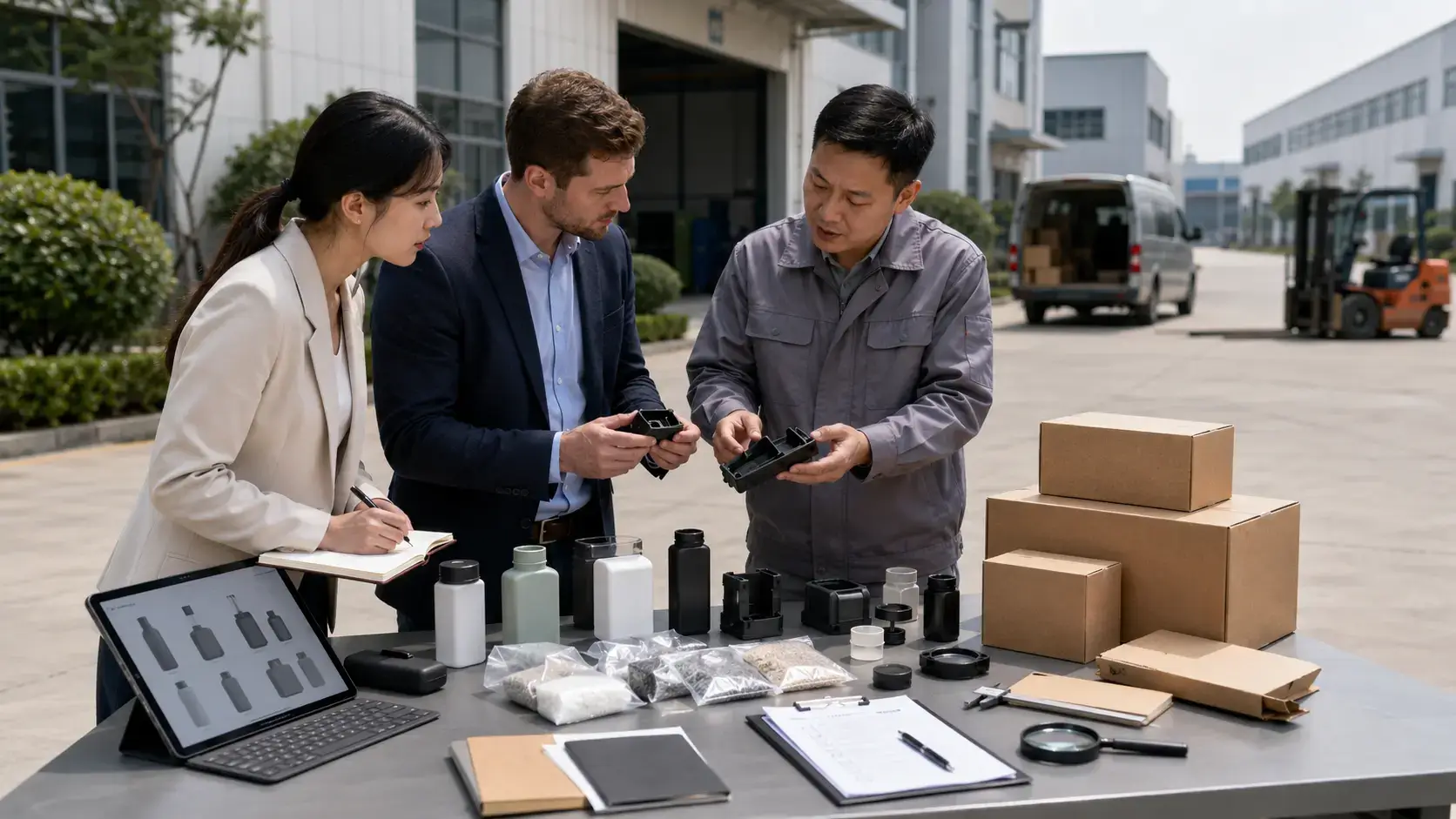
Finding a supplier and vetting a supplier are not two separate jobs. The information prepared before the search determines which companies appear suitable. The first conversations shape the shortlist. The RFQ then tests whether each candidate understands the requirement and can turn it into a workable offer. Only after that comparison is it worth spending more time and money on company verification, factory checks, samples, and onboarding.
This sequence matters because buyers rarely have unlimited time, travel budgets, or technical staff. A low-risk order for a standard item does not justify the same work as a custom electrical product with expensive tooling and mandatory safety requirements. The purpose of due diligence is to apply the right checks at the right time, then keep enough evidence to support the decision.[1]
The numerical examples below are illustrations, not fixed industry standards. Prices, lead times, payment terms, defect limits, and inspection plans must be adapted to the product and the buyer’s exposure.
Chapter 1: Sourcing Preparation and Planning
1. Define the Product Before Looking for Suppliers
An unclear requirement creates problems before a supplier has even been found. Search results become less relevant, quotations are based on different assumptions, and sample corrections multiply because each candidate has filled the gaps in its own way.
Consider a request for 5,000 stainless-steel parts. Without a grade, tolerance, finish, test method, packaging requirement, and destination market, one supplier may quote 304 stainless steel with export packaging while another prices a cheaper grade and an unfinished bulk pack. Both can claim to have answered the inquiry. The prices still describe different products.
A written product specification is therefore the starting point of the search, not a document to complete after a factory has been chosen. Buyers working from a product idea, drawing, sample, or target price can also review JS Sourcing’s product sourcing process.
Three practical ways to prepare the specification
Start from an established product. If the market already sells a standard item, obtain a legitimate public specification or an existing specification your company is entitled to use. Keep the established dimensions or performance levels that matter, then adapt the features, packaging, quantities, and target market to the project. This is usually the quickest route, but only when the buyer already knows which requirements are essential and which can remain standard.
Build it with the people who own the requirement. A technical product may need input from engineering, quality, marketing, logistics, and purchasing. Engineering may define material and tolerances, marketing may own appearance and retail packaging, quality may set tests and acceptance limits, and purchasing may add quantities, delivery timing, and commercial constraints. Larger organizations often take longer to release a specification, but a controlled internal review is still cheaper than correcting the product after tooling or production has started.
Build it from a template. When there is no suitable reference document or internal specialist, work from a structured template and fill it section by section. The exercise may expose questions that were not obvious at first: which process creates a critical finish, whether recycled material is permitted, how a dimension will be measured, or which subcontracted process must be declared. The work is slower, but it turns an idea into something a supplier can price and a buyer can later inspect.
The specification does not need to answer every imaginable question. It needs to remove the assumptions that could change product fit, cost, compliance, or delivery. For example:
- What material, dimensions, and performance limits define an acceptable product?
- Which tests, labels, and compliance documents apply in the destination market?
- What quantity, packaging, delivery point, and required date must the quotation cover?
- Which material, process, factory, or subcontractor may not change without approval?
For a machined part, “10 mm hole” may still be insufficient. A diameter of 10.00 mm with a tolerance of ±0.03 mm creates an acceptable range of 9.97 to 10.03 mm. That requirement affects equipment, inspection, yield, and price. It also gives the buyer a clear acceptance point when the sample arrives.
Keep the document set under control
The drawing, written specification, bill of materials, packaging file, and reference sample must tell the same story. Give each controlled document a version number and date. When an email changes a requirement, move the approved change into the formal document instead of leaving it inside a chat history.
The RFQ, sample approval, purchase order, factory file, and inspection checklist should refer to the same versions. If the RFQ used drawing V2 and the sample was approved against V4, production cannot start while the purchase order still lists V2. Old documents should be marked as cancelled, and the document hierarchy should state what takes priority if the drawing, sample, and written specification conflict.
This preparation saves more than sample costs. It makes supplier answers easier to compare, reduces repeated clarification, and gives competent suppliers a reason to take the project seriously. It also exposes unanswered buyer-side questions before a sales representative is waiting for a decision.
2. Set the Sourcing Plan and Risk Level
Once the product is defined, the buyer can decide how the search will be run. Set the target order quantity, price range, deadline, destination, required supplier type, compliance needs, and approval milestones before sending RFQs. Then decide which criteria are priorities and which are negotiable.
This plan becomes the reference point for later decisions. A low unit price may be attractive, but not if the supplier cannot meet the trial-order quantity. A direct factory may be preferred, but not if the project requires one party to coordinate several specialist processes. A short lead time may matter more than a small price difference when stock is already low.
Match the checks to the exposure
The table below is a planning guide rather than an official classification.
| Risk level | Typical situation | Likely safeguards |
|---|---|---|
| Low | Standard product, modest order, simple specification, easy replacement | Basic company and payment checks, written specification, suitable sample, and an inspection decision based on the order |
| Medium | Custom packaging, repeat orders, special performance, or meaningful tooling cost | Process review, pre-production sample, production records, change control, and inspection during or before shipment |
| High | Safety-related product, mandatory compliance, expensive tooling, large deposit, or long replacement time | Independent verification, factory audit, laboratory testing, pilot production, staged payments, continuity planning, and possible backup-source qualification |
Increase the work when failure could cause injury, customs rejection, a recall, a major customer claim, or a long interruption. Reduce it when the product is standard, easy to replace, and financially limited. Risk-based planning only works when the later checks actually follow the level chosen here.
Budget for sourcing and vetting
Supplier search has a cost even when no sourcing fee appears on an invoice. An internal search uses employee time, translation, subscriptions, sample freight, travel, technical review, quotation comparison, and project management. A trade fair adds transport, accommodation, and time away from regular work. Independent checks may add company-report, factory-visit, audit, inspection, and laboratory fees.
External help may be charged by project, task, hour, or order value. The relevant comparison is the complete scope and the control retained by the buyer, not the headline fee.
| Operating model | Main cost | Control question |
|---|---|---|
| Internal sourcing | Staff time, search tools, translation, travel, technical review, and follow-up | Does the team have enough time, language coverage, technical ability, and local access? |
| External agent | Project, task, hourly, or order-based fees | Will the buyer receive supplier identities, original quotations, evidence, and the right to make final decisions? |
| Mixed model | Internal product ownership plus local search, visits, or inspections | Are responsibilities, files, communication channels, and decision rights clearly divided? |
A small order for a common item may not justify full support. A custom product, several factories, a large deposit, or a difficult on-site check may. When Should You Hire a Sourcing Agent? examines that choice in more detail.
When an agent is used, agree at the start on access to the supplier’s legal name, factory address, original quotation, service fees, audit and inspection records, drawings, samples, and supplier files. External support adds control only when it reduces the buyer’s information gap.
By the end of Chapter 1, the buyer should know what is being sourced, how candidates will be judged, what the work may cost, and which risks justify deeper checks. Those decisions make the next stage a directed search instead of a collection of names.
Chapter 2: Finding and Shortlisting Suppliers
3. Find Supplier Candidates
Start the search with the product specification, but do not paste the entire file into every search box. Convert it into several search descriptions: the commercial product name, common alternatives, material, main manufacturing process, application, and any distinctive construction feature. A buyer looking for a welded steel enclosure, for example, may search by product, by fabrication process, and by the industries that use similar frames.
The objective is a longlist broad enough to show the market, not a race to send an RFQ to the first five results. Different channels reveal different suppliers and different kinds of evidence.
| Channel | Best use | Main blind spot | Buyer effort and cost |
|---|---|---|---|
| Export marketplaces | Fast discovery, common export terms, early product and MOQ indications | Ranking, membership, and advertising do not prove ownership of a factory or product fit | Low entry cost, but many profiles and answers need screening |
| Chinese domestic platforms | Factories and traders focused on the local market, local product vocabulary, and process clues | Prices may exclude export packaging, overseas compliance, English support, and export documents | Translation and stronger export-feasibility checks may be needed |
| Trade fairs and exhibitor lists | Comparing samples, meeting teams, and finding companies outside search rankings | A large booth or polished sample does not establish factory ownership or available capacity | Travel can be expensive; exhibitor-list research can begin remotely |
| Customs and shipment data | Finding exporters with visible shipment history and checking trade patterns | The exporter shown may be a trader, related company, or logistics entity rather than the manufacturer | Subscription and interpretation costs vary |
| Referrals | Finding suppliers outside paid rankings and learning how problems were handled | A good result for another buyer, product, or year may not transfer to this project | Low search cost, but the referral still needs independent checks |
| Sourcing agents and local specialists | Chinese-language search, local networks, visits, multi-factory projects, and regular follow-up | The buyer can lose transparency if identities, quotations, or commissions are hidden | Visible service cost, with value depending on access and scope |
Use at least two suitable channels where the order warrants it. The purpose is not to maximize the number of contacts. It is to avoid allowing one platform’s ranking system or one referral network to define the whole market.
Treat first contact as the start of evaluation
The first message should be brief enough to read and specific enough to show that the project is real. State the product, intended market, approximate quantity, timing, and the two or three requirements that will decide whether the supplier belongs in the search. Confidential drawings and full target costs can wait until identity, interest, and any required confidentiality agreement are in place.
Several avoidable mistakes weaken a search:
- Sending the same vague RFQ to dozens of companies, then trying to remember which answer came from whom.
- Recording only price and missing response time, technical fluency, questions asked, contradictory statements, and promised follow-up.
- Opening with a long demand for certificates, factory videos, customer lists, and the lowest price before giving the supplier enough project context to judge the opportunity.
- Treating a delayed answer as an automatic rejection without considering weekends, public holidays, trade fairs, travel, or the need for an engineer to review the request.
- Moving every discussion into platform chat, then losing the history or attachments when comparison and approval begin.
Create the candidate tracker before outreach. Use a stable email thread or another retrievable project record for important requirements, quotations, and confirmations. Platform chat can help with speed, but the final answer to a critical point should be moved into the supplier file.
4. Draw Supplier Profiles and Build the RFQ Shortlist
A longlist becomes useful only when each candidate is described in the same way. The profile does not need a full audit at this stage. It needs enough information to confirm basic product fit, expose obvious inconsistencies, and decide who deserves an RFQ.
Record the registered or declared company name, location, business model, main products, relevant processes, export experience, approximate MOQ, sample capability, early lead-time indication, and the name of the person answering technical questions. Add the source of each fact. “Factory” written on a marketplace profile is a claim; a business licence, consistent address, equipment evidence, and later visit carry different weight.
| Profile field | What to record before the RFQ |
|---|---|
| Identity | English sales name, registered Chinese name if available, address, website, and source channel |
| Product fit | Main products, similar models, materials, processes, and relevant completed work |
| Business model | Factory, trader, exporter, or a combination, including any declared production partner |
| Commercial fit | Approximate MOQ, sample terms, target quantity acceptance, and early lead-time range |
| Evidence | Business licence, product records, test reports, factory images or video, and the company named on each |
| Interaction | Response time, questions asked, technical understanding, consistency, and follow-up |
Basic risk screening begins here. Compare names, addresses, phone numbers, certificate holders, factory images, and bank information if it has already been provided. Different candidates may be sales companies representing the same factory. A factory and an exporter may also be related companies. Neither situation is automatically wrong, but it changes the choice and must be visible in the profile.
Remove candidates that will not identify the legal company, cannot confirm the target quantity, provide certificates for unrelated products, hide a process that is critical to performance, or repeatedly change basic explanations. Also remove companies whose product fit exists only in keywords and copied photos.
The result should be a manageable RFQ group, often five to eight candidates for a normal project, with the number adjusted to product complexity and market depth. At this point the buyer is not declaring any supplier approved. The shortlist simply identifies the companies worth comparing under the same commercial and technical request.
Chapter 3: The RFQ as Part of Supplier Vetting
5. Move from RFQ Launch to Final Offer
The RFQ is the first structured check of import feasibility. It asks whether a candidate can translate the buyer’s specification into a product, price, quantity, lead time, delivery term, and set of responsibilities that work together.
The answer is more informative than the unit price. It shows which requirements the supplier noticed, where it made assumptions, whether it can explain the process, and how it handles a question that requires input from engineering, production, or quality. A close answer is evidence that the supplier understood the request. It is not yet proof that normal production will comply.
Experienced purchasing teams often have quotation sheets and cost models that expose gaps quickly. New buyers can obtain the same discipline by using one comparison file, recording assumptions, and refusing to compare figures until the commercial basis is aligned.
5.1 Standardize the quotations
Even when the buyer sends a template, some suppliers will answer in their own format or complete only part of it. Export sales teams handle many inquiries, and a quotation that requires several departments may arrive in pieces. The buyer still needs one common record.
Normalize the offer in two passes. First confirm the core product and order basis: model, material, size, color, quantity, packaging, testing, destination, Incoterm, and lead time. Then capture the details that explain risk and cost: manufacturing process, critical subcontracting, test frequency, tooling ownership, exclusions, price validity, and warranty assumptions.
| RFQ field | Supplier A | Supplier B | Supplier C |
|---|---|---|---|
| Product and specification version | |||
| Material and permitted alternative | |||
| MOQ and trial quantity | |||
| Unit price, currency, and validity | |||
| Tooling, sample, test, and certification fees | |||
| Packaging, labels, and spare units | |||
| Incoterm and named place | |||
| Payment terms | |||
| Full lead time | |||
| Exclusions and open questions |
Incoterms allocate important delivery tasks, costs, and risks, but the rule must be paired with the correct named place or port.[4] “FOB” without a port or “DAP” without a destination leaves part of the comparison undefined.
Keep the working quotation, clarification emails, and revised offer together. Chat is useful for reminders and quick questions, but the approved answer to a material, compliance, price, or delivery point should remain retrievable after the salesperson, platform account, or project team changes.
5.2 Compare what the quotation reveals
RFQ comparison is part of vetting because it reveals how the supplier interprets the job. Look beyond costing:
- Does the offer refer to the correct drawing and specification versions?
- Are material, dimensions, tests, packaging, and compliance requirements confirmed or excluded?
- Can the supplier explain the process, equipment, inspection method, and critical subcontracting?
- Are the MOQ, sample method, lead time, payment terms, and warranty compatible with the buyer’s plan?
- Does the supplier identify assumptions and ask useful questions, or simply confirm everything?
- Do certificates, product records, factory images, or references relate to the actual product and legal company?
Test technical understanding on the few requirements most likely to fail. Send one critical requirement, ask the supplier to restate it, then ask which process and equipment will achieve it, how it will be checked, what record will remain, and what happens outside the limit. For the 10.00 mm hole with a tolerance of ±0.03 mm, an answer that names the measuring tool, frequency, 9.97 to 10.03 mm range, and rejection action is more useful than “no problem.”
Compare total cost, not only unit price
One supplier may include export packaging and another may not. One may quote a low unit price with a high MOQ, while another costs slightly more per piece but permits a safer trial order.
| Item | Supplier A | Supplier B |
|---|---|---|
| Unit price | USD 2.40 | USD 2.55 |
| MOQ | 10,000 pieces | 3,000 pieces |
| First-order product value | USD 24,000 | USD 7,650 |
Supplier A is about 5.9% cheaper per unit, but requires USD 16,350 more product spending on the first order. For an untested item, the smaller commitment may be worth more than the unit-price saving.
Total first-order cost can also include tooling, development, samples, testing, inspection, reinspection, packaging, transport, import charges, storage, rework, replacement, and delay. Costs that cannot be estimated precisely should still be recorded as exposure instead of being treated as zero.
Check price validity and the full lead time
Ask what material basis, currency assumption, and validity period support the price. National data can help identify questions, but it does not validate one factory’s quotation. China’s National Bureau of Statistics reported a 73.5% capacity-utilization rate for manufacturing enterprises above the designated size in Q2 2026, with wide differences among listed industries.[5] Its June 2026 data also showed sharply different purchasing-price movements across input categories.[6]
These figures are context, not supplier evidence. A buyer still needs the quotation basis, current material position, open orders, price-change trigger, and a clear explanation for any revision.
Lead time requires the same treatment. A quoted “12-day production time” may exclude seven days for material purchase, five for tooling setup, three for inspection and rework allowance, and two for packing. The shipment-ready time in that example is 29 days. Ask for the start and finish of the important stages and identify which date begins the count.
5.3 Select the final contenders
At the end of the RFQ process, compare the normalized offers with the objectives and risk priorities established in Chapter 1. Include the notes collected since first contact. A technically complete quotation from a responsive team may deserve deeper review even when it is not the cheapest. A low offer built on missing tests, an unsuitable MOQ, or an unexplained material change may not.
A normal project can move forward with three final contenders. Treat that number as an operating target, not a rule. Two may be enough in a narrow qualified market; a strategic or high-risk program may keep four until factory evidence and samples separate them.
The finalists should have plausible product fit, a commercially workable offer, no unresolved basic identity problem, and enough cooperation to support deeper checks. Expensive verification should now focus on these companies rather than the entire longlist.
Chapter 4: Post-RFQ Vetting and Supplier Onboarding
6. Verify the Legal, Factory, Export, and Payment Structure
The post-RFQ review should confirm that the company behind the attractive offer exists, that the responsible entities are known, and that the payment route matches the agreed structure. International Trade Administration guidance recommends conducting due diligence before entering a foreign business relationship and continuing it as the relationship develops.[2]
In China, the English sales identity, registered Chinese company, factory operator, exporter, contract signer, and bank beneficiary may not all be the same entity. This is not unique to China and can be legitimate. The practical difficulty is that a distant buyer may meet one sales company while production, contracting, export, and payment involve others. The relationship and responsibility for defects, refunds, replacement, and warranty must be documented before money moves.
Obtain the Chinese business licence, registered Chinese name, Unified Social Credit Code, registered and factory addresses, legal representative, establishment date, business scope, export entity, contracting company, and bank beneficiary. The Unified Social Credit Code is the organization’s unique identity code and appears on its business licence.[3] A valid licence proves neither factory ownership nor current product capability, so it is the beginning of verification rather than its conclusion.
Build a simple relationship map and attach the evidence:
| Role | Company | Evidence and relationship |
|---|---|---|
| Factory | Company A | Licence, factory address, site evidence |
| Exporter | Company B | Export documents or documented export arrangement |
| Contract signer | Company B | Quotation, contract, company stamp |
| Bank beneficiary | Company B | Bank details in the signed contract |
| Relationship | A and B | Common ownership, subsidiary documents, or written operating agreement |
Compare registration numbers, addresses, company stamps, bank details, certificates, quotations, contracts, invoices, and audit reports. A clear relationship can proceed. Related companies with unclear responsibility need clarification. Repeatedly changing explanations require a pause. An unsupported beneficiary should not be paid.
If bank information changes, stop the payment and verify the change through a previously confirmed contact route. Do not rely only on the email thread announcing the change. Business Email Compromise messages can appear to come from a known supplier or employee, and the FBI recommends independently checking changes to account numbers or payment procedures.[9]
7. Verify How and Where the Product Will Be Made
The next question is no longer “Can this supplier quote?” It is “Can this production system deliver the quoted product repeatedly?”
Start by mapping the process. Asking whether the candidate is a factory is too crude. A manufacturer may outsource heat treatment, coating, electronics, or packaging. A trading company may coordinate several qualified specialists. Record each critical step, its location, responsible company, equipment, records, and approval control.
| Process | Location | Responsible company | Evidence |
|---|---|---|---|
| Material receipt | Main factory | Supplier | Material certificate and incoming-inspection record |
| Machining | Main factory | Supplier | Machine list, production record, and measurement record |
| Heat treatment | Outside facility | Subcontractor | Batch report and process certificate |
| Final inspection | Main factory | Supplier | Final-inspection report |
Confirm which equipment is owned, rented, or unavailable. Ask who approves subcontractors, who inspects their work, where records are kept, and whether the production site can change without written approval. Direct manufacturing can be valuable when one process controls performance or engineering changes are frequent. A trader may be useful when several product groups or specialist factories must be coordinated. The better model is the one that gives the buyer sufficient competence, access, and control.
Verify compliance evidence
A familiar logo or standard number is not enough. Check the company and model named on the report, the tested materials and components, the product photos, the standard and version, the laboratory or certification body, the report number, and the destination market. Ask for the complete report rather than only its cover.
ISO develops standards but does not issue company certificates; certification is performed by external certification bodies.[7] An ISO 9001 certificate may support confidence in a management system, but it does not prove that a particular product complies with the buyer’s specification or law.
CE marking also depends on the product and applicable EU legislation. Not every product requires it, and not every CE-marked product requires a third-party certificate. The manufacturer must identify the rules, complete the required conformity assessment, prepare technical documentation, and issue an EU Declaration of Conformity when required.[8]
Audit the factory where the risk justifies it
A company check confirms legal information. A factory audit examines the site, equipment, processes, records, and quality system. A product inspection checks a particular order. Laboratory testing checks defined material, performance, safety, or legal requirements. They answer different questions.
JS Sourcing’s factory audit guide gives a fuller audit preparation and follow-up method. For this selection decision, the audit should concentrate on what the RFQ and risk plan made important: required equipment, achievable tolerances, material identification, calibrated measuring tools where needed, rejected-product control, work instructions, inspection records, subcontracting, current orders, and quality authority.
Every serious finding needs a description, immediate containment, root cause, permanent correction, responsible person, due date, evidence, and follow-up result. A long audit checklist is less useful than a short list of unresolved findings that can affect the order.
Check demonstrated and available capacity
A salesperson’s monthly capacity figure may describe theoretical output rather than output available to the buyer. Separate four ideas:
- Rated capacity under ideal assumptions.
- Demonstrated output from comparable production records.
- Good output after yield, setup, changeover, and maintenance losses.
- Available capacity after existing orders and material constraints.
If theoretical output is 1,000 pieces per day, a 90% good-product rate reduces it to 900. A further 10% loss for setup and maintenance reduces usable output to about 810 pieces per day. Existing commitments may reduce what is available for the new order again.
Ask for dated plans, machine lists, production records, maintenance schedules, material status, cycle time, yield, and changeover information. Then identify the slowest step. That bottleneck, rather than the fastest machine on the floor, limits the line.
Capacity also has a continuity side. One raw-material source, one critical machine, weak tooling-transfer rights, or a long replacement time can make a capable factory fragile. Depending on the risk, approve an alternative material source, check backup equipment, secure tooling and technical files, qualify a second supplier, or hold safety stock.
Use AI as an organizer, not as proof
AI can expand search terms, organize candidate files, compare quotation fields, translate replies, and flag missing information. It cannot prove that a company owns a site, that an exporter made the goods, or that an old profile reflects current capacity.
NIST’s supplier due-diligence guidance emphasizes ownership, provenance, stability, and supply-chain relationships, although the publication is mainly written for information and communications technology suppliers.[10] For an important AI-assisted finding, keep the original source, source date, exact legal company, missing information, and independent verification status. Do not upload confidential drawings, target costs, customer information, formulas, or unreleased plans without first checking the service’s data terms.
8. Approve a Production-Relevant Sample
A good sample can still mislead. It may have been made by a senior technician, from selected material, on different equipment, or at another factory. The buyer needs to know what kind of sample was requested and what its approval actually proves.
| Sample stage | What it should establish |
|---|---|
| Reference sample | Target appearance, size, function, or finish |
| Engineering sample | Whether the design can work and which changes are needed |
| Pre-production sample | Product made with the planned material, tooling, process, and production site |
| Golden sample | An identified physical reference retained by both parties for agreed attributes |
| Pilot batch | A small run under normal production conditions to test repeatability and controls |
The term “golden sample” can mean different things by industry and company. Record the sample identification number, drawing and specification versions, material and source, measurements, test results, appearance, packaging, approved differences, process, location, and approval dates.
Before approving it, ask who made the sample, where it was made, which equipment and material batch were used, and what will change during the full order. When a custom product or high-risk process is involved, the pre-production sample or pilot batch is more relevant than a hand-finished showroom sample.
Sample approval is also where earlier document discipline pays off. The approved sample, purchase order, factory instruction, and inspection checklist must point to the same product definition. Otherwise a technically good sample can coexist with an uncontrolled production file.
9. Turn Vetting Findings into Onboarding Controls
Vetting is complete only when its findings change the way the first order is run. A factory report that identifies subcontracted coating has little value if the purchase order still allows the production site to change without approval. A passed sample has little value if the inspection checklist uses another drawing version.
Put the important controls in writing
The contract, quality agreement, specification, or purchase order should identify the responsible legal entity, approved documents, material, production site, critical subcontractors, tooling ownership, inspection and testing rights, required records, change-approval process, rework and replacement duties, delivery and warranty terms, payment stages, and dispute process. Incoterms do not replace a complete sales contract, and important international orders may require qualified legal advice.
When the supplier proposes a material, component, process, factory, subcontractor, tool, or packaging change, require a written request. It should state what changes, why, which orders are affected, the effect on function and compliance, supporting test evidence, whether a new sample is required, who approved it, and when it becomes effective.
Choose inspection points from the failure mode
A final inspection can find a problem after the whole batch is complete. The risk plan should decide whether checks are needed at material receipt, first article, during production, pre-shipment, loading, or in a laboratory.
A During Production Inspection checks semi-finished and finished goods while repeated problems can still be corrected. A Pre-Shipment Inspection checks the completed order before final payment or shipment release. Container Loading Supervision records what is loaded, the quantity, carton and container condition, loading process, and seal information.
Before production, define the sample size, test method, defect categories, acceptance limits, required documents, reinspection rule, and response to failure.
Link approval and payment to evidence
Where the commercial negotiation allows it, payment stages can follow decision gates. An initial payment may require legal, bank, contract, and specification approval. A tooling or production payment may follow a first article or pilot batch. Final payment may depend on inspection and required documents.
The familiar 20%, 30%, and 50% structure is only one example. The actual split depends on order value, tooling cost, supplier bargaining power, payment protection, and product risk. The principle is more important than the percentages: the buyer should not release the next stage of money while the evidence required for that stage remains unresolved.
Complete the supplier handover
Create one supplier file containing the confirmed entities, approved specification, drawings and sample, production sites and subcontractors, tooling details, required records, inspection plan, payment gates, change process, export arrangement, and claims process.
Name the operational contacts for commercial terms, engineering, quality, production planning, payment, shipping documents, and serious escalation. This prevents important requirements from remaining only with the salesperson who handled the RFQ.
10. Approve in Stages
A weighted scorecard can compare finalists, but mandatory red flags must sit outside the score. An unexplained bank beneficiary, false compliance report, hidden production site, or refusal to identify the legal company should not be cancelled out by good price and communication scores.
Use staged approval to make the remaining uncertainty visible:
| Stage | Minimum result |
|---|---|
| Contact approved | The candidate fits the basic product, quantity, and timing need |
| RFQ approved | The offer answers the common technical and commercial request, with assumptions identified |
| Verification approved | Legal entities, payment structure, production path, key equipment, and critical evidence are clear |
| Sample approved | The identified sample passes the agreed checks against controlled documents |
| Trial order approved | A limited order can start under written production, inspection, payment, and change controls |
| Repeat order approved | Actual quality, delivery, documentation, and problem handling support another order |
The trial order remains part of supplier approval. Track on-time delivery, defects, rework, document accuracy, corrective-action response, unauthorized changes, price stability, and advance warning of problems. A supplier that passed the audit but failed the order has supplied new evidence. Repeat important checks when the factory moves, order volume rises sharply, a critical process changes, a compliance document expires, or the payment structure changes.
Conclusion
A sound supplier decision is built in sequence. Define the product, set priorities and risk, search through suitable channels, keep comparable candidate profiles, and launch the same RFQ to a controlled shortlist. Use the answers to identify the finalists, then spend the deeper vetting budget on legal and payment verification, production mapping, compliance evidence, capacity, the factory, and a production-relevant sample.
The final decision should not rest on a marketplace badge, the lowest unit price, or one polished sample. It should rest on a connected file of requirements, answers, documents, site evidence, sample results, commercial terms, and first-order controls. That structure does not remove supplier risk. It makes the remaining risk visible early enough for the buyer to accept it, control it, or choose another supplier.