Product sourcing in China works by turning a product idea into a controlled purchase. The buyer defines the product, checks the rules for the destination market, finds and verifies suppliers, compares like-for-like quotations, approves samples, signs clear order terms, checks production, inspects the goods, and arranges shipping and customs clearance.
The process is not mainly about finding the lowest factory price. A safe order depends on clear specifications, verified suppliers, controlled materials, useful test evidence, and payment stages linked to work that can be checked. Businesses that do not have staff in China may use a local product sourcing service to manage supplier searches, samples, production follow-up, inspection, and shipping.

Define the Product Before Asking for Prices
Do not send suppliers only a photo and ask for the “best price.” A photo shows the appearance, but it does not define the material, size, tolerance, function, packaging, quality level, or test method. Two products can look the same while using different grades, thicknesses, components, finishes, and packing.
Prepare a written specification that includes:
- product name and intended use;
- target user and destination country;
- dimensions, weight, and tolerances;
- material, grade, thickness, and finish;
- performance and service-life requirements;
- critical components and approved models;
- logo, printing, color, labels, and barcodes;
- retail packaging and export-carton requirements;
- order quantity and product variants;
- required tests, reports, declarations, and certificates.
For products with several important parts, add a bill of materials or a critical-component list. For an electronic product, this may include the battery cell, power adapter, wireless module, PCB revision, plastic resin, cable, firmware version, and safety parts. This makes it harder for a supplier to replace an important component without approval.
Use measurable requirements. Replace “strong stainless steel” with “304 stainless steel, minimum finished thickness 1.2 mm at the stated measurement points.” Replace “strong carton” with a stated board grade, maximum gross weight, closure method, and packing test. The number of carton layers alone does not prove that the carton is strong enough.
Small specification changes can materially affect cost and performance. For example, increasing a uniform steel thickness from 0.8 mm to 1.2 mm uses 50% more metal for the same surface area before allowing for forming waste. The two versions may look almost identical in supplier photos, which is why thickness must be written and measured.
For color, use an approved physical sample and state the material, gloss, lighting, and viewing method. A Pantone reference can help communication, but it is not a complete acceptance method for every plastic, metal, textile, silicone, or coated surface.
Mark each requirement as:
- Must-have: safety, legal, functional, installation, compatibility, or key branding requirements;
- Preferred: useful features that may be adjusted if cost or production difficulty is too high;
- Optional: features that can be removed without changing the product’s main value.
Give every specification, drawing, artwork file, packaging layout, and component list a version number and date. When a file changes, record what changed, who approved it, whether the price or delivery date changed, and whether testing must be repeated.
Check Product Rules Before Choosing the Final Supplier
The factory may know how to make the product but may not know the legal duties of the importer, brand owner, or seller in the destination market. Check the exact product category, intended user, sales channel, country, and state or local rules before freezing the design.
For U.S. consumer products, testing and certification duties depend on the product and the rules enforced by the Consumer Product Safety Commission.[1] Children’s products covered by CPSC rules generally require testing by a CPSC-accepted third-party laboratory, followed by a Children’s Product Certificate prepared by the responsible U.S. manufacturer or importer.[2] Certain regulated general-use products require a General Certificate of Conformity based on testing or a reasonable testing program.[3]
Since July 8, 2026, CPSC eFiling is in effect for imported consumer products that require certification. Certificate data must be filed electronically before the products enter U.S. commerce. The rule for products entered from a U.S. Foreign Trade Zone for consumption or warehousing takes effect on January 8, 2027.[4]
In the EU, the General Product Safety Regulation has applied since December 13, 2024. Products within its scope must meet the regulation’s safety, traceability, reporting, and economic-operator requirements.[5] Product-specific laws may also apply to toys, electrical equipment, radio products, machinery, batteries, personal protective equipment, cosmetics, medical devices, and other regulated goods.
CE marking is required only when the product is covered by EU rules that specifically require it. It is not a general certificate, and there is no central EU office that simply approves every CE-marked product.[6]
Depending on the product, check:
- electrical safety and electromagnetic compatibility;
- radio and wireless requirements;
- chemical and material restrictions;
- food-contact rules;
- toy and children’s-product rules;
- battery and dangerous-goods requirements;
- textile, care, warning, and language labels;
- recycling and extended producer responsibility;
- traceability, online-listing, reporting, and recall duties.
Do not accept the question “Do you have CE?” as a full compliance check. Ask which exact model was tested, which law and standard were used, which laboratory issued the report, whether the factory and components match, and whether the customized version remains covered.
Compare the test report with the planned product. Check the model number, photo, voltage, dimensions, material, battery, adapter, PCB, wireless module, manufacturer, factory address, sample date, standard, and page count. A report for a similar model does not automatically cover a changed battery, resin, coating, adhesive, firmware, load-bearing part, or safety component.
Add testing, sample shipping, technical files, label review, retesting, registration, and responsible-person services to the budget before deciding whether the product is profitable.
Find Suppliers That Match the Product and Process
Use more than one supplier channel. Common options include B2B marketplaces, trade fairs, search engines, industry directories, referrals, manufacturing clusters, and a local China sourcing company. A broader sourcing service may also help with quotations, factory checks, quality control, consolidation, and logistics.
Search by manufacturing process and material, not only by retail product name. A search for “custom kitchen organizer” may return many traders. Searches such as “stainless steel fabrication,” “wire forming,” “injection molding,” “die casting,” “CNC machining,” “PCB assembly,” or “silicone compression molding” are more likely to identify relevant production capability.
Choose the sourcing route that fits the order:
- Direct factory: suitable when the specification is clear, the quantity is attractive, and the buyer can manage quality, compliance, and logistics;
- Trading company: useful for mixed products, smaller quantities, communication, or consolidation, provided the real factory and responsibilities are disclosed;
- Sourcing company: useful when the buyer needs local supplier searches, quote comparison, samples, inspections, production follow-up, and shipping support.
For a common consumer product, a longlist of 10 to 20 suppliers may be practical. A specialized industrial product may have far fewer qualified options. Remove suppliers that cannot answer basic technical questions, refuse to provide company documents, give incomplete quotations, hide subcontracting, push for immediate payment, or send reports that do not match the product.
For example, a buyer may start with 12 suppliers. After removing four that do not make the required product, three with incomplete quotations, and two that cannot verify the production site, only three serious candidates remain. This is a screening example, not a fixed supplier target.
MOQ is often caused by raw-material purchases, machine setup, printing, color mixing, packaging quantities, component supplier minimums, or line-change costs. Ask what creates the MOQ. A smaller first order may be possible by using a standard color, existing tooling, plain packaging with a label, fewer models, or a paid setup fee.
Product and packaging MOQs may be different. If a factory accepts 500 products but the printed-box supplier requires 2,000 boxes, the buyer is purchasing packaging for four production batches. At an illustrative cost of $0.35 per box, the unused 1,500 boxes tie up $525 before storage, damage, or artwork changes are considered.
Verify the Company, Factory, and Bank Account
Supplier verification should cover three separate questions:
- Is the company legally registered?
- Can the factory make the product?
- Is the supplier commercially reliable?
Request the Chinese business license and check the legal name, registration number, address, legal representative, establishment date, business status, and business scope. Registered capital is only a company-record item; it does not prove cash, capacity, or credit quality.
Compare the names on the business license, quotation, contract, invoice, bank account, and export documents. If different companies are involved, record which one manufactures, sells, receives payment, exports, owns the tooling, provides compliance documents, and handles defects.
Do not pay a personal bank account for a normal commercial order unless the arrangement has been independently reviewed and fully documented. Treat every bank-account change as high risk. Confirm it through a previously known phone number or messaging account, not only through the email that requested the change.
A real manufacturer should be able to explain its materials, machines, process, cycle time, shifts, bottlenecks, test equipment, typical defects, subcontracted work, and realistic lead time. A daily-capacity number means little unless it is linked to machine count, cycle time, shifts, other orders, and material availability.
For a first order, high-value order, safety-sensitive product, or complex process, arrange an independent factory audit or inspection service in China. Check the production floor, machinery, material storage, testing area, rejected-goods area, warehouse, calibration records, work instructions, batch records, and subcontractors. A showroom is not proof of manufacturing ability.
Compare Complete Quotations, Not Headline Prices
Send the same RFQ and specification to every shortlisted supplier. Ask each supplier to state:
- unit price and MOQ;
- material grade, thickness, weight, and components;
- sample, mold, setup, printing, and packaging fees;
- testing and inspection costs;
- production lead time and quotation validity;
- payment terms;
- Incoterm, edition, and named place;
- inland transport and export charges.
Normalize every quotation before comparing it. EXW, FCA, FOB, CIF, and DDP prices cannot be compared directly because they include different costs, delivery points, and responsibilities.
An unusually low price may come from thinner material, a lower grade, cheaper parts, recycled content, missing tests, weak packaging, or unrealistic freight. It may also be valid if the factory has existing tooling, better purchasing power, an efficient process, or unused capacity. Ask for the reason instead of accepting or rejecting the price immediately.
For example, Supplier A may quote $4.80 per unit while Supplier B quotes $5.20. If Supplier A later adds $0.25 for stronger packaging, $0.20 for the specified material, and $0.15 for test support, its comparable price becomes $5.40. The original lowest quotation is then $0.20 higher than Supplier B.
| Item | Supplier A | Supplier B | Supplier C |
|---|---|---|---|
| Unit price | |||
| Material and grade | |||
| Product weight | |||
| MOQ | |||
| Tooling and setup | |||
| Packaging | |||
| Sample lead time | |||
| Production lead time | |||
| Payment terms | |||
| Incoterm and named place | |||
| Test evidence | |||
| Total comparable cost | |||
| Main risk |
Approve a Sample That Represents Mass Production
A stock sample shows general workmanship. A custom sample shows some requested changes. A pre-production sample should use the intended materials, components, tooling, and process. The final approved physical reference is often called the golden sample.
Ask how the sample was made. Confirm the factory, tooling, materials, components, handmade work, borrowed parts, and packaging. A hand-finished sample may look better than normal production.
Check the sample against the written specification. Measure size and weight, verify materials, test function, inspect finish and edges, check labels and barcodes, and test the product as a customer will use it. Depending on the product, this may include washing, load testing, charging, cycling, opening and closing, water exposure, sunlight exposure, assembly, fit checks, or packed drop tests.
Record the sample version, date, factory, measurements, photos, test results, approved features, rejected features, and required changes. Keep one approved sample and require the factory to keep an identical controlled sample.
A sample review may find five issues, such as two cosmetic defects, two functional problems, and one packaging weakness. Correcting the functional and packaging problems before production can prevent the same failures from being repeated across an order of 2,000 units.
Tooling and sample-development fees may need to be paid before the final sample exists. Keep these payments separate from the mass-production deposit. Release the production deposit only after the final specification and required production sample are approved.
Set Quality Rules Before Production Starts
Do not wait until final inspection to decide what counts as a defect. Define defects and tests before the purchase order is released.
- Critical defect: a safety risk, legal failure, or serious hazard. Examples include exposed wiring, the wrong voltage, a dangerous sharp point, or a missing mandatory warning;
- Major defect: a problem that affects function, saleability, assembly, branding, or customer use;
- Minor defect: a limited cosmetic issue that does not affect normal use.
Define the defect location, maximum size, permitted quantity, viewing distance, lighting, test method, and reference sample. Photos and boundary samples reduce arguments about words such as “small scratch” or “acceptable color.”
AQL means acceptance quality limit. It is a parameter used to select an acceptance-sampling plan; it is not the inspection method itself. The current ISO 2859-1:2026 standard provides sampling schemes indexed by AQL for lot-by-lot inspection.[7]
An AQL value is not permission to ship a known percentage of defects, and a passing sample does not prove that every unit is correct. State the standard and edition, lot size, inspection level, sample size, defect classes, AQL values, functional-test quantities, and packaging tests.
For example, if an agreed sampling plan calls for 80 units to be inspected from a 2,000-unit lot, the remaining 1,920 units have not been individually checked. The shipment decision is based on the agreed plan and the results found in the sample, not on a claim that every unit passed.
Defects can also be converted into money. In an illustrative 2,000-unit order, a 3% defect rate equals 60 units. If each affected unit costs $8.60 landed plus $6 for customer handling and replacement shipping, the direct cost is 60 × $14.60 = $876, before refunds, lost sales, or negative reviews.
Some critical features may need a 100% check, such as plug type, voltage, safety labels, serial numbers, leak tests, or barcode readability. A 100% check still depends on the quality of the test method, equipment, and operator.
Create an approved material and component list. Require written approval before changing a material, component, factory, subcontractor, firmware, artwork, label, or packaging. Every change request should explain the reason, proposed replacement, effect on function and compliance, price, delivery date, and need for new testing or sample approval.
Use a Clear Contract and Stage-Based Payments
The purchase order and contract should use the supplier’s correct legal name and attach the latest product documents. Include:
- specification and revision number;
- approved sample reference;
- quantity, variants, price, and currency;
- tooling cost, ownership, storage, maintenance, and permitted use;
- payment stages;
- production and delivery dates;
- Incoterm, edition, and named place;
- testing, inspection, packaging, and labeling requirements;
- approved materials and change-control rules;
- subcontracting limits;
- rework, sorting, reinspection, replacement, refund, and delay remedies;
- intellectual-property and dispute terms.
Do not rely on “good quality” or “same as sample.” Link each important requirement to a document, test, inspection method, and remedy.
For molds, dies, jigs, fixtures, and gauges, state who owns them, where they are stored, who may use them, who maintains them, whether they may be moved, and what happens when the relationship ends. Paying a mold invoice does not by itself give the buyer practical control over the mold.
Register important trademarks before widely sharing a new brand. WIPO’s Madrid System can simplify applications and management across participating territories, but each designated country or region still applies its own law when deciding protection.[8]
Separate sample or tooling payments from the mass-production deposit. Link later payments to evidence. For example, on a $20,000 order, a 30% production deposit equals $6,000 and leaves a $14,000 balance. This is only a payment example, not a standard term. Paying the full balance before reviewing inspection results removes most of the buyer’s remaining commercial leverage.
- Before production deposit: verified supplier, approved bank account, signed order, final specification, sample status, compliance plan, and production schedule;
- Before balance payment: production completion, inspection report, test reports, corrected defects, quantity, packaging, and checked shipping documents.
Do not pay the balance only because an inspection report says “pass.” Read the defect photos, measurements, test results, sample size, and corrective-action notes.
Monitor Production and Inspect at the Right Time
Build the schedule backward from the required warehouse or launch date. Include material purchasing, tooling, samples, testing, production, packing, inspection, correction, reinspection, export handling, transport, customs, and local delivery.
Clarify when production lead time starts. Some factories start counting only after receiving the deposit, final artwork, approved sample, and material confirmation.
Build dates backward with real numbers. If goods must reach the warehouse on October 1, and the plan allows 35 days for transport and destination handling, 7 days for inspection and correction, 30 days for production, and 14 days for materials, the order needs to be released around July 7 before adding any safety buffer. This is a planning example, not a fixed China lead time.
| Stage | Evidence to Request |
|---|---|
| Materials ordered | Purchase or supplier confirmation |
| Materials received | Incoming inspection record |
| First production units | Photos, measurements, and test results |
| Production checkpoint | Completed quantity and defect report |
| Packing starts | Packaging, label, and carton photos |
| Production complete | Final quantity report |
| Final inspection | Independent inspection report |
| Shipment booked | Booking confirmation |
For new suppliers, custom materials, expensive parts, new tooling, strict colors, or safety-sensitive goods, check early production. A pre-production inspection can check materials, tooling, equipment, approved samples, and production readiness. A during-production inspection can find defects while the factory still has time to correct the remaining batch.
A final pre-shipment inspection should be carried out when enough goods are finished and packed to represent the shipment. The inspector should receive the final specification directly from the buyer, not only from the factory.
The final inspection may check quantity, workmanship, dimensions, weight, function, accessories, labels, barcodes, retail packaging, cartons, shipping marks, and agreed on-site tests. It does not normally replace laboratory testing for chemical, radio, flammability, battery, food-contact, or advanced electrical requirements.
If the inspection fails, require the affected quantity, root cause, rework method, records, and reinspection evidence. Photos of a few corrected units do not prove that the full batch was corrected. For high-value or consolidated cargo, container loading supervision can check carton quantities, container condition, loading, and seal details.
Choose the Incoterm and Transport Method Carefully
Incoterms define delivery points, risk transfer, cost allocation, and selected transport and customs duties between buyer and seller. Incoterms 2020 contains 11 rules.[9] They do not define product quality, payment timing, ownership, or remedies for defective goods.
Always write the rule, named place, and edition, for example:
FCA Shenzhen, China, Incoterms 2020.
- EXW: the buyer takes on most transport and export work from the seller’s premises. It may be difficult for an overseas buyer that cannot manage Chinese export formalities;
- FCA: the seller delivers to the agreed carrier or place and handles export clearance. It works with any mode of transport;
- FOB: used only for sea or inland-waterway transport, with delivery on board the vessel at the named port;
- CIF: the seller pays freight and minimum required insurance to the destination port, but risk transfers earlier under the rule;
- DDP: the seller takes major delivery and import duties, but the buyer must still understand the importer of record, declared value, tariff code, tax, and compliance setup.
For containerized or multimodal cargo handed to a carrier before vessel loading, FCA often gives a clearer delivery point than FOB.[10]
Compare the full transport cost, not only the main freight. Include pickup, export charges, surcharges, destination handling, customs clearance, storage, insurance, and final delivery. Businesses that need freight coordination can use a shipping service from China.
Packaging dimensions can change freight and storage costs. Reducing a retail box from 40 × 30 × 20 cm to 36 × 28 × 18 cm cuts its volume from 24,000 cm³ to 18,144 cm³, a reduction of about 24%. The smaller box must still protect the product and pass the agreed packing tests.
Carton packing also matters. If a carton originally holds 8 units, 1,000 products require 125 cartons. If a safe packaging change allows 10 units per carton, the same order requires 100 cartons, reducing the carton count by 25 without changing the order quantity.
Confirm carrier acceptance before production ends for lithium batteries, liquids, magnets, chemicals, aerosols, oversized goods, fragile goods, temperature-sensitive cargo, or wood packaging.
Calculate Landed Cost Before Confirming the Order
Landed cost is more useful than factory price. Include:
- product, tooling, samples, engineering, packaging, and spare parts;
- factory audits, inspection, testing, certification, and reinspection;
- pickup, export handling, freight, insurance, destination charges, and local delivery;
- duty, import tax, customs bond, licenses, and trade-remedy duties;
- payment fees, currency conversion, warehousing, fulfillment, returns, warranty, storage, and emergency freight.
Example for 2,000 units:
| Cost | Amount |
|---|---|
| Product | $10,000 |
| Packaging | $800 |
| Inspection | $300 |
| Testing | $1,200 |
| Freight | $2,400 |
| Duty and tax | $1,500 |
| Brokerage and handling | $600 |
| Local delivery | $400 |
| Total | $17,200 |
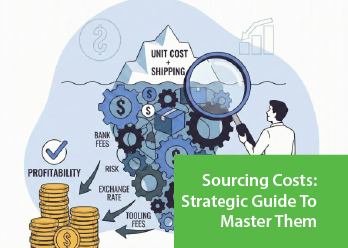
The factory price is $5 per unit, but the landed cost is $17,200 ÷ 2,000 = $8.60 per unit. Product margin should be checked against $8.60, not $5. Depending on the accounting method, platform fees, fulfillment, advertising, returns, and storage may still need to be added.
If the product sells for $15, using only the $5 factory price suggests a $10 difference before selling costs. Using the $8.60 landed cost reduces that figure to $6.40. The apparent unit margin falls by 36%, which can change whether the order is commercially viable.
Test more than the best case. Compare normal freight with emergency air freight, a low defect rate with a high one, one inspection with a failed inspection plus reinspection, and on-time delivery with a delayed launch.
Check Customs and Shipping Documents Before Departure
Common shipping documents include the commercial invoice, packing list, bill of lading or air waybill, certificate of origin where needed, test and compliance documents, permits, insurance documents, and dangerous-goods records.
Clarify who prepares the documents, books transport, completes export procedures, classifies the goods, reviews the customs value, acts as importer of record, submits compliance data, answers customs questions, and pays duties and taxes.
In the United States, using a customs broker does not remove the importer’s duty to use reasonable care and provide correct entry information.[11] The U.S. Harmonized Tariff Schedule is maintained by the U.S. International Trade Commission and should be used for U.S. tariff classification research.[12]
Do not rely only on the factory’s HS code. The supplier may be using a Chinese export code or a code from another customer. The destination country may require extra tariff digits or a different interpretation.
Check that the invoice, packing list, order, payment record, and actual goods agree on the seller, buyer, model, description, material, quantity, price, currency, weight, carton count, origin, and Incoterm. The tariff code may be required for the customs entry even when the full code is not required on the commercial invoice.
Foreign-origin goods entering the United States generally require clear English country-of-origin marking unless an exception applies.[13] EU importers can use Access2Markets to research tariffs, rules of origin, trade measures, procedures, and product requirements.[14]
Send draft documents to the customs broker before departure for a new, regulated, high-value, or difficult-to-classify product. Do not use false low values or vague descriptions such as “accessories,” “parts,” or “gift items” when a clearer description is required.
Review the First Order Before Reordering
Check the shipment after arrival for missing cartons, water damage, packaging failure, concealed defects, quantity errors, label problems, and customer returns. Then compare the actual result with the original plan.
Track:
- final landed cost;
- actual production and delivery time;
- first-pass inspection result;
- defect, rework, and return rates;
- packaging damage;
- document errors;
- supplier response time;
- unauthorized changes;
- whether problems were reported early.
Do not average serious misconduct into a normal supplier score. Falsified reports, hidden subcontracting, unauthorized material changes, deliberate customs undervaluation, repeated safety failures, or refusal to identify the factory may justify ending the relationship.
A smaller first order is usually safer than a large order placed only to obtain a lower unit price. Reduce first-order risk by using existing tooling, standard colors, fewer models, simple packaging, and fewer nonessential custom parts. Increase volume after the supplier has shown that it can meet the specification, pass inspection, deliver on time, and solve problems properly.
For example, increasing an order to 5,000 units may reduce the factory price by $0.20 and save $1,000. However, if a design or quality problem makes 5% of the order unsellable, 250 units are affected. At an $8.60 landed cost, the inventory loss alone is $2,150, more than twice the unit-price saving.
Conclusion
China sourcing works best when each payment and production step is tied to evidence. Before the production deposit, confirm the legal supplier, bank account, specification, sample, compliance plan, price, delivery term, and schedule. Before shipment, confirm production completion, inspection results, corrected defects, accepted test reports, packaging, quantity, and customs documents. A $5 factory price can become an $8.60 landed cost after testing, freight, duty, and handling, so compare total cost rather than unit price. Start with a manageable first order, keep materials and document versions under control, and increase volume only after the supplier proves consistent quality and delivery.