By the JS Sourcing hospitality team · Last updated: 23 November 2026
The hospitality procurement process turns an approved hotel design into furniture that is ready for installation. Most custom hotel FF&E projects involve eight stages: scope and budgeting, BOQ preparation, supplier selection, sample approval, contracting, production, shipping and installation. The process often takes six to nine months, depending on product specifications, approval times and site readiness.
Casegoods and upholstered furniture follow the same overall procurement process, but their manufacturing and quality requirements differ. Casegoods require careful checks on dimensions, panel construction, finishes and hardware. Upholstered furniture needs closer attention to frame strength, foam density, fabric quality, seams and stitching.
Before requesting supplier quotes, prepare a complete Bill of Quantities (BOQ) with product dimensions, materials, finishes, quantities and delivery requirements. In practice, missing dimensions, unclear finish references and outdated room drawings are common problems. These details should be resolved before suppliers begin pricing.
FF&E covers furniture, lighting, window treatments and artwork. OS&E includes operating supplies such as linen, china and guest amenities. Keep the two scopes separate in the procurement budget so suppliers quote against the same requirements.
What Are the Eight Stages of Hotel Furniture Procurement?
| Stage | What happens | Output | Duration |
|---|---|---|---|
| Scope and budget | Scope, budget framework, brand requirements and decision rights agreed | Brief and room-type matrix | 1–2 weeks |
| Specification and BOQ | Quantities taken off per room type, gaps logged | Approved BOQ, dated takeoff | 2–4 weeks |
| Quoting | Same BOQ to every bidder, scope normalised | Comparison matrix, shortlist | 2–4 weeks |
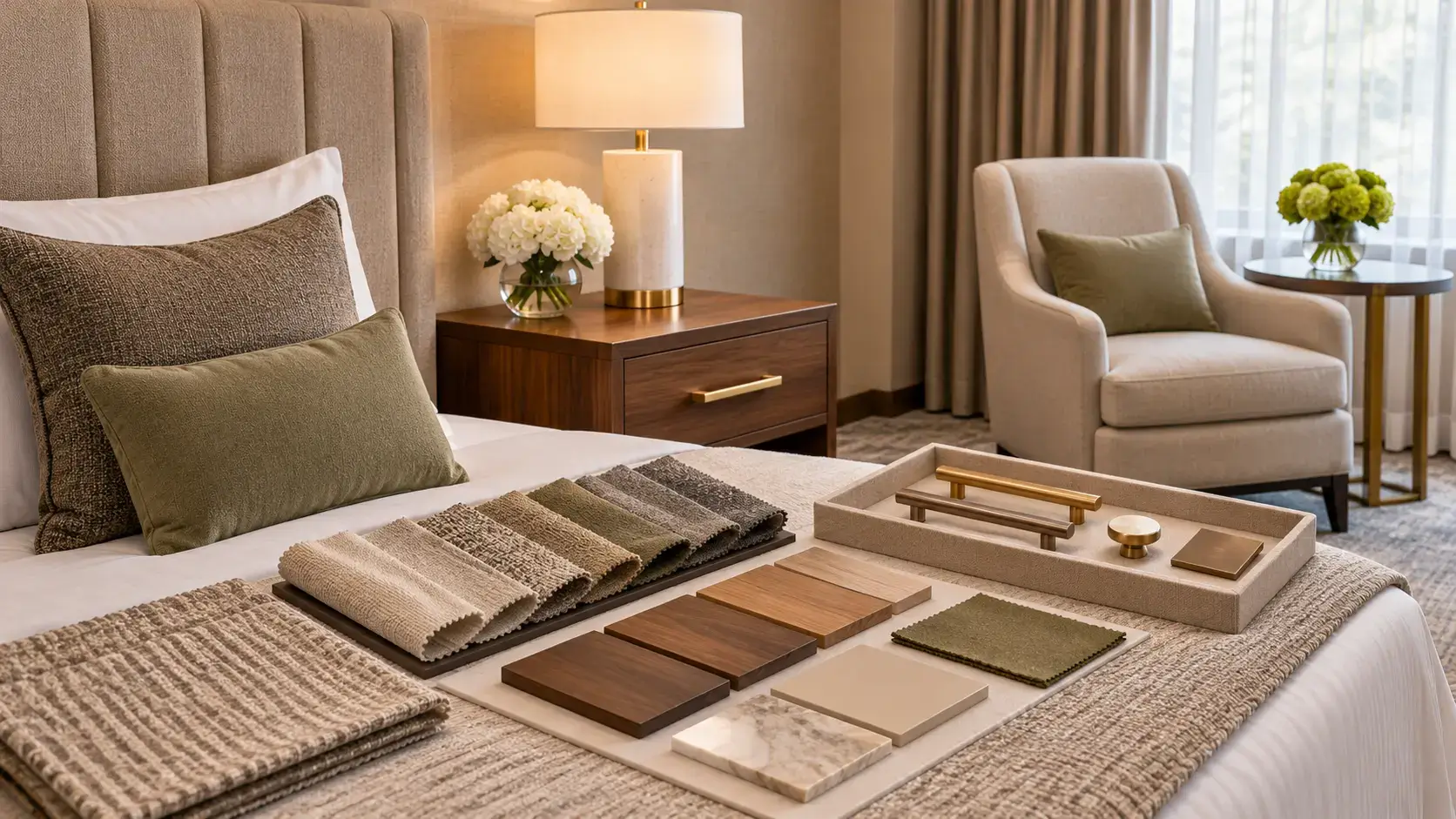
| Samples and mock-up | Finish samples, shop drawings, one mock-up per room type | Signed samples, approved room | 3–8 weeks |
| Contract and PO | Price, dates, Incoterm, inspection rights and remedies set | PO, deposit released against production | 1–2 weeks |
| Production and QC | Five inspection gates, weekly photos, pre-shipment check | QC file and inspection report | 6–12 weeks |
| Freight | Labelling, container loading, customs documents | Packing list by room, cleared entry | 2–6 weeks |
| Installation | Floor-by-floor delivery, punch list, warranty handover | Room-by-room acceptance, warranty pack | 1–4 weeks |
Which Procurement Stages Need the Closest Control?
What Should the BOQ Include?
Twelve fields per line: item code, area, room type, item name, quantity, dimensions, material, finish, hardware, upholstery, fire rating and delivery phase.
For example, a 100-key hotel with 11 specified furniture items per room — bed frame, headboard, two nightstands, desk, desk chair, wardrobe, luggage rack, TV cabinet, lounge chair and bench — has 1,100 pieces to track. The count changes with the room type and brand standard. A superseded drawing can multiply a quantity error across every key. For casegoods, the drawing fixes dimensions, panel construction and hardware locations; for upholstery, the frame construction, foam specification, fabric and seam details need equal control.
The specification has to be measurable: frame material and joint construction, foam density and indentation load deflection, fabric abrasion performance, hardware cycle rating and finish adhesion. For public and lounge seating, ANSI/BIFMA X5.4-2020 (R2025) provides a performance basis for safety, durability and structural adequacy. It is not a fire-compliance standard and should be applied to products within its scope [1].
What Should the Mock-Up Confirm?
Agree the mock-up count with the owner, designer and operator. A useful starting point is one approved mock-up for each materially different repeated room type or finish package; four distinct room types may therefore require four mock-ups. Use the room to test circulation, accessible clearances, housekeeping access, power and data locations, furniture operation and finish appearance under the actual lighting. Sign and date the approval, identify the drawing revision and finish samples, and retain the approval record.
How Should Quality Control Be Organized?
For these packages, the inspection plan can be organized around five gates: incoming materials, in-process production, finish, upholstery and pre-shipment inspection. Casegoods checks cover dimensions, panel thickness, drilling, drawer action, edge banding and veneer. Upholstery checks cover frame joints, foam specification and recovery, seams, stitching, fabric direction and tension. Inspection duration should be agreed against the SKU count, quantity, sampling plan, test scope and number of containers; one or two days may suit a mid-size package, but that is not a fixed rule. Failed inspection can require rework, re-inspection and a later sailing. The delay depends on factory capacity and the next available vessel.
Inspect against both the signed reference sample and the latest approved drawings and specifications. The sample helps define appearance, colour, texture and workmanship; the drawing and specification control dimensions, hidden construction, hardware and performance requirements. If they conflict, stop and obtain written clarification before accepting production. ISO 9001 applies to an organization’s quality management system; certification does not certify each furniture item or prove that a particular shipment is defect-free [2].
How Should Freight and Installation Be Coordinated?
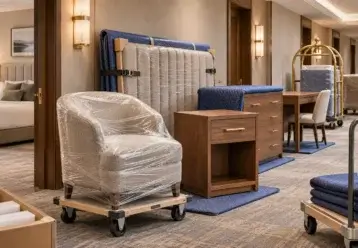
Apply carton labels at the factory using item code, room number, floor or delivery phase. We have seen labels left until the port, which meant the installation crew spent the first day sorting cartons instead of placing furniture. Upholstered items are often cube-limited, while flat-packed casegoods can use container space more efficiently; the actual load plan must account for carton dimensions, stacking limits, payload and protection. Ocean freight may take four to six weeks on some routes, but the quote must state whether it covers port-to-port or door-to-door transit and whether customs and inland delivery are included. Air freight can shorten the transport leg, but its timing also depends on the lane, capacity, clearance and last-mile delivery. Incoterms 2020 defines the agreed delivery obligations, costs and risk transfer point; state the rule and named place in the contract [3]. For U.S. imports, CBP entry documentation includes a commercial invoice or acceptable substitute, evidence of the right to make entry and a packing list where appropriate. Other documents depend on the goods and admissibility requirements. A certificate of origin may be needed for a specific origin claim or trade programme, while a fire-test report is normally a product-compliance or operator-approval document rather than a universal customs document [4][5].
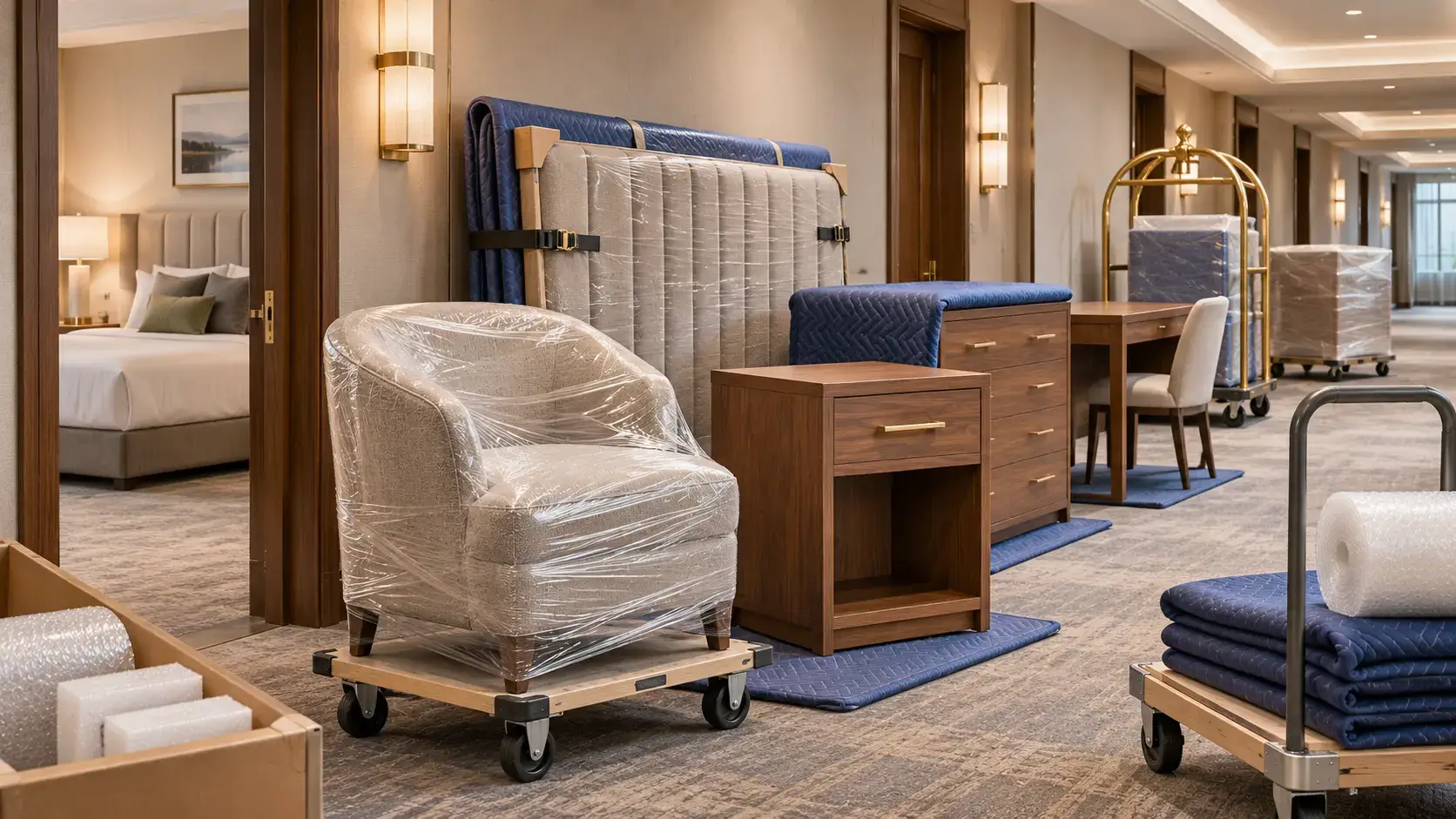
Installation takes 1–4 weeks, floor by floor. The punch list closes room by room, and the warranty pack goes with the keys.
How long does it take?
If all eight stages in the table are treated as sequential, their durations add to approximately 18–42 weeks. Actual programmes often overlap some specification, sourcing, drawing and site-preparation work, which is why a six-to-nine-month planning window can be workable for many custom packages. It is not a guaranteed delivery promise. Brand approvals, failed samples, production rework, shipping disruption or an unready site can push the opening schedule beyond nine months. Build the critical path around real approval dates and confirmed factory and freight slots.
| Milestone | Date | Basis |
|---|---|---|
| Rooms ready for furniture | 1 Sep | Fixed by the opening programme |
| Goods on site | 25 Aug | One week of buffer for access and staging |
| Ship from factory | 14 Jul | Six-week origin-to-site transit assumption, including the stated customs allowance |
| Pre-shipment inspection | 7 Jul | Final inspection and corrective-action clearance before dispatch |
| Production complete | 23 Jun | Ten weeks of production |
| Production start | 14 Apr | Material release after deposit |
| PO issued and deposit paid | 7 Apr | One week to place the order |
| Mock-up approved | 31 Mar | Three weeks to build and review |
| Samples and shop drawings approved | 10 Mar | Two weeks for sample revision |
| BOQ issued | 10 Feb | Two weeks of takeoff and checking |
Rule of thumb. The BOQ and approval dates influence the PO date; the PO and production dates influence the sailing; and the sailing date affects when the site can install. A June production start would already be about seven weeks later than the planned 14 April start in this example. Air freight may shorten the transport leg, but it cannot recover time lost in design approvals, sample revisions, production or site readiness.
Who Is Responsible at Each Procurement Stage?
One person signs the budget, one owns the design, one runs the process. The quantity check is the job nobody picks up by default.
| Party | Owns | Accountable for |
|---|---|---|
| Owner or developer | Budget and final approval | Trade-offs, sign-off on specification and samples |
| Interior designer | Design intent | Specification, finishes, drawings, value engineering |
| Procurement lead | The process | BOQ, tenders, contracts, tracking, closeout |
| Manufacturer | Production | Shop drawings, samples, QC, packing, warranty |
| Brand or operator | Standards | PIP compliance, mock-up approval, operability |
| Installer | Placement | Assembly, levelling, damage reporting, punch list |
How do I choose a supplier?
Invite three to five contract manufacturers to quote the same BOQ, then shortlist two or three. Review five items: a container loading plan, QC checklist, two relevant hotel references, sample shop drawings and a named project manager. If you use a 0–5 score for each item, a result of 12 out of 25 is a warning sign in that buyer’s screening method, not an industry benchmark. A polished catalogue cannot compensate for missing project controls.
A quote comes back as a costed BOQ, not a lump sum. If a factory will not break the line items down, we do not shortlist it. Compare landed cost, not the unit price: freight, duty, storage and spares decide the ranking.
What Commonly Goes Wrong in Hotel Furniture Procurement?
What Happens Without a Complete BOQ?
“Desk, 100 pcs” can produce five prices for five different products. Add dimensions, substrate, finish, hardware, upholstery where relevant, delivery phase and drawing revision so bidders price the same scope. Without those details, differences often surface as exclusions or change orders after the installation team is on site.
Why Can Residential-Grade Furniture Be a Risk?
Residential-grade furniture may look similar in a photograph, but it may not be designed for hotel use cycles, repeated cleaning, higher loading or the repair expectations of an operating property. Compare panel and frame construction, joint design, hardware ratings, finish system, relevant test evidence, warranty and spare-part availability. “Contract grade” should be supported by measurable specifications, not used as a label on its own.
What Happens When Procurement Starts Too Late?
If procurement starts after construction documents are fixed, dimensions, service locations and finish decisions may already be difficult or expensive to change. Late substitutions can trigger revised drawings, new samples and renewed brand approval. Bring the procurement lead into design development so value-engineering options can be checked before the specification is frozen.
Why Should Furniture Be Delivered in Phases?
Delivering every room’s cartons at once can turn the site into a warehouse and increase handling damage. Agree a floor-by-floor or zone-by-zone delivery sequence, identify a dry and secure staging area, and inspect cartons on receipt. Record damage before unpacking is complete and agree how replacement parts or panels will be supplied before the next installation phase.
Why Must Fire and Accessibility Be Checked Early?
Fire and accessibility requirements must be identified before samples and production. In the United States, upholstered seating within the scope of 16 CFR Part 1640 must use the TB 117-2013 test method and carry the required compliance label; confirm the product definition, test evidence and label before approval [5]. This is a smolder-resistance requirement for specified furniture components, not a substitute for every building or project fire requirement. The U.K. Furniture and Furnishings (Fire) (Safety) Regulations 1988 have a defined scope centered on furniture ordinarily intended for private use in a dwelling, so do not assume they automatically cover every hotel contract item. A hotel project may separately specify BS 5852 or other test evidence; confirm the applicable requirement with the operator and local compliance adviser [6]. In covered U.S. facilities, ADA requirements affect accessible routes, clear floor space, door maneuvering and accessible guestroom layouts. Coordinate furniture placement against the applicable ADA Standards rather than checking accessibility after installation [7]. A compliance gap discovered after production can require rework or prevent delivery.
How Do Casegoods and Upholstered Furniture Differ?
Casegoods are the boxes: nightstands, desks, wardrobes, TV consoles. Upholstery is the seating: headboards, lounge chairs, banquettes, dining chairs. What changes between them is the factory, the inspection and the container.
| Dimension | Casegoods | Upholstered furniture |
|---|---|---|
| Core skill | Joinery, panel processing, finishing, hardware | Frame engineering, foam, pattern cutting, sewing |
| Fails first | Drawer alignment, edge banding, veneer, hardware, moisture | Foam collapse, seams, frame loosening, fabric |
| Inspection | Dimensions, drilling, panel thickness, finish, drawer action | Frame joints, foam density, seams, fabric tension, stitching |
| Production | Indicative 6–10 weeks for some custom runs; confirm factory slot and finish complexity | Indicative 8–12 weeks; imported fabric, pattern approval and sewing capacity can extend the run |
| Freight | Often constrained by payload and protective packing | Often constrained by cubic volume and shape; confirm with a carton-level load plan |
Casegoods start as plywood or MDF, and the board spec decides how the piece handles moisture and screws. Composite wood in the U.S. falls under TSCA Title VI limits [8]. A workshop that is good at panels can still be mediocre at sewing, so ask which lines are cut, sewn and finished in-house.
Upholstered seating often uses more container volume per unit than flat-packed casegoods, but the actual quantity depends on carton dimensions, stacking limits, protection and container payload. Build the load plan from packed dimensions rather than a generic pieces-per-container estimate. Clothing storage units that fall within the scope of 16 CFR Part 1261 must meet the applicable U.S. tip-over stability requirements; confirm the product classification and test evidence instead of assuming every wardrobe or tall cabinet is automatically covered [9].
How Much Does Hotel Furniture Procurement Cost?
Use a project-specific BOQ and comparable supplier quotes to price FF&E; a percentage of total development cost is only a budget cross-check. HVS’s 2026 U.S. survey reports a median total development cost of $212,958 per room across its sample, while its overall budget breakdown allocates 6% to FF&E. The share varies by hotel category, and the survey cautions that its figures are general benchmarks rather than estimates for an individual property [10]. For a 200-key project, the overall median equates to about $42.6 million in total development cost, not a furniture-only budget. Hotel tier, room mix, brand standards, panel and frame specifications, hardware, stone tops, upholstery and freight all affect the actual FF&E price.
Value engineering can reduce cost, but there is no reliable universal saving percentage. Check each proposed substitution against dimensions, durability, finish consistency, applicable fire documentation, warranty, repairability and brand approval. Make those decisions before the PO and record the approved alternative in the specification.
What Should You Check Before Signing the Contract?
- Quantities verified by takeoff, with the drawing revision named
- BOQ approved by owner, designer and operator
- Specification measurable, with brand PIP requirements reconciled
- Landed cost calculated, including freight, duty, storage and spares
- Lead time confirmed against the on-site date
- Samples signed and dated in person
- Shop drawings approved, including MEP and outlet coordination
- Mock-up approved by owner, designer and operator
- Incoterm, named place and risk transfer documented
- Inspection rights and rejection criteria in the contract
- Payment milestones tied to sample approval and pre-shipment inspection
- Spare parts and touch-up materials priced as a line item
- Delivery phasing and warranty handover agreed with the site
Need help coordinating your hotel furniture package?
Send your BOQ, room count, brand requirements and target installation date for a sourcing review.
What Do Hotel Buyers Commonly Ask?
Does this work for a restaurant?
Yes. The same stages apply, but the BOQ, operating loads and compliance file change. A 60-seat restaurant may need a smaller package, but the mock-up count should follow the number of materially different furniture types, layouts and finishes.
When should procurement start before a hotel opening?
Start during design development, before the room schedule and finishes are frozen. For a custom package, use the six-to-nine-month window as an initial planning allowance, then build a project-specific critical path from BOQ approval, mock-up sign-off, production capacity, freight route and site-readiness dates.
Which fire standard applies?
It depends on the product, destination, building use, operator and project specification. In the United States, upholstered seating within the scope of 16 CFR Part 1640 must meet the TB 117-2013 test method and labeling requirements. In the U.K. and Europe, do not assume one test applies to every hotel project; confirm the required test method and documentation with the operator and local compliance adviser. Obtain the relevant test reports before production approval, not only when the shipment is ready.
What if the brand changes the spec late?
After production starts, a specification change may require revised shop drawings, new samples, re-costing and a production reset. The time impact depends on the affected materials, factory schedule and approval process. Get the brand’s written sign-off at the mock-up stage, before releasing the PO.
Should casegoods and upholstered furniture use the same inspection checklist?
No. Both need quantity, finish, packing and damage checks, but the technical checks differ. Casegoods need dimensional, panel, edge, drilling, drawer and hardware checks. Upholstered furniture needs frame-joint, foam, fabric, seam, stitching and applicable fire-documentation checks. Use one coordinated inspection plan with separate product-specific checklists.
What Should Buyers Remember?
Most of this is documents and dates. The documents are cheap to fix; the dates are not.
Write the BOQ before you ask for a price. Approve a room before you approve a run. Put inspection rights in the contract.
Who Prepared This Guide?
JS Sourcing has worked on hospitality FF&E packages since 2011, mostly for hotel, resort and restaurant projects sourced from China and Southeast Asia. Our team is based in Shanghai, with factory coverage in Jiangsu, Zhejiang and Guangdong.
Our sourcing process is the one described above: BOQ review, factory shortlist, sample and mock-up coordination, inspection, consolidation and shipping. We consolidate multi-supplier orders into full containers, so casegoods from one factory and seating from another leave on the same booking.
HVS figures are attributed to its published U.S. market report. Other commercial sources are industry references, not audited universal benchmarks. JS Sourcing’s process timings and inspection observations are operational planning guidance; confirm them against the actual room schedule, product specification, factory capacity and shipping route.
References
- BIFMA, ANSI/BIFMA X5.4-2020 (R2025), Public and Lounge Seating.
- International Organization for Standardization, ISO 9001:2015 Quality management systems.
- International Chamber of Commerce, Incoterms 2020.
- U.S. Customs and Border Protection, Basic Importing and Exporting.
- U.S. Consumer Product Safety Commission, Upholstered Furniture and 16 CFR Part 1640.
- UK Furniture and Furnishings (Fire) (Safety) Regulations 1988.
- U.S. Department of Justice, 2010 ADA Standards for Accessible Design.
- U.S. Environmental Protection Agency, Formaldehyde Emission Standards for Composite Wood Products (TSCA Title VI).
- U.S. Code of Federal Regulations, 16 CFR Part 1261, Clothing Storage Unit Tip-Over Stability.
- HVS, U.S. Hotel Development Cost Survey 2026.
Which Industry Sources Inform This Guide?
- DMD Furnishing, Hospitality FF&E: A Complete Procurement Guide.
- Andaaz Manufacturing, Our Process.
- Dushang, Hotel Furniture Industry 2026.
General information, not legal, fire-code, tax or customs advice. Confirm requirements with the authority having jurisdiction, the brand and local advisers before committing to a specification or a contract.