Author: JS Sourcing Editorial Team. This guide covers sourcing coordination, product-specification checks, and inspection planning for bulk buyers. Technical verification basis: Confirm model-specific dimensions, tolerances, assembly instructions, and replacement compatibility against current manufacturer documents and approved samples. Structural, wind-performance, and material-performance claims require confirmation from the manufacturer or a qualified testing body.
Check compatibility at three points: the canopy-to-frame fit, the frame’s joints and locks, and the replacement part’s mounting dimensions. Match the model and production version, compare drawings, and install the proposed replacements on samples. For a bulk order, put the approved combinations in writing and check production units against them before shipment.
What Manufacturer Documents Should You Request?
A product name or catalogue photograph is not enough to establish compatibility. Request documents that identify the exact model and production revision. Check that the drawing, parts list, sample, and quotation all refer to the same version.
| Document | Details to verify |
|---|---|
| Frame drawing | Overall dimensions, tube profile, wall thickness, joint geometry, hole positions, and drawing revision. |
| Parts diagram and spare-part drawings | Part codes, assembly positions, orientation, fastener sizes, supported frame versions, and replacement instructions. |
| Canopy specification sheet | Finished roof dimensions, fabric construction, seam layout, corner pockets, straps, vents, and peak attachment details. |
| Assembly and maintenance instructions | Correct installation sequence, adjustment settings, locking procedure, approved replacement method, and maintenance limits. |
| Performance documents, where relevant | Test reports or declarations that identify the exact product model and revision covered. Do not assume a report for an earlier frame or canopy also covers a revised combination. |
Check the issue date, revision number, product code, and manufacturer identity on each document. If the supplier provides only a generic catalogue or an undated parts list, ask for model-specific evidence before treating compatibility as confirmed. These documents help identify the intended design; they do not replace a physical fit check.
Which Gazebo Components Must Be Interchangeable?
When buying folding gazebos in bulk, specify whether replacements must fit only the new order or also existing units. Different sizes within one range may share sliders but use different roofs and scissor bars. Ask the supplier to confirm compatibility by component, not by brand or range name.
For existing gazebos, send photographs of the model label, corner slider, roof joint, and locking mechanism. Include the production date or revision if available. If the supplier cannot identify the frame, mark compatibility as unconfirmed until it checks the measurements and a sample.
| Item | Required identification |
|---|---|
| Frame | Model, size, production version, drawing revision, and parts diagram. |
| Canopy | Product code, supported frame versions, roof dimensions, and attachment layout. |
| Spare part | Part code, position in the assembly, supported versions, and fitting instructions. |
How Do You Check Canopy Size and Roof Shape?
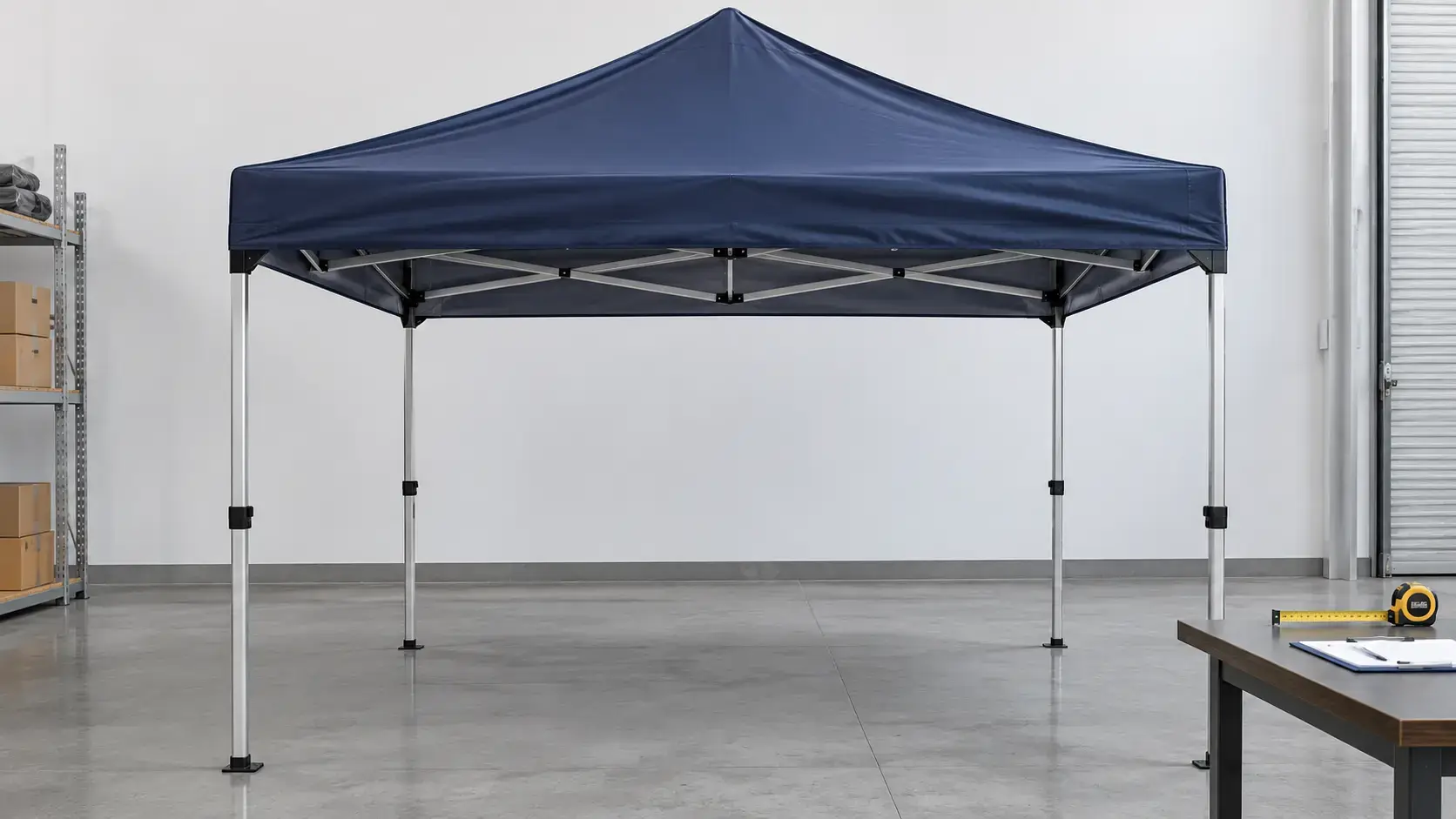
Measure the frame at the roof edges, separately from its foot-to-foot spacing. A slant-leg gazebo can have a ground footprint wider than its roof.
Ten feet equals 3,048 mm, which is 48 mm longer than 3 m. Suppliers may round product labels, so a “10 × 10 ft” top and a “3 × 3 m” frame need checking against actual dimensions. The conversion alone does not prove whether they fit. [1]
Measure from Matching Reference Points
Use a tape measure for roof spans and overall frame dimensions. Use a digital caliper for accessible tube outside or inside diameters, hole diameters, and small fittings. For tube-wall thickness, use a suitable thickness gauge or measure an accessible tube end where the design allows it; do not infer wall thickness from the outside diameter alone. Follow the manufacturer’s drawing and use the same reference points for every measurement. An outside-to-outside measurement cannot be compared directly with a center-to-center dimension.
Record roof-edge width and length, height from the roof edge to the peak, peak-cap shape, vent layout, and any roof-height adjustment setting. Photograph the measurement points. Do not use a stretched or shrunken old canopy as the sole pattern for a new one.
Inspect the Attachments
Compare corner-pocket dimensions, strap positions, clips, peak pockets, and reinforcement patches. The reinforced areas must meet the intended frame contact points, and straps must clear moving joints.
Fit the top using the manufacturer’s tension settings. Hold approval if it prevents full lock engagement, pulls a corner pocket out of place, or needs improvised strap extensions.
If sidewalls are included, attach neighboring panels and close their corner zipper. Check the fastening height and zipper direction while both panels are fitted; testing one wall at a time can miss the mismatch.
How Do You Match Frame and Spare-Part Connections?
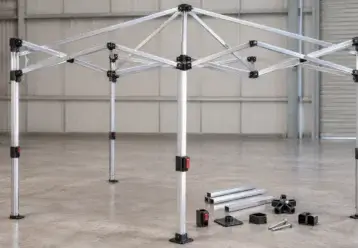
A slider may move over a leg without allowing the locking pin to engage fully. A replacement scissor bar may have the correct overall length but the wrong pivot spacing.
| Component | What to compare |
|---|---|
| Leg and slider | Tube profile, inside and outside dimensions, wall thickness, corner geometry, locking-hole position, and pin engagement. |
| Scissor bar | Overall length, pivot-hole center spacing, cross-section, hole diameter, end orientation, and material. |
| Roof joint | Connection angles, mounting holes, bolts, bushings, and spacers. |
| Peak assembly | Mounting points, adjustment range, locking mechanism, and canopy contact shape. |
Measure hole spacing from center to center. Confirm the part’s position in the frame: inner and outer bars, or differently oriented connectors, may have separate codes.
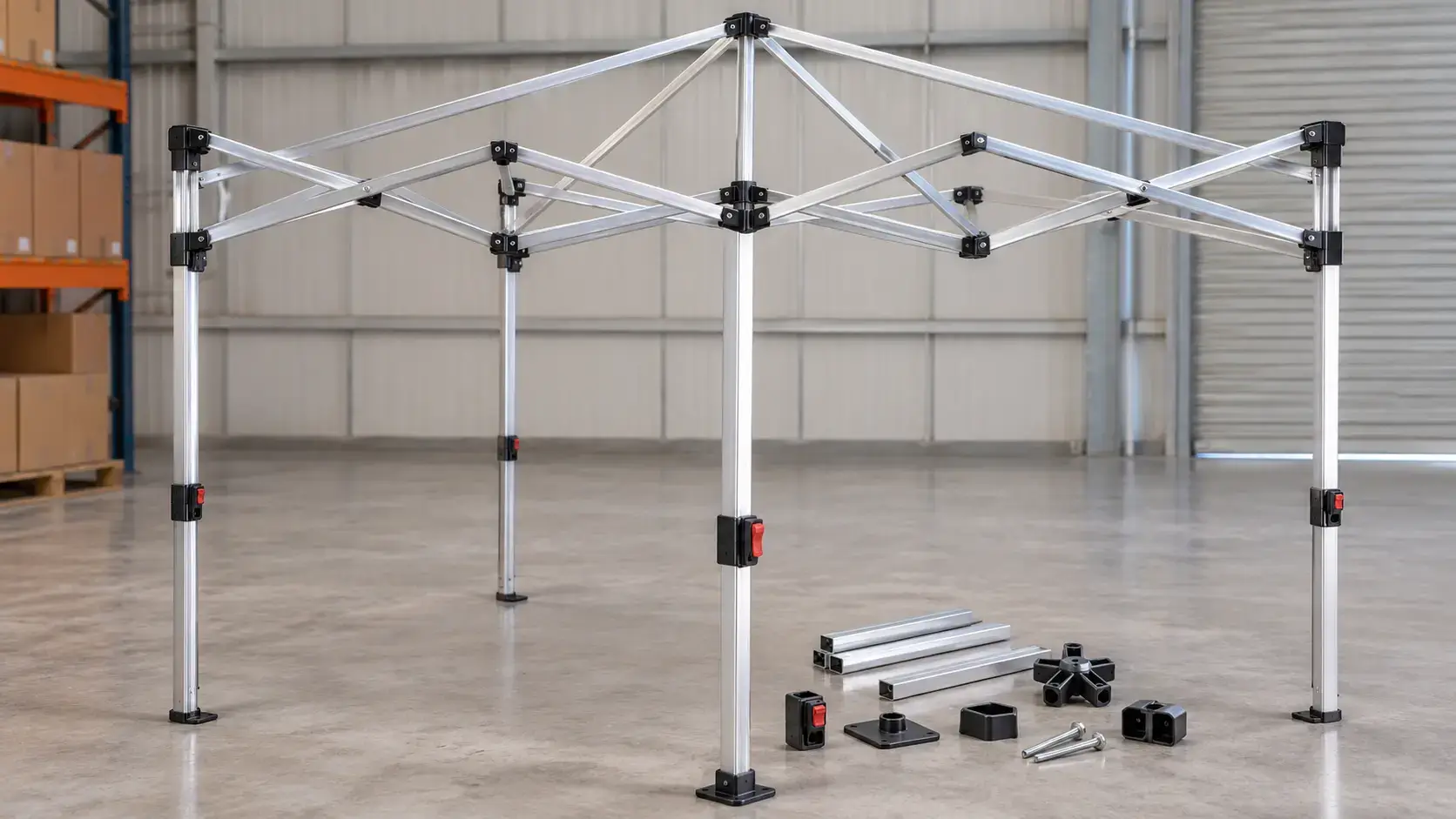
A “40 mm leg” description does not specify all the dimensions needed for a slider. Request the manufacturer’s tolerances rather than deciding how much play seems acceptable. Matching dimensions also do not establish equivalent strength or material quality.
Ask whether the component can be replaced separately or requires a complete assembly. HSE’s general work-equipment maintenance guidance calls for competent personnel and the use of manufacturer instructions when planning repairs. [2]
Stop if installation requires unapproved drilling, bending, or extra spacers. A cross-brand replacement needs approval for that combination or a documented technical assessment.
How Do You Test Separately Supplied Replacements?
Request production-equivalent samples and a separate pack of the spare parts you intend to order. A working assembled gazebo does not show that replacements from separate stock will fit it.
Define the samples before testing: Frame A and Frame B are two identified frame units or revisions, while Canopy A and Canopy B are the corresponding identified tops. Record each model code and production revision. If the supplier claims that the units are interchangeable, test Frame A + Canopy A, Frame A + Canopy B, Frame B + Canopy A, and Frame B + Canopy B. If A and B are different revisions, test cross-revision combinations only when the supplier specifically claims that those revisions are compatible. Include any older frame version that the order is expected to support.
| Combination | Checks to record | Result |
|---|---|---|
| Frame A + Canopy A | Roof fit, pocket seating, strap position, peak attachment, lock engagement, and folding. | Pass / fail / conditional |
| Frame A + Canopy B | Roof fit, pocket seating, strap position, peak attachment, lock engagement, and folding. | Pass / fail / conditional |
| Frame B + Canopy A | Roof fit, pocket seating, strap position, peak attachment, lock engagement, and folding. | Pass / fail / conditional |
| Frame B + Canopy B | Roof fit, pocket seating, strap position, peak attachment, lock engagement, and folding. | Pass / fail / conditional |
Practical sourcing note: Do not record a combination simply as “compatible.” Record the exact frame revision, canopy code, spare-part code, and adjustment setting. If a part fits only after loosening a connection, adding an unapproved spacer, drilling a hole, or changing a strap, record it as a modified fit—not as an interchangeable replacement.
Locate the Cause of a Failed Fit
If the assembly instructions permit it, check the frame without its canopy before installing the roof. This helps distinguish a frame problem from fabric tension or misplaced attachments. Never force a lock to complete the check.
| Observed problem | Recheck |
|---|---|
| The frame locks without the roof but not with it | Roof dimensions, peak setting, pocket seating, and strap placement. |
| The slider moves but the pin does not engage | Slider geometry, hole position, and the pin mechanism. |
| A replacement bar prevents full opening | Pivot spacing, orientation, spacers, and the bar’s position in the assembly. |
| One top fits only one of two nominally identical frames | Frame versions, measured dimensions, roof settings, and attachment differences. |
These checks help locate a problem; they do not establish its cause without inspection. Photograph the mismatch before adjustment. Record the correction, then repeat the affected pairing and opening-and-folding checks.
Keep a Reproducible Test Record
For each combination, record the frame ID, top or part code, measurements, adjustment settings, result, and photographs. Note the number of opening-and-closing cycles and any binding, snagging, or loose hardware. Record who performed the check and when.
If the supplier tests remotely, request a continuous video showing the component labels, installation, lock engagement, and folding. A photograph of an erected gazebo cannot show whether a replacement was modified to fit.
Retain the approved reference sample where practical. Sample fit checks do not establish load capacity, service life, or the defect rate of the shipment.
| Frame ID and revision | Canopy code and revision | Spare-part code | Fit result | Evidence reference |
|---|---|---|---|---|
| Record actual model | Record actual code | Record actual code | Pass / fail / conditional | Photo or video file ID |
| Spare-part code | Supported frame model and revision | Installation position | Fit result | Evidence reference |
|---|---|---|---|---|
| Record actual code | Record actual model and revision | Record assembly position | Pass / fail / conditional | Photo, video, or test-record ID |
How Do You Preserve Compatibility for Future Orders?
For each approved spare, obtain its price, minimum order quantity, stock location, and quoted lead time. Ask whether a revised part will fit older frames directly, need an approved conversion kit, or require a different assembly.
Label spare stock by part code and supported frame version. Keep similar-looking revisions in separate bins, and retain the original drawings for reorders.
If the supplier changes canopy construction, structural material, or connection design, ask whether the original performance documents still cover the revised combination. A successful fit check cannot confirm a wind-performance claim.
How Do You Verify Compatibility Across the Production Batch?
Check Compatibility at Three Production Stages
| Stage | What to verify | Record to retain |
|---|---|---|
| Pre-production sample approval | Confirm the exact frame, canopy, and spare-part codes; compare the sample with the current drawings and approved assembly method. | Signed sample approval, drawings, revision numbers, and compatibility matrix. |
| First production inspection | Check units made for the order against the approved sample. Recheck critical dimensions, connection positions, canopy attachments, and selected spare-part fit. | First-production inspection record, measurement results, and photographs. |
| Pre-shipment inspection | Select finished units under the agreed sampling plan. Test the required canopy/frame combinations and install selected spare parts from the separately packed stock. | Inspection report, sample identification, test results, and any corrective-action record. |
Attach the approved compatibility record, drawing revisions, fitting instructions, and reference-sample ID to the purchase order. Use a written substitution rule:
Canopies, frames, and spare parts must match the approved compatibility record and reference sample. Changes to dimensions, connections, materials, or supported frame versions require written approval before shipment.
Include canopy swaps and selected spare-part installations in the agreed pre-shipment inspection. Select units from the production batch and replacements from the separately packed spare stock. Agree in advance which sizes, versions, and production batches the inspection must cover.
Set the Batch Inspection Scope and Acceptance Criteria
Before production is complete, agree on the lot definition, sample quantity, selection method, inspection stages, defect categories, and reinspection procedure. Set the sample size according to the order quantity, product risk, and the inspection plan agreed by the buyer and supplier. Do not assume one universal sample size or acceptance limit applies to every gazebo order.
| Inspection point | What to verify | Acceptance basis |
|---|---|---|
| Product and revision identity | Compare frame, canopy, and spare-part labels with the approved compatibility record. | Codes and revisions match the approved order documents. |
| Canopy-to-frame fit | Install the selected canopy on the specified frame versions; check pockets, straps, peak attachment, and roof tension. | Fits using the manufacturer’s stated assembly method, without improvised extensions or forced installation. |
| Spare-part installation | Install selected separately packed sliders, bars, joints, or other ordered replacements. | Mounting points align, fasteners fit as specified, and locking parts engage and release correctly. |
| Opening and folding | Operate the assembled unit according to the manufacturer’s instructions and the agreed test procedure. | No binding, snagging, incomplete locking, or loose hardware is found during the agreed check. |
| Spare-stock identification | Check labels, quantities, packaging, and separation of different part revisions. | Parts are traceable by code and supported frame version, with no unapproved substitutions. |
Write the pass criteria before inspection begins. For example, define which frame versions must accept each canopy code, which spare parts must be installed, and how many opening-and-folding cycles are required by the manufacturer or the purchase agreement. If an AQL-based sampling plan is used, specify it in the inspection agreement; AQL does not replace the separate physical-fit criteria above.
Record each failure against the affected model, revision, and component code. Agree whether the supplier must sort, repair, replace, or rework the affected goods, and whether the failed combination must be tested again before shipment approval.
Approve only the combinations supported by the records and fit checks. Resolve failed tests and unapproved substitutions before shipment, then use the same component codes when ordering replacements.
Technical scope: JS Sourcing supports sourcing coordination and inspection planning. Product design approval, engineering tolerances, structural calculations, and wind-performance certification must come from the manufacturer or an appropriately qualified technical body. A successful fit test alone is not a safety or performance certification.
Frequently Asked Questions
Are Pop-Up Gazebo Canopies Interchangeable Between Brands?
Not necessarily. Two canopies can share the same advertised footprint but differ in roof-edge dimensions, peak shape, corner pockets, strap positions, or attachment points. Compare the manufacturer’s drawings and model revisions, then test the canopy on the exact frame version. Treat cross-brand compatibility as unconfirmed until the combination passes a documented sample fit check.
Can a 10 × 10 ft Canopy Fit a 3 × 3 m Gazebo Frame?
Do not assume that it will. Ten feet is 3,048 mm, while 3 m is 3,000 mm, a difference of 48 mm. Product labels may use rounded nominal sizes, so compare the actual roof dimensions, peak geometry, attachment layout, and manufacturer tolerances. Confirm the fit on a sample frame before approving a bulk order.
Are Pop-Up Gazebo Replacement Parts Universal?
No. Sliders, scissor bars, joints, and locking parts can vary by tube profile, wall thickness, hole position, pivot spacing, and frame revision. A part that looks similar or has the same stated length may still fail to align or lock. Match the part code to the frame version and test the installation using the manufacturer’s instructions.
What Should Buyers Check Before Ordering Gazebos in Bulk?
Confirm the frame and canopy revisions, request current drawings and parts lists, approve a production-equivalent sample, and test the combinations that the order must support. Identify spare parts by code and compatible frame version. Put substitution rules, fit criteria, inspection scope, and corrective-action requirements in the purchase agreement before production starts.