Do you know how many brands and retailers buy garden hand tools from China today? Enough to make China’s nickname, the “World’s Factory,” feel well earned, especially when you start browsing garden-tool catalogues. But let’s get back to you: you are probably here for concrete, reliable information about buying wholesale, without the damaged goods, costly surprises or supplier hassles. Good-looking pruning shears can still disappoint after a few days of use, which is why I have brought together technical and cost-related knowledge to help you source garden hand tools from China. From blade materials and handle construction to order quantities and retail margins, there is plenty worth knowing before the deposit leaves your account.
In this guide: Choosing the range · Materials and construction · Sourcing options · Comparable quotations · MOQ and private label · Sample approval · Landed costs · Packaging · Production quality · Shipping · Import requirements · First orders and reorders · FAQs
Which Garden Hand Tools Should Retailers Buy?
A trowel, fork, cultivator, weeder and pair of shears already cover several gardening jobs. Add a second trowel and you have six SKUs. That gives you a manageable starting range, provided each tool earns its space.
A balcony gardener working around small pots has different needs from someone loosening an established flower bed. That difference gives each product below a job to do within the range.
| Product | Specification to Check | Retail Application |
|---|---|---|
| Narrow hand trowel | Blade width, thickness, overall length | Container gardening and planting between closely spaced plants |
| Wide hand trowel | Blade width, steel grade, bending resistance | Moving potting mix and preparing planting holes |
| Hand fork | Tine material, spacing, attachment strength | Loosening soil around established plants |
| Hand cultivator | Tine geometry, rigidity, handle connection | Breaking surface soil and mixing compost |
| Hand weeder | Tip geometry, shaft thickness, corrosion protection | Removing individual weeds and roots |
| Bypass pruning shears | Blade material, rated cutting capacity, lock design | Cutting living stems and smaller branches |
Even two trowels can earn their place. A 60 mm blade reaches between closely spaced plants; a 100 mm blade carries more loose soil. Once you add weight, handle length and the soil your customers work with, that small difference in width becomes a useful distinction on the shelf.
Then there are garden tool sets. A trowel, hand fork and cultivator make sense together for planting. A bag adds somewhere to keep them and may make the set more appealing as a gift. Five almost identical tools? I would want a good reason for paying to package, ship and stock all five.
There is room for individual tools too. Someone replacing a favourite trowel may have no use for another complete set.
A useful garden-tool assortment covers distinct gardening jobs and gives each SKU a clear reason to occupy shelf space.
Garden Tool Materials and Construction: What Changes the Price
Let’s get underneath the polished finish. The metal head, blade and handle do different jobs, so they need different properties.
Different Parts Need Different Material Properties
| Component | Material options | What the buyer gains from the comparison |
|---|---|---|
| Pruning blade | SK5 or 65Mn; suitable stainless grades such as 3Cr13 or 420 | A basis for discussing edge retention, corrosion resistance and target cost together with heat treatment. |
| Trowel or fork head | Carbon steel, suitable stainless steel or aluminium, depending on design | A comparison of stiffness, weight, finish and resistance to the intended working loads. |
| Handle and grip | Wood, moulded plastics, metal structures and soft grip coverings | A way to compare comfort, connection strength, appearance and material requirements for the destination market. |
You will see “stainless steel” on plenty of offers. It sounds reassuring, but it leaves an important part of the specification unanswered: which grade? Heat-treatable 420 and 304 serve different purposes; 304 is generally unsuitable where high cutting-edge hardness is required. SUNWELL’s garden-tool materials guide gives a useful manufacturer overview.
The grade belongs in the quotation. The finished tool still has to prove itself in your hand.
Why Pruning Shears Deserve Their Own Comparison
Pruning shears, also called secateurs, can have an attractive finish, a comfortable grip and an impressive steel name on the packaging, yet still make a poor cut. On a bypass design, the blade passes alongside a counterblade. Grinding, heat treatment, alignment and pivot adjustment all contribute to how well those parts work together. And that “20 mm cutting capacity” needs a little context. Which branch species, in what condition, and under which test conditions? Those details affect both effort and results. Buying a longer pair does not settle the question.
Opening span is easy to overlook until you try a pair that feels too large. FELCO’s compact pruning-shear specifications distinguish hand size, cutting capacity and cutting-head adjustment. These give you concrete ways to compare an entry-level model with an upgraded one. Spare blades and springs can add another reason for a customer to pay more.
The Handle Connection and Finish
A stamped trowel gets some of its stiffness from its thickness and formed ribs or curves. Forged and cast designs offer other construction routes, each of which still needs evaluation as a finished tool. The manufacturing process is useful knowledge; it is only part of the explanation behind the price.
Holding the head while trying the handle can reveal movement around the shaft. You have a joint problem, even if the soft grip feels wonderfully comfortable. Wooden handles introduce their own points of comparison: fit, cracks and splinters.
With carbon steel, the finish is doing a job as well. Coating coverage around joints and edges helps protect the metal, while soil contact gradually wears the working surfaces. A useful comparison includes those areas, the underlying material and the care instructions your customer will receive. The front-facing catalogue photo rarely tells that whole story.
A material grade becomes commercially meaningful when it is considered alongside the tool’s construction, manufacturing process and intended use.
Where to Source Garden Hand Tools from China
Yongkang, in Zhejiang Province, is an established hardware manufacturing centre with metalworking and related tool production nearby. It is one place to begin a search for garden hand tools from China. For a large repeat order of one trowel, working directly with its factory may give you closer access to production and material decisions. For a range spread across several tool categories, a trading company may save considerable coordination work. The interesting part is finding out who actually controls forming, heat treatment, coating, handle moulding and assembly, including any subcontracted operations.
You still need confidence in the business identity, payment recipient and production facility behind the offer. That work should match the project. Developing a proprietary pruning shear deserves a different investigation from buying an established catalogue trowel.
At JS Sourcing, our product sourcing work brings the specifications and buying conditions together so you can compare actual offers. Our Home & Garden sourcing support also covers the packaging and coordination that can make a multi-factory range rather time-consuming.
How to Request Comparable Wholesale Quotations
Suppose one quotation includes printed hang cards, barcodes and export cartons, while another covers loose tools. The cheaper number catches your eye first. The missing packaging only becomes obvious later. When buying garden hand tools from China, a shared request for quotation (RFQ) helps bring those differences into view early. Product drawings, materials, critical dimensions, handle construction, quantities, packaging, destination and delivery terms give suppliers the same job to price. Your intended application and retail price also give them room to suggest sensible alternatives.
Prices at 500, 1,000 and 2,000 pieces show where the economics change. EXW and FOB offers need their named location and exclusions alongside them; otherwise you are comparing prices for different responsibilities.
If your inbox is already filling with offers that are difficult to line up, our guide to what a China RFQ should include can help.
Ask for separately priced options for the standard tool, branded tool and finished retail package to see which customization creates the largest cost or MOQ increase.
Wholesale Garden Tool Prices: MOQ and Private-Label Costs
When comparing wholesale garden tools, the unit price often drops as the quantity rises. So far, so appealing. Before celebrating the discount, it is worth seeing what happens to the total order. The minimum order quantity (MOQ) matters as much as the discount beside it.
Here are illustrative quotations for one standard hand trowel SKU. They are hypothetical figures for the calculation, not current Chinese market prices.
| Order Quantity | Factory Unit Price | Product Cost |
|---|---|---|
| 500 units | $3.10 | $1,550 |
| 1,000 units | $2.75 | $2,750 |
| 2,000 units | $2.50 | $5,000 |
At 2,000 units, the factory price is 19.4% lower than at 500 units. You also spend $3,450 more on the products before paying for shipping and import charges.
Now imagine selling 100 trowels a month. The smaller order covers five months; the larger one covers twenty, before allowing for seasonality, promotions and returns. That is quite a lot of time for your money to sit in a warehouse.
The multiplication continues across a range: six SKUs at 500 units each means 3,000 tools. A mixed shipment may save freight duplication, but the factory can still require a minimum for every model. Handle colour and printed packaging may bring their own minimums too.
This is where the discussion can get more useful than simply asking for a lower MOQ. A standard grip colour might remove one constraint. Shared packaging artwork with SKU labels might remove another. Holding unused printed packaging for a reorder is also an option to discuss, provided its cost, ownership and storage responsibility are clear.
Private-Label Costs
Private-label garden tools can start with an existing design: a logo, coloured grip or branded hang card gives it your identity. A new handle mould or structural change takes you into a different conversation about development cost and sample approval.
Take an illustrative $800 mould: spread over 2,000 units, it adds $0.40 to each. Packaging at another $0.20 per unit adds $400 to the order. The investment may be worthwhile if customers value the difference and repeat orders follow. A custom handle that exists mainly to make the range look different needs a stronger commercial argument.
If you pay for the mould, its ownership, maintenance, storage, exclusivity and transfer conditions deserve a written agreement. A successful product is exactly when you want those arrangements to be clear.
The lowest unit price can tie up the most cash when its order minimum exceeds realistic seasonal demand.
What Garden Tool Samples Can Tell You
The samples have arrived. This is the enjoyable part: you can finally put the offers side by side and feel what the photographs left out.
When sourcing garden hand tools from China, that comparison needs samples representative of the intended production. Each model’s material, dimensions, construction and specification revision keep your observations attached to the right offer.
A 100 mm stamped trowel might, for example, carry a ±2 mm width tolerance measured at agreed locations. That is an illustrative specification to adapt to the design. It gives you something measurable alongside your impressions of weight and comfort. Stainless steel, incidentally, does not automatically give the head greater bending strength than a carbon-steel alternative.
A Practical Sample Comparison
For trowels, the same prepared soil, insertion depth and loading method make comparisons useful. One head might remain straight while its handle begins to move. That tells you something quite different from a bent head with a firm connection, and gives the factory a more precise problem to investigate. With shears, comparable stems and operating conditions reveal the cut quality and effort required. The lock, spring return, jamming and blade damage add to the picture. An initial trial can uncover immediate problems; a claim about service life needs an appropriate endurance programme.
I would be wary of a test that looks impressively precise but has no connection to intended use. Loads, cycle counts and acceptance limits need a suitable standard or validated buyer procedure behind them.
Compare competing samples side by side on the same gardening task, recording comfort, performance and visible changes under consistent conditions.
After approval, that exact unit can become your golden sample, with the factory’s agreement. Its SKU, revision and approval date link it to the written material, dimensional and test requirements. Keeping both gives the production team a much clearer reference than “make it like the sample.”
Visually matching tools can differ in weight, grip comfort and durability, so a branded range needs approval as an assortment.
How Much Does Importing Garden Tools Cost?
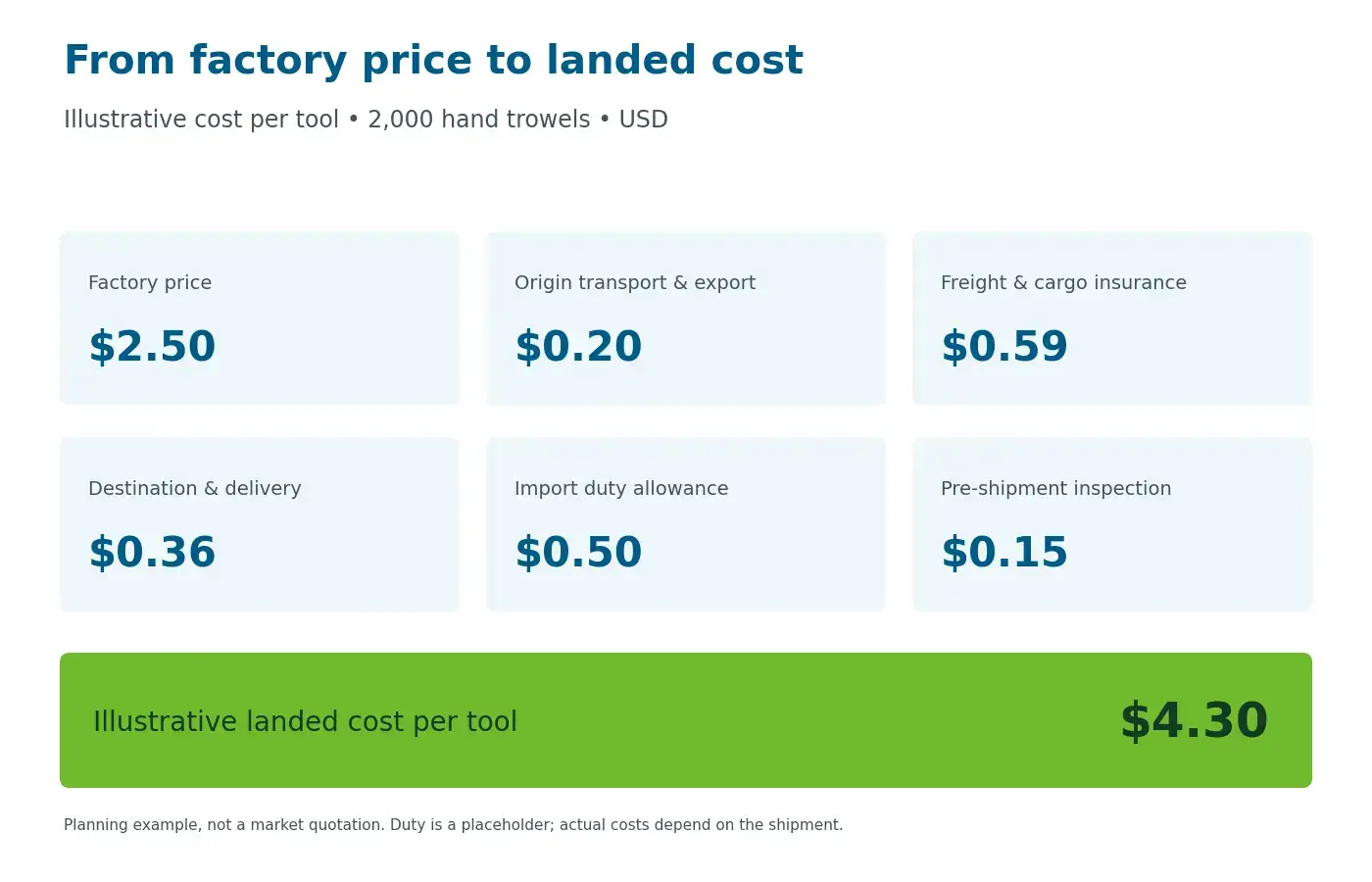
Let’s follow the 2,000 trowels a little further. At $2.50 each, the factory invoice comes to $5,000. Getting them into your warehouse adds several other costs.
The amounts below are planning assumptions for the same hypothetical order.
| Cost Item | Illustrative Amount |
|---|---|
| 2,000 hand trowels at $2.50 | $5,000 |
| China origin transport and export-related costs | $400 |
| International freight and cargo insurance | $1,180 |
| Destination handling, customs service fees, and warehouse delivery | $720 |
| Assumed import duty allowance | $1,000 |
| Pre-shipment inspection allowance | $300 |
| Total Landed Cost | $8,600 |
| Landed Cost per Unit | $4.30 |
The illustrative landed cost reaches $4.30 per tool. For a real order, the $1,000 duty allowance must be replaced by the applicable calculation for its classification, origin, destination and entry date, including any additional duties. The inspection allowance excludes laboratory testing and extra visits. This table is a way to build the budget, not a current U.S. import quotation.
Retail Margin
Selling at an illustrative $10.99 leaves $6.69 over the $4.30 landed cost, a 60.9% gross margin before selling expenses. Sales tax or VAT is excluded from that selling-price calculation. There is still a business to run. Selling fees, fulfilment and after-sales allowances of $2.10 per unit would leave a $4.59 contribution before advertising, storage, fixed overhead and other operating costs.
And if 3% of the shipment cannot be sold or recovered, the same acquisition spend now sits across 1,940 saleable tools. The effective cost becomes about $4.43 each, before replacement or disposal expenses. A few rejected cartons can take the shine off a good factory discount.
Landed cost per saleable unit connects the factory quotation with the margin the retailer can actually earn.
What Packaging Should Retail Buyers Approve?
Your trowel has survived the sample trial. Now it needs to survive the journey and sit properly on a shop display.
A hang card looks rather different with the weight of the actual tool attached. If the hanging hole tears through, the retailer has a display problem even though the trowel itself is perfectly good. Barcode scanning, product information, required warnings, origin marking and edge protection belong in this finished-package approval too.
Inside a three-piece set, the trowel, fork and cultivator need to stay in place. Loose metal heads can damage neighbouring products. Once that arrangement works, units per carton, dimensions, gross weight and labels give you reliable inputs for freight quotations.
For an assortment sourced from several factories, approve the tools together so handle colours, branding and packaging form a coherent retail range.
Retail packaging affects display, protection, freight volume and margin, making it part of the product specification from the start.
How Buyers Can Manage Production Quality
“Same as the approved sample” sounds clear enough until two people remember different samples.
The sample ID and specification revision settle that. Linked to the material, dimensions, quantities, packaging version, delivery terms and inspection criteria in the purchase order, they give production and inspection teams a common reference.
A pre-shipment inspection compares the finished goods with those requirements. ISO 2859-1:2026 provides AQL-indexed sampling schemes for lot-by-lot inspection. Inspection level, defect categories, acceptance criteria and sample selection need agreement for the actual order; sampling does not guarantee every shipped unit is defect-free.
- Safety: unsafe pruning locks, dangerously exposed edges or hazardous handle detachment.
- Function: unacceptable deformation, loose joints, incorrect materials or inadequate cutting performance.
- Appearance: coating damage, scratches and finish variation beyond approved limits.
- Packaging: incorrect barcodes, missing required information or inadequate blade protection.
The report becomes much more useful when it shows which lot and quantities were checked, with measurements and photographs. A loose handle should lead back to the relevant assembly batch and an investigation of fit, fastening or the assembly process. The agreement made before production then provides a basis for allocating sorting, rework and reinspection costs.
An agreed sample and specification give the factory, inspector and buyer the same basis for deciding whether the order is acceptable.
Shipping Garden Hand Tools from China
Our 2,000 trowels fit into 100 cartons if each carton holds 20 individually packed tools. At 50 × 35 × 25 cm per carton, that is 4.375 CBM. With each packed tool weighing 350 g and each master carton adding 1 kg, gross shipment weight is about 800 kg.
Now you have cargo details a forwarder can price. The selected Incoterm and named place show who arranges and pays for origin transport, freight, destination handling, customs services and final delivery. They also help reveal which costs are missing from an attractive shipping offer.
A multi-factory range adds a timing problem. If the forks are ready while the shears are still in production, somebody has to decide whether to wait, store the finished goods or split the shipment. Consolidation savings depend on that decision as well as inland transport and handling. Our shipping and consolidation support covers this coordination.
For illustration, two weeks for supplier and sample approval, four for manufacturing, five at sea, one for clearance and delivery, and two for contingency add up to fourteen weeks. Every allowance needs replacing with the actual project’s schedule, especially where new tooling or packaging is involved.
For a seasonal range, the date that matters is when your warehouse needs the stock. The purchasing schedule works backwards from there.
Ask each factory to confirm its goods-ready date before booking a consolidated shipment, including time for inspection and any necessary rework.
Import Requirements That Affect the Order
United States
Many agricultural and horticultural hand tools appear within heading 8201 of the U.S. Harmonized Tariff Schedule. Individual trowels, weeders, pruning shears and mixed sets need their own classification assessment. Applicable duties, including any additional measures on Chinese-origin goods, belong in the cost calculation for the actual entry date.
Marking and product information also affect artwork approval. Your customs broker can confirm the treatment of the exact tool or mixed set. It is much easier to settle that while the packaging is still on screen.
European Union
The General Product Safety Regulation brings product safety, traceability, technical documentation and relevant instructions into the project. If you place the tools on the market under your own name or trademark, you assume manufacturer obligations. That little logo on the handle comes with responsibilities.
There is a material question here too. REACH Annex XVII Entry 50 restricts certain PAHs in covered rubber or plastic components that contact the skin. ECHA’s restriction conditions include tools for domestic use. A report is useful when it matches the grip material and product you are actually purchasing.
Ordinary non-powered garden hand tools do not automatically require CE marking. The European Commission’s CE marking guidance explains that it applies where specific EU legislation requires it. The review changes if the assortment includes powered products.
Turning a First Wholesale Order into a Better Reorder
By the time you place the order, quite a few decisions have been made. A concise purchase order keeps the agreed versions together:
- SKU, material, dimensions and approved sample revision.
- Quantities, prices, packaging specifications and artwork version.
- Payment conditions, completion dates and delivery responsibilities.
- Inspection rights, acceptance criteria and corrective-action costs.
Inspection results, packing quantities and shipping documents support shipment release. Once the goods arrive, the figures become real: shortages, damaged cartons, rejected units and actual acquisition costs. Together, they give you buying information grounded in the order you actually received.
A successful SKU is tempting to reorder with a quick “same again.” But a changed grip formulation, finish or packaging version can alter performance or compliance. Knowing what changed protects the repeat purchase; knowing what sold tells you how much to buy. Customer comments and defect records may also point to a useful upgrade, or a tool that has had its chance.
A successful reorder repeats the approved product and packaging while adjusting quantities to actual sales and customer feedback.
Frequently Asked Questions
Sometimes. Buyers sourcing garden hand tools from China might agree on 400 trowels, 300 forks and 300 cultivators as a 1,000-unit order. Each model, colour and packaging variation still needs confirmation. Putting the cartons together for shipping does not itself change production minimums.
Is buying directly from a factory always cheaper?
For a large repeat order of one tool, it may be. Across several categories, the coordination saved through a trading company may be worth paying for. Packaging, inspection, consolidation and service charges all belong in the comparison.
Who pays when bulk products fail inspection?
The contract should define responsibility for sorting, repair, replacement, reinspection and delays. For defects discovered after delivery, evidence of the affected batch and quantity supports an agreed remedy such as local rework, replacement goods or credit. The solution needs to account for whether it reaches the buyer in time for the selling season.
What documents should buyers receive before shipping?
The commercial invoice, packing list, applicable transport documents, approved specifications and inspection report form the core order records. Additional customs filings, test reports and compliance documents depend on the product and destination.
Support for Your Garden Tool Sourcing Project
The tools look identical. Why are the quotations so different?
The photographs may be hiding differences in metal thickness, blade processing, joints or packaging. We can coordinate comparable specifications and samples so you can see what the extra money buys, and where it buys very little.
Can a first order offer variety without leaving us with too much stock?
That is a useful sourcing brief. We can assess the minimums model by model, explore customization and packaging options, and coordinate suppliers into one range. Your expected sales and available budget give the work its commercial direction.
A Better-Informed Garden Tool Purchase
We started with China’s seemingly endless garden-tool catalogues. There is plenty to choose from, and by now you have a few more ways to tell an attractive offer from one that deserves your order. You can look beyond the finish of a pair of shears, understand what sits behind a packaging minimum, and follow a factory price all the way to your retail margin.
That knowledge is useful when buying garden hand tools from China: it gives you more to negotiate with and fewer details to discover after the goods arrive. The aim is a range you can sell with confidence, at quantities your business can carry.
Then comes the next interesting part. Which tool do customers come back for, which one earns an upgrade, and which set deserves a place in next season’s range? Your first order should leave you with some good answers.
About the author: Florian Chauvin is Director at JS Sourcing. The company supports international buyers with product sourcing, supplier coordination, quality inspections and shipping from China.