Based on my experience, an RFQ built around a line such as “We need 18 mm particleboard for a furniture line” will prove inefficient. It identifies the material and thickness, but it does not tell a supplier enough to recommend and quote the right board.
Before contacting suppliers, decide what you are actually buying and what the board must do. Will it be supplied raw or laminated? Will it be used in a dry room, a humid interior or somewhere exposed to occasional splashes? Do you need full sheets, or components that the supplier must cut, drill and edge-band?
The finished product also changes the questions you need to ask. A hanging kitchen cabinet needs a board that can hold its fixings and carry the intended load. A movable desk may be assembled and dismantled several times, so the fittings must not quickly loosen in the board. A long shelf needs enough stiffness for its span and expected load. These are practical questions for your product designer, purchasing team and supplier. They help you choose the board grade and decide which performance figures belong in the RFQ.
The destination market is just as important. Formaldehyde limits, test methods and supporting documents differ between countries. Depending on where and how the board or finished furniture will be sold, customs, market-surveillance authorities, clients or project owners may ask for test reports and certificates. A supplier’s claim that a board is “E0,” “E1” or “ENF” has little value until the underlying standard, test method, factory and product are confirmed.
That is where many particleboard sourcing problems begin: with a request that names the material but leaves the grade, finish, use and market requirements open to interpretation. Settle those points first. You can then identify the right sourcing countries, approach suppliers that make the required board, compare like-for-like quotations and decide what must be checked before shipment.
This particle board sourcing guide follows that same order. It explains how particleboard differs from OSB, fibreboard and plywood; what your RFQ should say; which standards may apply; where the main supply markets are; how to shortlist suppliers and compare their offers; and how manufacturing, quality checks, landed cost and delivery timing affect the final purchasing decision.
In Short: How Should You Source Particleboard?
Before contacting suppliers, confirm what the particleboard will be used to make and what the supplier must deliver. State whether you need raw, laminated or pre-cut boards; the finished dimensions and tolerances; the grade and surface; whether the board will be used in dry or humid conditions; the strength, swelling, screw-holding or fire performance that matters for the product; the destination market; and the expected order volume.
Use trade data to decide which countries have a relevant supply base, then shortlist companies that can manufacture or process the board you need. Send each supplier the same RFQ and ask them to identify any point they cannot meet. Compare the proposed board and supporting documents before comparing unit prices. Then review MOQ, packaging, payment terms, lead time and landed cost.
Before placing a commercial order, decide which documents, samples, laboratory tests, factory checks and inspections are justified by the order value and by the consequences of failure.
That is the short version. The rest of the guide explains how to do each part without turning the project into a wood-science degree.
1. Confirm What Type of Particleboard You Need
Your first task is to describe the board the supplier must deliver. The material name and thickness are only the starting point.
State what the finished product is, where the board will be used and how much processing the supplier must perform. An 18 mm wardrobe side, a long shelf and a wall-mounted cabinet do not necessarily need the same grade or performance. Also state whether you need raw sheets, laminated sheets or components cut and drilled to your drawings.
Particleboard and wood chipboard
Particleboard belongs to the technical category of wood-based panels. It is made by combining wood particles with a binder, forming them into a mat, and pressing the mat under heat. The particles may come from chips, shavings, sawdust and other wood residues. Most furniture-grade boards have finer particles at the faces and coarser particles in the core. The finer faces improve surface quality; the coarser core helps produce the required thickness and structure efficiently.
“Particleboard,” “particle board” and “wood chipboard” are often used for the same general product family. Regional usage differs. In a specification, consistency matters more than the preferred spelling. Define the construction and performance once, then keep the same term across the RFQ, quotation, sample approval and purchase order.
Particleboard is not every board made from wood
Purchasers regularly encounter suppliers whose websites group particleboard, MDF, OSB and plywood under “wood panels.” That is fine for a website menu. It is not fine for an RFQ.
| Product family | How it is made | Purchasing distinction |
|---|---|---|
| Conventional particleboard | Discrete wood particles are bonded and pressed into a board | Common furniture and interior substrate; grade and moisture performance must be specified |
| Melamine-faced particleboard | A particleboard core is surfaced with resin-impregnated decorative paper | The core, décor, texture, surface resistance and colour consistency all matter |
| OSB | Larger wood strands are arranged in layers, usually with controlled orientation | Commonly selected for structural or load-bearing applications; it has a different supplier market |
| MDF and HDF | Wood is refined into fibres before bonding and pressing | Smoother and more uniform for profiling, routing and painting, but generally heavier |
| Plywood | Thin wood veneers are bonded in layers, normally with alternating grain direction | Different bending, fastener, moisture and appearance characteristics; not a particleboard substitute by default |
| Cement-bonded particleboard | Wood particles are bonded with cement rather than a conventional resin system | Heavier specialized board with different processing, performance and supplier capabilities |
| Non-wood particleboard | Agricultural or other ligneous particles are used instead of conventional wood furnish | Raw-material consistency, test reports and suitability for the intended use require separate review |
The Composite Panel Association defines particleboard through its cellulosic particles, binder, heat and pressure, and notes that particle geometry, resin level, density and process can be adjusted for different end uses. That last point is important. Two products can both be called particleboard while differing materially in strength, swelling, emission performance and machinability.
Confirm what the supplier must include
Before drafting the specification, settle four questions internally:
- Are you buying raw particleboard, finished decorative panels or components cut from particleboard?
- Is the board intended for furniture and dry interiors, humid interiors, flooring, packaging, doors or a load-bearing use?
- Will your company laminate, cut, drill and edge-band the board, or must the supplier perform some of those operations?
- Is the product a one-off project purchase or the start of repeat production?
The fourth question affects the type of supplier you need. A trader or regional distributor may solve a small, urgent purchase. For repeat furniture production, you may need a particleboard factory or laminator that can keep using the same core board, décor paper and resin system from one order to the next.
2. Write the Particleboard Specification for the Finished Product
Once you know what the board will be used to make, write a specification that the supplier can quote and your team can later inspect. Do not copy every property from a technical standard into the RFQ. State the grade, dimensions, finish, performance and documents needed for this order.
Start with how the board will be used
How the board will be used tells you which properties deserve attention. A 16 mm cabinet side, a 25 mm retail shelf and a fire-retardant wall lining should not share the same specification simply because all three use particleboard.
Ask the technical or product team for the information behind the request:
- Where will the board be used?
- Will it carry a load or hold fasteners?
- Will it be exposed to high humidity, occasional splashes or cleaning chemicals?
- Will its edges remain visible, be edge-banded or be sealed?
- Will it receive melamine paper, high-pressure laminate, veneer, paint or another finish?
- Which machining operations will follow?
- What service life and warranty does the finished product require?
If an important point is still unknown, say so. Do not hide it inside a broad product description and assume every supplier will make the same choice.
State the board construction, dimensions and finish
At minimum, confirm:
| Specification item | What to state in the RFQ | Why it matters |
|---|---|---|
| Board type and grade | General-purpose, furniture, moisture-resistant, fire-retardant, structural or another defined grade | Prevents a standard dry-use board from being quoted for a more demanding application |
| Finished length and width | Required sheet dimensions and tolerances | Affects cutting yield, loading, packaging and unit price |
| Finished thickness | Nominal thickness and acceptable tolerance | Influences strength, machining, assembled dimensions and price |
| Density | Target range or approved product range, if relevant | Influences weight, machining, screw holding and freight |
| Layer construction | Three-layer or other required construction, if functionally important | Influences face quality, core structure and edge performance |
| Raw or surfaced | Sanded raw board, melamine-faced, veneered, laminated or coated | Determines whether you are comparing cores or finished panels |
| Surface details | Colour or décor reference, texture, gloss, matching tolerance and one- or two-sided finish | Needed for visible furniture and interior applications |
| Edge condition | Square cut, sealed, profiled, tongue-and-groove or edge-banded | Changes processing scope and finished dimensions |
| Packaging | Pallet or skid design, protectors, wrapping, strapping, labels and stack height | Heavy panels are vulnerable to edge impact, moisture and poor handling |
Do not write “standard size” unless the required market and actual dimensions are stated beside it. A supplier’s standard press size may be useful for yield, but your purchasing unit is the finished sheet your company can use.
Select the performance requirements that matter
The list below is not a shopping list. Select the properties that matter for the intended use:
- Modulus of rupture (MOR): indicates bending strength.
- Modulus of elasticity (MOE): indicates stiffness and helps assess deflection under load.
- Internal bond strength: indicates how well the board holds together through its thickness.
- Screw-holding performance: matters for furniture, shelving and components that use mechanical fasteners.
- Thickness swelling after water exposure: helps distinguish standard boards from products designed for humid conditions.
- Moisture content: affects dimensional stability, processing and conditioning.
- Surface soundness: matters when laminating or applying finishes.
- Dimensional tolerances and squareness: affect cutting, assembly and finished-product consistency.
- Formaldehyde emission: must match the destination market and the claims made for the finished product.
- Reaction-to-fire or fire performance: relevant only when the intended use requires a documented classification.
The board colour is not proof of performance. Some mills use green pigment for moisture-resistant grades and red pigment for fire-retardant grades, but the colour is an identifier, not a test result. Ask for the grade, standard, property values and supporting report.
Treat decorative surfaces as a separate specification layer
When buying melamine-faced particleboard, purchasers sometimes examine the décor sample carefully and pay less attention to the core. The opposite mistake also occurs: the core is technically approved, but colour, texture and surface resistance remain vague.
Specify both:
- Core board grade, thickness, density and emission requirement
- Décor manufacturer or approved reference, where applicable
- Colour and texture reference
- One-sided or two-sided lamination
- Balanced construction if needed to control warping
- Surface resistance requirements, such as abrasion, scratching, staining, steam or heat
- Acceptable colour variation between approved sample and production
- Batch-consistency expectations when boards will be installed side by side
- Protective film, interleaving and packaging requirements
For a visible finish, approve a physical reference sample under controlled lighting. A PDF décor image is useful for shortlisting, not final colour approval.
State purchasing volume in usable units
Give suppliers the expected quantity per order and, if known, the annual requirement. Use finished sheets as the primary purchasing unit. Add square metres or cubic metres when useful for capacity and price normalization.
For each sheet:
Sheet volume (m³) = length (m) × width (m) × thickness (m)
Estimated sheet weight (kg) = sheet volume (m³) × density (kg/m³)
These calculations help you check a quotation and estimate loading, but they do not replace the supplier’s packing list. Actual density, pallet weight, container payload limits and load-securing requirements affect the final quantity.
Build one RFQ-ready specification table
The final specification can be compact:
| Field | Example format |
|---|---|
| Product | Raw three-layer wood particleboard for furniture manufacture |
| Intended use | Interior cabinet carcasses in dry conditions |
| Grade and standard | Applicable furniture/dry-use grade; supplier to identify standard and grade offered |
| Dimensions | 2440 × 1220 × 18 mm, finished size |
| Tolerances | State required length, width, thickness and squareness tolerances |
| Density | State required or acceptable range, if relevant |
| Performance | Internal bond, bending, screw holding and swelling requirements selected for the intended use |
| Emission | Destination-market requirement and supporting certification/report |
| Surface | Sanded both sides, suitable for subsequent lamination |
| Edges | Square cut, clean and without material break-out beyond agreed limit |
| Quantity | Finished sheets per order and forecast annual volume |
| Packaging | Skids, waterproof wrapping, corner/edge protection, labels and maximum stack height |
| Documents to provide | Technical data sheet, current test reports and product-specific certificates |
| Quotation basis | Unit price per finished sheet, quantity, Incoterm, lead time and payment terms |
Attach drawings, finish references and test requirements where needed. Our guide on what a China RFQ should include explains how to organize the wider commercial enquiry without overloading the technical sheet.
3. Which Particleboard Standards Apply to Your Order?
A standard is useful only when it covers the point you need to verify. One document may classify the board’s physical performance. Another may cover formaldehyde emissions. A chain-of-custody certificate addresses raw-material sourcing, not board strength. An ISO 9001 certificate covers the supplier’s quality-management system, not the compliance of the particleboard being quoted.
When a supplier sends a folder full of certificates, separate them by purpose before deciding whether the product is covered.
Product and performance standards
For European markets, EN 312 is widely used to classify particleboard by intended use and service condition. The familiar P1 to P7 types range from general-purpose and furniture boards used in dry conditions to load-bearing and heavy-duty boards used in dry or humid conditions. Do not select a higher number simply because it appears better. Select the type that matches the intended use.
When particleboard will be used in construction, additional rules may govern how the product is placed on the market and how its performance is declared. The way the board will be used, not its name alone, determines what documents are required.
ISO 16893:2016 provides an international classification and required tests for uncoated particleboard used for general purposes, furniture, load-bearing and heavy-duty load-bearing applications under different service conditions. ISO confirms that the standard’s property values classify products; they are not design values for engineers to use directly in structural calculations. ISO’s official summary is a useful starting point.
In North America, ANSI A208.1 is the voluntary particleboard standard commonly referenced for physical, mechanical, dimensional and formaldehyde-related characteristics. The Composite Panel Association’s technical material explains its role in classifying particleboard by density and strength.
The purchasing point is simple: ask the supplier to name the exact standard, grade and edition used for the quotation. “European standard,” “American quality” or “export grade” is not sufficient.
Formaldehyde requirements follow the destination market
Formaldehyde terminology creates unnecessary confusion because suppliers often place E0, E1, ENF, CARB Phase 2, TSCA Title VI and F★★★★ in one list, as if they were rungs on a single international ladder. They are not.
Different markets use different regulations, classes, test methods and certification systems. A low value obtained under one method cannot be casually converted into compliance under another.
For the United States, particleboard falls within the EPA’s composite wood products rule. Panels must meet TSCA Title VI requirements, including testing, certification and labeling provisions. The US EPA rule summary states that products manufactured in or imported into the country after 22 March 2019 must be certified and labeled as TSCA Title VI compliant by an EPA-recognized third-party certifier. The EPA’s implementation guidance for regulated stakeholders also makes clear that responsibilities extend through the supply chain. A generic CARB logo on a presentation is therefore not enough for a current US import.
For the European Union, the formaldehyde restriction for furniture and wood-based articles under Commission Regulation (EU) 2023/1464 has applied since 6 August 2026. Confirm the applicable limit, test conditions, product scope and any exemption with the company’s compliance specialist or qualified laboratory when preparing the order.
If the supplier is in China, keep Chinese classifications separate from destination-market approval. GB 18580-2025 became effective on 1 June 2026. The National Forestry and Grassland Administration’s explanation states that the mandatory standard retains an E1 limit for wood-based panels and requires E0 for covered panel products. GB/T 39600-2021 provides the related E1, E0 and ENF grading framework. These references help you interpret a Chinese particle board factory’s documents. They do not replace the legal and certification requirements of the destination market.
Other markets may use national standards or recognize particular product classes. In Japan, MLIT guidance on formaldehyde-emitting building materials includes particleboard within the F-star control system. F★★★★, usually read as “F four-star,” is the highest classification in that system. Covered building materials carrying this classification can be used without the interior-finish area restrictions applied to lower F-star classes. It is a Japanese classification tied to Japanese requirements and test methods, not another name for E0, ENF, CARB Phase 2 or TSCA Title VI.
If your finished goods will be sold in more than one country, identify every intended market at the RFQ stage. Do not approve a board for one destination and later assume the same documents cover another.
How to review a test report without becoming a laboratory
Check that the report names the manufacturer and production site, identifies the offered board and thickness, states the test method, shows the result and acceptance limit, and gives the sample and report dates. If certification is required, confirm the certificate in the issuer’s directory. A report for another factory, grade or product does not establish compliance for the board being quoted.
For a wider document-review method, see how to verify quality standards and supplier certificates.
Put additional quality requirements into the quotation
A standard gives you a baseline; it does not define every quality point that matters to your order. If your company needs tighter thickness tolerances, a narrower density range, lower swelling, better screw holding, a particular surface condition or more protective packaging, write those points into the RFQ.
Ask every supplier to state:
- The grade offered
- The standard and test method used
- Any deviation from the RFQ
- The test reports and certificates available
- Whether testing or certification costs are included
Ask the supplier to confirm these additional quality points in the quotation. If one of them changes the resin, production method, testing, grading, cutting or packaging, it must be understood and priced before the purchase order is issued. Discovering it after a quality claim is too late.
4. Which Countries Should You Source Particleboard From?
You have now defined the particleboard and identified the standards that apply. The next question is where to look for suppliers.
China may seem like the obvious starting point. It is one of the world’s largest manufacturing countries and a leading exporter of several wood products. But that does not make it the leading supply market for every type of wood panel.
This is where the distinctions covered earlier become useful. China is a major plywood exporter, while authority trade data shows that conventional particleboard exports are led by other countries. Starting with China out of habit may cause you to overlook more established particleboard markets.
The practical rule is straightforward: do not select the country first and then search for a suitable product. Use the product to identify the countries worth searching.
Keep wood-panel families separate when reading trade data
A general search for “wood-panel exporters” can produce an impressive but unhelpful country ranking. Check which product family the figures cover.
- Conventional particleboard: the main subject of this guide and a common furniture/interior substrate.
- OSB and waferboard: related wood panels with a different construction and a stronger link to structural applications.
- Fibreboard: includes MDF and HDF, made from refined fibres rather than discrete particles.
- Plywood: made from veneer layers and supported by a different supplier base.
Trade figures are useful because they reveal established export capacity. They cannot prove that a country offers the best specification, MOQ, freight route or landed cost for your company.
Use export data to decide where to search
The 2024 data tells a clear story. OEC records Austria, Germany and Thailand as the leading exporters of conventional wood particleboard excluding OSB and waferboard, with exports of approximately US$700 million, US$601 million and US$435 million respectively.
Each market offers a different reason to investigate:
- Austria sits at the centre of a mature European wood-panel and furniture supply chain. Its position is particularly practical for buyers serving European markets, where regional standards, shorter inland routes and established decorative-board systems may matter.
- Germany combines substantial panel capacity with a wide technical range. Major suppliers publish dry-use, humid-use, load-bearing, fire-retardant and low-emission options, which makes the market relevant when the requirement goes beyond a basic furniture board.
- Thailand has a strongly export-oriented panel industry and makes extensive use of rubberwood resources and residues. It can be a logical Asian sourcing base, particularly when shipment routes and customer markets favour Southeast Asia.
Change the product and the ranking changes. For OSB and waferboard, OEC’s 2024 data places Canada far ahead at about US$2.09 billion, followed by Romania and Germany at much lower values. Canada’s large softwood and aspen resource base, established structural-panel industry and access to the North American construction market explain why it deserves attention for OSB rather than conventional furniture particleboard.
For plywood, China exported about US$4.64 billion in 2024, followed by major Asian sources including Indonesia and Vietnam. That is a strong reason to investigate China for plywood. It is not evidence that China should lead a conventional particleboard search.
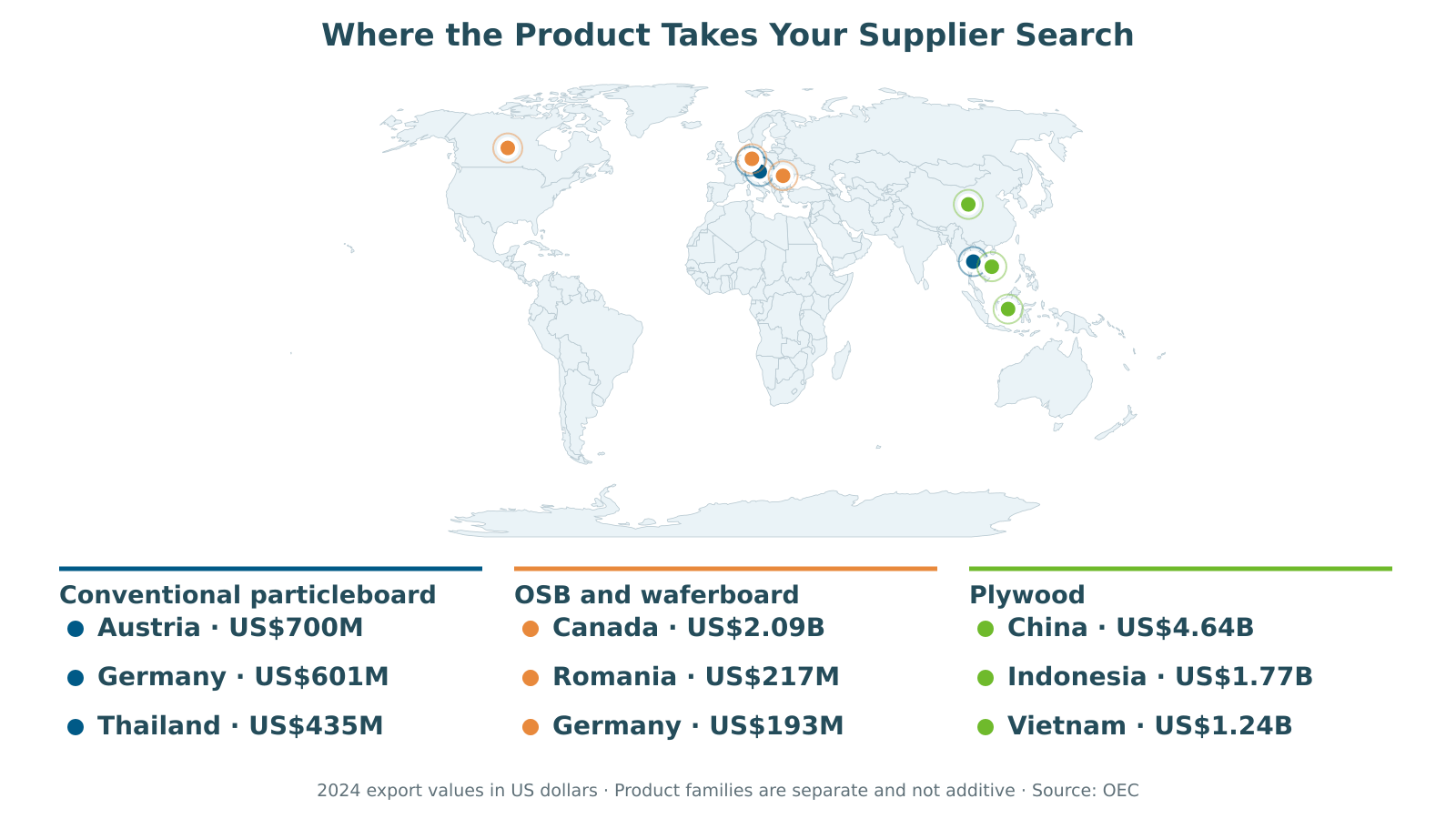
2024 export values in US dollars. The three product families are shown separately and must not be added together or treated as interchangeable. Source: OEC international trade data.
Use this map only to decide which countries deserve further research. The largest exporting country may still be unsuitable because of freight, MOQ, product range, trade measures or destination-market requirements.
5. How to Shortlist Particleboard Suppliers
By this point, you know what board you need, which standards apply and which countries are worth searching. You can now build a supplier shortlist around the RFQ instead of collecting company names first and trying to make them fit later.
Instead of asking suppliers whether they sell particleboard, you can ask whether they manufacture the required grade, dimensions and thickness; whether they can document the required emission or performance standard; and whether their MOQ fits your purchasing volume.
A useful shortlist is not a long list of company names. Remove suppliers that cannot meet the grade, dimensions, documents or order quantity before you spend time on detailed quotations, samples and technical discussions.
Compare Particle Board Suppliers Against the Same RFQ
The table below gives one established supplier associated with each selected market. It is not a ranking from best to worst. It is a starting set of benchmarks assembled from industry sources and checked against manufacturers’ current product materials.
| Country | Supplier | Brand or range | Particleboard capability most clearly documented | Standards or certificates shown in official material |
|---|---|---|---|---|
| United States | Timber Products Company | ENCORE and Apex | Commercial, industrial, door-core, countertop, shelving and moisture-resistant particleboard | FSC-certified options and CARB/TSCA documentation; product grade evidence to be checked per offer |
| Canada | Uniboard | NU Green | Raw low-emission particleboard and decorative-panel substrates, including ULEF/NAF options | ANSI A208.1, CAN/CSA O160, TSCA Title VI/CARB, ECC and FSC options documented for relevant products |
| China | DARE Panel | DARE | Raw and decorative particleboard for furniture and interior applications | Official company material references FSC Chain of Custody and CARB certification; product and mill scope must be verified |
| Turkey | Kastamonu Entegre | YONGAPAN, TEKNOPAN, YONGALAM and TEKNOLAM | Raw and melamine-faced particleboard, including specialized grades | EN 312/E1 documentation and FSC/management-system certifications are published; request current product-specific evidence |
| Switzerland | SWISS KRONO AG | P2 and BE.YOND | Furniture and interior P2 board, including low-emission products using a bio-based adhesive system | P2 under EN 312 and product-specific emission/environmental data |
| Austria | EGGER | EUROSPAN and EURODEKOR | Raw and decorative furniture/interior particleboard plus structural and moisture-resistant variants | Product-specific EN 312 grades, E1E05 and TSCA variants, declarations of performance and EPDs |
| Germany | Pfleiderer | ClassicBoard, PremiumBoard and LivingBoard | Broad range from P2 furniture board to humid-use, load-bearing, fire-retardant and low-emission panels | EN 312 grades P2 to P7 depending on product; FSC/PEFC and TSCA options documented for relevant ranges |
| Romania | Kronospan Romania | Kronobuild and Kronodesign | Raw P2/P3 boards and decorative particleboard for furniture, interiors and selected building uses | EN 312 product classes, E1 emission documentation and FSC/PEFC material published for relevant products and sites |
| Thailand | Vanachai Group | Vanachai particleboard and laminated particleboard | Export-oriented rubberwood particleboard and laminated board | Management-system and product documentation is published by the group; request current emission and product-specific reports for the offered mill |
Supplier certificates change, expire and differ by plant. Treat the last column as a direction for verification, not permission to copy the claim into a purchase order.
Chinese manufacturers: what the available records establish
China may still fit an order linked to a Chinese furniture factory, a consolidated building-material shipment or a regional supply chain. Available records give useful screening leads: Shandong government files document particleboard projects for Ningfeng Wood Industry and Luli; a Shanghai Stock Exchange filing supports company-level checks on Guangxi Fenglin; DARE’s 2025 annual report states combined MDF and particleboard capacity and group credentials; and a California Air Resources Board executive order identifies the certification scope of Wanhua Hexiang’s Jingmen operation.
These records do not prove current free capacity, MOQ, exact grade, price or suitability for your order. If China is within scope, use them as leads and vet each supplier against the RFQ, not as a ready-made ranking.
Confirm which production steps the supplier performs
“Are you a factory?” is not enough. An integrated mill, an independent laminator and an export trader can all be legitimate suppliers. They control different parts of the result.
| Supplier type | What it may control | Suitable use |
|---|---|---|
| Integrated particleboard mill | Raw material, particle preparation, resin blending, pressing, sanding, testing and sometimes finishing | Repeat raw-board programs, technical grades and larger volumes |
| Mill with laminating or finishing lines | Core production plus decorative surfacing or finishing | Projects requiring coordinated core and face control |
| Independent laminator or converter | Décor sourcing, laminating, cutting, machining and packaging, while buying the core elsewhere | Smaller finished sizes, broad décor selection or value-added processing |
| Export trader | Supplier coordination, documentation, consolidation and commercial communication | Mixed products, lower quantities or markets where mills do not export directly |
| Regional distributor | Stockholding, local delivery, smaller order quantities and established market documentation | Urgent or sub-container orders where local stock offsets a higher unit price |
The useful questions are: Which production steps take place in your facilities, which are subcontracted, and how will you make sure repeat orders match the approved board?
If a laminator buys its core board from another factory, identify the factory and grade when this information is needed to maintain consistency. A trader may not disclose every subcontractor during an initial enquiry. In that case, decide whether its traceability, your inspection rights and its contractual responsibility give you enough control over the product. Ask for information that affects the order; do not request a complete supply-chain disclosure simply as a routine exercise.
Decide which suppliers should receive the RFQ
Use six core criteria to decide who receives the RFQ:
- Products and grades manufactured: Does the supplier make the actual board or only a neighbouring product?
- Supported dimensions and thicknesses: Can it produce or cut the finished sheet economically and within tolerance?
- Moisture-resistant or fire-retardant grades: Are specialized grades made routinely, and is their performance documented?
- Emission and performance standards: Does the supplier have evidence for the destination market and offered product?
- Minimum order quantity: Is the MOQ workable by thickness, grade, décor and shipment?
- Export-market experience: Has the supplier handled the required documents, packaging and route for comparable customers?
Score every supplier against the same RFQ, not against its marketing. A famous manufacturer with the wrong minimum quantity is a poorer fit than a less familiar supplier that can repeatedly make the required board.
6. Compare Particleboard Quotations to Determine Which Offer Is Best
The first comparison should not be price. Check whether every supplier quoted the same finished board.
Mark each line as compliant, deviating or unclear. Clarify the unclear points before calculating a winner. If one offer uses a lower grade, wider thickness tolerance or different surface, its lower price has already explained itself.
Use the finished sheet as the primary purchasing unit
A square-metre price can help normalize sizes, but it may conceal cutting loss. If a supplier must cut a larger master board into your dimensions, its price may include material that becomes scrap. A price per square metre also does not confirm how many usable finished sheets will appear on the pro forma invoice.
For order calculations, use the price per finished sheet at the required dimensions and specification. Keep square-metre and cubic-metre prices as secondary checks:
Price per m² = finished-sheet price ÷ sheet area
Price per m³ = finished-sheet price ÷ sheet volume
These normalized figures can reveal an outlier, but they should not replace the actual purchasing unit.
Compare the offer line by line
| Comparison point | What to confirm | Common source of false savings |
|---|---|---|
| Product and grade | Same grade, standard, resin/performance and surface | Lower grade quoted against a higher requirement |
| Finished dimensions | Length, width, thickness and tolerances | Nominal or master-board dimensions used instead of finished size |
| Density and weight | Offered range and estimated shipment weight | Lighter board changes performance; heavier board changes freight |
| Finished-sheet quantity | Exact number of usable boards | Area-only quotation hides yield or cutting loss |
| Raw or surfaced board | Core, face material, texture and one/two-sided finish | Decorative surface excluded or a different décor system used |
| MOQ | Per grade, thickness, décor and order | Headline MOQ applies only to a standard product |
| Packaging | Skids, wrapping, protectors, labels and stack | Weak packaging transfers cost into breakage and claims |
| Testing and certification | Included tests, reports and third-party fees | Compliance cost added after selection |
| Incoterm | Named place and current Incoterms rule | Two FOB or DAP prices cover different responsibilities |
| Payment | Deposit, balance trigger, credit cost and bank charges | A cheaper price requires earlier or riskier payment |
| Lead time | Starts from which event and covers which activities | Lead time begins only after sample, décor or deposit approval |
| Claims | Notice period, evidence, replacement or credit mechanism | Low unit price comes with no workable remedy |
Compare deviations, not just numbers
Create a deviation column beside every offer. Require suppliers to list their exceptions rather than silently rewriting your request inside the quotation.
A useful quotation summary has four statuses:
- Compliant: the supplier accepts the requirement and includes it in the price.
- Alternative: the supplier proposes a clearly described substitute for review.
- Not compliant: the supplier cannot meet the requirement.
- Not confirmed: evidence or clarification is still missing.
Review alternatives separately
An alternative is not automatically a failure. A manufacturer may propose a standard sheet size that reduces cutting waste, or an established grade that reaches the required performance under a different standard. The purchasing and technical teams should decide whether the alternative is acceptable. Do not accept it merely because the deviation was left unmarked in the comparison sheet.
Look at container utilization before celebrating the unit price
Particleboard is bulky and heavy. Sheet dimensions, density, pallet construction and payload limits affect the loaded quantity. Ask for a preliminary loading plan showing:
- Sheets per pack
- Number of packs
- Gross and net weight
- Pack dimensions
- Container type
- Total sheets per container
- Loading and bracing method
Compare freight per finished sheet, not only freight per container. A slightly higher factory price can produce a lower delivered unit cost if the board and packaging use the container more efficiently.
7. How Particleboard Is Manufactured and Why Purchasers Should Care
You do not need to know every press setting to issue an RFQ. The manufacturing process becomes useful when you review a factory or investigate a defect, because it shows where moisture, particle size, resin dosing, pressing and sanding can change the finished board.
The US Forest Products Laboratory describes particleboard manufacturing as a dry process covering particle preparation, classification and drying, adhesive application, mat formation, pressing and finishing. Its Wood Handbook chapter on composite panels also explains why fine face particles, coarser core particles, moisture control and resin selection affect the finished panel.
The manufacturing sequence
- Raw-material reception and storage
- Chipping and particle preparation
- Screening and classification
- Drying
- Resin, wax and additive blending
- Face and core mat formation
- Pre-pressing
- Hot pressing
- Conditioning and cooling
- Trimming, sanding and sizing
- Laminating or surface finishing, if required
- Testing, grading and packaging
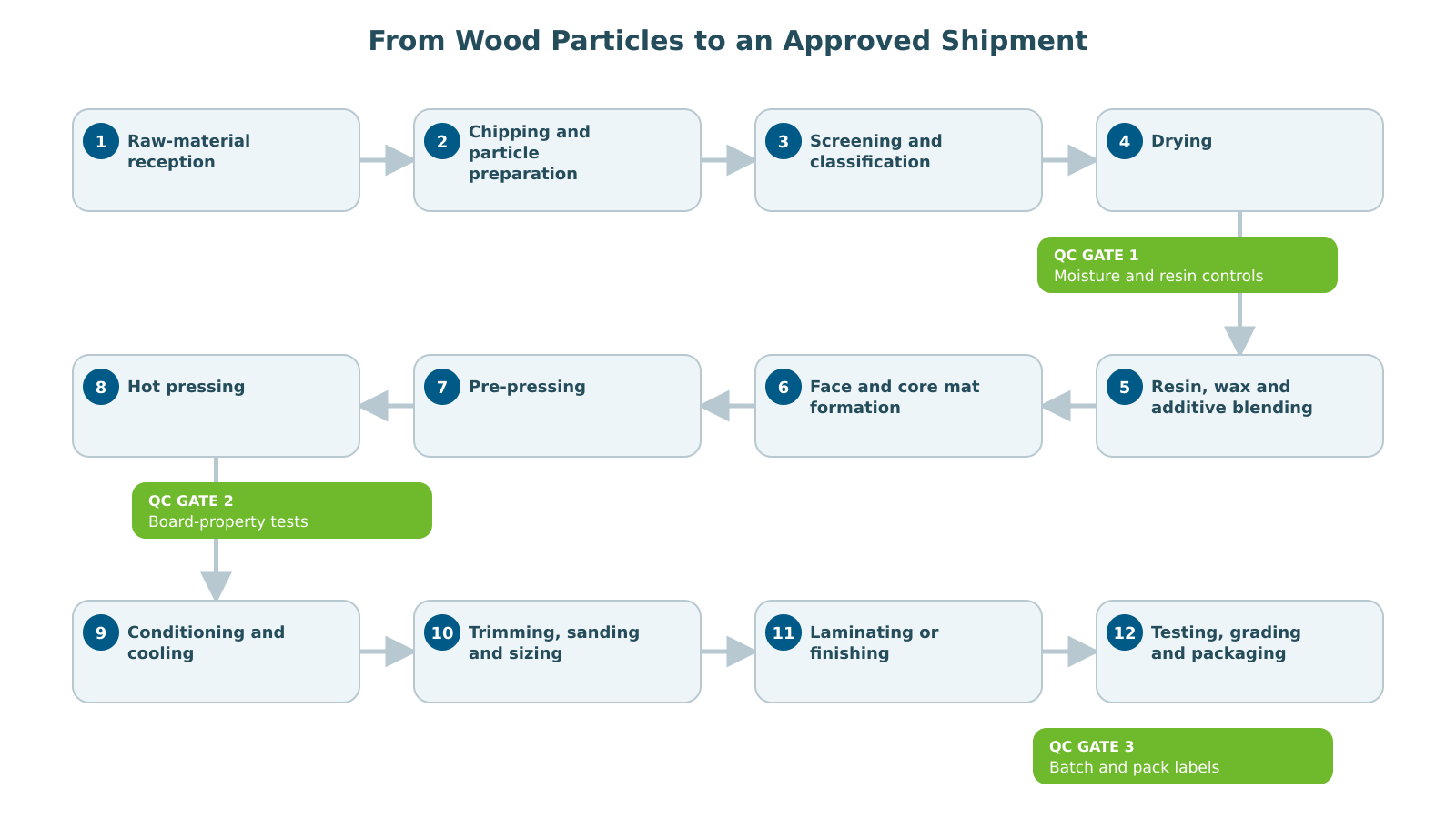
Three points deserve particular attention: moisture and resin during production, tests on the finished board, and labels that connect each pack to its production batch.
Where manufacturing problems can affect your order
For purchasing purposes, concentrate on the production points that can change the board you receive: raw-material and particle consistency, moisture and resin dosing, pressing and conditioning, thickness calibration, surface finishing, testing and packaging. Poor control can lead to weak bonding, swelling, warping, uneven thickness, rough surfaces, emission failures or damaged packs.
During supplier qualification, ask how these points are monitored and how finished packs are linked to production and test records. Then check the controls that matter through representative samples, current reports, batch labels and the agreed packaging. A detailed particleboard factory-process audit can be covered separately.
8. Basic Risk-Management Steps Before a Particleboard Order
Not every order needs every check below. Choose them according to the order value, technical complexity, destination-market requirements, available time and budget, and the cost of failure. A stock dry-use board purchased locally does not require the same plan as a custom fire-retardant decorative board shipped across an ocean for a hotel fit-out.
Review standards, reports and certificates
Begin with documents that identify the actual product. Verify the factory, board, thickness or product family, test method, result, date and certifier. If the supplier relies on a certificate directory, check the listing rather than a screenshot.
Documentation review is inexpensive and can eliminate unsuitable suppliers early. Its limitation is equally clear: documents do not prove that the shipment will match the tested sample.
Obtain representative samples
Use samples to review colour, surface, cross-section, thickness, flatness, edge quality and machinability. If the board will be laminated, drilled, routed or edge-banded by your company, process the sample under normal production conditions.
Confirm how the sample was made. A hand-selected laboratory sample may help during product development, but it says little about how consistently the normal production line will make the board.
Arrange independent testing where it adds value
Independent testing may be appropriate for regulated emissions, moisture performance, fire classification or critical mechanical properties. Agree on the product identity, sampling method, test method and acceptance limit before the test.
A precise test is still useless if the sample does not match the board you intend to buy. A surfaced board, raw board, different thickness or different resin system may need to be tested separately.
Assess the supplier or production site
During a supplier assessment, check whether the offered board is made routinely, how wood particles and resin are controlled, what the laboratory tests, how batches are approved for shipment and how complaints are handled.
The aim is not to count machines. It is to find out whether the supplier can repeatedly make the approved board and trace the production records if a result is questioned.
If travel is not practical, you can begin by verifying a Chinese factory without visiting China. Where order value, product risk or unresolved evidence justifies an on-site review, use a defined scope to conduct a factory audit in China.
Approve a reference sample
A signed or otherwise controlled reference sample gives both parties a physical comparison point for appearance, surface, edge and construction. Record the product code, date, thickness, décor and relevant test/report references.
Keep enough material for later comparison. One small offcut can disappear quickly once production, sales and quality teams all want it.
Use a pilot or limited first order
A smaller first order can test processing, packaging, documents and delivery performance before the company commits to the regular volume. It is most useful when the limited quantity can be produced on the same line, with the same materials and controls planned for repeat orders.
Conduct a pre-shipment inspection
Inspection can check finished quantity, product markings, dimensions, thickness, visual condition, packaging and selected on-site tests. The sampling plan and acceptance criteria must be agreed in advance. Keep the inspection scope distinct from the broader supplier audit and inspection services that may be used earlier in qualification.
An inspector cannot reconstruct missing laboratory certification on the loading day. Separate visual/dimensional inspection from regulatory or performance testing and schedule both early enough for corrective action.
Confirm batch and test-report traceability
Ask how pack labels, production dates, line records and test results connect. Traceability is particularly useful when several thicknesses, grades or décors share one shipment.
This is practical traceability, not paperwork for its own sake. If a problem affects 12 packs, the buyer should not have to quarantine 40 because nobody can identify which production lot went where.
Put quality and claims terms into the order
The specification, approved sample, inspection method, acceptance criteria and remedy should appear in the contractual documents. Define notice periods, evidence, containment, replacement or credit responsibilities, and the handling of nonconforming goods.
Commercial terms cannot rescue an unclear specification, but they can prevent an agreed requirement from becoming optional after production begins.
9. Confirm Purchasing Cost and Timeline
Once the quotations describe the same board and you have chosen the necessary checks, compare the total purchasing cost and delivery plan. The lowest quoted sheet price may no longer be the lowest-cost offer once freight, testing, packaging and payment terms are included.
Calculate total landed cost
Start with the finished-sheet quantity and accepted quotation. Add the costs required to move that specific shipment to the point where your company can use it. Account for supplier-to-port transport, export handling, freight, insurance, destination charges, duties, taxes, customs services, inspection/testing and inland delivery.
For purchases from China, our guide to calculating real landed cost from China provides a wider cost structure for this comparison.
Particleboard is freight-sensitive. A factory located close to a suitable commercial port may outperform a lower-priced inland supplier after truck transport and handling are added. Sheet dimensions and density can also change the number of finished sheets carried within payload and space limits.
Calculate landed cost per finished sheet for every shortlisted offer. Keep any recoverable taxes separate from true cost according to your company’s accounting practice. If duties or trade remedies are uncertain, show the assumption and a sensitivity range rather than burying the uncertainty inside one total.
Clarify when lead time begins. “Twenty days” may mean 20 days after deposit, after artwork approval, after décor paper arrives or after the factory schedules the grade for its next production run. Those are different promises.
Align payment milestones with the timeline. A long gap between a substantial deposit and material production increases financial exposure. A balance payment due before inspection reduces leverage if corrective work is needed.
Prepare the decision document
Bring the final information into one clear comparison:
| Decision area | Information to show |
|---|---|
| Technical match | Grade, dimensions, surface, performance, standards and deviations |
| Documents and open checks | Reports, certificates, production records and points still requiring verification |
| Commercial offer | Finished-sheet price, quantity, MOQ, Incoterm and payment |
| Logistics | Pack plan, shipment quantity, route and landed cost per finished sheet |
| Selected checks | Samples, tests, supplier assessment, inspection and contractual protections |
| Timeline | Approval, production, payment, shipment and delivery milestones |
| Repeatability | Capacity, input consistency, traceability and corrective-action capability |
Your decision-maker should not have to open nine quotations to discover that one price excludes testing and another is based on a different thickness. The recommendation should show what is comparable, what remains uncertain and why the preferred supplier is the best fit for the order.
Particle Board Sourcing Guide Checklist
Before placing the order, confirm that you can answer yes to the points that apply:
- The product family and intended use are clear.
- The finished sheet dimensions, thickness and tolerances are stated.
- The grade, performance properties and surface construction are defined.
- Destination-market emission and compliance requirements are identified.
- Additional quality expectations appear in the RFQ and quotation.
- Suppliers were shortlisted for their ability to make the required board, not only for company size.
- Quotations cover the same finished product and disclose deviations.
- Price is compared per finished sheet and normalized where useful.
- The loading plan and freight per finished sheet have been checked.
- Product-specific reports and certificates have been verified.
- The selected checks match the order’s value and the cost of failure.
- Landed cost includes logistics, duties, testing and destination expenses.
- Payment and delivery milestones are recorded in one decision document.
- Repeat-order capacity and traceability have been considered.
Frequently Asked Questions About Particleboard Sourcing
What is the difference between particleboard and wood chipboard?
Particleboard, particle board and wood chipboard usually describe the same general product family: wood particles bonded with resin and pressed into panels. Regional terminology varies. A purchaser should rely on the defined grade, construction, dimensions and performance rather than the name alone.
Is particleboard the same as MDF?
No. Particleboard retains discrete wood particles, while MDF is made from wood refined into fibres. MDF generally provides a smoother, more uniform material for routing, profiling and painting. Particleboard is widely used as a cost-efficient core for furniture and decorative panels. The correct choice depends on the finished product and processing method.
Is moisture-resistant particleboard waterproof?
No. Moisture-resistant particleboard is designed to achieve specified performance in humid conditions or during defined water-exposure tests. It should not be assumed suitable for permanent water contact, exterior exposure or an unsealed wet application. Check the grade, test result, edge treatment and installation conditions.
Which country is the best source of particleboard?
There is no single best country for every order. Austria, Germany and Thailand were the leading exporters of conventional wood particleboard in the 2024 OEC data used for this guide. The best source for a particular buyer still depends on specification, destination, MOQ, freight route, standards, lead time and landed cost.
Is China a major source of particleboard?
China has a large wood-panel and furniture industry, and qualified Chinese particleboard suppliers do exist. However, China is not one of the leading export sources for conventional particleboard. Its leading position in plywood should not be used as proof of the same position in particleboard. Check the product-specific trade data before deciding where to focus the search.
Should particleboard be priced per sheet, square metre or cubic metre?
Use the price per finished sheet as the primary purchasing figure because it corresponds to the quantity ordered and received. Price per square metre and cubic metre are useful secondary measures for normalizing offers with different formats or thicknesses. They should not hide cutting loss or replace the confirmed number of usable sheets.
Which particleboard documents should a supplier provide?
The appropriate documents depend on the product and destination. They may include a technical data sheet, declaration of performance, formaldehyde certification, product test reports, chain-of-custody certificate and batch quality records. Check that each document covers the offered factory, grade, construction and relevant product range.
What should be inspected before particleboard is shipped?
A pre-shipment inspection can check finished quantity, markings, dimensions, thickness, visual defects, flatness, edges, packaging and selected on-site tests. Laboratory or regulatory compliance should be verified separately and early enough to correct a failure before loading.
Conclusion: Select a Supply Source, Not Just a Low Price
Finding companies that advertise particleboard is easy. Building a comparison that supports a purchasing decision is the real work.
By following this particle board sourcing guide, you can identify the board your company needs, separate it from neighbouring wood products, choose the standards that apply, and write the necessary grades and quality limits into an RFQ suppliers can confirm and price.
Trade data gives the search a better starting point. China may be the first country that comes to mind, but Austria, Germany and Thailand lead exports of conventional wood particleboard. Canada becomes more relevant for OSB, while China is a much stronger export source for plywood. The product changes, so the supplier map changes with it.
The final choice still comes down to the actual offer: a finished sheet with defined performance, credible documents, workable commercial terms, a realistic landed cost and an achievable delivery date.
That is the difference between finding someone who sells particleboard and establishing a source your company can order from again.
Need Support with a Particleboard Sourcing Project?
JS Sourcing can help turn a purchasing brief into an RFQ, find suppliers that make the required board, clarify quotations, coordinate samples and testing, assess production capability, and inspect goods before shipment. This work can be handled through our product sourcing service or as part of a wider building materials sourcing assignment.
Contact JS Sourcing to discuss the product, destination market, expected volume and current stage of your project.
Sources and Further Reading
- Composite Panel Association: Particleboard
- Composite Panel Association: Particleboard standards and properties
- ISO 16893:2016, Wood-based panels: Particleboard
- US EPA: Formaldehyde Emission Standards for Composite Wood Products
- US EPA: Implementation FAQ for regulated stakeholders
- EUR-Lex: Commission Regulation (EU) 2023/1464
- SAMR: GB 18580-2025
- National Forestry and Grassland Administration: GB 18580-2025 explanation
- National Forestry and Grassland Administration: GB/T 39600-2021 grading framework
- Japan MLIT: Formaldehyde-emitting building materials
- US Forest Products Laboratory: Wood Handbook, Chapter 11
- OEC: Wood particleboard excluding OSB and waferboard
- OEC: OSB and waferboard
- OEC: Plywood
- Shandong government: Ningfeng particleboard project record
- Shanghai Stock Exchange: Guangxi Fenglin filing
- Shenzhen Stock Exchange: DARE 2025 annual report
- California Air Resources Board: Wanhua Hexiang executive order
- Shandong government: Luli particleboard project record
- Official product and certification materials linked in the supplier table.