If you’re buying medical gauze from China, compare mesh count, ply, fabric weight (GSM), and absorbency before looking at prices. An 8-ply, 23 GSM pad measuring 10 × 10 cm has a theoretical fabric weight of 1.84 g. A 12-ply pad at 14 GSM weighs just 1.68 g by the same calculation. The finished weight may differ because of folding. You’ll also need to agree on fabric standards, sterility, packaging, and the rules in your destination market.
Which Medical Gauze Specifications Matter Most?
Asking a factory for a price on “8-ply cotton gauze” isn’t enough. Two suppliers might quote completely different products under that description. When sourcing medical supplies from China, give every factory the same specifications.
Include warp and weft thread counts with their units, the number of layers, fabric GSM, finished-pad dimensions, absorbency test methods, and edge construction. Tell the supplier whether the gauze needs to be sterile and where you plan to sell it. Those details determine which tests, documents, and labels may be required.
Also, gauze used to cover an external wound isn’t the same as gauze used inside the body during surgery. They have different finished-device requirements.
Mesh Count: Is 26 × 18 Better Than 19 × 15 Gauze?
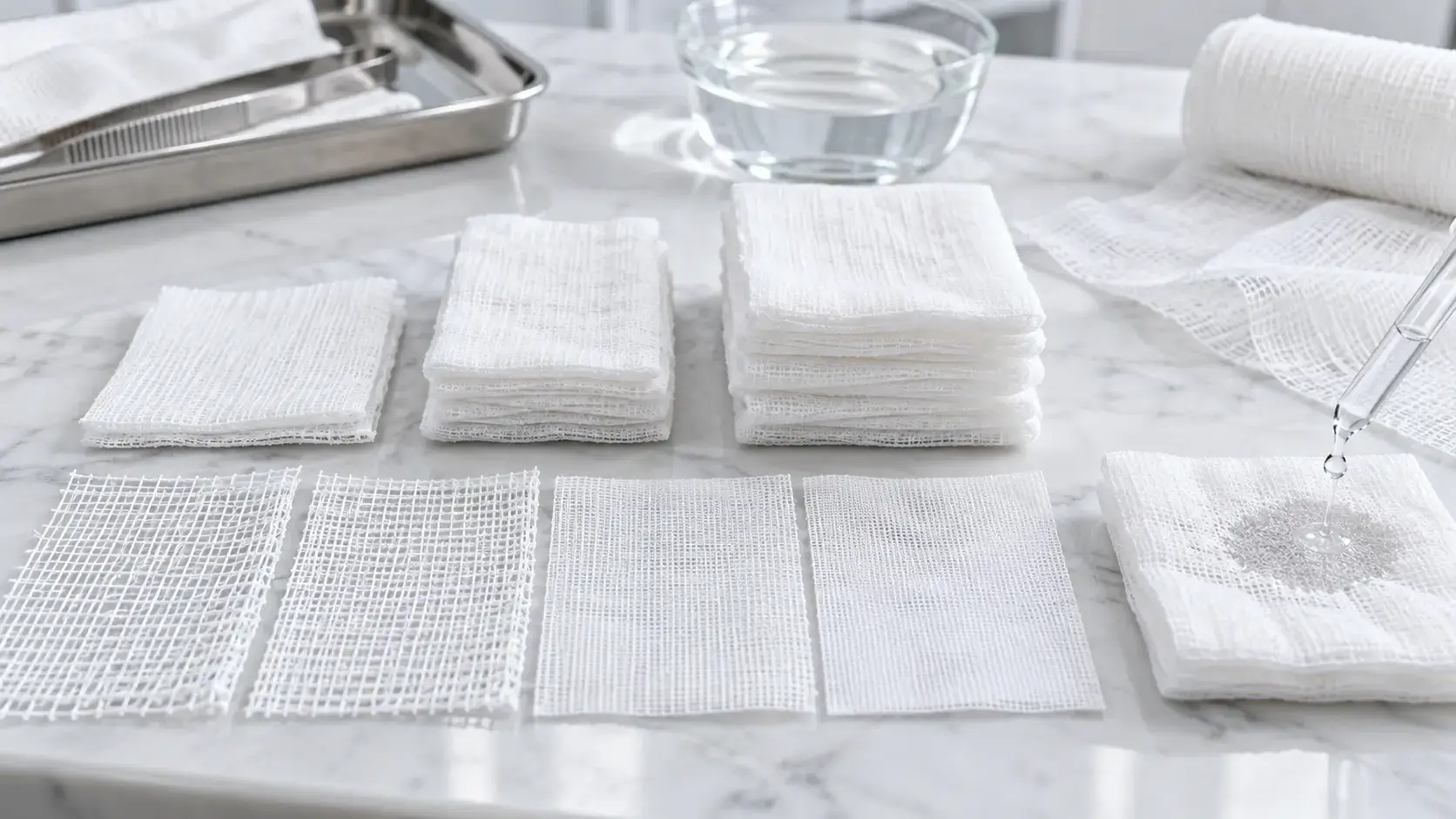
Mesh count tells you how many threads run in each direction of the woven fabric. Warp threads run lengthwise, while weft threads run across the fabric. Chinese suppliers often give these counts per inch. EN 14079 uses threads per 100 mm instead. To convert threads per inch to threads per 100 mm, multiply by roughly 3.94.
| Commercial Mesh (per inch) | Warp / 100 mm | Weft / 100 mm |
|---|---|---|
| 19 × 15 | About 75 | About 59 |
| 26 × 18 | About 102 | About 71 |
| 30 × 20 | About 118 | About 79 |
A 26 × 18 fabric has about 37% more warp threads and 20% more weft threads per unit length than 19 × 15 gauze. If the yarn thickness is similar, the gaps between threads will usually be smaller. But a higher mesh count doesn’t automatically mean heavier fabric or better absorbency. You’ll need to check those properties separately.
How Does Mesh Compare with EN 14079?
EN 14079:2003 sets out several types of absorbent cotton gauze. The table below shows selected requirements for four fabric constructions. All thread counts are measured per 100 mm.[1]
| EN 14079 Type | Warp / 100 mm | Weft / 100 mm | Minimum GSM |
|---|---|---|---|
| Type 13 Light | 73 ± 4 | 57 ± 4 | 14 |
| Type 17 | 100 ± 5 | 70 ± 4 | 23 |
| Type 20 | 120 ± 6 | 80 ± 5 | 27 |
| Type 22 | 120 ± 6 | 100 ± 5 | 30 |
Take 26 × 18 gauze as an example. Its converted thread count is roughly 102 × 71 per 100 mm, which falls within the Type 17 thread-count tolerances. That doesn’t mean it automatically meets Type 17 requirements. The fabric must also weigh at least 23 GSM and meet minimum breaking loads of 50 N in the warp direction and 30 N in the weft direction, measured per 50 mm. Ask for test results from the actual fabric lot, not just a supplier’s mesh description.
Ply vs. GSM: Which Gauze Pad Contains More Cotton?
Ply means the number of fabric layers. GSM means how many grams one square metre of fabric weighs. If two pads use identical fabric and have the same dimensions, a 12-ply pad contains 50% more material than an 8-ply pad. But if the fabrics have different GSM values, the 8-ply pad could actually contain more cotton.
How to Calculate Theoretical Gauze Pad Weight
You can estimate how much fabric a pad contains with this formula:
Theoretical fabric mass (g) = Pad length (m) × Pad width (m) × Ply × GSM.
For this simplified calculation, each 10 × 10 cm layer covers 0.01 m². Here’s how the numbers change with different constructions.
| Construction | Calculation | Theoretical Fabric Mass |
|---|---|---|
| 8-ply, 14 GSM | 0.01 × 8 × 14 | 1.12 g |
| 12-ply, 14 GSM | 0.01 × 12 × 14 | 1.68 g |
| 8-ply, 23 GSM | 0.01 × 8 × 23 | 1.84 g |
| 12-ply, 23 GSM | 0.01 × 12 × 23 | 2.76 g |
Look at the middle two examples. The 8-ply pad made from 23 GSM fabric contains about 9.5% more material than the 12-ply pad made from 14 GSM fabric. More layers don’t always mean more cotton.
These are theoretical fabric weights, not measured finished-pad weights. A factory may use overlapping folds, different cutting dimensions, or extra material around the edges. Trimming and moisture can also affect the result. Set an acceptable finished-weight range and weigh actual production samples.
How to Check GSM and Folded Edges
To measure GSM, weigh a fabric sample and divide its mass by its area in square metres. For example, a 20 × 20 cm sample has an area of 0.04 m². Test several pieces from the same fabric lot under the agreed conditions. Record the results rather than relying on one measurement.
Check how the factory finishes the edges, too. Folding the cut edges inward hides loose thread ends, but it may also add fabric. Ask for a folding drawing and inspect samples for exposed threads or fibres that come loose. A folded edge doesn’t guarantee lint-free gauze.
Comparing Gauze Prices from Different Factories?
Send us your mesh count, ply, GSM, pad size, sterile requirements, order quantity, and destination. We can use the same specifications when requesting quotations from different factories.
Absorbency: What Should Medical Gauze Be Tested For?
Gauze that gets wet quickly doesn’t necessarily hold more liquid. These are two different properties. EN 14079:2003 sets a maximum sinking time of 10 seconds under its specified test method. This tells you how quickly the gauze wets and sinks during the test. It doesn’t tell you the total amount of fluid the pad can absorb.
| Measurement | Result | What Buyers Should Compare |
|---|---|---|
| Sinking time | Seconds | Actual sinking time against the specified limit |
| Liquid uptake | g liquid / g dry gauze | Absorption capacity measured with the same liquid and method |
| Liquid retention | Liquid remaining after drainage or compression | How much liquid stays in the gauze under the same test conditions |
To calculate liquid uptake, use the dry weight and the weight after soaking and draining:
Liquid uptake (g/g) = (Wet mass after specified drainage − Dry mass) ÷ Dry mass.
The test liquid, soaking time, temperature, and drainage method all affect the result. If one factory tests with a different procedure, its g/g result isn’t directly comparable with another factory’s figure. Give both suppliers the same test method. If you need to measure how much liquid stays in the gauze after compression, set a separate retention requirement. Neither uptake nor retention is the same measurement as the EN 14079 sinking-time test.
What Other Material Tests Apply?
EN 14079:2003 also sets limits for substances left in the fabric. Ether-soluble substances and water-soluble substances each have a maximum of 0.50%, while loss on drying is limited to 8.0%. The standard also covers fibre identity, foreign fibres, fluorescence, surface-active substances, and starch.
Ask the factory for the relevant test reports. Each report should identify the sample, test method, actual result, and acceptance limit. A certificate that simply says “Passed” gives you much less to check.
Which Standards Apply to Medical Gauze from China?
Suppliers may show you a fabric test report, an ISO 13485 certificate, or medical-device registration documents. They don’t all prove the same thing. A fabric report covers tested material properties. A quality-system certificate covers the manufacturer’s management system. Medical-device requirements depend on the finished product, its intended use, and where it will be sold.
YY/T 0331—2024: China’s Gauze Standard
YY/T 0331—2024 covers performance requirements and test methods for absorbent cotton gauze and cotton-viscose gauze. It came into effect on March 1, 2025, replacing YY/T 0331-2006. The standard doesn’t cover gauze made entirely from viscose or medicated gauze.[2]
Check which edition appears on the supplier’s report. A test carried out against the 2006 edition doesn’t, by itself, show that the material meets the 2024 requirements.
ISO 13485:2016: Factory Quality Management
ISO 13485:2016 sets out quality-management requirements for organizations working with medical devices.[3] When a supplier sends you a certificate, check the company name, manufacturing address, certified activities, issuing body, and validity.
Find out whether the factory handles weaving, fabric finishing, sterilization, and packaging itself. If another company does part of the work, get its details. And remember, an ISO 13485 certificate doesn’t replace testing of the fabric or finished gauze you’re buying.
United States: FDA Classification
Under 21 CFR 878.4014, qualifying nonresorbable gauze or sponges intended for external use fall under Class I and are generally exempt from 510(k) notification, subject to the regulation’s limitations.[4]
Gauze intended for internal surgical use is covered separately under 21 CFR 878.4450. That device description includes X-ray-detectable elements.[5] The term “nonresorbable” in these classifications doesn’t mean the gauze cannot soak up wound fluid.
The FDA’s Quality Management System Regulation (QMSR) took effect on February 2, 2026. It incorporates ISO 13485:2016 into the FDA’s medical-device quality-system framework, with FDA-specific provisions and applicable exemptions.[6]
Before placing a US order, confirm the correct product code and the requirements for establishment registration, device listing, labeling, and quality management. FDA registration or device listing doesn’t mean FDA approval.[7]
European Union: MDR and Intended Use
Under EU Regulation 2017/745, Annex VIII, Rule 4, gauze that contacts injured skin may fall into different risk classes depending on what it is intended to do.
Products used as a mechanical barrier, for compression, or to absorb wound exudate may be Class I. Products mainly intended to manage the wound microenvironment may be Class IIa. Certain products for wounds that can heal only by secondary intention fall under Class IIb.[8]
For sterile Class I devices, a notified body must be involved in the sterility-related aspects of conformity assessment.
For EU orders, check the legal manufacturer’s identity, applicable declaration of conformity, CE marking, authorized representative where required, and approved labels. Biological safety evidence should also match how the gauze contacts the patient and for how long. ISO 10993-1:2025 provides a risk-based framework for that evaluation.[9]
Sterile vs. Non-Sterile Gauze: What Changes?
A sealed pouch doesn’t prove that the gauze inside is sterile. If you’re buying a product labeled as sterile, ask how the finished product is sterilized, how the packaging keeps it sterile, and how each batch is released. You’ll also need evidence supporting its shelf life.
- Sterilization: If the factory uses ethylene oxide (EO), request process-validation and routine-control records against ISO 11135:2014 and applicable amendments.[10]
- Sterile-barrier materials: Check the packaging-system evidence against ISO 11607-1:2019 and applicable amendments.[11]
- Sealing operations: Ask for validation of the forming, sealing, and assembly processes under ISO 11607-2:2019 and applicable amendments.[12]
- EO residues: When EO sterilization is used and the standard applies, check evaluations of EO and ethylene chlorohydrin residues under ISO 10993-7:2026.[13]
- Release and shelf life: Get batch-linked sterilization release records, package-integrity evidence, expiry-date support, and records that allow you to trace each lot.
One passing sterility test isn’t enough to prove that a sterilization process works consistently. The process itself must be validated.
If you plan to import non-sterile gauze and sterilize it afterward, the finished configuration, packaging, and sterilization process must be validated under the applicable regulatory requirements. You can’t simply sterilize the product and change its label without the necessary controls.
How to Verify a Medical Gauze Manufacturer in China
Start by finding out who actually makes the gauze. The company sending your quotation may be a trading company rather than the factory.
Ask for the manufacturer’s Chinese business license, unified social credit code, production address, relevant medical-device documents, and quality-system certificates. If the exporter and manufacturer are different companies, confirm who handles testing and who approves the finished batches for release.
Next, ask the factory to trace a finished lot back through production. It should be able to connect the packaged gauze to its fabric batch, incoming yarn or cotton records, weaving measurements, absorbent processing, cutting, and folding. Sterile products also need records linking them to the sterilization lot.
Compare the batch numbers and sample identifiers on the test reports with those records. They should lead back to the material and products being supplied.
An on-site supplier audit in China can check the original documents, production equipment, laboratory arrangements, and traceability system. If the factory can’t connect the purchased gauze to its test results, investigate the gap before approving a bulk shipment.
Need to Verify a Medical Gauze Factory?
Send us the factory name, production address, gauze specifications, and available certificates. We can discuss an on-site audit covering production records and traceability.
What Should a Medical Gauze RFQ Include?
Send every supplier the same written specification. Otherwise, you could end up comparing prices for gauze made with different fabric weights, thread counts, or packaging.
Here’s an example for a 10 × 10 cm, 8-ply, non-sterile cotton gauze pad made from EN 14079 Type 17 fabric. It’s a starting point for requesting quotations, not a complete product design or proof of regulatory compliance.
| RFQ Item | Example Requirement |
|---|---|
| Intended use and market | Non-medicated gauze for external use; specify destination market |
| Material | 100% absorbent cotton |
| Fabric standard | EN 14079:2003, Type 17 |
| Thread count | Warp 100 ± 5; weft 70 ± 4 threads/100 mm |
| Fabric mass | At least 23 GSM; provide actual measurements for the supplied lot |
| Breaking load | At least 50 N warp and 30 N weft per 50 mm |
| Finished pad | 10 × 10 cm; 8-ply; approved size and weight tolerances |
| Edges | Folded inward according to the approved drawing |
| Absorbency | EN 14079 sinking time ≤ 10 s; add other tests if required |
| Sterility | Non-sterile; quote sterile versions separately |
| Packaging and labeling | Quantity per pack, carton layout, lot codes, approved label artwork |
| Quality documents | Fabric-lot test reports, finished-pad checks, applicable medical-device documents |
| Commercial terms | MOQ, order quantity, lead time, Incoterm, named delivery place, and exclusions |
Get a finished sample before production and approve the latest version of the specification. If the factory wants to change the yarn, GSM, ply, processing method, sterile status, or packaging, have it submit the change for written approval.
Your China sourcing RFQ should also state how often the product will be tested, what results are acceptable, and who is responsible for arranging and paying for third-party testing.
How to Compare Medical Gauze Prices from China
Make sure the quotations cover the same fabric, pad dimensions, absorbency requirements, sterile status, and pack quantity. A carton of bulk-packed non-sterile gauze isn’t comparable to individually packed sterile pads, even if the pad dimensions are identical.
Ask each factory to separate the basic product cost from sterilization, individual packaging, additional testing, labeling, and any tooling or setup charges. That makes it easier to see why one quote costs more.
For shipping from China, calculate freight using the actual packed carton dimensions and gross weight. Don’t use the theoretical cotton weight of the pads. Compare total quotations at the same named delivery point and check what’s excluded from each price.
How to Inspect Medical Gauze Before Shipment
Before shipping, compare the finished gauze with your approved sample and specification. You can check size, layers, folding, appearance, and packaging during a physical inspection. Fabric performance and sterile release also need supporting test and production records.

| Inspection Area | How to Verify |
|---|---|
| Size and ply | Measure finished pads and unfold samples to count the layers against the approved drawing |
| GSM and pad weight | Review fabric-lot GSM results and weigh finished samples against the agreed range |
| Edges and appearance | Look for poor folding, loose threads, contamination, stains, and other visible defects |
| Absorbency | Check batch-linked test reports, methods, actual results, and acceptance limits |
| Packaging | Check pack quantities, seals, labels, expiry markings, and carton condition |
| Traceability | Match product and carton lot codes with manufacturing and test records |
| Sterile products | Review applicable sterilization release, packaging, and residue records |
How Should Sampling and Release Work?
ISO 2859-1:2026 provides sampling plans for lot-by-lot inspection using acceptance quality limits (AQL).[14] Agree on the lot size, inspection level, defect categories, acceptance numbers, and conditions for holding a shipment before the inspection starts.
Don’t classify every problem as a minor defect. Incorrect product identification or a damaged sterile barrier may affect patient safety. Such findings need a safety-based decision, not the same treatment as a small cosmetic issue.
Which Documents Must Match the Shipment?
Check that the purchase order, current specification, SKU, manufacturing lot, test reports, approved labels, and shipped quantities all match. For sterile gauze, include the sterilization lot and release records.
If a test report shows a different SKU or batch number, ask the factory for records explaining the connection. Don’t release the shipment based on an unrelated report.
A pre-shipment inspection in China can document finished dimensions, fabric construction, quantities, packaging, and visible defects. It doesn’t replace laboratory testing or validation of the sterilization process.
Need to Check Your Gauze Order Before Shipping?
Share the factory location, order quantity, approved drawings, inspection criteria, and packaging requirements. We can discuss a pre-shipment inspection based on your order specifications.
Frequently Asked Questions
What Does 40s Mean in Medical Gauze?
“40s” usually refers to yarn fineness under the English cotton-count system. It doesn’t tell you the fabric’s mesh count, GSM, or number of layers. Ask the factory to confirm which yarn-count system it uses and provide the complete fabric specifications.
Can a Gauze Roll Test Report Be Used for Finished Swabs?
It can support some material properties, provided the fabric roll can be traced to the finished swabs. These may include yarn count, thread density, GSM, and other tested fabric properties. You’ll still need to check the finished swabs for size, ply, folding, packaging, and any changes caused by further processing.
Can Non-Sterile Gauze Be Sterilized After Import?
Yes, if the product’s manufacturing and regulatory arrangements allow it. The finished product configuration, sterilization cycle, packaging, and routine release process must be properly validated. Simply adding a “sterile” label after processing isn’t enough.
What If the Supplier’s Test Report Has No Batch Number?
Ask for another sample identifier and records showing which fabric or finished-product lot was tested. If the supplier can’t connect the report to your shipment, the report doesn’t prove that the gauze you’re buying has those properties.
Finally
Compare gauze prices only after you’ve agreed on mesh, ply, GSM, absorbency, finished dimensions, and packaging. Before shipping, check that the product, test results, labels, and batch records match your order. Sterile gauze also needs valid sterilization and packaging evidence. A mesh count or factory certificate alone isn’t enough to confirm that the product meets your requirements.