
Nobody includes a close-up of a plastic screw cap in a boutique hotel’s brochure. Why would a plastic screw cap matter? Because it hides the cam lock fastener behind it. Yet someone on the procurement team has to decide whether that detail belongs in the room. That is where flat-pack vs assembled hotel furniture becomes a question of positioning, workmanship and budget. At JS Sourcing, most furniture we source for high-end and boutique hotels is pre-assembled, with knock-down construction reserved for suitable products or components. Understanding why helps explain the price difference, where KD makes commercial sense, and which savings remain compatible with the room your client approved.
KD furniture vs assembled furniture is often presented as a choice between cheaper shipping and easier installation. In the high-end projects we handle, the difference begins with the furniture itself.
Listen to this article
Quick links
- Why KD and assembled furniture are made for different projects
- When does KD furniture make sense in a five-star hotel?
- How to control costs when buying assembled hospitality furniture
- Finally
Why KD and Assembled Furniture Are Made for Different Projects
A spreadsheet comparing KD furniture vs assembled furniture can be perfectly calculated and still answer the wrong question. If the client expects a particular finish and feel, a cheaper product that delivers a different experience is a different purchasing proposal.
What Is KD Furniture?
KD stands for knock-down. The furniture is designed to travel as separate components and be assembled at destination. Ready-to-assemble, or RTA, and flat-pack are closely related terms. Flat-pack commonly describes components packed into flat cartons; KD also includes products such as bed frames with detachable rails.
Panels or structural members arrive with the holes, joints and fittings needed for assembly. Depending on the design, connections may use cam locks, bolts, screws or interlocking joints. Wardrobes, desks, nightstands, shelving, tables and bed frames can all use KD construction.
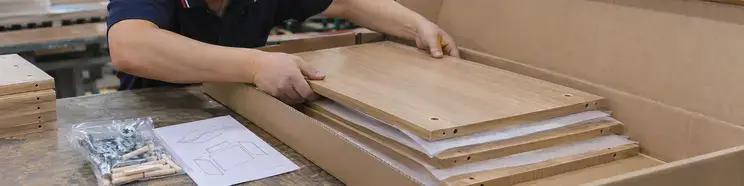
KD furniture travels as separate components, with the fittings and instructions needed for assembly at destination.
For hospitality, KD can be custom-made to the project’s dimensions, layout, colour and hardware requirements. A budget hotel’s custom KD furniture can be strong, durable and entirely appropriate for daily use. Its construction still determines where components meet, how edges are finished and which fittings need access during assembly.
KD furniture can be custom-made, strong and durable; those qualities do not make its detailing, finish and feel equivalent to assembled furniture.
What Is Assembled Furniture?
Assembled furniture arrives with its main structure already built. Suppliers also use pre-assembled, factory-assembled, ready-assembled or fully assembled furniture. The purchasing documents clarify whether legs, handles, tops or other components travel separately.
In custom high-end work, factory assembly allows the maker to join components permanently, align them and complete the detailing as part of a finished piece. Where the design requires it, finishing can continue after components have been joined. The site team receives that completed construction.

Factory assembly allows the maker to complete the body, align components and finish the detailing before shipment.
Casegoods such as nightstands, desks and cabinetry, along with lounge chairs, sofas and finished headboards, often ship assembled. Large installations may travel as several assembled sections. Semi-KD describes a partial arrangement: the main body stays assembled while suitable components are attached at destination.
Fitted wardrobes likewise commonly use prebuilt casing or assembled sections fitted into a reserved recess, with perimeter gaps finished on site. The installer’s remaining work does not make the wardrobe a kit of loose panels.
Pre-assembled does not mean installation-free. Positioning, wall fixing, connections and adjustment may remain on site. The distinction is how much of the furniture itself the installer must build.
Why High-End Hospitality Projects Usually Use Assembled Furniture
The largest share of furniture imported for the high-end hospitality projects JS Sourcing handles is assembled. The reason becomes clearer when we look beyond dimensions and function.
A KD cabinet and a pre-assembled cabinet may offer the same storage. KD construction has to accommodate parts that travel separately and are joined on site. A workshop building the complete body can make permanent joints, integrate exposed edges and finish the junctions as part of the piece. Those differences remain in the finished appearance and feel.
In upholstered furniture, the frame construction, connections, contours and seams also contribute to the finished appearance. Our hospitality upholstery guide explores how these decisions affect supplier proposals.
For a 4- or 5-star hotel, resort, serviced apartment or restaurant, that refinement contributes to the experience the client wants to offer. A budget property has different priorities and can create excellent value with well-made KD furniture. Both projects need dependable products, but they are buying different combinations of cost, detail and guest experience.
The appointed design/engineering company develops suitable custom solutions. Where no such company is involved, manufacturers put proposals forward based on their experience. Purchasing and inspection then follow the agreed construction and finish.
Furniture can perform the same function while creating a different hospitality experience, which is why price alone cannot establish its value to the project.
KD Costs Less, but Does It Offer the Experience Your Client Wants?
When we compare KD furniture vs assembled furniture for our projects, KD usually has the lower purchase price. More economical materials and finishes, simpler detailing and less workshop assembly help explain why. Its compact packing usually adds a freight advantage.
KD is often lighter in practice because the materials and construction differ. Taking an otherwise identical item apart would not, by itself, reduce the weight of its components.
There is little commercial sense in trying to prove that assembled furniture always becomes cheaper after installation. A KD offer may remain substantially cheaper. What matters is whether its appearance and feel suit the project.
Who is this guide for? Procurement companies, designers, contractors and buyers sourcing furniture for hotels, resorts, serviced apartments and restaurants.
A cheaper proposal has arrived. What changes for your client? JS Sourcing can compare materials, construction, finish and packing against the approved drawings and samples, then coordinate quotations for the alternatives your team is willing to consider.
KD Furniture vs Assembled Furniture: How Much Does KD Actually Save?
Consider two custom nightstand offers with similar dimensions and storage. One uses melamine-faced panels and KD connectors. The other uses a factory-assembled body with veneer, lacquer and more integrated detailing. They serve the same function but have different specifications.
This cost comparison of KD furniture vs assembled furniture uses illustrative planning inputs for 100 units, not supplier quotations or market averages. The figures show the cost difference between the two specifications.
| Cost per nightstand | Custom KD | Custom assembled |
|---|---|---|
| Furniture and export packing | $90 | $180 |
| Allocated international freight | $10 | $25 |
| Allocated inspection cost | $5 | $3 |
| Site assembly and fitting | $20 | $8 |
| Subtotal of these costs | $125 | $216 |
The freight assumptions are 0.10 m³ and 0.25 m³ per unit, allocated at an illustrative $100 per m³ in a shared shipment. Site work assumes 30 and 12 minutes respectively at $40 per two-person crew-hour. The inspection allocations are budget assumptions.
KD saves $91 per unit across these four costs, or $9,100 for 100 units. Duties, taxes, inland delivery, storage, sourcing fees and corrections remain outside this subtotal. An actual budget adds them using the project’s route and commercial terms.
The saving is clear. It does not turn the KD offer into the same finished product. The client is deciding whether the different furniture creates sufficient value for the intended property.
A trial assembly using the proposed manual can reveal missing steps, incorrect part numbers and unclear drawings before shipment.
Why Flat-Pack Furniture Is Still Associated With Lower Quality
The perceived quality of KD furniture vs assembled furniture comes down to the appearance, detail and feel guests experience. Strong furniture can still look economical. A well-made cabinet does not acquire a refined appearance simply because it survives repeated use.
The BBC’s 2020 feature Is the future flat-packed? discusses flat-pack’s inexpensive image and designers working beyond it. It also describes contract furniture whose designers use KD construction while preserving the quality and appearance they want.
The IKEA effect adds an interesting distinction: people can attach more value to something they helped assemble. A hotel guest generally has no such involvement. The purchasing team therefore has to judge the experience the finished furniture creates for someone encountering it for the first time.
A lower KD price can be a genuine saving while the furniture still lacks the refinement expected for a particular high-end project.
When Does KD Furniture Make Sense in a Five-Star Hotel?
The choice of KD furniture vs assembled furniture can vary from hospitality project to another. Based on our experience, dealing with a high-end hospitality resort involves way lesser KD furniture than a 2 star hotel chain project will . The purchasing team can distinguish suitable exceptions from changes that alter the intended experience.
Bed Frames and Other Parts Guests Do Not See
A bed frame may use knock-down side rails, supports and fittings designed for straightforward assembly. When concealed by the finished bed, those connections have little influence on its visible detailing. The frame still needs a suitable design for daily use.
The headboard has a different role. Its upholstery, veneer, decorative elements and finished junctions contribute directly to the room. In our high-end projects, headboards are almost never supplied as loose flat-pack components for workers to build and finish. Large headboard walls may travel in several finished sections.
Designer Furniture Built Around KD Construction
Some furniture makes its assembly method part of its identity. Exposed interlocking pieces and carefully designed connections can belong to the aesthetic the designer wants, rather than being details to conceal.
Mustang Home Goods, for example, presents architectural plywood furniture for boutique hospitality. Its designs use tool-free, interlocking construction across seating, tables and bedroom furniture. It illustrates a deliberate design approach, rather than an attempt to reproduce a different assembled product at a lower price.
When a project’s own design uses this approach, the manufacturer’s task is to execute its construction and finish consistently. The fact that it comes apart is already part of the approved concept.
KD makes sense where its construction is concealed or deliberately contributes to the design the client wants.
What Can Go Wrong With a KD Furniture Order?
Once KD has a place in the project, complete and correctly identified kits become essential. A neatly manufactured item can still be impossible to assemble with what arrives in its cartons.
- Missing parts or hardware: the installer cannot complete the furniture.
- Unnumbered parts: similar components leave the installer guessing where they belong.
- Incorrect numbering: following the labels leads to parts that do not fit together.
- Unclear instructions: drawings, fittings references or assembly steps leave room for interpretation.
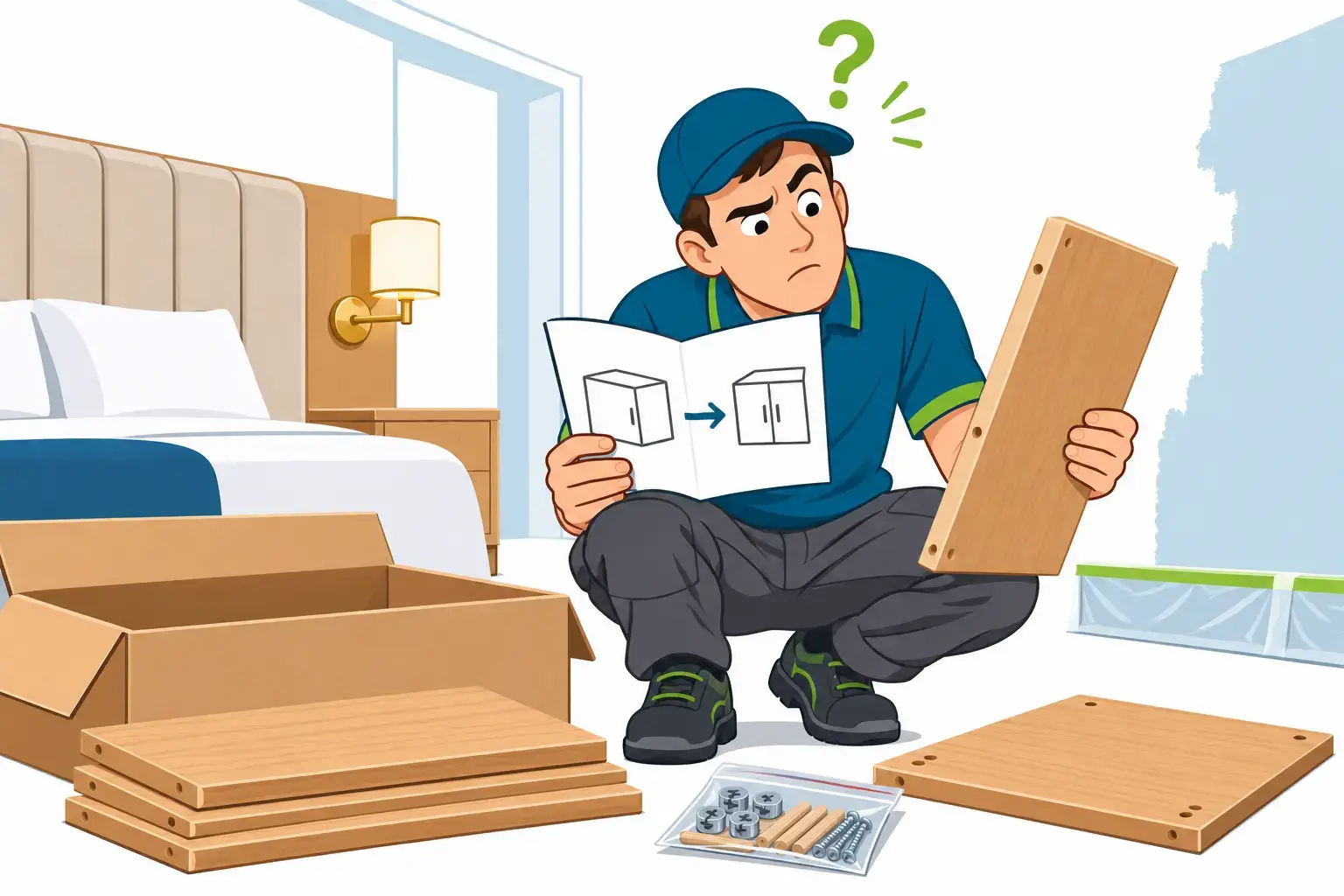
Complete kits, correct part identification and clear instructions help prevent assembly problems at destination.
Matching identifiers across the component list, parts, hardware packs and manual makes the kit easier to follow. Agreed spare fittings help with losses during installation, but cannot compensate for an incorrectly machined or missing furniture component.
KD’s price advantage depends on receiving complete, correctly identified kits that the destination team can assemble as intended.
Inspection time also affects the cost of KD furniture vs assembled furniture. Pre-shipment inspection usually requires more time for KD because the agreed scope includes recording assembly, examining the completed item and following its parts through disassembly and repacking. Inspection coverage and the number of variations influence the time required.
A panel from a wider desk can look almost identical to one from a narrower version. Mixing them during inspection may leave two incomplete kits, even when both were complete at the start. The checklist needs to identify the relevant dimensions, finish, component references and manual for each variation.
When inspecting variations of the same furniture piece, a detailed checklist and an inspection process that keeps each variation’s parts separate help prevent mix-ups.
That identification continues through repacking. The inspected kit’s components and fittings return to the correct cartons, linked to the right product code. Photos and assembly records help the buyer understand any problem while the supplier can still correct it in China.
How to Control Costs When Buying Assembled Hospitality Furniture
If the client’s approved design requires assembled furniture, there is little value in reopening the KD furniture vs assembled furniture debate. There are other ways to control the budget through manufacturing, packing and coordination.

Budget control means finding savings that preserve the furniture and guest experience the client approved.
Where Manufacturers Can Reduce Costs Without Changing the Approved Design
A suitable workshop is the starting point. A manufacturer already experienced in the required joinery, finish or upholstery can offer a more practical route than one learning those processes for the order. JS Sourcing’s hospitality sourcing service helps procurement teams identify manufacturers suited to the work.
Comparable quotations reveal what the price covers: substrate and thickness, veneer or coating, hardware, construction, packing and remaining site work. A lower offer with a changed finish is an alternative for approval, rather than an unnoticed saving.
Repeated dimensions, internal components and hardware across room types can reduce purchasing and production complexity. Shared hidden components may offer savings while visible designs remain distinct. Combining quantities that use the same material or finish can also make production batches more efficient.
Manufacturer proposals remain subject to the responsible design team’s review. The client decides whether a change preserves the intended result. Sample and development coordination helps turn those decisions into approved references for production.
Material, construction and finish checks during manufacture can catch corrections before the full order is complete. Avoiding repeated rework and replacement shipments is another practical contribution to the budget.
Your client wants the assembled furniture, but the quotations exceed the budget. Where is there room to negotiate?
JS Sourcing can discuss supplier capabilities, production quantities, agreed alternatives and packing arrangements with the workshops, giving your team priced options to review with the client.
How Better Packing and Consolidation Reduce Shipping Costs
An assembled cabinet contains empty space within its body, so packed volume matters. Nevertheless, changing the furniture into a flat-pack kit is only one way to reduce it. Carton dimensions, suitable removable components, protection and loading arrangements can all affect the space occupied.
A nominal 40-foot high-cube container has around 76 m³ of internal volume. Hapag-Lloyd’s equipment example lists 76.3 m³. Carton geometry, pallets, voids, access and securement reduce the space usable for the actual order.
Comparing KD furniture vs assembled furniture on freight cost requires final carton dimensions, gross weights and a loading plan. A shared-container allocation can help compare items; dedicated-container budgets follow the whole containers actually booked. Smaller cartons produce a cash saving when they change the freight bill.
Where the design allows it, shipping detachable legs or bases separately can reduce packed volume while keeping the main furniture body assembled.
Protection still has a job to do. Corners, finished surfaces and protruding details need packing suited to the product and route. Removing protection to make a carton smaller can simply move expenditure into site repairs.
Consolidation brings goods from several workshops into one shipment. Coordinated production releases help avoid a partial shipment caused by one supplier finishing late, or unnecessary storage while the other goods wait. Clear carton marks also help the destination team locate items for each room type.
Loading supervision checks the shipment against its packing records and documents handling and securement. Local access, room readiness and installer availability complete the cost picture. The hotel FF&E sourcing guide connects these dependencies across the project.
Suitable manufacturers, agreed production efficiencies, better packing and consolidation offer savings while preserving the required furniture.
Finally
The question is not whether flat-pack furniture wins over assembled furniture, or vice versa. Comparing KD furniture vs assembled furniture means asking which type creates more value for your hospitality project.
KD furniture for budget hotels can be custom-made, strong and durable, and serve its intended purpose very well. Its construction, however, produces a different appearance and feel. The joints, seams and finishing details do not achieve the same refinement as custom assembled furniture. For high-end hospitality projects, that difference matters because furniture contributes directly to the experience guests perceive.
There are sensible exceptions. A concealed bed frame may suit KD construction perfectly. Designer furniture may make its assembly method part of its appeal. In either case, complete kits, correct identification, clear instructions and suitable inspection remain essential to making the choice work.
Where assembled furniture provides the required result, budget control still has plenty to offer. Suitable manufacturers, clearly compared quotations, agreed production efficiencies, better packaging and shipment consolidation can reduce expenditure while preserving the approved design.
Cost therefore belongs alongside the guest experience and perceived value in the purchasing decision. And those qualities become easier to assess when the furniture is seen together: a convincing individual sample does not automatically create a convincing room. Our guide to hotel mock-up room approval explores how those individual choices come together before bulk production.
About the author: JS Sourcing supports hospitality procurement companies, contractors and designers with supplier sourcing, sample coordination, production follow-up, quality inspection and shipment consolidation in China. This guide draws on the team’s work with high-end and boutique hospitality projects.