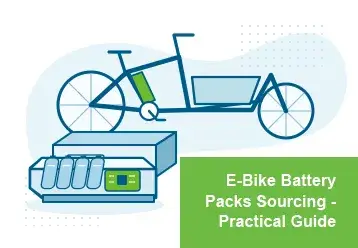
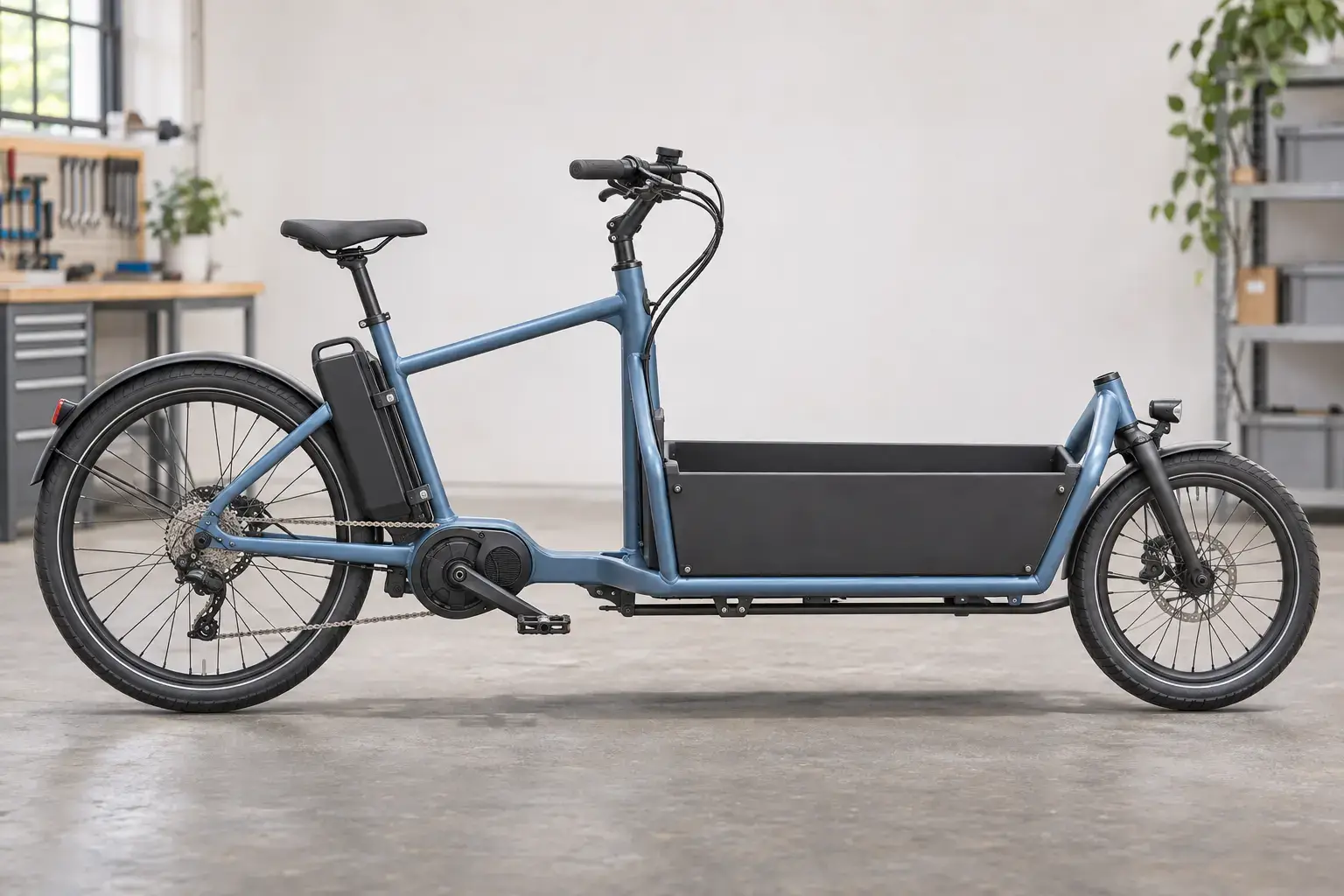
You’ve been sourcing parts for your company’s new cargo e-bike range, and you have one prototype and two battery samples, one from each supplier. You ride bikes yourself, so you know what you want from a cargo bike on a long climb, even if you’re still finding your feet with the electrics. There’s a satisfying click when the first battery slides into the prototype’s rail.
Both battery labels say 48 V and 720 Wh, but when your engineer asks how much current each pack can sustain on a climb with a full load, only one supplier’s spec sheet gives you a figure. It’s a small gap on paper, but it’s exactly the sort of detail that matters when you’re comparing e-bike battery manufacturers in China before placing a bulk order.
Why Two 720 Wh Packs Can Behave Differently
An e-bike battery stores the energy the motor uses to assist the rider. The controller draws current from the pack as the motor needs it. Inside the pack, connecting cells in series raises voltage. Connecting cells in parallel increases amp-hour capacity and lets them share the current. The battery management system (BMS) monitors the cells and can interrupt charging or discharge when conditions go outside its protection limits.
48 V × 15 Ah gives about 720 Wh using nominal ratings. That tells you the rated energy. How much you can use depends on the discharge load, temperature, and cutoff voltage. On a loaded climb, the pack also needs to sustain the controller’s current draw for the length of the climb. A peak current figure without a duration leaves that question open. [1]
Cell choice matters, too. Nickel manganese cobalt (NMC) lithium-ion cells generally store more energy for a given weight. Lithium iron phosphate (LFP) cells generally offer greater thermal stability and can deliver long cycle life, with a weight trade-off for the same energy. The numbers 18650 and 21700 describe cylindrical cell sizes. For the cargo-bike buyer, the trade-off shows up in the pack’s fit, weight, and measured performance on the intended route. [2]
Two packs with the same watt-hours can behave differently on the same bike, so compare their continuous current, peak current and duration, and usable energy under the same test conditions.
What E-Bike Battery Manufacturers in China Need to Quote
That missing current rating belongs in the request for quotation. A single finished-pack specification gives both suppliers the same bike and controller, use case, destination, and order quantity. A delivery fleet and a commuter-bike brand may have different loads, charging patterns, and warranty needs. If a supplier offers a different cell or pack design, a separate price and a short list of deviations make the option visible.
| Area | Required details |
|---|---|
| Cells and protection | Cell maker and exact model, BMS hardware and firmware, and protection settings |
| Energy and load | Nominal voltage and rated Wh, measured capacity, continuous current, and peak current with duration |
| Fit and charging | Dimensions, weight, mounting rail and lock, connector pinout and polarity, communication protocol, and approved charger |
| Test conditions | Discharge current, temperature, cutoff voltage, sample count, and whether the results are for cells or complete packs |
Who actually assembles the pack?
A quote tells you what the seller proposes. The next question is who can build it again. The cell maker, pack assembly factory, and company integrating the pack with the bike may be different businesses. Factory-direct and trading-company offers can both be evaluated by identifying the assembly site, confirming access for inspection, and naming the company responsible for the warranty.

The seller’s registered Chinese name and Unified Social Credit Code can be checked through China’s National Enterprise Credit Information Publicity System. The quotation should make it clear how the seller, assembly site, and payment beneficiary relate to each other. An auditor can review confidential records on-site by agreement.
During a factory audit, tracing one pack serial number back to its cell lot, component revisions, and final test record, then tracing that lot forward to the other packs and shipments, shows how precisely the factory could isolate a problem.
At JS Sourcing, this is part of how we approach sourcing bicycle and e-bike components. The quotation, the factory records, and the measured sample results tell us different things. Keeping them separate makes it easier to see where a supplier’s offer still needs evidence.
What the Safety Documents and Pilot Each Prove
Once you know who builds the pack, you can match its model and configuration to the safety evidence. The issuer, listing number, standard edition, and manufacturing site are useful details to confirm with the certification body. If the pack has changed since testing, the question is whether the evidence still covers the version being offered.
UL 2271 covers batteries for light electric vehicles. UL 2849 evaluates the e-bike’s electrical system, including the drive, battery, and charger combination. New York City requires accredited-laboratory certification to UL 2849 for powered bicycles and UL 2271 for their storage batteries. For an EU light means of transport (LMT) battery, the supplier file should cover the EU declaration of conformity and supporting technical documentation under the Batteries Regulation. Article 77 also sets a battery-passport requirement for LMT batteries placed on the EU market or put into service from 18 February 2027. For orders near that date, it’s worth settling who supplies the required data while both offers are still open. [3] [4] [5]
Will the production pack behave like the sample?
The documents establish what was assessed. A pilot using the planned production components lets you compare fit, charging, communication, and performance on your bike. For the loaded climb, the engineering team can compare both packs at the same starting charge and temperature while logging the controller’s current draw. Buyer-selected samples with recorded serial numbers and agreed limits make those results traceable.
A “1,000 cycles” claim also needs a defined endpoint and test conditions. For a pack that measures 15 Ah initially, an 80% retention endpoint means 12 Ah under the same measurement conditions. The cycle count only makes sense alongside the charge and discharge rates, temperature, depth of discharge, and sample count.
If the approved cell goes out of stock, a substitute becomes a separate proposal. Before authorizing it, the buyer and supplier can review the expected performance, agree on any retesting, and confirm the effect on certification and transport documentation with the relevant lab or certification body.
If the quoted cell is hard to secure, ask the supplier to price a stock reservation and a separately validated alternative so you can compare the cost and lead time of each option.
For the bulk run, welding and insulation records, protection checks, calibration, and rejected-pack handling show how the factory controls production. A pre-shipment inspection can compare finished-pack identification, quantities, labels, and packaging with the order. Hazardous tests such as short-circuit, crush, and overcharge testing belong with a qualified laboratory.
When the pilot results carry the exact cell model, BMS revision, and charger, the buyer has a record to work from if the supplier proposes a change before production.
Which Offer Works as a Bulk Order?
Once both suppliers have quoted a pack you can approve, the prices start to mean something. The same quantity, delivery point, and scope are the basis for comparison. In this example, Supplier A looks cheaper until you open the charger line.
| Cost item | Supplier A | Supplier B |
|---|---|---|
| Base quotation | $150 | $160 |
| Approved charger | $12 extra | Included |
| Packaging and freight | $18 | $18 |
| Allocated validation and inspection | $6 | $6 |
| Comparable subtotal | $186 | $184 |
Supplier A starts $10 lower and ends $2 higher. These figures are hypothetical, with other costs assumed equal. A full landed-cost comparison also accounts for tooling, duties, and nonrecoverable taxes where applicable. Recoverable import taxes can be tracked separately.
When pricing shipping from China, the Incoterms rule, named place, importer of record, and route accepted by the dangerous-goods forwarder help explain what each price covers. The UN 38.3 test summary should cover the battery type being shipped. It is transport evidence, separate from the safety evidence for use on the bike. [6]
Can I get a pilot without committing to the full MOQ?
A paid pilot and a separately priced production order can give both sides a way forward. At 100 packs a month, a 1,000-pack minimum order quantity (MOQ) represents ten months of sales. If the minimum comes from a cell purchase or a custom enclosure, the supplier may be able to price a smaller first run or spread a larger commitment across delivery and payment dates. The comparison then includes how long the supplier holds the stock, its production dates, and when the production lead time starts.
Who pays when a failed pack can’t go back to China?
A free replacement can still leave you paying for local assessment and freight. Another supplier might credit the invoice against a report from an agreed local specialist. Those offers are easier to compare when the warranty spells out whether fleet use or capacity loss is covered, who pays for assessment and disposal, and how quickly the supplier will settle the claim. For a damaged or defective pack, any proposed shipment needs a separate assessment of the applicable transport rules and carrier acceptance. [7]
A warranty is easier to use when the supplier agrees in advance who can assess a failed pack locally, what evidence is enough, and when a credit or replacement is due.
If you’re weighing quotes with different cell options, order minimums, or warranty terms, JS Sourcing can help put the offers on the same basis and coordinate supplier checks and sampling. Discuss your battery sourcing project with JS Sourcing.
From the Prototype to the Purchase Order
By the time that battery clicks into place again, you want the rest of the fit to be just as clear. Both suppliers priced the same specification, the pilot gave you results you can compare, and you know who picks up the bill if a pack fails in service. Once those answers are on the table, the price comparison gets a lot easier.
The next job is carrying the approved pack into production. A golden sample gives the factory a physical reference. The purchase order ties it to the approved specification, pilot results, and rules for substitutions. A good inspection report gives you a record of what was verified on the finished order.
Sources
- European Commission Joint Research Centre. Performance and durability analysis of electric bicycle batteries, 2026.
- German Federal Environment Agency. Electric bikes get things rolling, section 3.4, 2014. U.S. Department of Energy, cylindrical cell format examples.
- UL Solutions. E-bikes certification and testing to UL 2849.
- New York City Department of Consumer and Worker Protection. Micromobility Devices and Batteries.
- European Union. Regulation (EU) 2023/1542 concerning batteries and waste batteries, Articles 18 and 77.
- U.S. Department of Transportation, PHMSA. Lithium Battery Test Summaries.
- U.S. Department of Transportation, PHMSA. Transporting Lithium Batteries, guidance on damaged, defective, or recalled batteries.