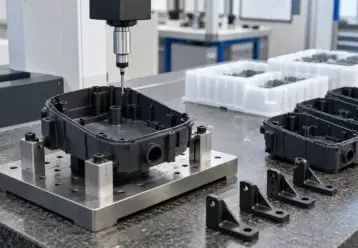
To source custom plastic parts from China, choose the manufacturing process that fits your part’s shape, material, tolerances, and expected order volume. CNC machining and 3D printing are usually good starting points for prototypes and small batches. Injection molding deserves consideration for repeat orders, especially when the lower unit cost can recover the mold investment. Extrusion, thermoforming, blow molding, and rotational molding are often better suited to specific shapes such as long profiles, large covers, and hollow containers.
Before placing an order, send Chinese suppliers the same approved drawings and material requirements. Compare tooling fees, unit prices at different volumes, sample approval conditions, and total delivered costs. Confirm who will actually manufacture the parts and who owns any custom tooling.
Which Manufacturing Process Should You Choose?
| Process | Suitable Parts | Main Buying Consideration |
|---|---|---|
| Injection molding | Enclosures, clips, connectors, repeat-production components | Mold cost, cavity count, cumulative order volume |
| CNC machining | Precision brackets, guides, functional prototypes | Machining time, material stock, tolerances |
| 3D printing | Design prototypes, complex shapes, small custom batches | Printing method, material properties, finishing |
| Vacuum casting | Small batches of matching prototype enclosures | Master pattern, silicone mold life, casting resin |
| Thermoforming | Large equipment covers, trays, packaging inserts | Sheet thickness, wall thinning, trimming |
| Extrusion | Rails, tubes, seals, continuous profiles | Cross-section, straightness, cutting tolerance |
| Blow molding | Bottles, tanks, hollow containers | Wall distribution, neck dimensions, sealing |
| Rotational molding | Large hollow tanks, boxes, outdoor containers | Wall variation, dimensional accuracy, cycle time |
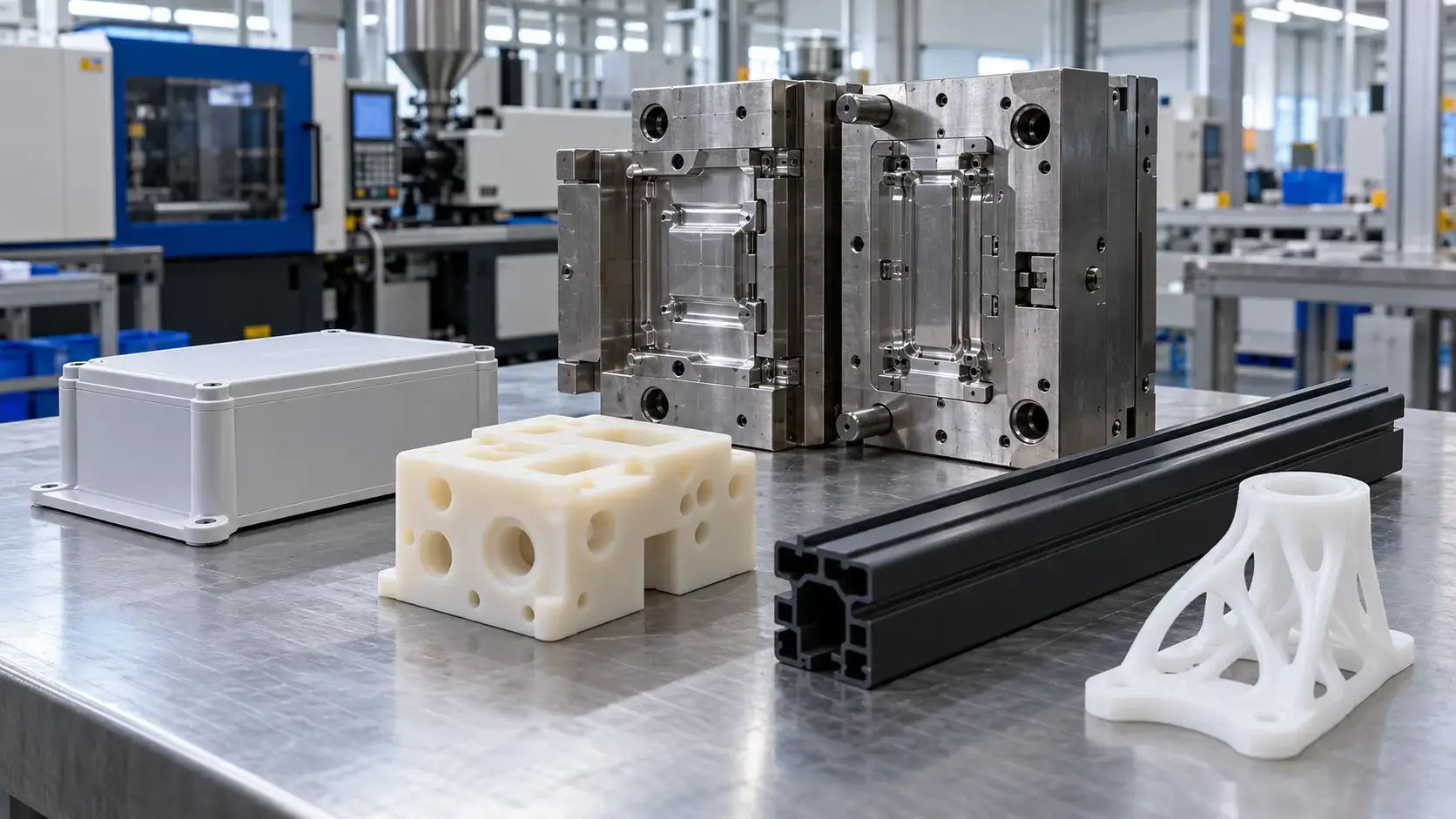
For an order of 20 POM guide blocks with precisely located mounting holes, CNC machining is a sensible first process to quote. There is no dedicated molding tool, and changes to the hole locations can often be made through the machining program.
If the same component will be ordered in thousands, injection molding becomes worth evaluating. The part must still be suitable for molding. A design with thick sections, enclosed side holes, or difficult undercuts may require a more complicated mold than its size suggests.
For an electronics enclosure that hasn’t reached its final design, rapid prototyping in China can be used to test connector positions and assembly. If there are three possible cable-opening locations, making two samples of each version gives the buyer six physical parts to compare before investing in tooling.
The prototype material also matters. A printed nylon clip may fit perfectly but behave differently from the injection-molded version under repeated bending. Use parts made with the intended production resin and process for final functional approval.
For a 1,000 mm plastic rail with a constant cross-section, extrusion is worth quoting. A large, thin-wall equipment cover may be better suited to thermoforming. For a bottle or sealed hollow container, blow molding should be assessed before considering conventional injection molding for the complete body.
When Does Injection Molding Become Cheaper?
The break-even quantity depends on the tooling investment and the cost difference between manufacturing processes.
Consider a simple ABS bracket that can meet its functional requirements through either CNC machining or injection molding. The following figures are hypothetical quotations used to demonstrate the calculation.
| Cost | CNC Machining | Injection Molding |
|---|---|---|
| Initial tooling | ¥0 | ¥18,000 |
| Unit manufacturing cost | ¥26 | ¥5 |
| 100 parts | ¥2,600 | ¥18,500 |
| 1,000 parts | ¥26,000 | ¥23,000 |
| 5,000 parts | ¥130,000 | ¥43,000 |
The injection-molded part costs ¥21 less per unit. Recovering the ¥18,000 mold investment requires:
Break-even quantity = ¥18,000 ÷ (¥26 − ¥5) = 857.14 parts.
In this example, injection molding becomes cheaper from the 858th part onward. If a design change adds ¥3,000 to the mold cost, the break-even quantity rises to 1,000 parts.
These figures are not Chinese industry averages or actual factory quotations. They exclude costs that might differ between the two processes, such as finishing, testing, inspection, freight, and rejected production.
Suppose your first order is 300 parts, with an annual forecast of 8,000. Request pricing at 300, 2,000, and 8,000 parts. If the larger orders are not confirmed, calculate the total cost at the lower quantities before paying for the mold.
The quote should also identify the mold’s cavity count, construction, expected service life, trial-sample allowance, and costs for engineering changes. A lower tooling quote may cover fewer services or use a different mold specification.
What Should Your RFQ Include?
Chinese manufacturers need enough technical information to calculate material use, select suitable machinery, plan tooling, and confirm dimensional requirements.
| RFQ Item | What to Provide or Request |
|---|---|
| Design files | STEP model, 2D drawing, revision number, critical dimensions |
| Material | Resin manufacturer, exact grade, color, permitted substitutions |
| Quantities | Prototype order, first production order, expected annual volume |
| Tooling | Mold fee, cavity count, trial samples, ownership, maintenance |
| Quality | Tolerances, functional tests, surface standards, inspection records |
| Delivery | Tooling and production lead times, packaging, Incoterms, named place |
Material and Tolerance Requirements
ABS, PC, PP, POM, and PA are common materials for custom plastic parts. The exact grade matters more than the general polymer name. Ordinary ABS, heat-resistant ABS, and flame-retardant ABS may have different properties and prices.
Specify the resin grade and request the manufacturer’s technical data sheet. Any substitute should be approved against the product’s mechanical, thermal, dimensional, and regulatory requirements.
Only assign tight tolerances where they affect fit or function. For example, a 150 mm plastic enclosure might permit an outside-length tolerance of 150.0 ± 0.5 mm, while two PCB mounting holes require 80.00 ± 0.10 mm center-to-center spacing.
These dimensions are illustrative engineering requirements. The factory must confirm they are achievable with the intended material and manufacturing process.
ISO 20457:2026 covers dimensional and geometrical tolerances for plastic molded parts, including the effects of material behavior, shrinkage, and warping. It does not set acceptance limits for cosmetic defects such as sink marks, unwanted flow patterns, or surface roughness. Those need separate requirements. [1]
Design for Manufacturability
Before cutting an injection mold, ask the supplier for a Design for Manufacturability (DFM) review showing gate positions, parting lines, ejector locations, undercuts, draft issues, and areas likely to sink or warp.
An enclosed side hole may require a sliding mold mechanism. If the hole can be redesigned as an open slot without changing the product’s function, request prices for both versions before approving the tool.
If you only have an old physical sample, the project may first require measurements and engineering drawings. When sourcing parts without complete drawings, worn surfaces and damaged features should not automatically become the dimensions of the replacement part.
How Do You Verify a Chinese Manufacturer?
Ask each shortlisted supplier which factory will make the parts, who will build the mold, and whether machining, painting, or assembly will be subcontracted.
For injection molding, request the proposed machine model, clamping force, shot capacity, mold-size limits, and cavity layout. For CNC parts, request measured samples showing the dimensions critical to your assembly.
Check the supplier’s legal entity using its Chinese registered business name. Compare the registration details with the company named in your purchase contract and the payment information.
A supplier audit in China can check equipment, material storage, inspection records, subcontracting arrangements, and actual production capacity before the buyer commits to expensive tooling or repeat orders.
ISO 9001:2026 was published on September 16, 2026. Suppliers certified to ISO 9001:2015 have a transition period extending to September 30, 2029, so an otherwise valid 2015 certificate should not be rejected solely because a new edition has appeared. Neither certification establishes that a particular plastic component meets its drawing. [2]
Experience From a Multi-Supplier Project
JS Sourcing’s published custom shared-bike manufacturing project involved more than 20 components and over 12 suppliers. The project covered custom part development, supplier coordination, production follow-up, and shipment consolidation.
The quality checks included dimensional inspection and assembly testing with a complete set of bike parts before shipment. Each shipment also required an aluminum mill certificate for the frame.
This was a multi-component manufacturing project, not a documented plastic injection molding trial. It illustrates a problem that also occurs with custom plastic parts: a housing, bracket, or cover may pass its individual inspection but fail to fit the adjoining parts.
When a plastic component will be assembled with electronics, metal brackets, seals, or fasteners from other suppliers, include those mating parts in sample approval. Checking only the plastic part’s outside dimensions may miss an assembly problem.
What Must Pass Before Mass Production?
Use samples made with the approved production material and intended manufacturing process. A 3D-printed prototype can confirm shape and assembly space, but it does not automatically establish the strength or dimensional behavior of the final injection-molded part.
The first-article inspection should identify the drawing revision, material grade, measured dimensions, inspection equipment, and results. Record actual values for critical features rather than marking every dimension simply as “PASS.”
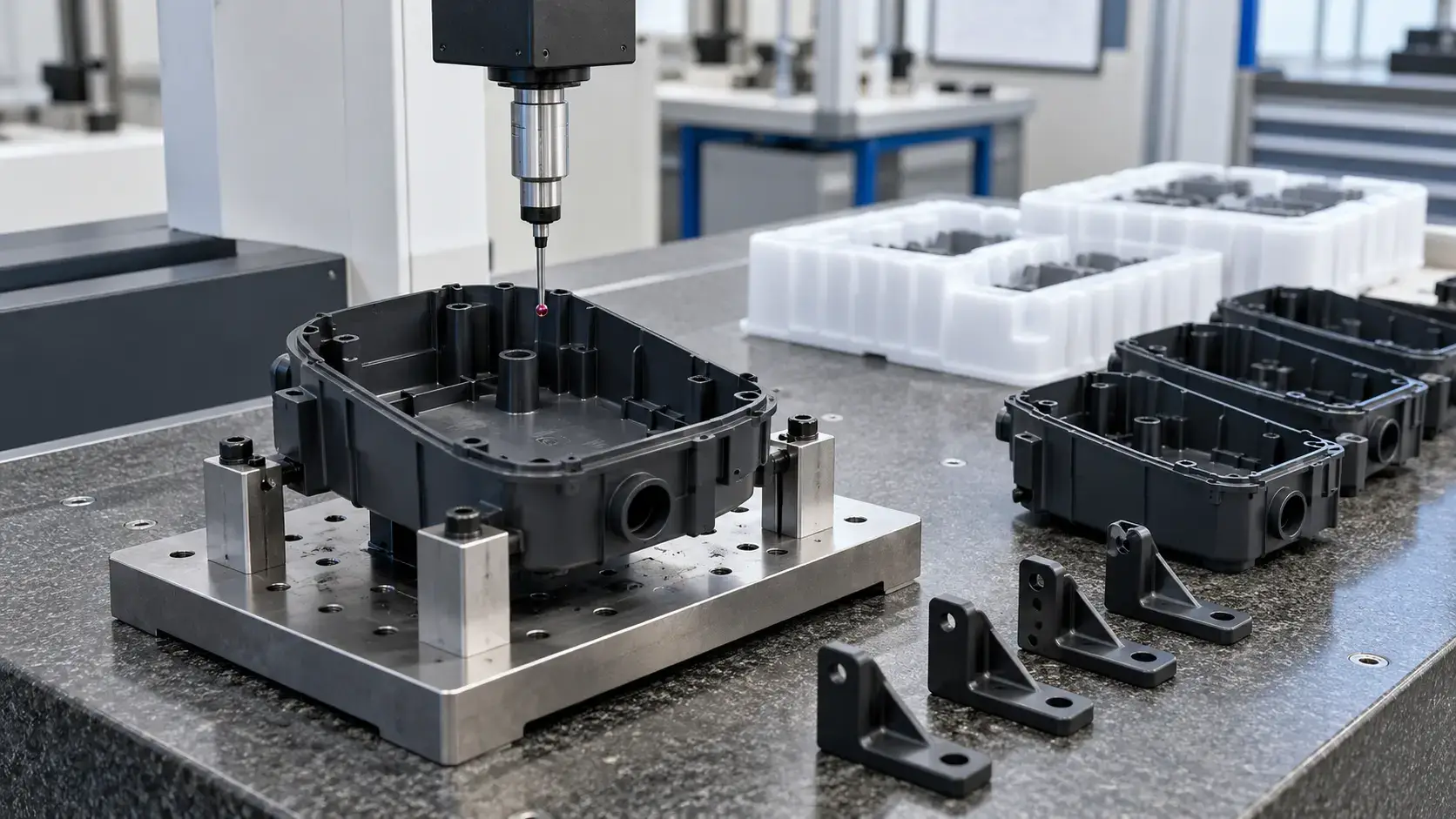
For multicavity molds, identify the cavity that produced each inspected part. Check samples from different cavities and production periods to find recurring dimensional differences.
For a housing with an 80.00 ± 0.10 mm mounting-hole spacing, the inspection record should show each measured value and whether it falls within the approved limits. The housing should also be assembled with the intended PCB and fasteners.
A pre-production inspection can confirm that the approved material, tooling, drawings, and production instructions are available before the factory starts mass production.
For finished batches, ISO 2859-1:2026 provides AQL-indexed sampling schemes for lot-by-lot inspection by attributes. The purchase agreement should specify defect categories, inspection levels, sampling schemes, and acceptance/rejection numbers. An AQL of 2.5 does not mean a shipment is guaranteed to contain no more than 2.5% defective parts. [3]
Use a pre-shipment inspection to check finished quantities, key dimensions, assembly, appearance, labeling, and packaging before the goods leave the factory.
Clear covers and high-gloss housings may need individual protective sleeves, dividers, or fitted trays. Open packed samples during inspection to check for scratches and deformation.
Who Owns the Mold?
If the buyer pays for a dedicated injection mold, the tooling agreement should identify its owner, cavity count, storage location, permitted use, maintenance responsibility, and transfer conditions.
Settle access to drawings and agreed tooling records before making the deposit. Ownership of the physical mold does not automatically transfer the supplier’s manufacturing programs or existing technical know-how.
Moving a mold to another factory may involve machine adjustments, trial molding, and renewed first-article approval. Those expenses should be included when comparing long-term suppliers.
What Is the Total Cost of Importing the Parts?
Calculate landed cost using the purchase price, allocated tooling fees, inspection, packaging, freight, applicable duties, and destination handling. Avoid counting charges already included in the agreed Incoterm.
For containerized goods handed to a carrier at a terminal, FCA is often more appropriate than FOB. Under Incoterms 2020, FCA permits delivery at an agreed carrier handover point, while FOB transfers delivery risk when the goods are loaded on board the vessel. [4]
U.S. buyers should check the product’s Harmonized Tariff Schedule classification and the duties applicable to Chinese-origin goods on the import date. The USITC published 2026 HTS Revision 21 on October 9, 2026. Different plastic components may require different tariff classifications depending on their function and characteristics. [5]
If the plastic component will contact food, check the material’s authorized use rather than relying on a generic “food-grade” claim. The FDA evaluates food-contact materials according to their components and the conditions under which they contact food. [6]
Before Placing Your Order
Compare manufacturing options using the same approved drawings, material grade, tolerances, and realistic order quantities. Confirm factory capability, mold ownership, sample acceptance, and delivered cost before approving tooling or mass production.