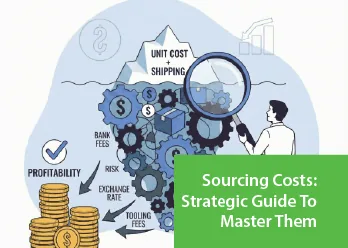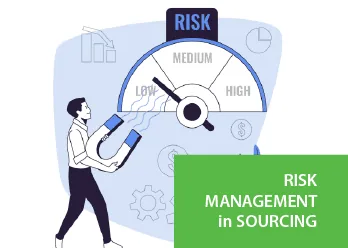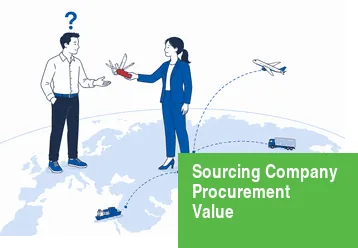
A sourcing company reduces procurement costs when its supplier access, product knowledge, quality control, logistics coordination, and local follow-up remove more cost than the company charges in fees. The saving should be measured against the buyer’s total procurement cost, not only against the lowest factory quotation.
Consider a 50,000-unit order. A $0.20 reduction in unit price saves $10,000. One $8,000 emergency shipment and $4,000 of rework turn that apparent saving into a $2,000 loss. This is why a useful sourcing company works on the complete cost of the order: product, quality, logistics, inventory, cash exposure, internal workload, and supplier risk.
In short: the sourcing company’s job is not only to identify the best value for money offer from manufacturers. A sourcing agent’s procurement value lies in its ability to reduce expenses and risks throughout the order in China process. It empowers international buyers with additional, sourcing-specific skills, and prevents business exposure to quality costs and brand damage.
Start With the Full Procurement Cost, Not the Unit Price
Purchase price is only one cost layer. The European Commission’s guidance on life-cycle costing makes the same basic point: acquisition price does not capture every cost of purchasing, using, and disposing of a product.[8] For an importer, the relevant calculation begins before production and continues until conforming goods are available for sale.
| Cost layer | Typical cost drivers | How a sourcing company may reduce it | Evidence the buyer should retain |
|---|---|---|---|
| Purchase price | Materials, labor, overhead, supplier margin, intermediary margin | Factory search, quotation normalization, cost breakdown, negotiation | Comparable RFQs, quotations, price history |
| Product and tooling | Custom parts, excessive tolerances, scrap, molds, fixtures, difficult assembly | Value analysis, standard parts, design-for-manufacture review, tooling amortization | Drawings, BOM, approved changes, tooling register |
| Quality | Defects, sorting, rework, replacements, claims, returns | Supplier qualification, pre-production checks, in-process control, final inspection | Approved sample, inspection criteria, reports, corrective actions |
| Logistics and packaging | Pickup, export handling, freight, insurance, damage, inefficient carton volume | Common Incoterm comparison, packaging review, consolidation, loading control | Freight quotations, packing list, CBM calculation, damage data |
| Inventory and cash | MOQ, deposits, long lead time, storage, markdowns, obsolete stock | MOQ negotiation, staged production, split deliveries, realistic order planning | Inventory days, payment schedule, sales forecast, stock write-offs |
| Internal procurement | Supplier search, calls, travel, quote comparison, follow-up, issue resolution | Local coordination, standard reporting, supplier-base management | Internal hours, travel expense, cycle time, issue log |
| Risk and transition | Delays, emergency freight, compliance gaps, failed suppliers, supplier switching | Milestone control, backup qualification, document review, transition planning | On-time delivery, risk register, qualification cost, switching payback |
Build one baseline covering :
- purchase price,
- product and tooling,
- quality,
- logistics,
- inventory and cash,
- internal work,
- and risk
Before you start weighing the cost-efficiency of the sourcing fee.
1. Relying solely on Purchasing Price is a basic pitfall
Remember that your reach is limited. Thus your costing assessment is too.
Overseas buyers often find suppliers through marketplaces, Google, trade fairs, and directories. These channels are useful, but they favor suppliers that market themselves well. They do not necessarily reveal the factory with the right process, equipment, capacity, MOQ, and export experience for a specific order.
Always keep in mind that not all suppliers choose to promote their business, and when they do, they choose their communication channels carefully. This is especially true if you are targeting a manufacturer. Some very reliable suppliers aren’t even visible on the internet.
JS Sourcing operates from Shanghai and works with manufacturing networks across major Chinese industrial areas. Its product sourcing service focuses on finding and screening suppliers that match the buyer’s product, quality requirements, order size, and target price.
Why a cheap unit price on a Chinese Proforma Invoice is not necessarily what you seek.
Suppose you are a buyer tasked with purchasing a USP800 compliant modular cleanroom that incldues all basic equipment and furniture from a supplier in China. RFQs fill up in your inbox and it becomes obvious that nobody is quoting the same product, because offers vary greatly.
The USD 26470 offer from a supplier in Jiangsu cataches your eye. Compared to the USD59260 offer, from a modular cleanroom manufacturer in Suzhou, it looks promising.
Unfortunately, a closer look at the costing details reveals that the supplier in Jiangsu did excluded some equipment, material and furniture from the quote. Plus, it asks for a 50% deposit against 30% for the supplier in Suzhou.
But most importantly, JS Sourcing was able to confirm that the supplier in Jiangsu manufactured the sandwich panels only. While the modular cleanroom manufacturer in Suzhou concentrated metalworking, ff&E, and cleanroom pass boxes.
59260-26470 = $32,790 potential saving will end up being an additional, unforecasted cost if not vigilant.
While removing an unnecessary intermediary can certainly reduce cost, the most critical is your ability as a purchaser to accurately identify “non compliant” quotes from valid ones. It does not mean that assessing the profile a supplier is not as important. It is, but there are many nuances to the trading company vs manufacturer arguments than we are usually presented with. For example, a specialized trading company with the right resources (engineering, R&D,quality), that holds stock, or offers lower MOQs, is definitely worth considering for a smaller importer. Because factories usually focus on buyers with large purchasing volumes.
Any business dealing relies on one thing “knowledge gap”. The ones able to fill this gap are best equipped to face competition, and lead the market. The example above about cleanrooms shows it. It is even more a reality when dealing with bike parts sourcing, or hardware purchasing in China. The simplier the product looks, the easier it is to reduce the knowledge gap in your advantage. And to know its manufacturing cost, the better you will assess risks and opportunities with each supplier. In order to do just that, you will need to take a closer look, compare, and standardize suppliers quotes.
Standardize supplier quotations before ranking them
Two hotel chairs can look almost identical in photos while differing in tube thickness, foam density, fabric weight, coating quality, packaging efficiency, and overall product durability. A $36 chair is not $6 cheaper than a $42 chair if the specifications and commercial responsibilities are different.
Before comparing price, fix the main requirements:
- material, grade, dimensions, weight, thickness, and tolerance;
- finish, color, performance, and approved reference sample;
- packaging, labels, accessories, testing, and documentation;
- quantity, tooling, payment terms, lead time, and quotation validity;
- delivery point and Incoterm.
For example, $9.50 EXW and $9.80 FOB do not include the same responsibilities. Incoterms® explain how transport tasks, costs, and risks are divided between buyer and seller.[1] FOB is intended for sea or inland-waterway transport. For many container shipments handed to a carrier before vessel loading, FCA may be more suitable.[2]
If Supplier A quotes $10.00 FOB and Supplier B quotes $9.50 EXW, but pickup and export-related costs add $0.80 to Supplier B’s price, its comparable cost becomes $10.30. The apparently cheaper supplier is now $0.30 more expensive before international freight.
Negotiate with volume, timing, and cost drivers
“Give me your best price” provides little reason for a factory to change its offer. A useful negotiation connects price to facts: annual demand, repeat-order potential, production timing, payment terms, standard components, packaging changes, and comparable quotations.
If a factory quotes $8.40 for 5,000 units but the buyer expects 30,000 units during the year, a $0.20 annual-volume reduction produces:
$0.20 x 30,000 = $6,000 annual saving
The agreement should state what volume triggers the price, whether the volume is firm or forecast, and what happens if raw-material prices move. Otherwise, the “annual price” may be little more than a promise attached to an uncertain forecast.
2. Remove Cost From the Product Before Negotiating Harder
When several qualified factories quote similar prices, the cost problem may be in the design or specification rather than in the supplier’s margin. Repeated price pressure may then produce only a small reduction or push the supplier toward an unsafe substitution.
Build a simple product-cost breakdown
A metal cabinet price can include sheet steel, cutting, bending, welding, powder coating, hardware, assembly, packaging, overhead, and margin. If steel and metal components represent $18 of a $40 cabinet and a validated design change reduces that portion by 5%, the saving is $0.90 per unit. At 30,000 units, that equals $27,000.
Useful value-analysis questions include:
- Can a standard profile, fastener, hinge, bearing, or motor replace a custom one?
- Does the tolerance need to be this tight for the function?
- Can the part count or number of welds be reduced?
- Can material sizes match the factory’s standard stock to reduce scrap?
- Can hidden surfaces use a simpler finish without affecting protection?
- Can the product stack, nest, fold, or ship flat?
This work is most effective before mass production. JS Sourcing’s product development service covers supplier selection, prototypes, tooling, material choices, production checks, and manufacturing follow-up for custom products.
Standardize components and amortize tooling correctly
A component saving of $0.08 looks trivial. If two are used in 100,000 products, it becomes $16,000. Standard parts may also reduce component MOQs, spare-parts stock, assembly mistakes, and future supplier-switching costs.
Separate recurring cost from non-recurring cost. A mold costing $18,000 over an expected 90,000 units represents $0.20 per unit. If lifetime production reaches only 20,000 units, the same tool costs $0.90 per unit. The calculation is also misleading if the tool requires major maintenance halfway through production.
Before paying for tooling, record ownership, expected life, maintenance responsibility, storage, identification, permitted use, and whether it can be moved. Also check whether a supplier already owns a suitable mold, die, fixture, or standard profile.
Make every cost-sensitive requirement measurable
“Make it stronger,” “use premium material,” and “make the finish darker” are not production specifications. Use material grades, drawings, dimensions, tolerances, Pantone or RAL colors, approved samples, test methods, and acceptance criteria. A hole position of 50 mm with a tolerance of +/-0.5 mm means 49.5 to 50.5 mm. “About 50 mm” does not.
If a supplier wants to change a material, component, process, or subcontractor, require written approval and decide whether a new sample, inspection, or test is needed. JS Sourcing’s China manufacturing service covers supplier matching, tooling, production follow-up, quality checks, and shipping coordination.
3. Prevent the Cost of Poor Quality
Quality cost should not be reduced to an inspection invoice. ASQ distinguishes prevention and appraisal costs from failures found before or after delivery.[3] The late failures are usually the most expensive because the buyer has already paid for production, freight, duty, handling, and often customer delivery.
Suppose a 10,000-unit order costs $12 per unit and 5% is defective. That means 500 units, representing $6,000 of order value, are affected. If the units can be reworked for $4 each, the incremental rework cost is $2,000. The $6,000 is product value at risk, not an additional loss. If the products cannot be recovered and must be replaced, the buyer could instead lose the $6,000 product value plus sorting, replacement freight, claims, and other related costs.
Use inspection at the point where it can change the outcome
- Before production: confirm raw materials, components, tooling, drawings, approved samples, colors, finishes, and packaging.
- During production: check process-dependent risks such as welding, dimensions, printing, stitching, surface finish, and assembly while correction remains possible.
- Before shipment: verify quantity, appearance, workmanship, dimensions, function, labels, accessories, and packaging before the balance payment or dispatch.
- During loading: confirm container condition, quantities, loading method, carton condition, and seal details when these risks matter.
ISO 2859-1:2026 provides AQL-based sampling schemes for lot-by-lot inspection by attributes.[4] A sampling inspection does not prove that every unit is defect-free. A 100% inspection also cannot guarantee that every possible defect will be found. The inspection method, defect definitions, equipment, conditions, and human error still matter.
Product inspection does not replace legal testing or certification. In the United States, manufacturers and importers of many products covered by CPSC safety rules have testing and certification duties.[5]
JS Sourcing’s quality inspection services cover checks before production, during production, before shipment, and during container loading. For a new supplier, a factory audit can check equipment, capacity, processes, and quality systems before the buyer becomes committed.
Turn failures into corrective action, not recurring claims
If 600 tables require $14 of repair after arrival, the direct rework cost is $8,400. If the same defect can be corrected at the factory for $4 per unit, the repair costs $2,400. The timing creates a $6,000 difference.
A claim may recover some money, but it does not repair lost time, stockouts, or customer confidence. Record the defect, contain affected goods, identify the cause, define corrective action, and verify the next production run. Keep approved samples, specifications, photos, purchase orders, inspection reports, test results, and supplier responses.
4. Lower Logistics and Packaging Cost per Saleable Unit
Freight is volatile. UN Trade and Development reported that container, bulk, and tanker freight rates remained elevated and volatile through 2024 and 2025.[10] Buyers therefore need a repeatable loading and packaging method, not a calculation that assumes one freight quotation will remain stable.
Landed cost should also be calculated on a consistent customs basis. Customs duty cannot always be estimated by applying a percentage to the supplier’s quoted price. Under the WTO Customs Valuation Agreement, transaction value is the primary valuation method when its conditions are met, with prescribed adjustments and alternative methods when it cannot be used.[7]
Improve container utilization
During the manufacture of an order combining custom lighting fixtures and bespoke hotel furniture, the workshops submitted a loading plan for 34 CBM of goods. JS Sourcing’s review found that part of the packaging was wasting container space. After several exchanges with the workshops and an on-site validation of the revised packaging, the same quantity of goods occupied 27.7 CBM.
At the time, a 20-foot container from Shanghai to Port Elizabeth cost $2,537 port to port. Under the original 34 CBM plan, the shipment would have required that full container plus 6.3 CBM sent as consolidated LCL cargo. At an average port-to-port LCL rate of $160 per CBM, the freight would have been:
$2,537 + (6.3 x $160) = $3,545
With the validated packaging, all 27.7 CBM fit in the 20-foot container. The port-to-port freight remained $2,537, safely below $3,000. The packaging work therefore avoided approximately $1,008 in additional LCL freight without reducing the quantity of lighting or furniture shipped.
For bulky products, useful changes include flat-pack construction, nesting, knock-down frames, smaller voids, revised carton dimensions, and load-plan testing. JS Sourcing’s hotel furniture sourcing work includes custom furniture procurement where packaging, loading, and sea freight materially affect final cost.
Balance packaging savings against damage
A carton change that saves $0.70 across 10,000 units appears to save $7,000. If the damage rate rises from 0.5% to 3%, that creates 250 additional damaged units. At $35 to repair or replace each one, the change creates $8,750 in added loss. The cheaper carton produces a net loss of $1,750.
Packaging changes should be validated against product weight, stacking, humidity, handling, route, palletization, warehouse requirements, and damage history. Lower packaging cost is useful only when the saleable-unit yield remains acceptable.
Consolidate only when the full route is cheaper
Combining three small shipments can remove repeated pickup, documentation, handling, and minimum freight charges. It can also create collection mileage, warehouse charges, longer storage, and a delay while the last supplier finishes. Compare the consolidated route with the separate routes using the same cargo-ready dates and destination requirements.
JS Sourcing’s China sourcing services include supplier sourcing, quotation work, supplier management, production follow-up, quality control, and coordination with logistics.
5. Control MOQ, Inventory, and Cash Exposure
A lower unit price can become expensive when it forces the buyer to purchase stock that will sit in a warehouse, require discounting, or become obsolete.
Suppose a supplier offers 1,000 units at $9.00 or 5,000 units at $7.80. The larger order is $1.20 cheaper per unit, but a buyer needing only 2,000 units commits cash to 3,000 unnecessary units. Assuming freight, duty, and other landed-cost components bring the inventory value to $10 per unit, that is $30,000 tied up before storage, financing, markdowns, or write-offs. It is cash exposure, not automatically a $30,000 economic loss.
A sourcing company can ask about:
- lower MOQ at a revised but still viable unit price;
- staged production or material reservation;
- split deliveries from one production batch;
- repeat-order pricing instead of one oversized order;
- fewer colors, sizes, or packaging variations;
- shared components across several SKUs.
Compare payment terms as cash requirements
A $100,000 order with a 30% deposit commits $30,000 at the start. A second supplier may quote $97,000 but require a 50% deposit, or $48,500. It is $3,000 cheaper in total but requires $18,500 more cash before production is complete.
This does not make the second offer automatically worse. It means the comparison must show deposit, balance-payment trigger, production status, inspection conditions, payment method, and the time between cash outflow and sale. Before a major payment, confirm the supplier’s legal identity, bank details, approved specification, production status, and any agreed inspection or testing requirement.
6. Reduce Internal Procurement Work Without Giving Up Control
Supplier management has a real cost. Suppose a buyer spends 17 hours a week on supplier communication, quotations, production follow-up, and quality or shipping issues. Across 40 weeks, that is 680 hours. At a fully loaded staff cost of $35 per hour, the gross internal workload costs $23,800 before travel or specialist support. The avoidable internal cost depends on how many of these hours the sourcing company actually removes rather than duplicates.
A sourcing company’s local team may reduce search time, combine supplier communication, arrange factory visits, follow production, coordinate inspections, and consolidate reporting. That frees the buyer’s team for product, sales, customer, and strategic decisions.
But outsourcing procurement work does not transfer the buyer’s accountability. The buyer should retain control of:
- product, regulatory, safety, and market requirements;
- approved specifications and change authority;
- commercial objectives and acceptable risk;
- supplier approval and major payment decisions;
- access to quotations, supplier records, tooling records, and quality evidence.
External support works best when the scope is explicit. A sourcing company may handle a complete project, a product category, or selected tasks such as supplier identification, factory verification, inspection, or production follow-up. A vague “manage everything” assignment makes performance and savings difficult to measure.
Rationalize suppliers without creating dependency
Too many suppliers increase communication, inspections, payments, paperwork, and shipment coordination. Reducing overlapping suppliers can concentrate volume and simplify control. Critical products may still need a qualified backup. NIST includes supply-chain mapping, risk assessment, supplier scouting, and alternative suppliers among the tools manufacturers can use to improve resilience.[6]
7. Avoid Delay Costs and Measure the Cost of Switching Suppliers
Track production with evidence
“Production is on schedule” is not a production milestone. Track dates and quantities for raw materials, tooling, production start, percentage completed, inspection, rework, and cargo readiness.
If ocean freight was planned at $4,000 but a late order forces an urgent $12,000 shipment, the delay adds $8,000. A $0.25 unit-price saving on 20,000 units equals $5,000, so the delay removes the entire negotiated saving and adds $3,000 more cost.
Calculate supplier-switching payback
A new supplier can require samples, audits, testing, engineering, tooling transfer, new packaging, first-order inspections, and buffer inventory. If a new quote saves $0.10 on 50,000 units per year, annual saving is $5,000. A $15,000 transition cost then has a simple payback of about three years.
The U.S. Government Accountability Office recommends that cost estimates document assumptions, use sensitivity and risk analysis, and update estimates with actual costs.[9] The same discipline is useful here. Test the switching case at realistic volume, defect rate, freight, lead time, and ramp-up conditions. Do not divide transition cost by an optimistic forecast and call the result certain.
8. Prove Net Savings After the Sourcing Fee
Separate three ideas that are often mixed together:
- Price reduction: the comparable purchase price falls.
- Cost reduction: an existing cost falls, such as freight per unit or internal management hours.
- Cost avoidance: a probable expense is prevented, such as rework caught before shipment.
Do not present every prevented problem as guaranteed cash saving. Cost avoidance needs a documented baseline and a reasonable probability. A defect found during production may prevent a large loss, but the estimate should show how many units were exposed, what correction would have cost later, and what was actually paid to correct it now.
A simple net-value calculation is:
Net sourcing value = verified price reduction + verified operating-cost reduction + supportable cost avoidance – sourcing-company fee – transition cost
Example:
- comparable supplier price saving: $12,000;
- packaging and freight saving: $5,000;
- supportable avoided defect and rework cost: $8,000;
- sourcing fee: $10,000;
- one-time transition and qualification cost: $2,000.
$12,000 + $5,000 + $8,000 – $10,000 – $2,000 = $13,000 estimated net value
Every figure must cover the same measurement period, and the categories must not overlap. For example, a defect-related saving should not be counted once under supplier-price reduction and again under cost avoidance.
Track the estimate against actual results. Useful measures include comparable purchase price, landed cost per saleable unit, defect and rework cost, freight per unit, on-time delivery, lead time, inventory days, cash committed before shipment, internal procurement hours, and supplier-switching cost.
When a Sourcing Company Will Not Reduce Your Costs
A sourcing company may increase total procurement cost when:
- it adds a margin but does not improve supplier access, specifications, quality, logistics, or workload;
- its fee or supplier commission is unclear;
- quotations are not compared on the same specification and delivery basis;
- it lacks technical knowledge of the product or manufacturing process;
- the buyer gives up supplier, tooling, quality, or document visibility;
- performance is measured by quoted savings rather than delivered results;
- the assignment is too vague to define responsibilities or calculate value.
The practical test is simple: identify the cost layer the sourcing company will change, establish the baseline, agree on the evidence, and subtract every fee and transition cost. If the provider cannot explain that mechanism, the claimed saving is not yet a business case.
Finally
Sourcing companies help reduce procurement costs by widening the factory search, normalizing quotations, improving product and tooling choices, controlling quality, reducing logistics waste, negotiating workable MOQs and payment terms, and handling local supplier coordination. None of those benefits should be assumed. Measure them.
The best result is not the lowest supplier quote. It is a repeatable buying plan that leaves the buyer with the lowest reliable cost after conforming goods arrive, every sourcing fee is paid, and the operational consequences are included.