China’s foreign trade in goods reached 45.47 trillion yuan in 2025, according to data released by the General Administration of Customs and published by the State Council of the People’s Republic of China.[1] WTO-UNCTAD data also shows that China accounted for 14.4% of world merchandise exports in 2025.[2] With the latest global data available, China remains ahead of the U.S.A., and exports more than Germany and the Netherlands together.
For overseas buyers, this creates a strong attraction to buy from China. But nothing comes easy. To import from such a manufacturing hub, international buyers need cash flow, preparation, and the right conditions for success. Yet, when it comes to choosing the supplier, many buyers may still be tempted to secure a deal without meeting their counterpart in the flesh.
I have learned over time that first contact, and first impression, can have a long-term effect on a business relationship. This is why, even if you are running out of time and cannot visit China in person, a live factory visit or remote verification is a great tool to check whether what you were sold is in line with reality.
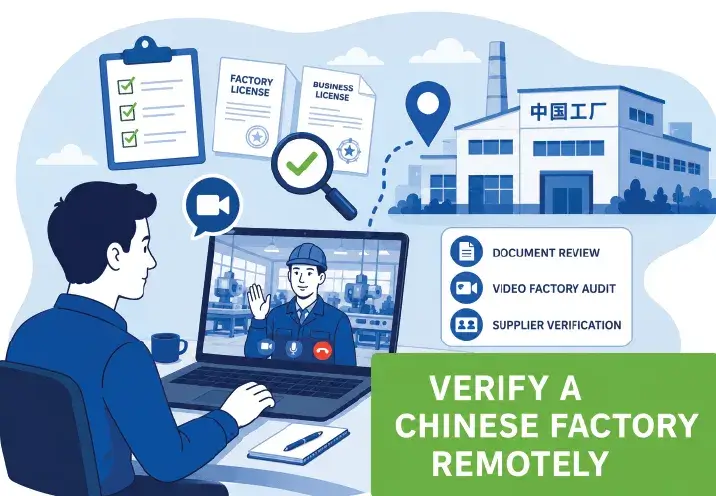
If you are about to place an order in China, and do not have the time or budget to come visit your supplier in China, one of the safest solutions to verify a Chinese factory is to do it remotely. For that, you can combine live video, document checks, independent third-party verification, and a controlled trial order. Each step catches a different type of risk: fake locations, weak production capacity, document inconsistencies, and poor delivery performance.
A remote audit should not rely on one document, one video, or one promise. It should compare multiple pieces of evidence that are hard to fake at the same time.
| Verification Step | Main Purpose | Key Checks | Main Red Flags |
|---|---|---|---|
| Video Factory Audit | Confirm the factory is real and operating | Live location, gate video, machines, warehouse | No live video, inconsistent address, idle machines |
| Document Review | Check legal and compliance status | Business license, ISO certificates, export records | Wrong business scope, unverifiable certificates, mismatched HS codes |
| Third-Party Verification | Get independent evidence from the site | GPS photos, equipment photos, on-site videos | Supplier refuses inspection or limits access |
| Trial Order | Test delivery, quality, and communication before bulk production | Small batch, PSI, AQL-based sampling | Late delivery, failed inspection, poor problem-solving |
Video Factory Audit
Request Live Location First
The first step of a remote factory audit is confirming the factory’s real operating location. Ask the supplier to share a real-time location through WeChat or another live location tool. Do not accept only a screenshot, because screenshots can be edited or taken from a different place.
Compare the live location with the address on the business license, the address shown on the supplier’s website, and the address listed in the National Enterprise Credit Information Publicity System. The National Enterprise Credit Information Publicity System is China’s official platform for checking enterprise registration information, including the unified social credit code, registration status, legal representative, registered address, and business scope.[3]
A registered address that differs from the production site is not always fraud. Some Chinese companies register at an office address while operating production at a separate workshop. However, the supplier should be able to explain the difference clearly and provide matching evidence for both locations.
- Check whether the live location matches the claimed city and industrial zone.
- Use satellite view on Baidu Maps or another map tool to see whether the surroundings look like an industrial area.
- Check whether roads, gates, signs, and nearby buildings match the supplier’s description.
- Ask why the registered address and factory address are different if they do not match.
After confirming the location, ask for a continuous 30-second panoramic video around the factory gate. The video should show the gate, road, signage, delivery vehicles, and nearby landmarks in one unbroken shot. Ask the supplier to show a current delivery receipt, work order, courier document, or another dated document during the video call.
If the supplier cannot provide continuous live video of the factory entrance, treat it as a major warning signal.
- Ask the supplier to show the factory gate in one continuous shot.
- Ask them to show a dated delivery receipt, work order, or courier document.
- Check whether road signs, factory names, and nearby landmarks match the live location.
- Ask the person filming to walk from the gate into the workshop without cutting the video.
Combined with professional supplier background checks, address verification helps buyers separate real factories from trading companies using borrowed factory images.
Inspect Each Machine One by One
During the video call, ask the factory manager to film each key piece of equipment. They should pause on the nameplate for at least five seconds so you can capture the brand, model, serial number, rated capacity, and production year.
Do not judge equipment only by age or brand. Production stability depends on machine model, calibration, maintenance, tooling, operator skill, process control, and whether the machine is actually running. A newer machine that is poorly maintained may be less reliable than an older machine with strong maintenance records.
- Record each machine’s brand.
- Record the model and production year.
- Capture the serial number clearly.
- Ask the supplier to show the control panel.
- Ask the supplier to start the machine during the call.
- Ask for recent maintenance or calibration records for critical equipment.
For high-value or precision production, serial numbers can sometimes be checked with the equipment manufacturer or service agent. A professional inspection service can also verify whether the machines are installed, powered, and suitable for the claimed production process.
If the supplier claims to have 12 CNC machining centers but only a few machines can be powered on during the call, do not accept a vague explanation such as “under maintenance.” Ask which machines are active, which are down, how long they have been down, and whether the factory can show current production records for those machines.
The “start each machine” method quickly exposes fake or overstated production capacity.
Ask the supplier to film machines with sound while they are operating. Motor noise, spindle movement, screen data, tooling, and operator activity are useful indicators of whether the equipment is genuinely in use.
Warehouse Inventory Walkthrough
Warehouse inventory is one of the strongest indicators of a factory’s real operating condition. Ask for a real-time panoramic video of both raw material and finished goods areas.
Check incoming date labels on raw material batches. Long storage does not automatically mean the materials are unusable, but it should trigger follow-up questions. For plastic resin and similar materials, moisture, contamination, poor sealing, and improper storage can cause defects such as bubbles, voids, splay marks, silver streaks, and surface problems during molding.[4]
- Check the incoming dates on raw material labels.
- Check whether bags, drums, or boxes are sealed and undamaged.
- Compare warehouse volume with the supplier’s claimed order volume.
- Look at semi-finished goods and work order dates.
- Check whether the warehouse looks active or stagnant.
- Ask whether sensitive materials require drying, temperature control, or moisture-proof storage.
In the finished goods area, check contract numbers, shipping marks, and planned shipping dates on packaging. If most cartons carry one client’s order number across multiple months, that client may occupy a large part of the factory’s available capacity. This does not automatically disqualify the supplier, but it can create delivery risk for your order.
Floor cleanliness, shelf dust, blocked fire exits, mixed materials, and unlabeled inventory also reflect management quality. A during production inspection service can assess warehouse control, production flow, and on-site order status before the factory reaches final shipment.
Document Review
Verify the Business License
The supplier’s business license should be cross-checked through the National Enterprise Credit Information Publicity System. Enter the Chinese company name or unified social credit code to verify registration status, legal representative, registered address, establishment date, registered capital, and business scope.[3]
A company registered only for “hardware wholesale” but claiming to manufacture precision electronic components is a warning signal. Business scope wording in China can be broad, so one unusual phrase is not enough to reject a supplier. However, the claimed manufacturing activity, product category, and actual workshop should be reasonably consistent.
- Check whether the business scope matches the product and service being offered.
- Check whether the company is active, deregistered, revoked, or listed as abnormal.
- Compare registered capital with paid-in capital and actual factory scale.
- Check whether the establishment date supports the supplier’s claimed experience.
- Check whether the legal company name matches contracts, invoices, bank accounts, and certificates.
Also check the gap between registered capital and paid-in capital. Under Article 47 of China’s revised Company Law, which came into effect on July 1, 2024, the registered capital subscribed by all shareholders of a limited liability company must generally be paid in full within five years from the date of establishment, unless laws, administrative regulations, or State Council decisions provide otherwise.[5]
A large registered capital amount does not prove strong production capacity. A supplier may show high registered capital but still operate a small workshop with limited equipment. Treat registered capital as one reference point, not as proof of financial strength.
Using a supplier investigation service helps cross-check business license data, company status, legal identity, and factory address before you make payment.
Verify ISO Certificate Numbers
ISO 9001 and ISO 14001 certificates can be useful indicators, but they do not guarantee product quality by themselves. ISO states that it does not perform certification or issue certificates. Certification is performed by external certification bodies.[6]
Use IAF CertSearch, the issuing body’s official database, or the relevant accreditation body to verify the certificate number, company name, certification scope, issue date, expiry date, and certification body status. IAF CertSearch is the global database for validating accredited management system certifications issued by certification bodies.[7]
The certificate may exist, but the management system behind it may still be weak. Always check the scope, certification body, accreditation status, and current validity.
- Check the certificate number in IAF CertSearch or the issuing body’s official database.
- Confirm that the certification body actually exists and is accredited.
- Check whether the certified company name matches the supplier’s legal name.
- Check whether the audit scope matches the product you plan to buy.
- Check issue and expiry dates.
- Ask for recent internal audit records, management review records, and corrective action records.
A certificate with a scope such as “metal product sales” does not prove capability in “precision machinery manufacturing.” A valid certificate with the wrong scope should not be treated as evidence of production capability.
Using a pre-production inspection service helps verify qualification documents and compare them with actual workshop conditions.
Cross-Check Export Records
Ask for export-related records from recent shipments, such as commercial invoices, packing lists, bills of lading, and customs declarations. The U.S. International Trade Administration lists commercial invoices, bills of lading, and packing lists among common export documents, although document requirements vary by country and product.[8]
Do not expect every document to show the same type of information. A bill of lading usually contains shipment details such as which goods are being shipped, where the shipment is coming from and going to, and the shipper, carrier, and consignee details. It does not always show transaction value. Commercial invoices and customs declarations are more relevant for checking value, currency, and payment consistency.[9]
- Check product descriptions across the invoice, packing list, bill of lading, and customs declaration.
- Check destination countries and shipment dates.
- Check quantities, weights, carton counts, and shipping marks.
- Check whether the exporter name matches the verified legal company or an explained export agent.
- Check whether document formats look natural, not copied with repeated formatting errors.
HS code checks should focus on the correct product category. The Harmonized System is an international product nomenclature developed by the World Customs Organization. It includes more than 5,000 commodity groups, each identified by a six-digit code, and is used by more than 200 countries and economies as a basis for customs tariffs and international trade statistics.[10]
At minimum, check whether the international six-digit HS code is consistent with the product. The first four digits are useful for a rough category check, but the six-digit level is more reliable for international comparison. Destination countries may require longer national tariff codes, such as eight or ten digits.
If a supplier claims to export medical devices but the documents repeatedly show an unrelated product category, ask for an explanation. The issue may be a trading company, export agent, mixed shipment, or wrong classification. If the explanation is weak or the documents remain inconsistent, treat the supplier as high risk.
Cross-check bank settlement slips or payment records against invoices and customs records where possible. Amounts, currency, dates, and company names should align. If the supplier cannot disclose buyer names for confidentiality reasons, ask them to redact sensitive buyer details while keeping product descriptions, dates, quantities, and shipment data visible.
Third-Party Verification
Send Someone to the Factory Gate
Hiring a local third-party inspection company for an on-site visit is one of the most reliable ways to verify a supplier remotely. Inspection fees vary by service type, location, factory distance, and number of man-days required. SGS, a leader in production inspection worldwide, fees vary depending on FOB value, scope of inspection, and days spent on the factory floor. [11]
The inspector’s first task should be simple: confirm that the factory exists at the claimed address. Ask for GPS coordinates, a gate photo, a short entrance video, and photos of the building name, signage, reception area, and surrounding roads.
- Confirm GPS coordinates at the factory gate.
- Take a clear photo of the entrance and signage.
- Record key equipment and workshop conditions.
- Check raw material and finished goods areas.
- Collect on-site videos as independent evidence.
- Confirm whether the supplier allows normal inspector access.
For quality system or vendor capability checks, global inspection companies such as SGS provide vendor assessment and technical audit services to assess whether a supplier can deliver specific orders and meet relevant statutory regulations and quality standards.[12]
A supplier that refuses independent inspection should not be treated as low risk.
There are legitimate reasons to restrict access to some areas, such as customer confidentiality, dangerous operations, or proprietary tooling. However, the supplier should offer a reasonable alternative, such as redacted documents, partial access, or controlled photos. A flat refusal with no explanation is a serious warning signal.
Combining factory gate verification with container loading supervision creates a stronger verification chain from factory identity to final shipment.
Ask Peers About Prior Experience
Peer feedback carries more weight than supplier self-promotion. Search for the supplier on Alibaba.com, Made-in-China, Google, LinkedIn, Facebook groups, industry forums, and local importer communities. Use the supplier’s Chinese legal name, English trade name, brand name, website domain, and phone number.
- Search the supplier name with keywords such as “complaint,” “scam,” “late delivery,” and “quality issue.”
- Check Alibaba or marketplace reviews, especially negative reviews about quality and delivery.
- Ask industry peers whether they have purchased from the same company.
- Ask for two or three client references in similar product categories.
- Check whether the reference company names and shipment history match the supplier’s export claims.
Be careful with both positive and negative comments. A competitor may post false negative reviews, and a supplier may use friendly buyers as references. The goal is not to rely on one comment, but to look for repeated patterns: late delivery, poor packaging, repeated quality failures, warranty disputes, or sudden changes in company name.
Using a supplier credit evaluation process can make peer background checks more systematic and easier to document.
Start with a Trial Order
A trial order is one of the most practical ways to test a new supplier before full production. By this point, you may have checked the license, taken part in a live factory visit, reviewed certificates, and asked for export records. Still, none of that tells you completely how the supplier works when it actually manufactures products you ordered from them.
With a trial order, your business will be able to gauge the real performance of this new supplier, and decide whether to onboard the supplier. At this stage, doing weighs more than talking. You will be able to confirm whether the supplier can deliver on its promises in terms of output, workmanship, compliance, delivery time, and service. At the end of the trial order, you and your team will have a better understanding of what your supplier’s strengths are, but, more importantly, its weaknesses. So you can act upon them and deploy safeguards if you plan to rely on them for upcoming bulk orders.
Set a Trial Order Size That Means Something
The trial order should be large enough for the factory to treat it as real production, but small enough to limit your financial exposure. For many products, 10%-15% of the intended full order can work as a starting point, but the right size depends on MOQ, tooling, unit value, lead time, and inspection cost.
If the trial order is too small, the factory may hand-make it or treat it as a sample project. If it is too large, the cost defeats the purpose. The goal is to be able to assess mass production performance: communication, scheduling, material control, defect rates, packaging, and delivery timeline.
The core value of a trial order is not product perfection. It is seeing how the supplier responds when real production problems appear.
What to Watch for During a Trial Order in China
During the trial order, do not wait until shipment day to check what happened. Follow the order while it is moving. This is often where the difference appears between a supplier that is good at selling, and a supplier that is good at producing.
But your Chinese manufacturing partner is not the only one responsible. If you are on a learning curve, a RETEX (return of experience) highlights your own inefficiencies and space for improvement.
- Is payment smooth, cumbersome, or outright impossible to cope with?
- Do updates come before you ask?
- Are delays explained clearly?
- Does the packing match what was agreed in the order?
- Was production completed before the deadline?
- What is the defect rate on this order?
- How does the Chinese manufacturer handle rejected batches?
- How many days were lost between the end of production and the vessel leaving China?
These small details matter. A factory that already becomes confused during a trial order may still be able to improve, but the buyer should not ignore the warning signs.
- Check response speed.
- Check communication efficiency.
- Check delivery discipline.
- Check problem-solving ability.
- Check whether quality issues are corrected quickly.
- Check whether the supplier follows up with their bank when an international wire transfer is delayed.
Inspect Before Paying the Balance
Arrange pre-shipment inspection before releasing the trial order balance. Pre-shipment inspection is normally done when production is mostly complete and the goods are ready, or nearly ready, for shipment. JS Sourcing’s [pre-shipment inspection service covers inventory, packaging and labelling, workmanship, dimensional checks, and product tests before the goods leave China.
Use AQL-based sampling correctly. ISO 2859-1 specifies an acceptance sampling system for inspection by attributes and is indexed in terms of acceptance quality limit, or AQL.[13] In practice, AQL helps define how many units are checked during inspection. Intertek’s Passport Express material also refers to AQL sample size, product risk, and inspection protocols by product category.[14]
AQL 2.5 does not mean that 97.5% of the order is good. It only gives the inspection a reading frame. When the result is outside the agreed level, the discussion should come back to the goods themselves: what defects were found, how many pieces are affected, what can be sorted or repaired, and whether another inspection is needed before shipment.
A trial order should be followed by a written supplier evaluation. Record delivery date, defect findings, communication problems, corrective actions, packaging condition, and final commercial outcome. If the supplier performs poorly during a trial order, do not assume performance will improve under a larger bulk order.
Review the Trial Order Before Scaling the Order
A trial order should not be closed only because the goods have shipped. Once it is finished, take time to review what actually happened. Delivery date, defects found, packing condition, communication, corrections made, extra costs, and final result. It does not need to be complicated, but it needs to be written down.
A weak trial order does not always mean the supplier must be rejected. Sometimes the problem can be corrected. Sometimes it shows a deeper weakness in planning, production control, or communication. In both cases, the next order should not simply be larger because the first one is over.
The review should help adjust the buying strategy: tighter specifications, smaller next order, added inspection, different payment terms, or supplier replacement if the risk is still too high.
For buyers without a local team in China, a managed procurement process can help keep supplier screening, trial order follow-up, inspection, shipment, and bulk order approval in the same workflow.
Final Risk Decision
A remote factory audit works best when the buyer compares evidence from different sources. Live video confirms whether the site exists. Business license checks confirm legal identity. Certificate verification checks whether claimed management systems are real. Export records show whether the supplier has shipped similar goods before. Third-party inspection provides independent site evidence. A trial order tests actual production behavior.
No single step eliminates all risk. A supplier can pass a video call but fail a trial order. A company can have a valid ISO certificate but weak day-to-day production control. A factory can have real machines but insufficient capacity for your delivery schedule. The buyer’s job is to combine evidence and decide whether the risk is acceptable before committing to bulk production.
If the supplier is real, cooperative, document-consistent, inspection-friendly, and performs well on a controlled trial order, the risk is much lower than relying only on quotation price and sales promises.