Start with one approved BOM and make every production run match it. Each item needs a fixed quantity, measurable specification, approved source, shelf-life rule and inspection limit. If 5,000 kits each need 20 bandages, production should account for about 100,000 bandages plus recorded samples or scrap. Any change to the supplier, size, material, formulation or label should be reviewed before it reaches the packing line.
Start With the Actual Use
Decide who will use the kit, where it will be stored and where it will be sold before choosing the contents.
| Item | Example |
|---|---|
| Market | United States |
| User | Household |
| Use | Minor cuts, scrapes, burns and basic first aid |
| Capacity | Family of 2–5 people |
| Storage | Home or vehicle |
| Case | Portable zip pouch |
| Drug products | Yes / No |
| Refillable | Yes / No |
| Sales channel | Retail / Marketplace / Distributor |
| Required standard | If applicable |
The same content list will not work equally well for every use.
| Kit Type | What Changes |
|---|---|
| Vehicle | Storage temperature, adhesives, wipes, medicines and long storage periods matter more. |
| Workplace | Quantities need to reflect worker numbers, hazards and how quickly supplies can be replaced. |
| Outdoor | Moisture, case strength, weight and storage conditions need more attention. |
| Household | Common minor injuries and simple replacement of used items usually matter most. |
| Travel | Size, weight, destination rules, language and transport limits can affect the contents. |
For US workplaces, OSHA requires first aid supplies to be readily available. Larger workplaces or locations with different operations may need additional kits, different supplies or larger quantities.[1]
ANSI/ISEA Z308.1-2021 sets minimum requirements for workplace first aid kits and supplies. ISEA also recommends choosing the kit class after looking at the actual workplace hazards.[2]
Decide What Belongs in the Kit
Before adding an item to the BOM, ask four questions:
- Will the intended user actually need it?
- Does another item already do the same job?
- Does adding it create extra labeling, shelf-life or regulatory work?
- Can the same item be sourced again for repeat orders?
This catches a common problem with private label kits: products are sometimes added because a competitor has them or because they increase the printed piece count.
If two items serve almost the same purpose, adding both may make the kit look fuller without making it more useful. On the other hand, an item used only occasionally can still be worth keeping if there is no practical substitute for it.
Repeat sourcing matters too. A low-cost component that disappears every few months can create more work than a slightly more expensive item with a stable supplier and clear specification.
Check What the Piece Count Hides
A 100-piece, 200-piece or 300-piece kit should not be judged by the number on the case.
Suppose 120 pieces in a 200-piece kit are small bandages, wipes or similar low-cost consumables. Those items already make up 60% of the advertised count. Only 80 pieces remain for larger dressings, gloves, tape, tools and other products.
Break the contents into groups:
| Group | What to Check |
|---|---|
| Adhesive wound care | A useful mix of sizes instead of many copies of one small bandage |
| Gauze and dressings | Enough larger items for the intended use |
| Protection | Glove quantity, size and material |
| Cleansing | Product type, quantity and market suitability |
| Tape and wraps | Useful widths, lengths and quantities |
| Tools | A clear function rather than another number added to the count |
| Drugs | Only when the product needs them and the extra regulatory work has been reviewed |
The final number should come from the BOM. The BOM should not be built around a marketing number.
Lock the BOM Before Production
A list that says only “40 bandages, 10 gauze pads and 4 gloves” leaves too much room for change.
| Field | Example |
|---|---|
| Item code | FAK-BD-01 |
| Product | Adhesive bandage |
| Quantity | 20 |
| Size | 72 × 19 mm |
| Backing | PE |
| Pad | Non-stick absorbent pad |
| Sterile | Yes |
| Packaging | Individually sealed |
| Artwork | Approved revision |
| Lot | Required |
| Expiry | As applicable |
| Approved source | Supplier A / approved alternative |
| Substitution | Written approval required |
Give the BOM one clear revision number, such as FAK-US-100 Rev.04. Put that same revision on the purchase order, packing sheet, inspection record and approved sample.
Each component also needs its own code:
- FAK-BD-01 — adhesive bandage;
- FAK-GZ-01 — sterile gauze pad;
- FAK-GL-01 — disposable gloves;
- FAK-SC-01 — scissors.
If 5,000 kits each need 20 bandages:
5,000 × 20 = 100,000 bandages
Purchasing, warehouse and production records can now be checked against the same expected quantity.
Set Pass and Fail Limits
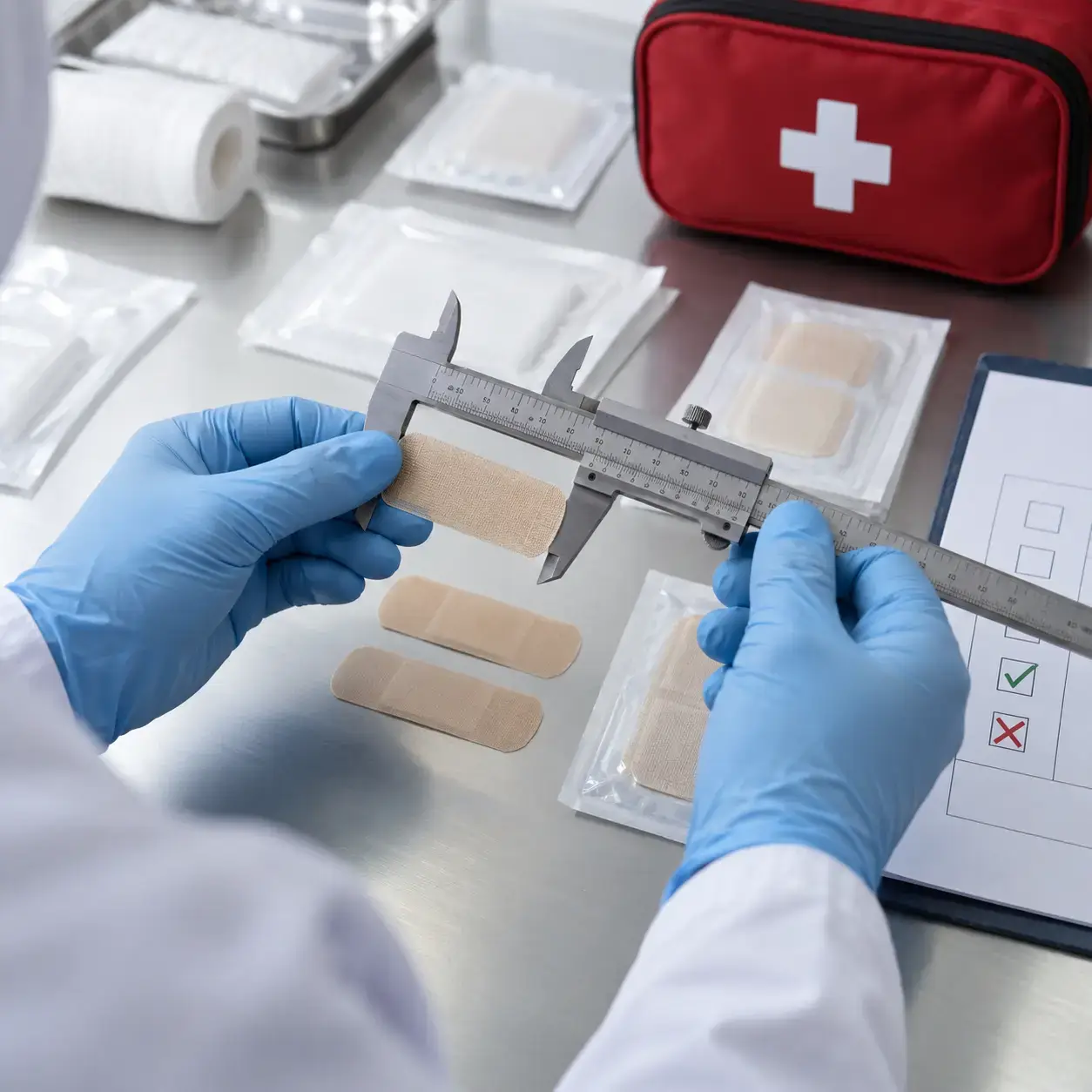
The BOM needs limits that QC can use without guessing.
| Requirement | Specification | Pass Condition |
|---|---|---|
| Bandage size | 72 × 19 mm | Within the agreed tolerance |
| Individual pack | Sealed | No open or damaged seal |
| Quantity | 20 | 20 pieces in the finished kit |
| Artwork | Rev.04 | No older revision |
| Shelf life | Per approved component | Meets the agreed remaining life at shipment |
If the bandage target is 72 mm long, agree the allowed variation before production starts. When QC later measures 71.5 mm, the answer should already be in the specification.
The same applies to tape width, roll length, case dimensions, package weight and any other measurement that can vary.
Match Each SKU to Its Source
The factory packing the finished kit may be buying components from several manufacturers.
| Component | Manufacturer | Special Process | Final Assembler |
|---|---|---|---|
| Bandage | Company A | As applicable | Company X |
| Sterile gauze | Company B | Sterilizer C | Company X |
| Gloves | Company D | None | Company X |
For important components, record the actual manufacturer and production site rather than only the name of the kit assembler.
FDA treats activities such as manufacturing, sterilizing, repackaging and relabeling as different roles. The obligations of a private label business depend on the work it actually performs.[3]
Public information can help confirm that a supplier has the facilities it claims to operate. For example, its company information and production platform can be compared before the exact legal entity and production site are recorded in the purchase file.
For regulated components, keep a small document table:
| Item | Manufacturer | Model | Document | Status |
|---|---|---|---|---|
| Gauze | Supplier A | GZ75 | Document A | Approved |
| Bandage | Supplier B | BD72 | Document B | Approved |
| Gloves | Supplier C | GL-M | Document C | Review |
- An ISO 13485 certificate does not prove that every product is accepted in every market.
- A test report does not automatically cover different sizes, materials or models.
- An EU declaration needs to match the relevant manufacturer and product.
- FDA establishment registration is not the same as FDA product approval.
Separate Drugs From Device Items
A first aid kit may contain devices, drugs, accessories and packaging. Keep their requirements separate in the BOM.
| Product | Possible Category |
|---|---|
| Adhesive bandage | Medical device |
| Sterile gauze | Medical device |
| Medical tape | Medical device |
| Certain antiseptic products | OTC drug |
| Pain medicine | OTC drug |
| Gloves | Depends on intended use and claims |
| Scissors or tweezers | Depends on product and intended use |
| Instruction card | Labeling or product information |
| Carrying case | Packaging |
For the US market, FDA currently lists first aid kit without drug under product code OHO as Class I under 21 CFR 878.4014.[4]
FDA lists first aid kit with drug under product code LRR as “Not Classified.” Drug products inside the kit still have to meet the requirements that apply to those drugs.[5]
“Not Classified” does not mean unregulated.
For every drug item, record:
- product name;
- active ingredient;
- strength or concentration;
- dosage form;
- manufacturer;
- labeler where applicable;
- package size;
- lot and expiry format;
- NDC or listing information where applicable;
- Drug Facts label;
- warnings and directions;
- storage requirements.
FDA requires OTC medicines to carry standardized Drug Facts information, including active ingredients, purpose, uses, warnings and directions.[6]
An NDC number is not proof of FDA approval. FDA states that assigning an NDC does not mean the product has been approved.[7]
Write Specs That QC Can Measure
Words such as “standard size,” “good adhesive” and “high-quality gauze” are not useful inspection criteria.
For adhesive bandages, specify:
- overall dimensions;
- pad dimensions and position;
- backing material;
- adhesion requirement;
- individual wrapper;
- sterile status where claimed.
For gauze and dressings:
- finished dimensions;
- construction or ply where relevant;
- sterile or non-sterile status;
- number per packet;
- package condition.
For tape:
- width;
- roll length;
- backing material;
- unwind condition;
- adhesion where specified.
For gloves:
- material;
- size;
- powder status where relevant;
- number of pairs;
- packaging;
- supported material or performance claims.
For scissors and tweezers:
- overall size;
- material;
- tip or blade design;
- cutting or gripping function;
- corrosion;
- surface defects.
For sterile components, open, torn, punctured or wet packs should fail the agreed package check.
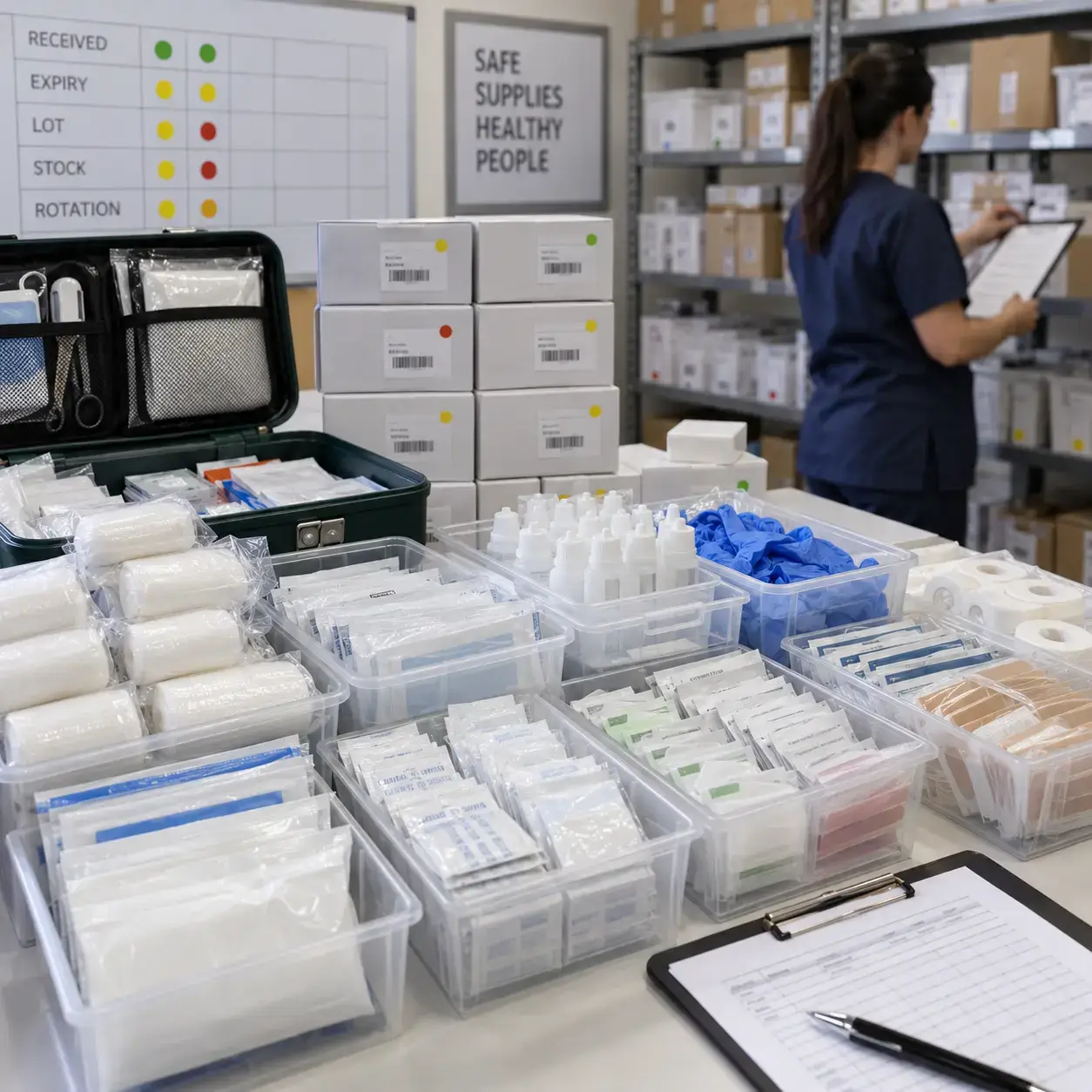
A pack that looks intact is not proof that the sterile packaging process was properly validated. FDA currently recognizes ISO 11607-1 for sterile barrier and packaging-system requirements for terminally sterilized medical devices, and ISO 11607-2 for validation of forming, sealing and assembly processes.[8]
Set a Minimum Remaining Shelf Life
| Item | Lot | Expiry | Remaining Life at Shipment |
|---|---|---|---|
| Gauze | G260701 | 2029-06 | 33 months |
| Wipe | W260615 | 2028-05 | 20 months |
| Drug A | D260802 | 2028-07 | 22 months |
These dates are examples, not universal shelf-life requirements.
Allow for manufacturing, shipping, customs, warehouse time, distributor stock and retail stock when setting the minimum.
For example, a component leaves the factory with 24 months remaining and then spends:
- 1 month in transport;
- 1 month in receiving;
- 4 months in distributor stock;
- 4 months in retail stock.
The customer receives it with about 14 months remaining. The supply chain has already used 10 of the original 24 months, or about 42%.
Set the minimum remaining shelf life before the order is placed.
If different components carry different expiry dates, the finished kit should not be presented as fully in-date after one of those components has already expired. The final dating method still needs to follow the rules for the products and market involved.
For dated inventory, First Expired, First Out is often more useful than simply shipping the oldest received stock first. Record the item code, lot, expiry, received quantity, issued quantity and remaining balance.
Also check that the storage statement for the finished kit does not conflict with storage limits for medicines, wipes, adhesives or other sensitive items inside it.

Reconcile Material Use Before Shipment
Production quantities are useful for catching packing errors that may not appear in a small final sample.
If 10,000 kits each require four gauze pads:
10,000 × 4 = 40,000 gauze pads required
Calculate actual use:
Opening inventory + received quantity − closing inventory − documented scrap = actual production use
Then compare it with:
Finished kits × BOM quantity per kit = theoretical use
If production used 40,120 pads instead of 40,000, the difference is 120 pads, or 0.3%.
That does not automatically mean the kits were packed incorrectly. The 120 pieces may be explained by samples, damaged material, setup use or scrap. What matters is that the difference has a record behind it.
If actual use is below the expected quantity, check for missing components, inventory errors or use of an unrecorded lot.
Clearly marked bins, current packing sheets and in-process checks help reduce these errors. Finished-kit weight can also help, but only as a secondary check.
Stop Unapproved Substitutions
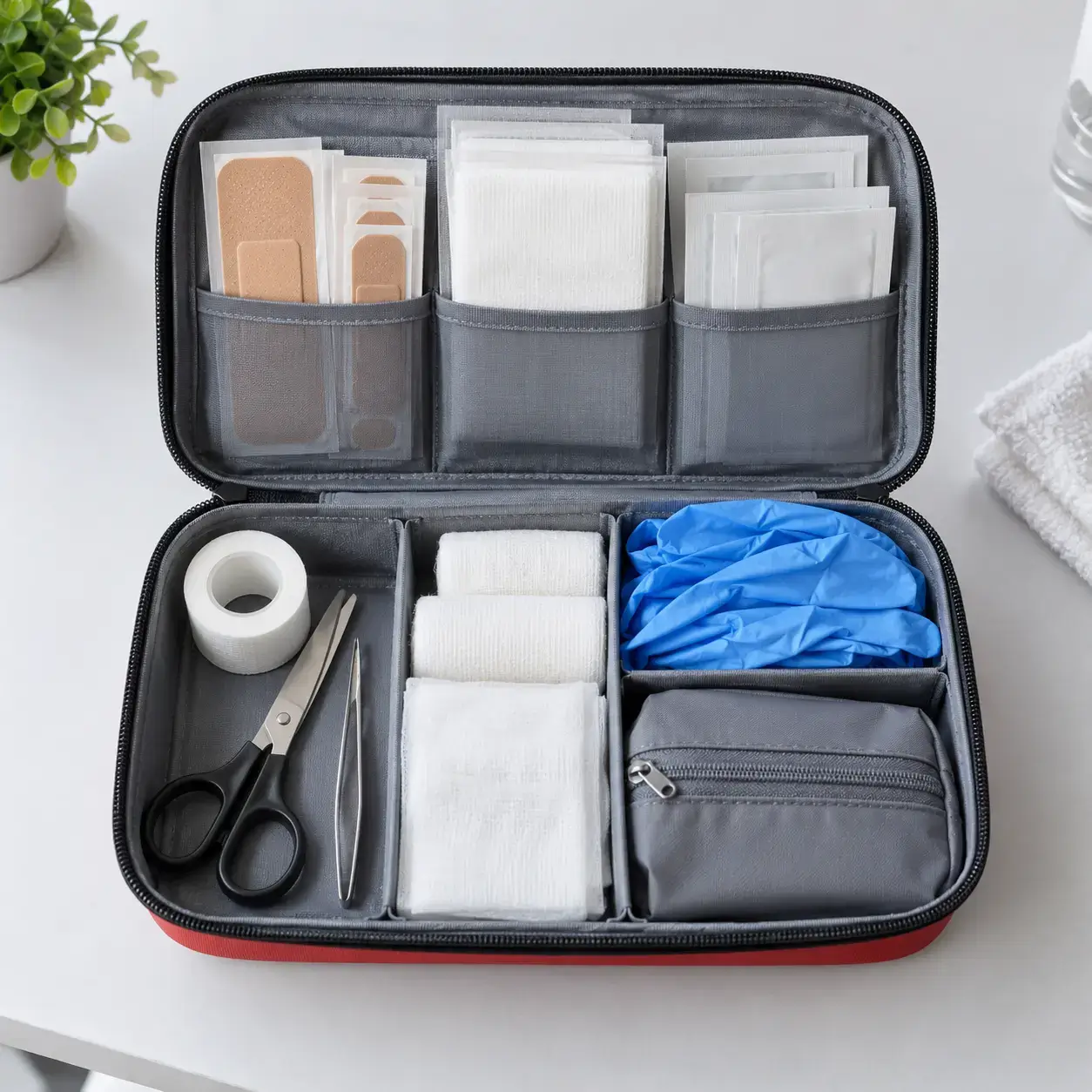
The factory should ask before changing:
- manufacturer;
- production site;
- material;
- dimensions;
- formulation;
- active ingredient;
- sterile status;
- sterilization process;
- individual packaging;
- labeling;
- shelf life;
- regulatory status.
Suppose the BOM requires a 72 × 19 mm PE adhesive bandage from Supplier A. Supplier A is out of stock, so the assembler offers a 70 × 18 mm bandage from Supplier B.
The new bandage is only 2 mm shorter and 1 mm narrower. It may look almost the same, but it no longer matches the released BOM.
Use a simple change path:
change request → impact check → document or sample review → written approval → BOM update
Keep US and EU Versions Separate
A US BOM and label set should not automatically be reused for the EU.
Where Article 22 of the EU Medical Device Regulation applies to a system or procedure pack, the person placing the combination on the market has duties around the products being combined, compatibility, packaging and supplied information.[9]
The EU also gives different responsibilities to manufacturers, authorised representatives, importers, distributors and system/procedure pack producers.[10]
For each market, check the component status, required labels, responsible company information and claims before approving the final version.
Tie Every Label to the BOM Revision
Give the artwork its own controlled revision:
BOM: FAK-US-100 Rev.04
Pouch: ART-POUCH-04
Content Card: ART-CARD-04
Carton: ART-CTN-03
Compare the printed information with the current BOM before the line starts.
- The artwork says 20 bandages but the BOM has 15.
- The old glove material is still printed.
- A removed drug is still listed.
- An old barcode remains.
- The wrong warning sheet is packed.
- US and EU labels are mixed.
FDA device labeling rules treat false or misleading labeling as misbranding and require an accurate statement of the quantity of contents where applicable.[11]
Claims such as “sterile,” “latex-free,” “waterproof,” “hypoallergenic,” “ANSI/ISEA compliant,” “medical grade” or “FDA approved” should have evidence for the exact product and wording being used.
If one factory packs several similar versions, give each version its own item codes and packing sheet. Clear old labels and components from the line before changing to the next version.
Trace Finished Kits Back to Component Lots
| Finished Lot | Component | Component Lot |
|---|---|---|
| FAK260901A | Bandage | BD260812 |
| FAK260901A | Gauze | GZ260730 |
| FAK260901A | Gloves | GL260815 |
| FAK260901A | Wipe | WP260821 |
If one wipe lot contains 20,000 pieces and each kit uses four wipes:
20,000 ÷ 4 = 5,000 finished kits
If 3,800 kits have already shipped and 1,200 remain in stock, the records should show both groups immediately.
- Backward: finished kit → component lot → supplier.
- Forward: component lot → finished-kit lot → shipped quantity → customer or distributor where records allow.
If that wipe lot later has a confirmed problem, the 1,200 units in stock can be held while the 3,800 shipped units are traced. There is no reason to treat unrelated kit lots as affected if the component records are complete.
Approve the Complete Packed Kit
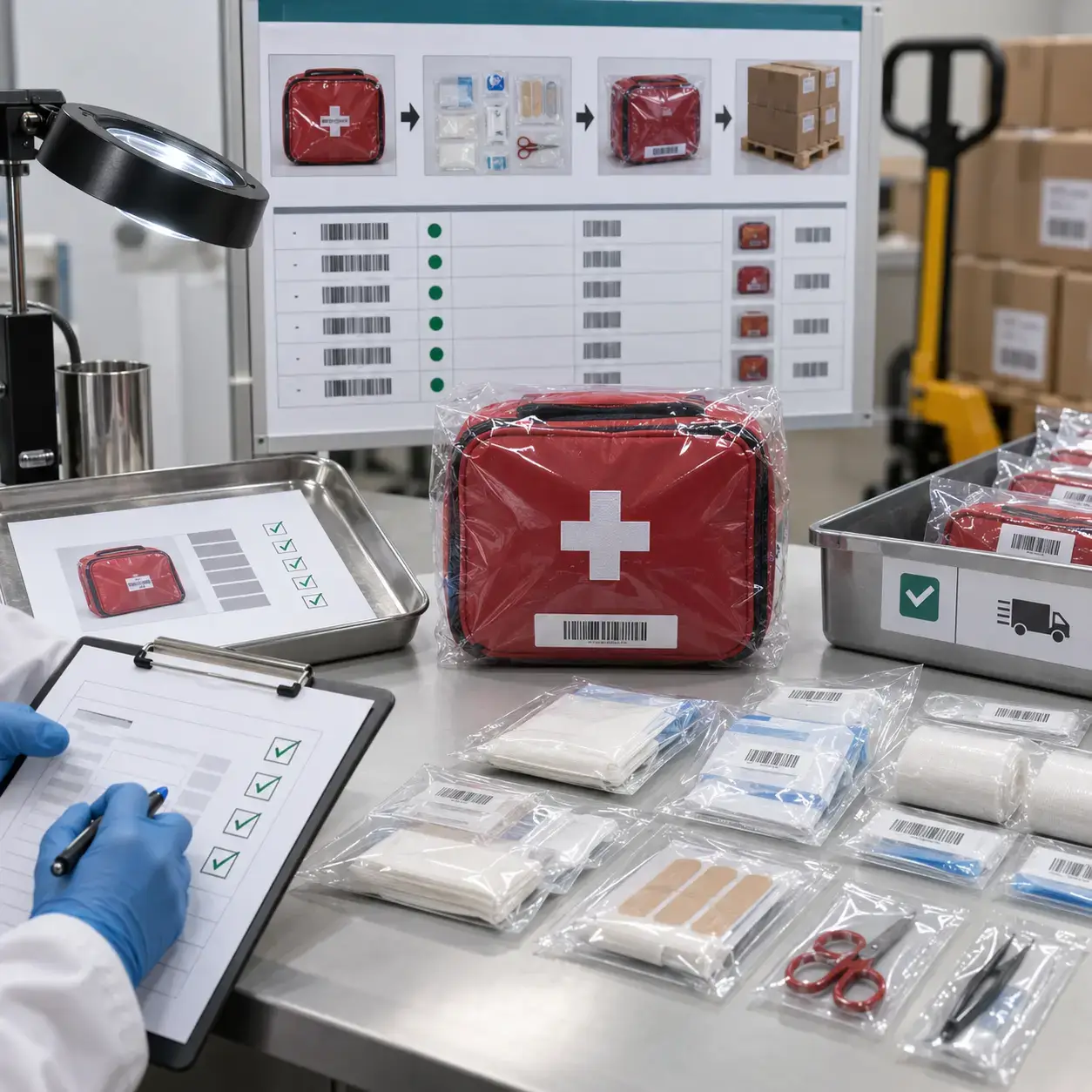
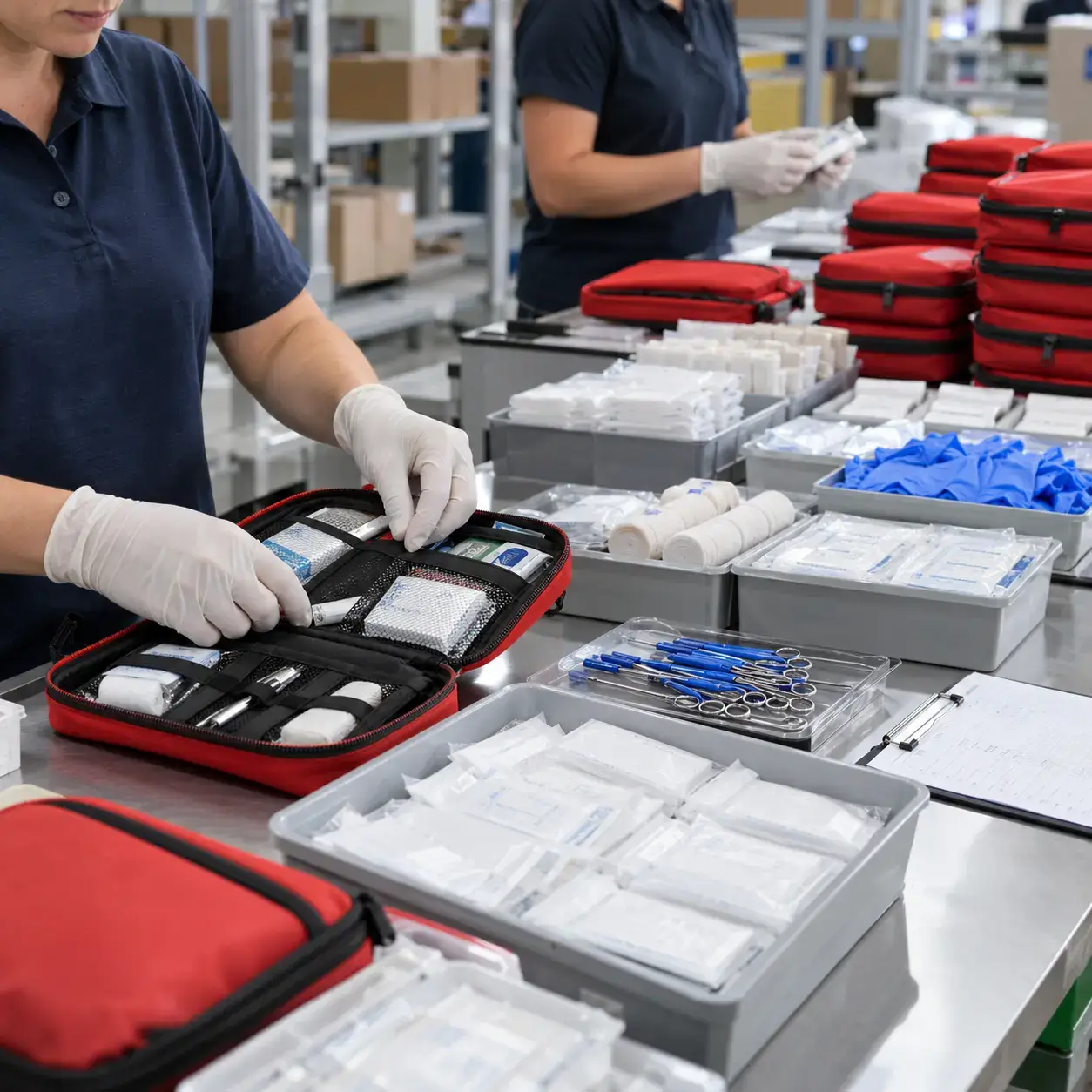
The pre-production sample should be a finished kit, not a tray of loose components.
Compare it with the BOM:
- item codes;
- quantities;
- dimensions;
- materials;
- individual packaging;
- artwork;
- lot format;
- expiry format;
- internal arrangement.
Then check what happens when all the items sit together inside the case:
- the case closes without excessive pressure;
- scissors do not puncture sterile packs;
- heavy items do not crush small packets;
- liquids cannot easily leak onto dressings or labels;
- items stay in their compartments;
- labels remain readable;
- the shipping carton protects the finished kits.
Keep clear photos and, where practical, one physical reference sample. Approve another sample when a change affects the manufacturer, material, formulation, sterile packaging, case size, artwork, internal layout or target market.
Inspect Defects by Risk
Critical defects may include:
- wrong regulated product;
- serious labeling error;
- missing required warning;
- expired regulated product;
- opened sterile package;
- contamination;
- unauthorized drug formulation.
Major defects may include:
- missing component;
- wrong quantity;
- wrong size or material;
- remaining shelf life below the purchase requirement;
- wrong instruction sheet;
- unreadable lot code;
- defective case closure.
Minor defects may include:
- small cosmetic marks;
- minor non-functional case defects;
- small print-position differences within the approved limit.
The acceptance rule should match the effect of the defect. An opened sterile pack should not be treated the same way as a small cosmetic mark on the outside of the case.
Update Everything After a Change
| Rev. | Change | Reason | Approved By |
|---|---|---|---|
| 01 | Initial release | New product | QA |
| 02 | Bandage size changed | Product update | QA / Product |
| 03 | New glove source | Supply change | QA |
| 04 | Artwork updated | Label change | QA / Regulatory |
Before approving a change, check whether it also affects:
- BOM;
- artwork;
- regulatory documents;
- testing;
- shelf life;
- storage;
- approved sample;
- existing inventory;
- refill packs.
A new glove can make an old material claim wrong. A new bandage size can make the printed content list wrong. A new drug formulation can change the Drug Facts label, expiry or storage instructions.
Give Refill Packs Their Own BOM
A refill pack should be treated as a separate controlled SKU.
Record:
- refill SKU;
- compatible main-kit revision;
- component codes;
- quantities;
- component lots;
- shelf life;
- labels;
- instructions.
For example:
Main kit: FAK-100 Rev.04
Compatible refill: RF-100 Rev.02
If each refill contains two pairs of gloves, 1,000 refill packs need:
1,000 × 2 = 2,000 pairs of gloves
When the main kit changes, review the refill BOM at the same time. An old refill should not stay on sale simply because the product name still looks the same.
Use Complaint Data to Change the BOM
Record complaints by the actual problem:
- missing or wrong item;
- incorrect quantity;
- damaged sterile package;
- poor adhesion;
- leakage;
- expired product;
- wrong label;
- broken case;
- product performance problem.
Then compare them by component lot, finished-kit lot, supplier and production date.
If 12 complaints are received and nine involve the same bandage lot, 75% of the complaints point to one lot.
That does not prove the whole lot is defective, but it gives the investigation a clear starting point. Check retained samples, warehouse stock and supplier records first.
If the same problem keeps coming back, tighten the specification, increase inspection, change the approved source or revise the BOM. Complaint data is useful only when it changes what happens on the next production order.
Finally
A private label first aid kit is under control when the BOM, physical contents, labels, supplier records and component lots all tell the same story. If 10,000 kits need four gauze pads each, about 40,000 pads should be accounted for, plus documented scrap and samples. If one 20,000-piece wipe lot is used at four wipes per kit, it can affect 5,000 finished kits. Before shipment, clear unexplained quantity differences, unapproved substitutions, short-dated stock and label mismatches. Those records make repeat orders easier and let you isolate the right stock quickly if a component later has a problem.