Five disposable syringe manufacturers in China are profiled below by product range, operating location and the records a buyer should check before approving any of them. Each company’s own website or product catalog lists disposable syringes as a current product line, and the profiles name the syringe configurations that company publicly advertises. They are starting points for supplier research, not an audited ranking or a guarantee of product quality or regulatory clearance. Confirm the legal manufacturer, production site, exact model, current certificates, and destination-market eligibility before placing an order. U.S. buyers should review the FDA’s current safety communication before sourcing plastic syringes made in China.
Which Disposable Syringe Manufacturers in China Should You Evaluate?
The following companies were selected because their official websites or product catalogs identify disposable syringes as part of their product range. This comparison reflects publicly disclosed information. It does not confirm that every model is currently available, that all production takes place at the listed address, or that a certificate covers the product being quoted.
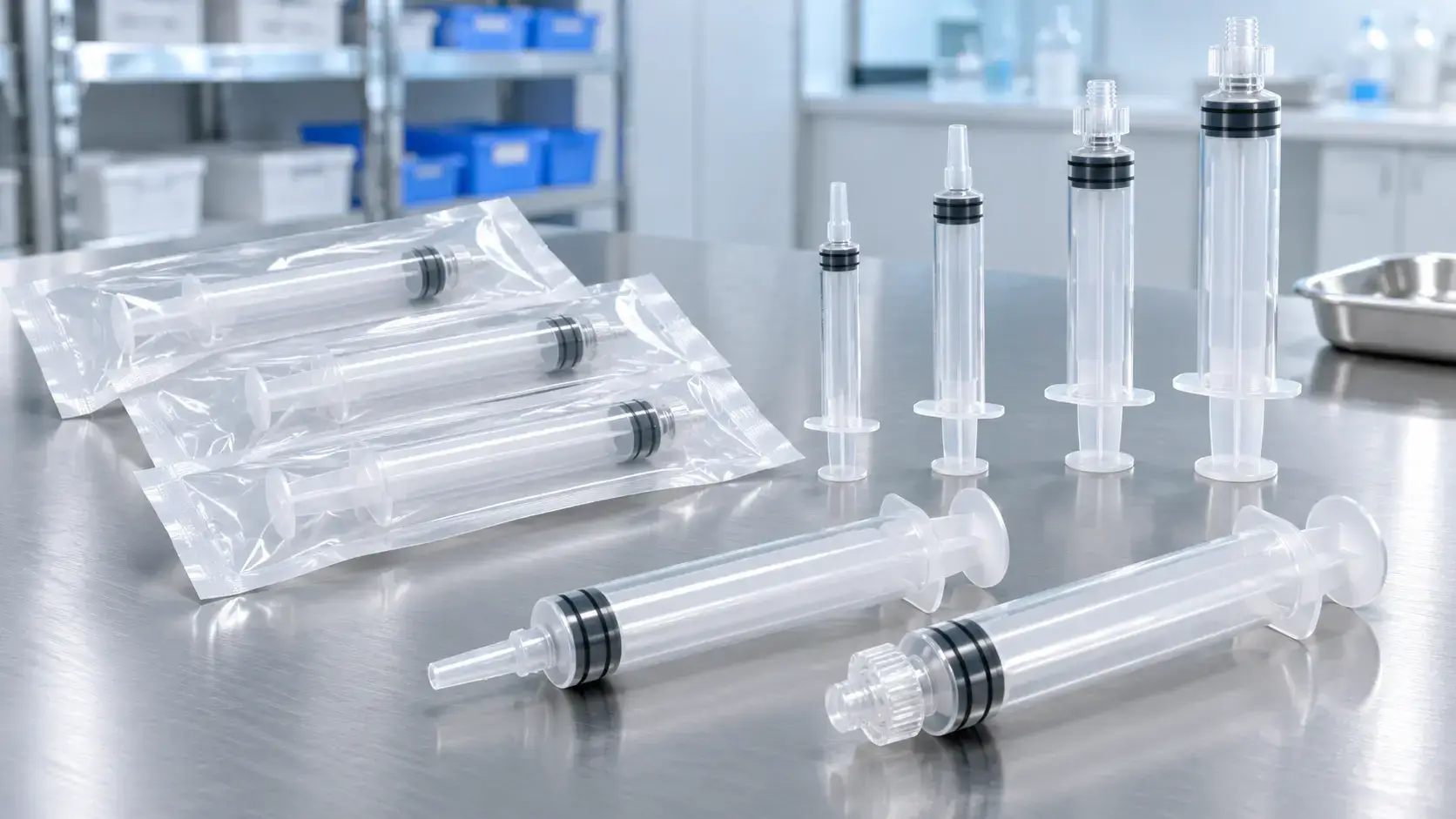
| Manufacturer | Location | Products listed publicly | What buyers should verify |
|---|---|---|---|
| WEGO Medical / Weigao Group | Weihai, Shandong | Sterile hypodermic, luer-lock and luer-slip, catheter-tip, ENFit, vaccine and prefilled syringe lines | Legal manufacturer, manufacturing site, model range and entity named on product registrations |
| Changzhou Medical Appliances General Factory Co., Ltd. (LELUN) | Changzhou, Jiangsu | Luer-slip and luer-lock, two-part, fixed-needle insulin, safety, auto-disable, oral and enteral syringes | Current certificates, exact production address and whether the quoted model is made there |
| Jiangsu Eyoung Medical Devices Co., Ltd. | Changzhou, Jiangsu | Luer-slip and luer-lock, two-part, low-dead-space, insulin, oral, enteral and catheter-tip syringes | Current output by model, sterilization arrangements, needle options and product-specific test reports |
| Berpu Medical Technology Co., Ltd. | Wenzhou, Zhejiang | Regular and safety syringes, insulin syringes, hypodermic needles, safety needles and injection devices | Syringe-specific capacity, in-house process scope and certificates for the exact device |
| Jiangyin Fanmei Medical Device Co., Ltd. | Jiangyin, Jiangsu | Two-part and three-part syringes, insulin syringes, hypodermic needles, infusion and scalp-vein sets | Current capacity, cleanroom scope, model-level quality records and certificate validity |
WEGO Medical / Weigao Group — Broad Medical-Device Portfolio
WEGO Medical’s catalog lists sterile hypodermic syringes, catheter-tip, ENFit, light-resistant, vaccine and prefilled syringes. Its syringe brochure describes standard models with or without needles, luer-lock or luer-slip connections, polypropylene barrels and EO sterilization. This is a candidate to investigate when a buyer needs several syringe configurations or a broader hospital-consumables portfolio.
Do not treat the group name, export contact and legal manufacturer as interchangeable. Ask which legal entity manufactures the exact model, which facility releases the finished lot, and whose name appears on the label and regulatory records.
Changzhou Medical Appliances General Factory Co., Ltd. (LELUN) — Standard and Safety Syringes
Changzhou Medical Appliances General Factory identifies itself as a disposable medical-device manufacturer established in 1988 in Changzhou, Jiangsu. Its catalog lists luer-slip and luer-lock syringes, irrigation syringes with catheter tips, fixed-needle insulin syringes, two-part syringes, retractable-needle safety syringes and auto-disable syringes. This range is relevant to buyers comparing standard injection products with safety-engineered or immunization-related models.
The company website displays ISO 13485 and CE-related claims. Treat these as supplier-provided information until current certificates are checked. Confirm the certificate holder, manufacturing address, product scope, validity period and whether the exact syringe model is included.
Jiangsu Eyoung Medical Devices Co., Ltd. — Multiple Syringe Configurations
Jiangsu Eyoung Medical Devices lists luer-slip and luer-lock syringes, two-part syringes, low-dead-space or low-dead-volume syringes, insulin, oral, enteral and catheter-tip syringes. Its public contact page gives an address on Dongtang Road in Zhenglu Town, Changzhou, Jiangsu.
This product mix makes the company worth contacting for buyers comparing conventional hypodermic syringes with low-dead-space or non-injection dosing products. Ask for exact model codes, needle configurations, dead-space specifications, sterilization method and current production capacity. A general catalog does not confirm that a specific model is available for a particular market.
Berpu Medical Technology Co., Ltd. — Safety and Injection-Device Range
Berpu Medical is based in Wenzhou, Zhejiang. Its official product menu separates safety products, injection products and diabetes-care products. The published range includes safety syringes, regular syringes, insulin syringes, hypodermic needles, insulin needles and other puncture or injection devices. The company also describes a medical-device research institute and mold-development capability.
Berpu is a relevant candidate when the project includes safety-engineered injection devices, insulin products or needle-related components. A broad puncture-device portfolio does not prove that every syringe configuration is manufactured on the same line. Request a process map for the quoted product and identify outsourced component production, assembly or sterilization.
Jiangyin Fanmei Medical Device Co., Ltd. — Two-Part and Three-Part Syringes
Jiangyin Fanmei Medical Device identifies its location as Jiangyin, Jiangsu. Its public catalog lists two-part and three-part disposable syringes, luer-slip and luer-lock designs, insulin syringes, hypodermic needles and infusion sets. The company also describes automated molding, sorting and packaging equipment.
Fanmei is worth including in a quotation round for buyers comparing standard two-part and three-part syringes or related infusion consumables. Its website publishes production and certification claims, but these should not be used for purchasing approval without current evidence. Ask for output by model and shift, cleanroom classification, ISO 13485 certificate scope and recent product-specific test reports.
Important: These five companies are a research shortlist, not a quality ranking. Public information establishes that they advertise relevant product categories; it does not establish current regulatory approval, defect rates, delivery performance or suitability for a particular tender. Retain only manufacturers that pass document review, sample evaluation and a factory-level assessment.
Which Manufacturer Fits Your Syringe Project?
Start with the exact device configuration, then use the public product catalogs to decide which companies are worth contacting. Every entry below reflects catalog information as published; reconfirm it against the current model catalog and technical file before requesting a quotation.
| Project requirement | Companies whose catalogs list relevant products | Key technical check |
|---|---|---|
| Standard luer-slip or luer-lock syringes | WEGO, LELUN, Eyoung, Fanmei | Capacity, connector dimensions, graduation accuracy, needle/no-needle configuration, leakage and packaging |
| Low-dead-space or low-dead-volume syringes | Eyoung; confirm current model availability with other shortlisted companies | Residual volume, fixed-needle design, dose performance and model-specific validation |
| Insulin syringes | LELUN, Eyoung, Berpu, Fanmei | U-40 or U-100 scale, nominal volume, graduation interval, needle gauge and length |
| Safety-engineered syringes | LELUN and Berpu; confirm the exact safety design and model range | Activation sequence, accidental activation risk, needle protection and mechanism reliability |
| Auto-disable vaccination syringes | LELUN lists auto-disable syringes; confirm the exact fixed-dose model | Disable mechanism, fixed dose, needle configuration and current WHO E008 status where required |
| Oral, enteral or catheter-tip syringes | WEGO, LELUN, Eyoung | Connector compatibility, enteral-specific design, labeling and risk of misconnections |
Do not send the same generic inquiry to every company. For example, a buyer sourcing a 0.5 mL U-100 insulin syringe should request insulin-specific drawings, graduation accuracy data and needle specifications. A buyer sourcing a 5 mL luer-lock syringe should instead compare connector fit, leakage, barrel dimensions, graduation visibility and packaging. Product-family experience is useful, but it is not a substitute for evidence covering the quoted model.
How Do You Confirm That a Supplier Is the Actual Manufacturer?
A company may own a factory, manage exports, or trade products made by another organization. These roles are not interchangeable. The legal manufacturer is responsible for the finished device and its applicable regulatory obligations. Before approving a supplier, reconcile the following records:
- Business identity: Obtain the Chinese business license, registered company name, unified social credit code and registered address. Check that the contracting entity is clearly identified.
- Production site: Obtain the full factory address and the applicable medical-device manufacturing license or filing information. Confirm the site against the product registration and quality-system documents.
- Product identity: Match the model number, product name, intended use, size, connector, needle configuration and legal manufacturer across the quotation, label, instructions for use and regulatory records.
- Commercial chain: Compare the seller on the quotation, contract, invoice and payment beneficiary. If an exporter or trading company is involved, document its relationship with the legal manufacturer.
- Process ownership: Identify which company performs molding, printing, assembly, needle attachment, packaging, sterilization, testing and final release. Record all outsourced processes and subcontractor sites.
For medical consumables sourcing in China, separate the supplier’s commercial role from the legal manufacturer’s regulatory responsibilities. A trading company can coordinate an order, but it does not replace evidence from the factory responsible for the finished medical device.
What Should a Factory Audit Examine?
A useful audit follows the actual syringe through production rather than relying on a showroom, office tour or certificate wall. Ask the factory to demonstrate the process for the exact model under consideration.
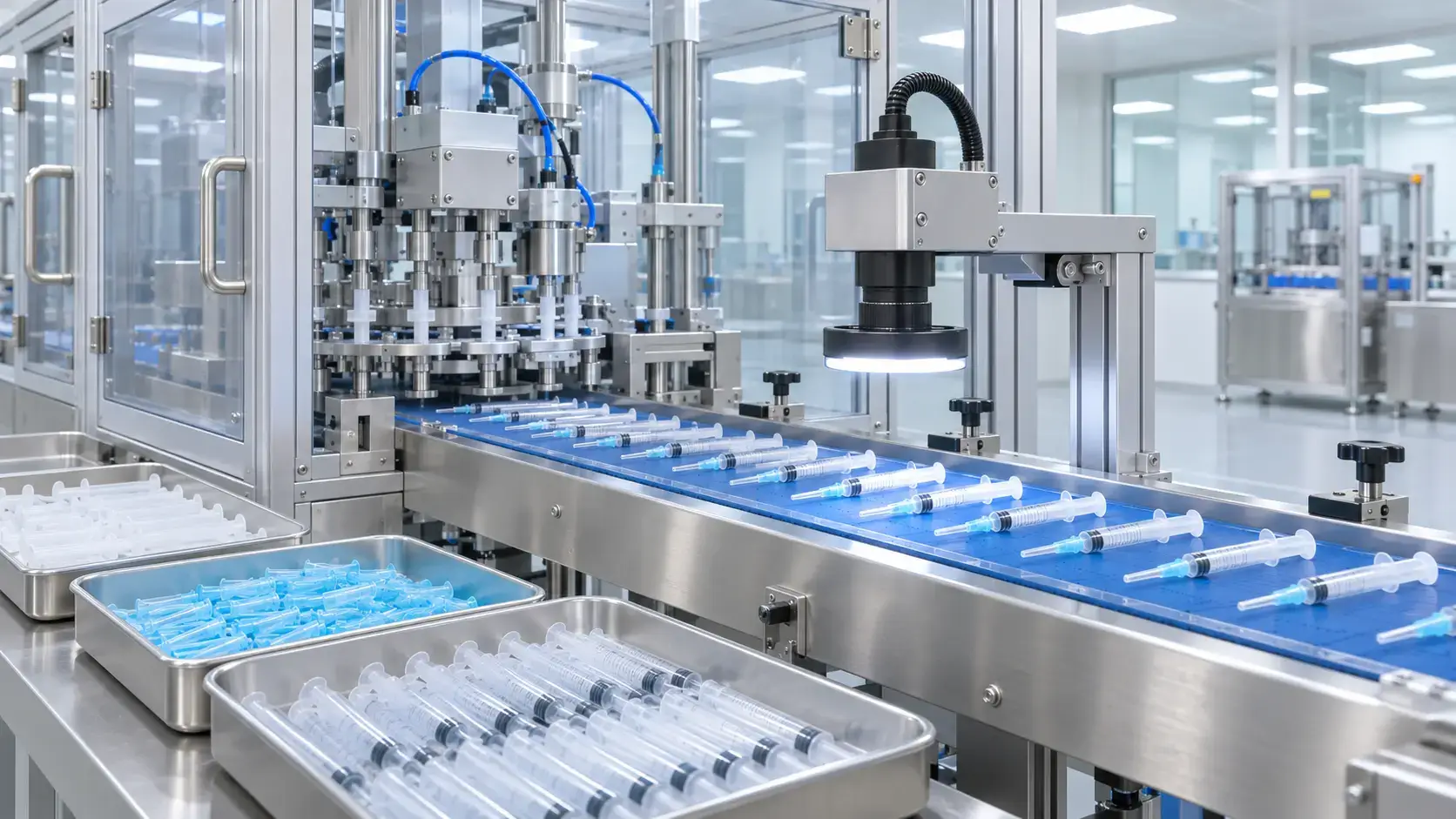
- Injection molding: Check barrel and plunger molding equipment, mold identification, resin batch records, material storage and controls for regrind or material substitution.
- Barrel printing: Review graduation artwork, print registration, legibility, adhesion and the checks used to detect scale or marking errors.
- Assembly: Observe barrel, piston, plunger and gasket assembly. Check controls for fit, movement, leakage, lubricant application and component mix-ups.
- Needle assembly: For needle-equipped products, review cannula specifications, hub attachment, needle protection, bond strength and the process used to control sharp-point damage.
- Sterile packaging: Inspect pouch or blister materials, sealing equipment, seal parameters, packaging validation and how damaged packs are rejected.
- Sterilization and release: Determine whether EO or another method is used, whether sterilization is performed in-house or by a subcontractor, and how the manufacturer reviews cycle records and authorizes batch release.
Ask for a live walkthrough of the relevant line, not only photographs. Record the machine and line identifiers, production status, operators’ work instructions, in-process inspection points and the lot number being manufactured. If the supplier cannot show the process for the quoted model, keep the supplier at the investigation stage.
Which Documents Should You Request Before Supplier Approval?
Do not accept a folder of generic certificates as a complete qualification package. The documents must identify the legal manufacturer, site, device family and, where applicable, the exact model or configuration.
| Document group | Evidence to request | Reason to hold approval |
|---|---|---|
| Company and site identity | Business license, manufacturing license or filing where applicable, site address, legal manufacturer details | Different or unexplained company names and production addresses |
| Quality management | Current ISO 13485 certificate, scope, issuing body and relevant quality-system records | Expired, unverifiable or out-of-scope certificate |
| Product authorization | Applicable NMPA records, destination-market registration or clearance, EU declaration and notified-body records where required | Evidence refers to a different model, manufacturer or site |
| Product performance | Drawings, material specifications, model-specific test reports, acceptance criteria and actual results | Reports cover another configuration or omit test methods and results |
| Sterilization | Validated sterilization process, routine cycle records, subcontractor details and release authorization | No traceable evidence supporting the sterile claim |
| Packaging and shelf life | Sterile-barrier validation, sealing-process validation, transport or aging evidence and shelf-life rationale | Packaging or expiry claims cannot be supported |
| Traceability and complaints | Representative batch history, component records, release records, complaint handling and corrective-action process | Critical components cannot be traced to finished lots |
ISO 13485:2016 addresses quality-management systems for medical devices. ISO 11135 addresses validation and routine control of ethylene oxide sterilization. ISO 11607-1 and ISO 11607-2 address sterile-barrier packaging materials and packaging-process validation. The applicable product standard also matters: ISO 7886-1 covers sterile single-use hypodermic syringes for manual use, ISO 8537 covers insulin syringes, and ISO 7886-3 covers auto-disable syringes for fixed-dose immunization. Confirm the current edition and applicability for the product and market.
What Should You Include in a Disposable Syringe RFQ?
Send the same controlled specification to every shortlisted manufacturer. A quotation for a 5 mL luer-lock syringe without a needle cannot be compared directly with a 5 mL luer-slip syringe supplied with a needle. State the configuration first, then ask each factory to quote the same quantity breaks and delivery terms.
Sample RFQ: Please quote 100,000 sterile, single-use 5 mL hypodermic syringes with a luer-lock connector, without needle, individually packaged. Please identify the legal manufacturer and production address, exact model number, barrel and plunger materials, graduation specification, applicable product standard, sterilization method, validated shelf life, product test reports, inner-pack and carton quantities, MOQ, production lead time, available monthly capacity for this model, destination-market documents, payment terms, and FOB Shanghai price. Please identify any outsourced assembly, packaging or sterilization process.
For syringe-and-needle sets, add needle gauge, length, cannula material, hub design and attachment method. For insulin syringes, specify U-40 or U-100, nominal volume, graduation interval, needle gauge and length. For auto-disable devices, state the fixed dose, needle arrangement, disable mechanism and any required WHO prequalification reference.
Ask suppliers to quote at several realistic quantities, such as 10,000, 100,000 and 500,000 units, if those volumes are accepted. These are comparison scenarios, not standard Chinese factory MOQs. Request separate prices for standard packaging, OEM labels, custom printing, tooling, additional testing and any validation caused by a design or packaging change.
For a 100,000-unit order, a $0.01 difference in unit price changes the product expenditure by $1,000. Compare the full landed-cost structure, including packaging, sterilization, testing, freight, insurance, customs charges, duties and taxes under the agreed Incoterms. A lower unit price is not a saving if it excludes required validation, compliant packaging or inspection.
Check the Pack Count Before Confirming the Order
Use the factory’s current packing specification for the exact model. As an illustrative calculation, 100,000 syringes packed only in complete cases of 3,000 units would require 34 cases, or 102,000 units. Confirm whether partial cases are permitted before agreeing to the purchase quantity.
Request units per primary pack, inner box and master carton, carton dimensions, gross weight, lot-label format and expiry-date marking. Do not calculate freight or order quantity from another supplier’s packaging data.
How Should You Audit Samples and the First Production Run?
Approve a controlled reference sample before mass production. The sample record should identify the manufacturer, model, drawing revision, materials, connector, needle configuration, packaging and labeling. Keep a signed or otherwise traceable approval record. Any change to the barrel, plunger, gasket, needle, connector, sterile barrier or sterilization process should go through documented change control.
Pre-Production Checks
A pre-production inspection can verify that the factory has the approved raw materials, components, tooling, packaging stock, reference samples, work instructions and production schedule before the order enters full production. Check whether the line and equipment shown during the audit are the same ones assigned to the order.
Production and Batch-Record Checks
Select a completed production lot and reconcile the quantities through the batch records. The following is an illustrative reconciliation, not a claimed result from an actual syringe factory audit:
| Batch record | Quantity |
|---|---|
| Units produced | 20,000 |
| Units rejected | 250 |
| Units retained for testing | 50 |
| Units released | 19,700 |
| Total accounted for | 20,000 |
The released quantity must reconcile with production, rejects, retained samples and documented rework or other dispositions. Follow a critical component lot forward as well. If one needle lot was used in three finished syringe lots containing 8,000, 6,000 and 5,000 units, the records should identify all 19,000 potentially affected syringes.
For outsourced sterilization, link each finished-product lot to the sterilization provider’s processing reference and the manufacturer’s final release decision. Different internal batch numbers are acceptable when their relationship is documented. These checks follow the bidirectional approach used in medical consumables lot-traceability reviews: trace finished goods back to components and process records, then trace suspect components forward to every affected finished lot.
Pre-Shipment Inspection
A pre-shipment inspection can compare finished goods with the approved specification. Check capacity, graduations, connector dimensions, needle configuration, visible defects, plunger movement, packaging condition, lot identification, expiry information and carton quantities.
Define the sampling method, sample size and defect acceptance criteria before inspection. AQL sampling may support checks for selected physical defects, but it cannot establish sterility or replace validated manufacturing, sterilization records and formal batch release. Hold shipment if a critical safety, quality or regulatory issue remains unresolved.
How Do U.S. and EU Rules Affect Manufacturer Selection?
United States
The FDA’s safety communication, updated on August 16, 2024, continues to recommend using plastic syringes not manufactured in China where possible because of potential quality and performance concerns. It advises users to transition away from affected plastic syringe products made by three manufacturers: Jiangsu Caina Medical Co., Ltd., Jiangsu Shenli Medical Production Co., Ltd. and Shanghai Kindly Enterprise Development Group Co., Ltd. The same August 2024 update removed Zhejiang Longde Pharmaceutical Co., Ltd.’s plunger syringes from Import Alert 89-04, so the four companies named in earlier versions of the communication are no longer one group. The communication does not cover glass syringes, prefilled syringes or topical syringes; the plastic hypodermic syringes discussed in this guide do fall within it. This is a material sourcing consideration for U.S. buyers, not a routine paperwork check. Review the FDA safety communication before proceeding.
Do not assume that a manufacturer omitted from the FDA communication is approved or that its products are cleared for U.S. sale. Verify the exact device, product code, legal manufacturer, establishment information, applicable 510(k) or other premarket requirements, recalls and current import alerts. FDA establishment registration or device listing does not by itself mean that a device is FDA cleared or approved. The FDA’s Quality Management System Regulation became effective on February 2, 2026, incorporating ISO 13485:2016 by reference alongside applicable U.S. requirements.
European Union
Under EU MDR 2017/745, check the CE marking, EU declaration of conformity, legal manufacturer, authorized representative, labeling, UDI information and notified-body certification where required. Match the documents to the quoted syringe model and the responsible manufacturer.
As of May 28, 2026, the first four EUDAMED modules are mandatory to use under the applicable arrangements. These include Actor Registration, UDI/Device Registration, Notified Bodies and Certificates, and Market Surveillance. Review the European Commission’s EUDAMED overview and confirm which obligations apply to the manufacturer, importer and other economic operators.
WHO Immunization Tenders
For auto-disable vaccination syringes, check the exact device and dose against the WHO E008 product listing where prequalification is required. A listing for one product, dose or configuration does not extend to the manufacturer’s entire catalog. Verify the current status and technical specifications before tender submission.
Frequently Asked Questions
Are the five companies listed here the best disposable syringe manufacturers in China?
No. They are examples of companies whose official websites publicly list relevant syringe products. This is not a ranking, factory-audit result or endorsement. The right shortlist depends on the exact syringe design, destination market, required regulatory evidence, order quantity and production schedule.
Does an ISO 13485 certificate prove that a syringe is approved for export?
No. ISO 13485 concerns the manufacturer’s quality-management system. It does not replace product-specific registration, clearance, conformity assessment, labeling or importer obligations. Check the certificate holder, scope, site and validity, then verify the device documents required by the destination market.
How can I tell whether a supplier is a factory or a trading company?
Compare its business license, manufacturing license or filing, production address, product registration, ISO 13485 certificate and the legal manufacturer shown on the device label. During an audit, ask to see the molding, assembly, packaging and release processes for the exact model. If the seller outsources production, identify the actual factory and document the commercial and quality responsibilities.
Can one manufacturer supply standard, insulin and auto-disable syringes?
Some companies list more than one of these categories, but capability must be checked model by model. Insulin syringes require the correct U-40 or U-100 scale and dose accuracy. Auto-disable syringes require a validated disable mechanism and the relevant product evidence. A general disposable-syringe catalog does not prove competence in every specialized device.
Can U.S. buyers safely assume that an unlisted Chinese manufacturer is acceptable?
No. The FDA recommends using plastic syringes not manufactured in China where possible and continues to evaluate potential quality and performance issues. Absence from a list of specifically identified manufacturers does not establish FDA clearance, approval or product suitability. Review the current FDA communication and device-specific regulatory status before sourcing.
Need to Screen a Disposable Syringe Manufacturer?
Share the syringe specification, supplier name, factory address, order quantity and destination market. JS Sourcing can support supplier screening, factory audits, production follow-up and inspection coordination. The manufacturer remains responsible for the medical device and its regulatory documentation.
Before You Place an Order
Use the five company profiles to build an initial contact list, then narrow it to manufacturers that can produce the exact syringe configuration and provide evidence for the actual production site. Compare product-specific documents, sample results, sterilization controls, packaging validation, batch traceability, capacity and full delivery terms. Do not treat a website catalog, ISO certificate or low quotation as proof that a product is suitable for your market. For U.S. procurement, assess the FDA’s recommendation on plastic syringes made in China before moving into supplier approval.
References
- WEGO Medical — Product and Solution Catalog
- WEGO — Disposable Hypodermic Syringe and Needle Brochure
- Changzhou Medical Appliances General Factory Co., Ltd. — Official Website
- Jiangsu Eyoung Medical Devices Co., Ltd. — Official Website
- Berpu Medical Technology Co., Ltd. — Official Website
- Jiangyin Fanmei Medical Device Co., Ltd. — Official Website
- FDA — Safety Communication on Plastic Syringes Made in China
- FDA — Registration, Clearance and Approval
- FDA — Quality Management System Regulation
- European Union — Medical Device Regulation 2017/745
- European Commission — EUDAMED Overview
- WHO — E008 Single-use Injection Devices
- ISO — ISO 13485:2016
- ISO — ISO 11135
- ISO — ISO 11607-1
- ISO — ISO 11607-2
- ISO — ISO 7886-1:2017
- ISO — ISO 8537:2016
- ISO — ISO 7886-3:2020