By JS Sourcing | Buyer-side sourcing analysis | Updated October 29, 2026
Short answer: For a 150-room hotel buying bathroom fixtures from China, approve ceramic toilets, ceramic washbasins, and shower enclosures against the actual room drawings before placing a bulk order. Tie each of those three finished-fixture models to a room-type drawing, an approved sample, model-level safety or performance evidence, a comparable China-side quotation, and a site receiving window. In the illustrative project below, one unit of each category per standard room creates a 450-unit planning baseline, not a final bill of materials.
Scope and disclosure: This article covers only three finished bathroom fixture categories: ceramic toilets, ceramic washbasins, and complete shower enclosures. The pricing examples compare finished fixture units rather than separate component purchases. The hotel, quotations, decisions, prices, and schedule are illustrative, not a documented JS Sourcing customer project. The sourcing controls are instructions a buyer can adapt, not claims of work performed or savings achieved. No additional bathroom product categories are included.
The 150-Room Project: Three Fixture Categories
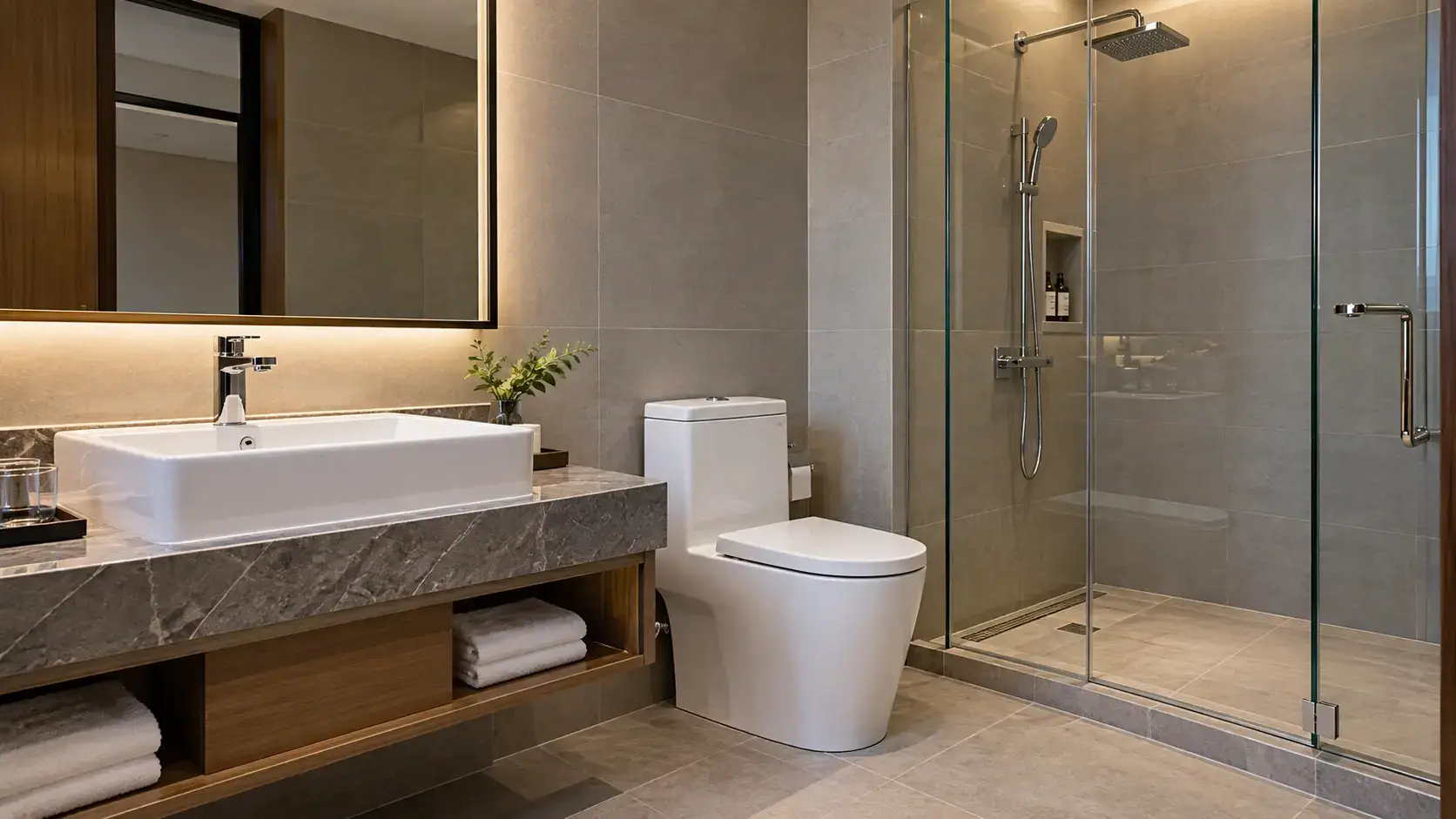
The hypothetical hotel has 150 standard guestrooms and an initial specification for one toilet, one washbasin, and one shower enclosure per room. The architect supplies room-type drawings; the purchasing team obtains China-side quotations; the construction team provides the sequence in which bathrooms will be ready for installation. The purchasing decision therefore has two separate gates: the China-side producer must substantiate the quoted finished-fixture model, and the project team must confirm it works within the approved room conditions. Neither gate can substitute for the other.
| Fixture category | Illustrative quantity | Approval risk | Required evidence |
|---|---|---|---|
| Ceramic toilets | 150 | Rough-in and waste-outlet mismatch; unstable fixing; unacceptable flushing performance | Model drawing, installation clearance, finish sample, applicable test evidence |
| Ceramic washbasins | 150 | Incorrect wall support, installation cut-out, dimensions, or glaze consistency | Dimensional drawing, mounting method, approved ceramic sample |
| Shower enclosures | 150 | Finished opening or door clearance differs from the quoted size; glass damage | Approved enclosure drawing, glazing evidence, final-measurement rule, protective packaging plan |
Quantity control: 150 + 150 + 150 = 450 core units. This assumes each standard room has all three categories. Accessible rooms, suites, rooms with different shower arrangements, public bathrooms, and spare inventory must be counted separately before the purchase order is issued. A purchasing schedule should identify each room type and its exact fixture model rather than multiply a standard-room list across the whole property without checking exceptions.
Scenario: Four Decisions Before the Production Deposit
First decision: the approved sample does not match the finished room
The buyer initially accepts three catalog samples. During the drawing review, the toilet’s outlet location is inconsistent with the proposed floor layout, and the washbasin’s mounting position does not match the wall reinforcement. The enclosure supplier has priced a nominal glass width, but the usable opening depends on the completed tiled walls and floor. All three items could pass a factory appearance check and still be unsuitable for the hotel.
Modeled response: Purchasing holds bulk approval. The architect and installation contractor issue one controlled room-type schedule showing toilet rough-in, washbasin support and overall projection, and the enclosure’s finished opening, door movement, and tolerance allowance. Samples and drawings are reviewed together. The purchase order is not released until the responsible parties sign off those details.
Second decision: a catalog is not model-level evidence
A trading catalog offers all three categories, but the team cannot tell whether the toilets and basins share a ceramic production site or where the enclosure glass is processed. The supplier also presents a general quality-management certificate rather than test evidence matching the exact models. This creates two distinct risks: the buyer may approve an unverified production source, and a document may be incorrectly treated as proof of product compliance.
Modeled response: The team asks for the actual manufacturing location, model identifiers, test reports, and responsibility for outsourced operations. Ceramic production is reviewed separately from enclosure glass processing and assembly. A supplier audit may verify processes and records, but it does not replace fixture-specific product testing.
Third decision: the lower enclosure quote does not cover the same finished fixture
The buyer receives two hypothetical quotations for a 150-unit order of shower enclosures that must meet the same approved finished-product specification. Offer A begins at $210 per enclosure, but meeting the complete approved enclosure specification adds $50 per unit, and protective export packaging adds another $17. Offer B quotes $269 per complete, specification-compliant enclosure, including export packaging. The purchasing team compares the cost of one finished enclosure ready for shipment under each offer, rather than comparing headline prices for different deliverables.
| Illustrative price item | Offer A | Offer B |
|---|---|---|
| Initial shower enclosure quote | $210 | $269 |
| Adjustment to meet the approved finished-enclosure specification | $50 extra | Included |
| Export protective packaging | $17 extra | Included |
| Comparable unit subtotal | $277 | $269 |
| 150-unit subtotal | $41,550 | $40,350 |
In this constructed example, Offer B is $1,200 lower for 150 complete enclosures before freight, insurance, import charges, and site installation. It should only be selected if the finished enclosure’s glazing, dimensions, opening clearances, finish, warranty, packaging, and model-specific test evidence meet the same approved requirements. These figures illustrate quotation normalization, not actual market prices or achieved savings.
Fourth decision: factory completion is not site readiness
The three fixture categories are ready to ship at different times. Some bathrooms have not reached their required finishing stage, and the site has limited protected storage for ceramics and glass. Shipping all 450 units together could expose fragile goods to unnecessary handling, while holding every unit until the last production lot is complete could delay rooms that are already ready.
Modeled response: The buyer groups deliveries against installation zones and approved receiving dates. As a scheduling illustration, a team completing 15 rooms per week would need 10 weeks for 150 rooms once work areas are available; this is not a measured installation rate. Each release requires an approved model revision, inspection disposition, packing list, carton identification, and a confirmed site receiving window. The scenario ends at this conditional order-release decision; it does not claim a completed hotel delivery.
Turn the 150-Room Plan into Three China RFQ Schedules
Do not send one generic “150 hotel bathrooms” inquiry. For this scenario, send China-side bidders three finished-fixture schedules: 150 provisional ceramic toilets, 150 provisional ceramic washbasins, and 150 provisional complete shower enclosures. Attach the architect’s controlled room-type drawings and identify the exact revision. The 150-per-category count is only the standard-room baseline; accessible rooms, suites, public areas, and spares remain separate until the architect confirms the final allocation.
For every line, record a provisional model code, intended room types, quantity, dimensional drawing, specified finish, performance or safety evidence, sample approval status, export packing method, and required site receiving phase. For example, use internal labels such as T-01 for a toilet, B-01 for a basin, and E-01 for a complete shower enclosure; these are illustrative procurement identifiers, not real supplier model numbers. Require each Chinese bidder to return the same schedule with its own manufacturer model code, exceptions, quotation currency, Incoterm with named place, production lead time, and document references.
Release rule: If the architectural drawing and supplier’s production drawing disagree, leave that line as “Revise and resubmit.” A buyer should not assume that an approved catalog image or a total price for 450 units authorizes all three categories for manufacture. Sign off each finished fixture by room type first; only then convert the provisional quantity into a purchase-order line.
Ceramic toilets: verify geometry, flushing, and finish
Request a dimensioned drawing showing the toilet footprint, outlet orientation, rough-in dimensions, fixing method, seat height, and the clearance needed for installation and cleaning. For a wall-hung configuration, confirm that the project drawings define the structural support and load path; do not assume a floor-mounted model can be substituted. Compare the approved bowl shape and glaze color against the production sample, not against a catalog photograph.
For a U.S.-destination scenario, ASME A112.19.2/CSA B45.1-2024 provides a relevant ceramic plumbing fixture standard. Where a WaterSense-labeled tank-type toilet is specified, the applicable EPA criterion includes a maximum effective flush volume of 1.28 gallons (approximately 4.8 liters) per flush. A claimed standard number is not enough: obtain documentation tied to the proposed model and have the project design or compliance professional verify the applicable local requirements. [1] [2]
Ceramic washbasins: approve the actual mounting arrangement
State whether the basin is wall-hung, countertop, under-mount, or semi-recessed. Verify width, depth, projection, installation opening, support locations, overflow configuration where specified, and the intended finish. A basin that is 10 mm wider than the approved cut-out, for example, may require redesign or site rework; 10 mm is an illustrative mismatch, not an allowable installation tolerance. Tolerances must come from the approved product drawings and the installation detail.
Review ceramic surface quality under agreed inspection conditions. Define rejectable cracks, glaze pinholes, warping, chips, visible color variation, and dimensional deviations before the factory starts the order. The approved reference sample and drawing revision must remain identifiable for final inspection. A generic product photo or an unrelated test report should not be accepted as model approval.
Shower enclosures: specify glass, opening, and movement
Require an enclosure drawing with panel arrangement, finished width and height, opening direction, clearance to surrounding bathroom elements, glass type and thickness, edge finishing, support method, and any adjustment range. Where the opening cannot be confirmed until tiling is complete, make the order conditional on site measurement or obtain an explicitly approved dimensional allowance. Do not cut glass on site as a workaround without written design approval and a suitable manufacturing method.
For U.S. projects, 16 CFR Part 1201 includes safety requirements for architectural glazing used in shower doors and enclosures. Ask for evidence appropriate to the specified enclosure glass and verify the current jurisdictional requirements. The enclosure’s glazing requirements are separate from ceramic sanitary-ware standards; a ceramic fixture certificate cannot establish glass safety. [3]
Verify the China Production Route Behind Each of the Three Models
In the 150-room scenario, a supplier may quote all three categories on one document even when the finished fixtures come from different production sites. Request the actual manufacturing site and legal manufacturer for T-01 and B-01, including who forms, glazes, fires, and inspects the ceramics. For E-01, identify the plant responsible for glass processing and the site responsible for the complete enclosure’s assembly and final verification. Where operations are subcontracted, record the subcontracted activity and the company accountable for nonconformities; do not infer shared manufacturing capability from a catalog.
For the buyer’s China-side verification file, match each quoted model to a drawing revision, product and packaging photographs, actual production site, relevant test report, production capacity or committed schedule, and corrective-action contact. Check that a test report describes the offered model and a suitable scope. A quality-management-system certificate such as ISO 9001 may support an organizational assessment, but it is not product certification. A supplier audit can examine process controls and records; it cannot replace safety or performance evidence for the actual toilet, basin, or enclosure. [4]
Project decision: If the enclosure’s glass production site cannot be confirmed, put E-01 on hold without automatically blocking the two ceramic fixture lines. If the buyer chooses a consolidated order later, require one accountable party to reconcile factory readiness, model revisions, inspection findings, and export packing lists across the ceramic and glass production streams. Supplier names belong in the buyer’s internal verification register, not this illustrative article.
Use a Mock-Up to Approve Installation, Not Just Appearance
For the hypothetical hotel, make one representative standard-room mock-up a documented T-01/B-01/E-01 approval gate before releasing those finished-fixture models. Place the toilet and washbasin according to approved room dimensions and evaluate the complete shower enclosure with its intended door movement. Have the design representative and installation contractor record fit, user clearance, access for cleaning, and any changes needed. If a project includes accessible rooms, assess those room types independently against the applicable accessibility drawings rather than treating them as standard rooms. U.S. ADA standards include specific requirements for accessible toilets, lavatories, and bathing areas. [5]
Issue a written close-out log after the review: model code, issue found, drawing affected, responsible party, revised sample or drawing due date, and approval status. Use statuses such as Approved, Approved with recorded conditions, Revise and resubmit, or Rejected. Do not interpret silence as acceptance. A revised enclosure size or ceramic profile must be rechecked against the corresponding approved room-type drawing.
Normalize China Quotes Against the 150-Unit Enclosure Decision
Use the same RFQ revision and the same finished-fixture acceptance specification for every bidder. The earlier example is useful because Offer A’s $210 headline price is not a complete comparable enclosure: the $50 specification adjustment and $17 protective export packaging bring it to $277 per approved enclosure. Offer B is $269 per complete comparable enclosure, including that packaging. At 150 units, the modeled subtotals are $41,550 and $40,350, respectively—a $1,200 difference before freight, insurance, duties, taxes, destination handling, and installation.
Do not call Offer B the winner until the purchasing team confirms the same glass specification and safety evidence, enclosure dimensions, door movement, finish, warranty, acceptance criteria, packing method, delivery term, and named destination. Check whether a quote covers a complete enclosure set or a differently defined finished unit; document exclusions rather than comparing two headline totals. Apply the same discipline to the 150 ceramic toilets and 150 washbasins, without creating fictional ceramic price comparisons.
Project decision: Enter both enclosure quotations in a comparison sheet linked to E-01 and its drawing revision. Mark Offer B “commercially lower on the stated assumptions,” not “approved supplier.” The release is conditional on technical equivalence, model-level evidence, site measurement, an accepted inspection plan, and a feasible receiving date. Any change to the finished enclosure specification requires both suppliers to reprice the same revised version.
Inspect Ceramic Fixtures and Shower Glass Separately
The inspection checklist should follow the product’s failure modes. For ceramic toilets and basins, check model identity, critical dimensions, visible glaze defects, chips and cracks, and packing condition. For toilets, obtain the required performance evidence and perform agreed functional checks where feasible. For shower enclosures, inspect glass dimensions, visible damage, edge quality, hole positions, panel identification, assembly fit where practicable, and protective separation between panels.
For the provisional 150/150/150 order, create separate inspection records for the toilet, basin, and enclosure production lots, especially where two China production sites are involved. Pre-shipment inspection should use an agreed sampling plan for each relevant lot, defined defect categories, and clear acceptance decisions. ISO 2859-1:2026 provides attribute-sampling schemes; it does not guarantee that a passed lot contains no defects. Safety-critical tests and required compliance evidence need their own controls. A pre-shipment inspection report should identify the T-01/B-01/E-01 model revisions actually checked, lot sizes and sample sizes, observed nonconformities, and whether each relevant shipment lot can be released or requires corrective action. [6]
Pack and Release the 450 Provisional Fixtures by Site Readiness
The hypothetical order contains two breakage-sensitive ceramic lines (T-01 and B-01) and one complete glass enclosure line (E-01). Confirm the protective packaging and carton identification at the relevant China production sites before agreeing to any combined shipment. Specify immobilization, separation between fragile surfaces, suitable outer-carton strength and palletization where needed. Label every carton with the finished fixture’s model revision and room-type allocation; for a multi-carton enclosure, the receiving team must be able to match the cartons that together make one approved complete unit.
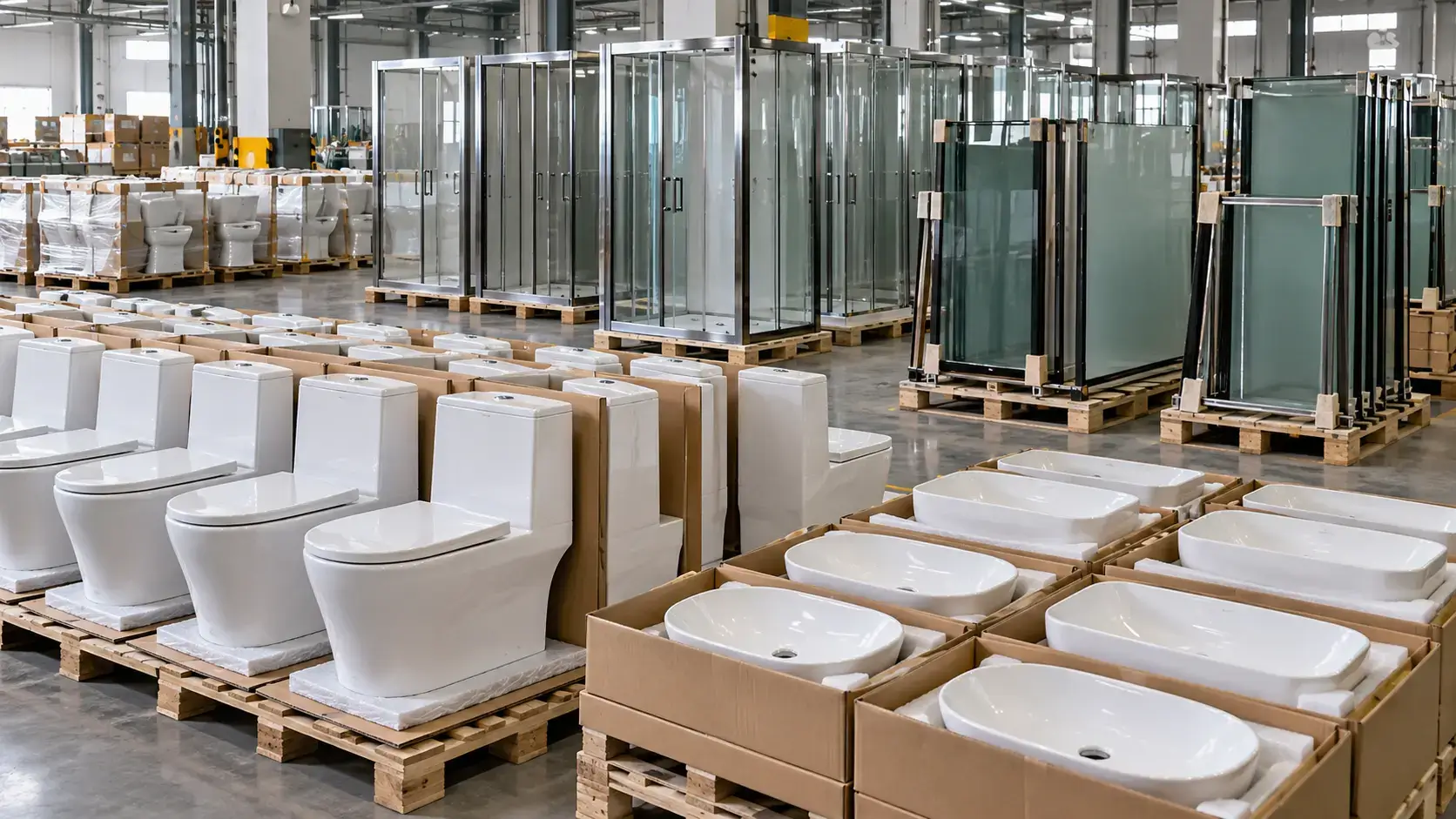
Connect shipment release to the scenario’s 15 rooms per week illustrative site-installation pace. At that planning rate, a zone covering 15 standard rooms would require 15 approved toilets, 15 washbasins and 15 complete enclosures—45 finished fixtures per zone. Ten such zones would account for the provisional 450-unit baseline, assuming no room-type exceptions, delays or spares. This is an example of a receiving and allocation schedule, not evidence of an achieved installation rate or an instruction to arrange one international shipment every week. The actual shipping batches must reflect factory completion, transit lead time, protected storage capacity and installation-zone readiness.
Release rule: Before a China-side batch leaves, reconcile the approved model list, inspection disposition, carton count, zone labels, packing list, shipment terms, and receiving appointment. On arrival, record carton condition and visible damage before distributing glass and ceramic fixtures to the corresponding rooms. When sourcing from multiple Chinese production sites, cargo consolidation guidance may inform coordination, but do not consolidate until the packing and traceability plan for both ceramics and enclosure glass has been approved.
Keep Warranty and Replacement Planning Within the Fixture Scope
Ask how a damaged ceramic toilet or basin will be replaced if the exact glaze batch is no longer available. For enclosures, record whether replacement glass can be ordered to the approved dimensions and what documentation will identify the original panel design. A warranty stating only its duration does not explain who pays for transport, how damage is documented, or whether replacement units will match the original finish.
For this project scenario, organize the handover file by T-01, B-01, and E-01 and link each finished-fixture model to approved room types. Include approved drawings, finish references, relevant test and inspection reports, packing and delivery records, warranty terms, and a replacement-order contact process. Keep any project spare percentage as a buyer-approved allowance, not a claimed universal industry standard. A room-by-room asset schedule makes later replacements easier to match to the installed product.
Project Conclusion: A Conditional Release, Not a Completed Case
For this modeled 150-room project, the buyer starts with a provisional 450-unit count and finishes with a clear approval sequence: (1) room-type and T-01/B-01/E-01 drawings reconciled, (2) China production locations and model-level evidence verified, (3) finished-fixture quotations normalized and approved, and (4) mock-up, inspection, packaging, and receiving gates closed. If any gate fails, hold the affected model or shipment lot and document the corrective action instead of treating the order as ready.
The illustrated $1,200 enclosure comparison is a conditional quotation difference, not proven savings. The 15-room-per-week and ten-zone schedule is a planning illustration, not an actual delivery result. The outcome of this scenario is an auditable go/hold decision for three defined bathroom fixture categories—not an invented customer success story or a generic guide to unrelated bathroom products.
Frequently Asked Questions
Which products are included in this bathroom fixtures project?
Only ceramic toilets, ceramic washbasins, and complete shower enclosures. Each must be quoted and approved as a finished fixture model with its stated dimensions, finish, and performance requirements. Other bathroom product categories are outside this article’s purchasing scope.
Does a 150-room hotel automatically need 450 fixtures?
No. That is an illustrative calculation based on one of each of the three categories in every standard room. The final quantity requires separate schedules for suites, accessible guestrooms, other room layouts, public spaces, and agreed spare inventory.
Can the same test report cover ceramics and shower enclosures?
No. Ceramic toilets and washbasins and glass shower enclosures have different product characteristics and relevant safety or performance requirements. Check evidence against the exact model, product category, applicable standard, and destination jurisdiction.
Should bulk production start after the catalog samples look acceptable?
Not until the critical dimensions, drawings, applicable evidence, room-type mock-up decisions, and quotation scope are approved. Appearance alone does not confirm correct installation or safe use.
What should a hotel buyer send to request a fixture quotation?
For this scenario, send controlled room-type drawings and three finished-fixture lines (T-01, B-01, E-01), each with its provisional 150-unit quantity, destination country, dimensions, finish, model-level evidence requirements, and expected receiving zones. Include applicable accessibility or enclosure-glass safety requirements. Ask bidders to itemize exclusions and provide model-specific documents.
Planning a Hotel Bathroom Fixtures Project?
Share your drawings, ceramic fixture schedule, shower enclosure requirements, quantities, and receiving plan for a defined China sourcing review.
Sources and Scenario Methodology
The 150-room hotel, T-01/B-01/E-01 example identifiers, three provisional 150-unit categories, four modeled decision points, two enclosure offers, the $1,200 comparison, and the 15-room-per-week schedule are constructed planning examples, not customer data. The U.S. compliance references below are included as an example of destination-specific review; they are not a universal certification checklist. Actual requirements depend on the jurisdiction, intended use, and product model. Published JS Sourcing service and blog pages are links for background, not evidence that this illustrative hotel project occurred.
- ASME — A112.19.2/CSA B45.1-2024, Ceramic Plumbing Fixtures
- U.S. EPA — WaterSense Toilets
- U.S. eCFR — 16 CFR § 1201.1, Architectural Glazing Materials (including shower doors and enclosures)
- ISO — Certification and Management Systems
- U.S. Access Board — ADA Chapter 6: Plumbing Elements and Facilities
- ISO — ISO 2859-1:2026, Sampling Procedures for Inspection by Attributes