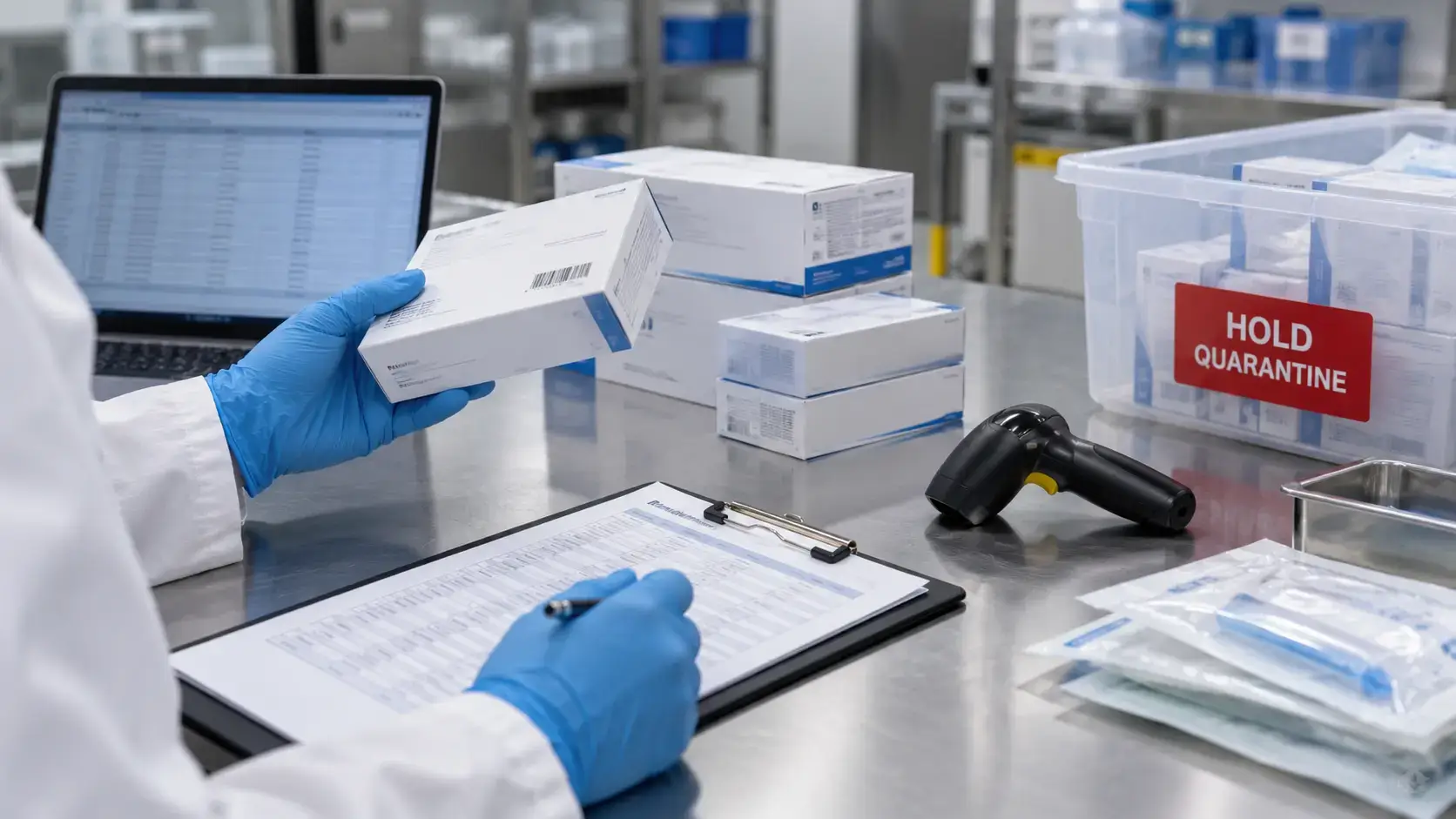
Take one real lot and trace it in both directions. You should be able to confirm the exact product, find the production and release records behind it, and account for every unit that was received or shipped. If 15,000 units came in, the stock, customer shipments, samples, returns, and disposal records should add back to 15,000. Different production, packaging, or sterilization numbers are fine as long as the records clearly show how they are connected.
Record the Product First
Start with a unit from the actual shipment. Copy the information from the label rather than relying on a supplier spreadsheet.
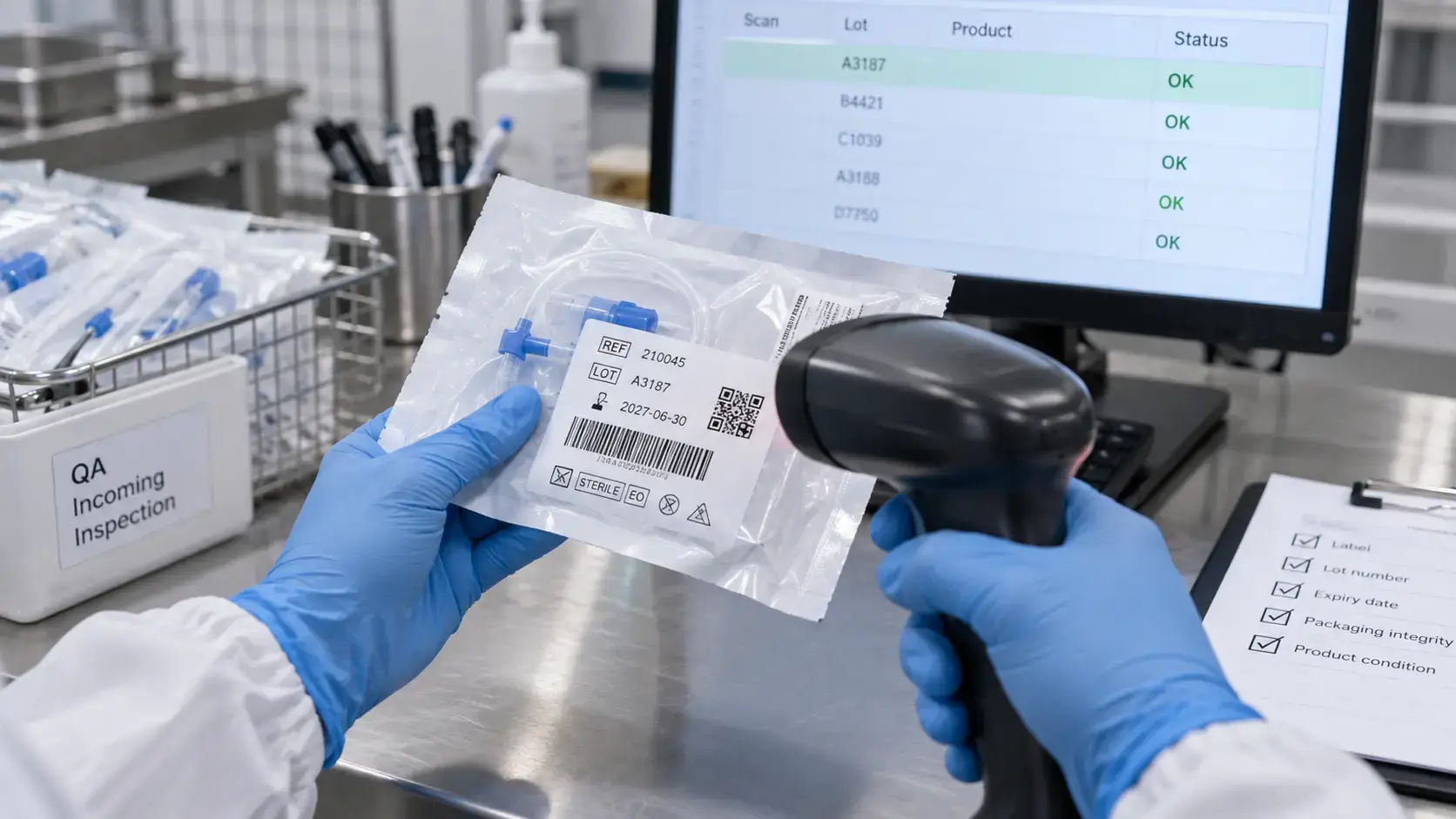
| Field | What to Record |
|---|---|
| Manufacturer | Legal manufacturer shown on the label |
| Product | Exact product name |
| REF/catalog number | Manufacturer’s item number |
| Lot/batch | Every character exactly as printed |
| Expiry | If shown |
| Manufacture date | If shown |
| UDI | If applicable |
| Pack size | Units per pouch, box, or case |
| Sterile status | Sterile or nonsterile |
| Supplier | Company that shipped the goods |
| PO | Your purchase order |
| Quantity | Quantity received from this lot |
Keep the lot number exactly as printed. Do not remove leading zeros, spaces, letters, hyphens, prefixes, or suffixes.
For example, 026A107 should not automatically become 26A107. Software sometimes removes a leading zero, but the two values could also refer to different lots. Check the manufacturer’s numbering format before changing the record.
Use More Than the Lot Number
A lot number is not always unique across an entire company.
| Product | REF | Lot |
|---|---|---|
| Examination Glove | GLV-100 | 240501 |
| Wound Dressing | DRS-220 | 240501 |
Both products use Lot 240501, but they are different products.
For a reliable search, use at least:
Manufacturer + Product REF + Lot
The manufacturing site may also matter. A supplier with several factories may use similar numbering across more than one site. A company’s production footprint can show which facilities exist, but the batch record still needs to identify the site that made the actual lot.
Ask the supplier whether its lot numbers are unique by product, factory, year, or across the whole company. Do not assume the lot number alone is enough.
Check the Packaging
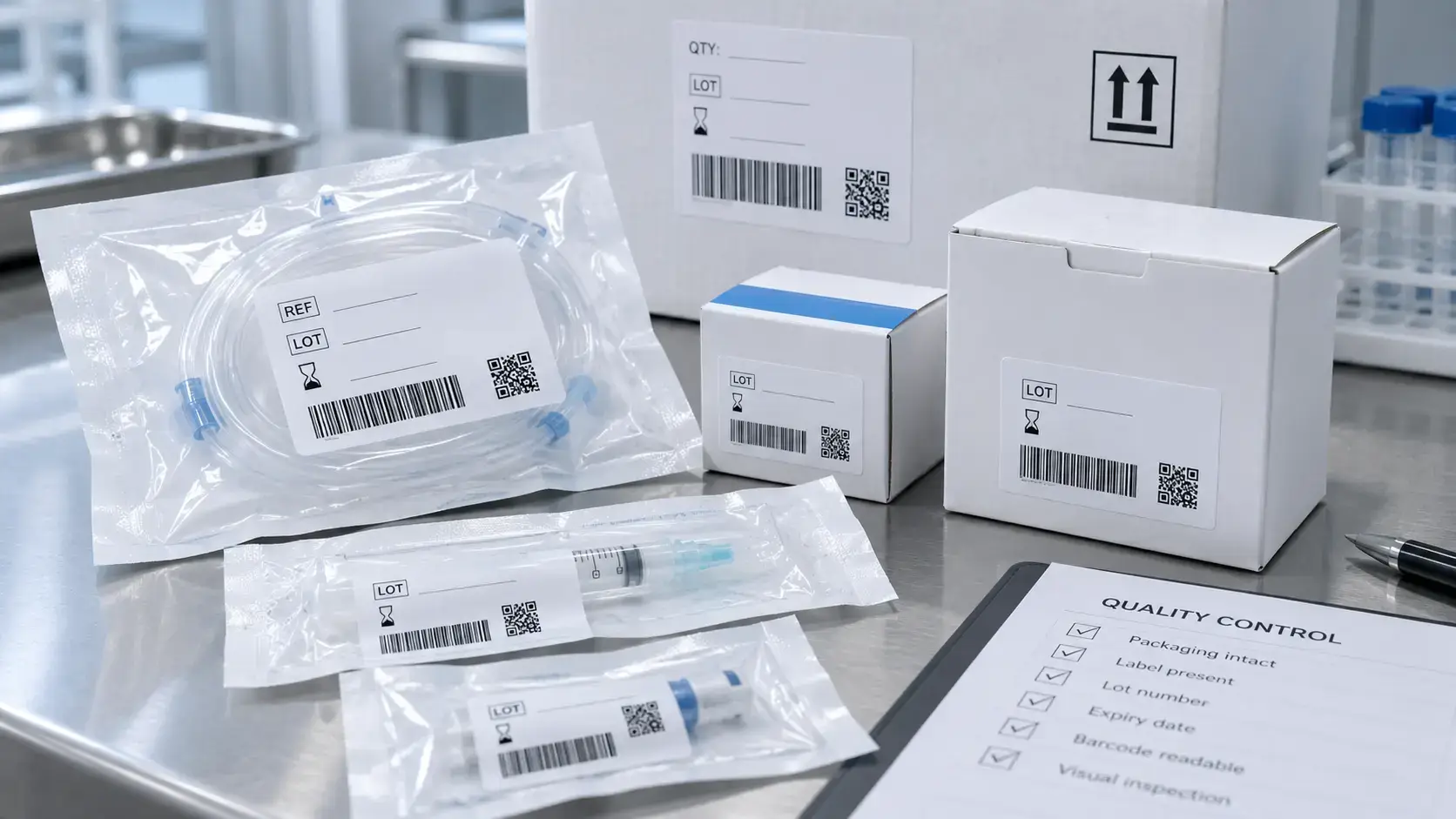
Look at the packaging that actually arrived.
Depending on the product, this may include:
- individual unit;
- sterile pouch;
- inner box;
- dispensing box;
- shipping carton;
- master case.
For example:
20 cases × 10 boxes per case × 50 units per box = 10,000 units
If the outer cases are discarded after receiving, check whether the packaging that remains still carries the identification required for that product and packaging level.
Look for:
- blurred lot numbers;
- missing characters;
- printing hidden by a fold or seal;
- labels coming loose;
- stickers covering original information;
- handwritten changes;
- different lot numbers on units that should belong to the same lot.
FDA labeling guidance states that device labels should remain in place and legible during normal storage, handling, distribution, and use.[1]
Match the Shipment Records
The receiving record should show exactly which lot arrived and how much of it was received.
| PO | Product | Lot | Quantity |
|---|---|---|---|
| PO-54187 | REF MED-210 | 260817A | 4,800 |
| PO-54187 | REF MED-210 | 260821B | 3,200 |
The order total is 8,000 units, but the record still shows that 4,800 came from Lot 260817A and 3,200 came from Lot 260821B.
A record that only says “Medical Consumables — 8,000 units” is not enough for lot-level control. If Lot 260817A later has a problem, you would not know how much of the shipment is affected.
The useful record chain is:
Receiving Record → Finished Lot → Production Record → Inspection → Release → Shipment
Do not stop because a packing list, CoC, and test report all show Lot A101. The same lot number may simply have been copied onto all three documents. A101 should also lead to the actual production and release records.
For any CoA, CoC, inspection report, or release record, check:
- the exact product;
- the exact lot;
- what was tested or inspected;
- the result;
- whether the result was reviewed;
- whether the lot was released.
A CoA is not automatically better than a CoC. Some products need lot-specific analytical results. Others rely more heavily on final inspection, process records, or batch release. The document should match the actual product and the checks required for it.
Connect Different Batch Numbers
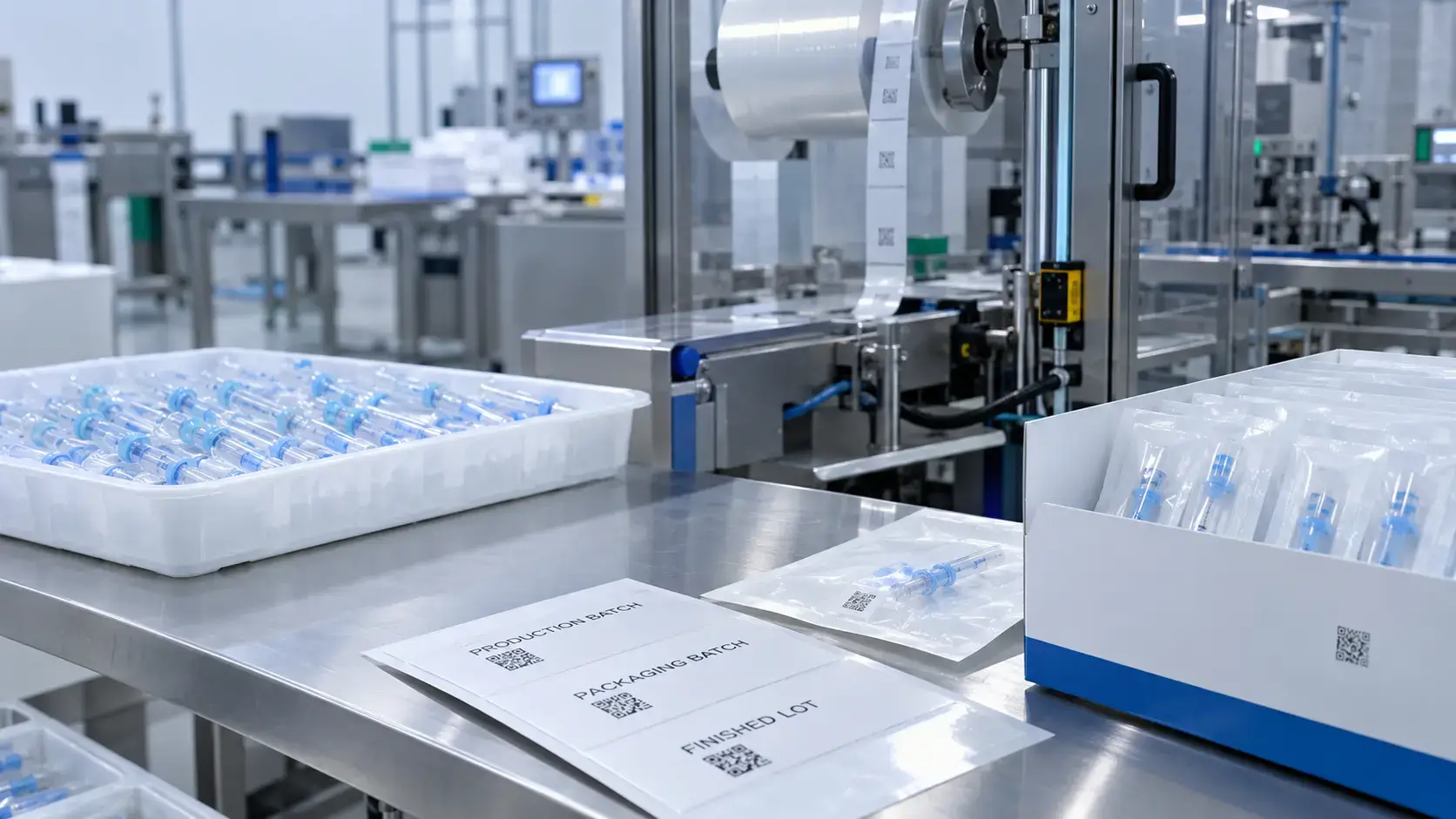
Different stages of production may use different numbers.
| Stage | Identifier |
|---|---|
| Manufacturing batch | B240701 |
| Packaging batch | P240706 |
| Finished lot | L240707 |
| Sterilization load | EO240709-03 |
The numbers do not need to be identical.
The records should show a clear link:
L240707 → P240706 → B240701 → EO240709-03
The problem is not that the numbers are different. The problem is when the supplier cannot show how one number leads to the next.
Scan the Barcode
If the package has a barcode or 2D code, scan it and compare the decoded information with the printed label.
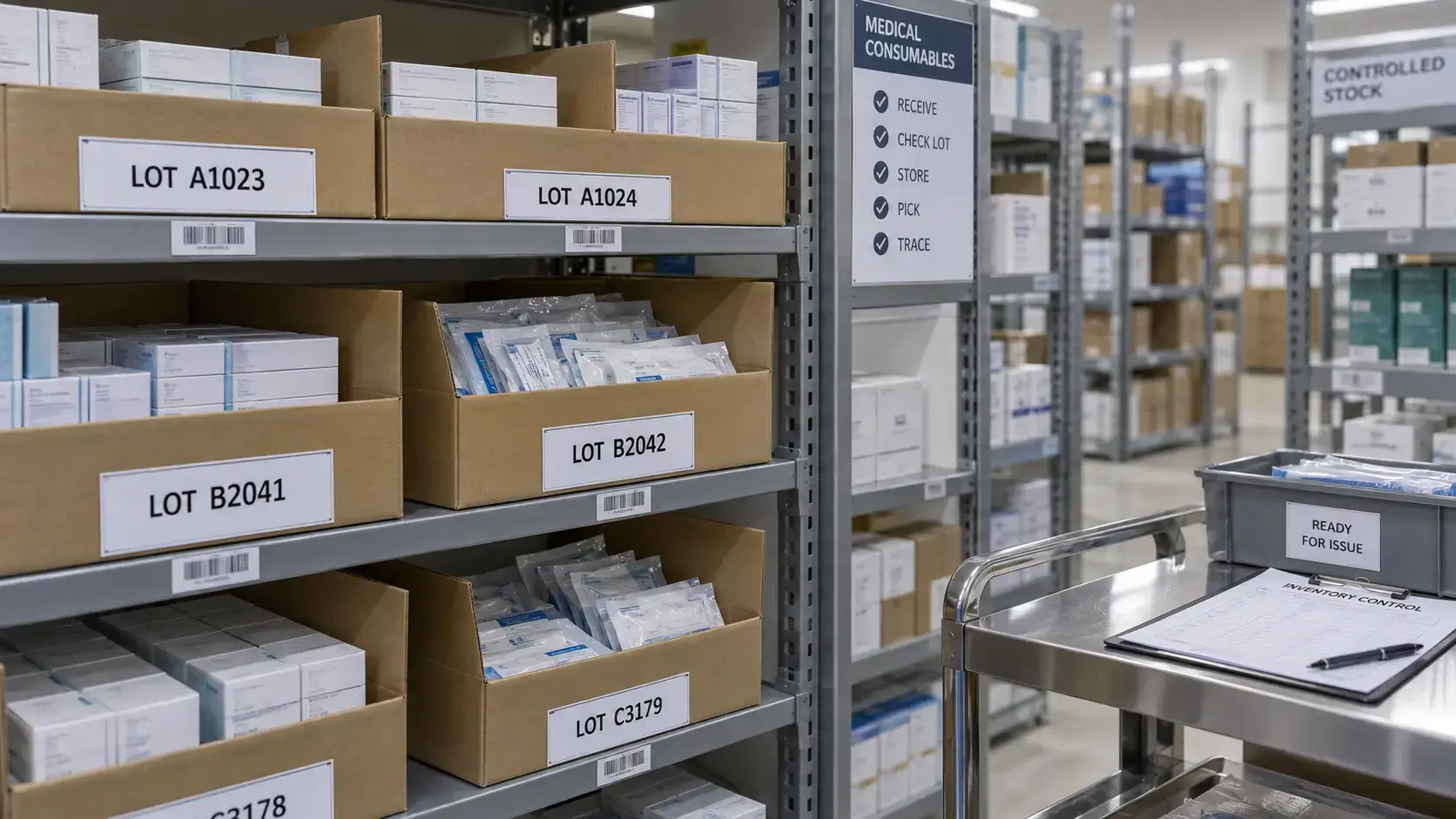
For GS1-based identification, common Application Identifiers include:
| GS1 AI | Meaning |
|---|---|
| (01) | GTIN |
| (10) | Lot or batch |
| (11) | Manufacturing date |
| (17) | Expiration date |
| (21) | Serial number |
GS1 uses these identifiers in healthcare identification systems.[2]
Example:
Printed label
- LOT A26108
- EXP 2029-08-31
Decoded barcode
- LOT A26108
- EXP 2029-08-31
The values match.
If the printed label says A26108 but the barcode returns A26180, do not choose the number that looks more likely. Put the affected stock on hold under your quality procedure and check the manufacturer’s controlled record.
Common causes include:
- wrong print data;
- wrong label roll;
- mixed labels;
- rework mistakes;
- barcode setup errors.
If the code does not scan at all, try another compatible scanner and check the print quality, damage, barcode type, and software before deciding that the label is wrong.
UDI and Lot Numbers
A UDI and a lot number are related, but they are not the same thing.
FDA divides a UDI into:
- Device Identifier (DI): identifies the labeler and the specific device version or model;
- Production Identifier (PI): can include the lot or batch number, serial number, expiration date, or manufacturing date when those values appear on the label.[3]
The DI tells you which device you are looking at. The PI helps identify which production group the unit came from.
FDA’s GUDID contains the DI but does not store the actual PI values for individual manufactured lots.[4]
Finding the product in AccessGUDID therefore does not prove that Lot A26108 is a valid production lot. The actual lot still needs to be checked against manufacturer records.
The EU system also separates UDI-DI and UDI-PI. The European Commission describes UDI as a tool for better device identification, traceability, and recall handling.[5]
If there is no UDI on the package, first check whether UDI requirements apply to that product and packaging level.
Trace Back to Production
A finished lot should open the records used to make and release it.
Finished lot: SG260817B
Packing run: PK260817-04
Production batch: PR260816-02
Material lot: RM260730-11
Inspection: IPQC-260816-02
Release: QA-260818-07
| Record | What to Check |
|---|---|
| Work order | Product and planned quantity |
| Production date | When it was made |
| Equipment | Line or machine where relevant |
| Critical materials | Actual material lots used |
| In-process inspection | Results during production |
| Nonconformance | Problems recorded during the batch |
| Rework | Units corrected or processed again |
| Final inspection | Finished-product results |
| Release | Approved quantity and release status |
Suppose the batch record shows:
- 20,000 units produced;
- 1,200 units placed on hold;
- 900 units reworked and passed reinspection;
- 300 units scrapped;
- 19,700 units released.
The released quantity is 19,700, not 20,000.
For medical consumables, the important upstream lots depend on the product. They may include patient-contact polymers, adhesives, tubing, needles, filters, reagents, coatings, or sterile-barrier materials.
Trace Split and Combined Lots
One production batch may be divided into several finished lots.
Bulk Batch B001 — 30,000 units
| Finished Lot | Quantity |
|---|---|
| L001-A | 10,000 |
| L001-B | 10,000 |
| L001-C | 10,000 |
If B001 later has a confirmed problem, the records should immediately show all three finished lots made from it.
The opposite can happen too. One finished lot may contain parts from several upstream lots.
Finished Syringe Lot F100 — 8,000 units
- Barrel Lot B21
- Plunger Lot P31
- Needle Lot N18
Suppose Needle Lot N18 was used in:
| Finished Lot | Quantity |
|---|---|
| F100 | 8,000 |
| F101 | 6,000 |
| F102 | 5,000 |
| F103 | 7,000 |
The first group to investigate is therefore 26,000 finished units. The investigation may later reduce that number if the records show that only part of the material or production period was affected.
The records should work both ways:
Finished Lot → Component Lots
Component Lot → Finished Lots
Check the Released Quantity
Traceability does not prove that a product passed its quality checks.
For example:
- 10,000 units produced;
- 240 fail a required dimensional check;
- 9,760 meet the release requirements.
Knowing where all 10,000 units came from does not make the 240 failed units acceptable.
Depending on the product, release records may include:
- final inspection;
- dimensional results;
- functional testing;
- material checks;
- packaging inspection;
- sterilization review;
- lot-specific analytical results.
Company-level certificates are also different from lot-level evidence. Certifications shown on a supplier’s certifications page can help with supplier qualification, but they do not show whether one specific lot passed its own inspection and release checks.
Trace Forward to Customers
The finished lot should also lead to every place it was sent.
| Location | Quantity |
|---|---|
| Main warehouse | 2,200 |
| Customer A | 3,000 |
| Customer B | 2,500 |
| Customer C | 1,800 |
| Samples | 300 |
| Scrapped | 200 |
| Total | 10,000 |
If the sales system only says “7,300 units of MED-210 sold,” but cannot show which customers received this lot, the forward trace is incomplete.
For EU medical devices, MDR Article 25 requires relevant economic operators to be able to identify direct suppliers and direct recipients in the supply chain.[6]
IVDs are covered separately by the IVDR. Article 22 contains the corresponding supply-chain identification requirement.[7]
Reconcile Every Unit
Use one base unit and make sure the numbers add up.
Received = Stock + Shipped + Samples + Returns/Adjustments + Scrap or Disposal
Example:
- Received: 12,000;
- Current stock: 4,150;
- Shipped: 7,600;
- Samples: 150;
- Damaged/disposed: 100.
4,150 + 7,600 + 150 + 100 = 12,000
Unexplained quantity: 0.
If the records only add up to 11,920, there are still 80 units to find.
Common causes include:
- receiving errors;
- samples that were never entered;
- picking errors;
- warehouse transfers;
- damage or disposal;
- returns;
- mixed lots;
- manual inventory changes.
Keep the unit of measure consistent.
1 case = 20 boxes
1 box = 50 pieces
12 cases = 12,000 pieces
If purchasing records use cases, warehouse records use boxes, and sales records use pieces, convert everything to the same unit before comparing totals.
Keep Mixed Lots Separate
| Lot | Quantity |
|---|---|
| A26071 | 3,200 |
| A26072 | 1,800 |
| Total | 5,000 |
If one customer receives all 5,000 units, the shipping record should still show the 3,200 + 1,800 lot split.
The same issue appears when one lot runs out while an order is being picked.
- Lot A remaining: 2,000;
- Lot B remaining: 2,000;
- Customer order: 2,500.
The shipment may contain:
- Lot A — 2,000;
- Lot B — 500.
If the shipping record only says “MED-210 — 2,500 units,” the lot-level shipment history has been lost.
Keep the Original Lot on Returns
Returned goods should keep the manufacturer’s original lot number.
Record:
- product REF;
- manufacturer lot;
- quantity;
- customer;
- return date;
- return reason;
- package condition;
- storage status;
- final disposition.
Example:
RMA-260811 → REF MED-210 → Lot A2601 → 120 units
If 120 units were returned but only 100 are physically present, the other 20 still need to be explained.
The RMA number tracks the return transaction. It should not replace the manufacturer’s lot.
For sterile products, also check whether the package was opened or damaged and whether the storage conditions after shipment are known.
Resolve Expiry Date Conflicts
Check any case where the same finished lot shows different dates.
- two expiry dates on the same lot;
- barcode expiry different from printed expiry;
- manufacture date that does not fit the stated shelf life;
- new expiry label covering an earlier date;
- expiry extension with no supporting record.
Example:
- Lot: A2601;
- Manufacture date: 2026-03;
- Box 1 expiry: 2029-03;
- Box 2 expiry: 2030-03.
Do not simply choose one date. The supplier should have a controlled record explaining why the same finished lot carries two expiry dates.
Not every general medical device requires shelf-life dating simply because it is a medical device. FDA notes that shelf-life dating solely for package integrity and sterility is not usually required for general medical devices, while products with finite-life components and IVDs may have specific dating needs.[8]
If the Lot Number Is Missing
Before deciding that the label is wrong, check:
- whether a serial number is used instead;
- whether another production identifier is used;
- whether the lot appears on another packaging level;
- whether an applicable exception or alternative applies;
- whether required information was left off the label.
Do not use a purchase order as a replacement manufacturing lot.
PO-71208 — 6,000 units
If those 6,000 units actually came from three manufacturer lots of 2,000 units each, PO-71208 cannot tell you which production batch an individual unit came from.
If an identifier that should be present cannot be found, put the affected stock on hold under your procedure and get a documented answer from the supplier or manufacturer.
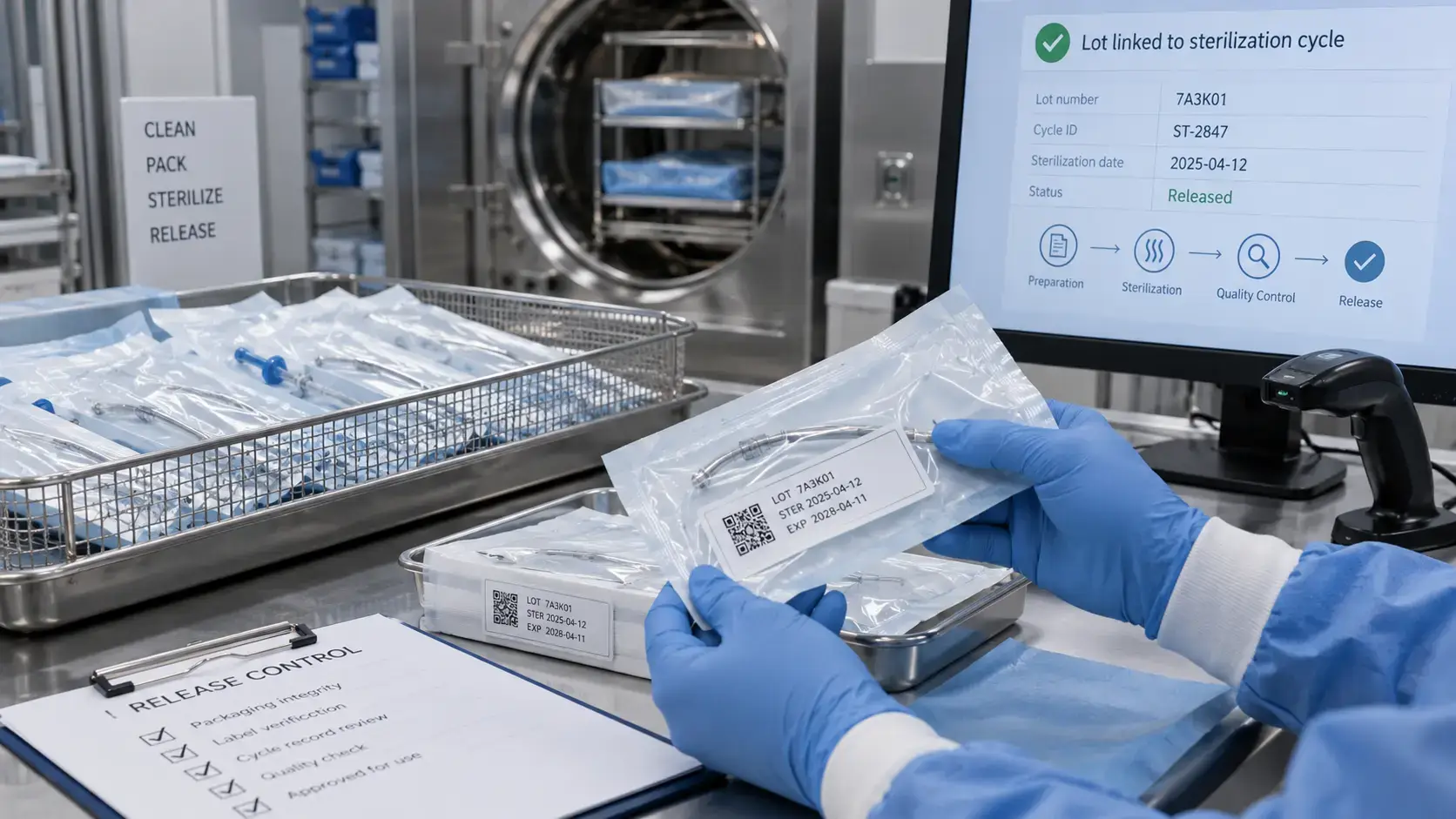
Link Sterile Lots to Sterilization
For sterile consumables, the finished lot should connect to the relevant sterilization record.
Finished Lot ST260817 → Sterilization Load EO260820-03 → Review → Release QA260825
Suppose the load contains:
| Finished Lot | Quantity |
|---|---|
| ST260817 | 8,000 |
| ST260818 | 6,000 |
| ST260819 | 4,000 |
| Total | 18,000 |
If the sterilization load later becomes part of an investigation, all three finished lots should be easy to identify.
Check:
- which finished lots were included;
- sterilization date;
- sterilization provider;
- processing reference;
- release status;
- related packaging records;
- recorded deviations.
If an outside company performs the sterilization, the manufacturer still needs a record linking its finished lot to the outside provider’s processing record.
Trace IVD Components
For IVD products in the U.S., 21 CFR 809.10 requires a lot or control number that allows the complete manufacturing history to be determined. For multiple-unit products, the control must also allow the individual units to be traced.[9]
Depending on the product, the trace may include:
- reagent lots;
- control lots;
- calibrator lots;
- strip lots;
- collection-device lots;
- expiry dates;
- storage conditions;
- release results.
Example:
Kit K26041 — 5,000 kits
- Reagent R26018
- Control C26011
- Strip S26037
If Reagent R26018 was also used in K26042 and K26047, the manufacturer should be able to find all three finished kit lots by searching R26018.
Preserve the Lot After Repacking
A distributor can add its own SKU or lot number, but the original manufacturer information should still be recoverable.
Distributor SKU MED-4418 → Manufacturer REF 72018 → Manufacturer Lot B26072
Suppose the distributor creates:
Distributor Lot D8821 — 4,000 units
and the lot contains:
- Manufacturer Lot M260801 — 2,500;
- Manufacturer Lot M260802 — 1,500.
The 2,500/1,500 split should stay in the records.
Creating a distributor lot is not the problem. Losing the original manufacturer lot is.
Test the Supplier With Real Lots
Do not let the supplier prove traceability using only a lot prepared in advance.
A simple audit can use:
- one recent lot still in stock;
- one older lot already shipped.
For both, ask for the production, inspection, release, and shipment records. The recent lot shows whether the current system works. The older lot shows whether historical records can still be found.
Be cautious if the answer depends on one employee’s memory, personal spreadsheets, email searches, chat messages, or files stored on one computer.
FDA’s Quality Management System Regulation became effective on February 2, 2026 and incorporates ISO 13485:2016 by reference into FDA’s medical-device quality-system framework for finished-device manufacturers within its scope.[10]
Check Old Records and Corrections
Try the same trace on an older lot that is still within the required retention period.
For example, compare:
- one lot made last month;
- one lot made 12 months earlier.
The 12-month gap is only an audit example, not a general retention rule.
Try to retrieve:
- production history;
- inspection records;
- release records;
- critical material lots;
- shipment history;
- customer records where applicable.
Also check one corrected lot record.
If:
A26051 → A26052
the record should show:
- who made the change;
- when it was changed;
- what was changed;
- why it was changed;
- who approved it when approval was required.
If 250 labels were printed with the wrong lot number, the correction record should also show what happened to all 250 labels.
Run a Mock Recall
Choose one distributed lot and account for it as if a real problem had just been reported.
Lot R2608 — 15,000 units received
| Location or Status | Quantity |
|---|---|
| Warehouse | 4,250 |
| Customer A | 4,000 |
| Customer B | 3,200 |
| Customer C | 2,700 |
| Samples | 300 |
| Scrapped | 550 |
| Total | 15,000 |
Unexplained quantity: 0.
| Check | What You Need to Know |
|---|---|
| Scope | Which product and lot are affected? |
| Quantity | Can the full quantity be explained? |
| Location | Does physical stock match the system? |
| Distribution | Which customers received the lot? |
If the system says 1,000 units are in Warehouse Zone B, physically check that Zone B contains the stated lot.
FDA correction and removal requirements show why lot-level records matter. Applicable reports can include model or catalog numbers, lot or serial numbers, device quantities, manufacturing or distribution dates, and consignee information.[11]
Do not use a made-up rule such as “every mock recall must finish in two hours.” Compare the actual time with your own procedure, contracts, product risk, and applicable requirements.
Use Complaints to Check the Lot
| Customer | Lot | Complaint |
|---|---|---|
| A | A210 | Open package seal |
| B | A210 | Weak package seal |
| C | A210 | Seal separation |
For Lot A210, pull the production date, packaging line, packaging-material lot, seal inspection results, recorded problems, rework records, and customer shipment history.
You can also check nearby lots that used the same packaging material or equipment. This gives the investigation a sensible starting point without assuming that every nearby lot is affected.
Serious Traceability Gaps
- finished lot cannot be linked to production;
- supplier cannot identify where an affected lot was shipped;
- critical component lot cannot be linked to finished lots;
- sterile lot cannot be linked to the relevant sterilization record;
- barcode and printed lot conflict with no documented explanation;
- mixed lots were shipped without lot-level quantities;
- repacking removed the original manufacturer lot;
- inventory cannot be reconciled;
- historical records cannot be found when they should still exist;
- critical lot information can be changed without leaving a record.
A different internal number is not automatically a problem. Distributor Lot D8821 and Manufacturer Lot M260801 can both be valid when the records clearly link them.
Lot Traceability Checklist
| Check | Pass Condition |
|---|---|
| Product identity | Manufacturer, REF, and product match |
| Lot | Recorded exactly |
| Packaging | Required identification remains readable |
| Barcode | Decoded data match printed data |
| UDI | Correct where applicable |
| Receiving | Lot and quantity are recorded |
| Production | Finished lot links to manufacturing records |
| Materials | Critical upstream lots can be found |
| Inspection | Results are linked to the lot |
| Rework | Affected quantity and reinspection are recorded |
| Release | Released quantity is known |
| Sterilization | Linked where applicable |
| Warehouse | Quantity and location are known |
| Shipment | Customer lot history is available |
| Mixed lots | Lot quantities remain separate |
| Returns | Manufacturer lot remains identifiable |
| Reconciliation | 100% of the lot is accounted for |
| Historical records | Records remain available as required |
| Changes | Important changes leave a clear history |
| Mock recall | Scope, quantity, location, and customers can be identified |
FAQ
Can two medical products have the same lot number?
Yes. Some manufacturers only make the lot number unique within one product, factory, or period. Use the manufacturer, product REF, and lot together rather than relying on the lot number alone.
Can the production batch and finished lot have different numbers?
Yes. Manufacturing, packaging, sterilization, and finished-product records can use different identifiers. The supplier should be able to show how the numbers are linked.
Can one lot be shipped to several customers?
Yes. If 10,000 units are divided among four customers, record how many units each customer received and how much is still in stock. After samples, returns, and disposal are included, the numbers should still add back to 10,000.
Can a distributor create its own lot number?
Yes, as long as the original manufacturer lot can still be found. If the distributor’s number replaces the original lot and there is no cross-reference, the upstream trace is broken.
Does full lot traceability prove the product is safe?
No. Traceability shows how the product was made and where it went. Sterility, materials, dimensions, function, packaging, and other requirements still need separate inspection, testing, and release evidence.
Finally
A good lot trace should close without guessing. If 15,000 units were received, the stock, customer shipments, samples, returns, and disposal records should explain all 15,000. The finished lot should lead back to the production batch, critical materials, inspection, rework, and release records, and forward to every customer that received it. Different production or sterilization numbers are acceptable when the records clearly connect them. Stop and investigate when quantities do not add up, production records are missing, the original manufacturer lot has been lost, or a shipment cannot show which lot was sent.