When comparing PIR and PUR sandwich panel suppliers, make sure everyone is quoting the same thing first. Core type, thickness, steel facings, coating, thermal data, fire reports, joints, structural data, factory QC, delivery, packing, and warranty all need to line up. If a supplier cannot meet a required fire, thermal, structural, or compliance condition, there is no point comparing its price with the others.
RFQ Data to Send
| Item | What to Specify |
|---|---|
| Application | Wall, roof, ceiling, cold room, clean room, warehouse |
| Core | PIR or PUR if already fixed |
| Thickness | Required thickness or project U-value |
| Outer steel | Thickness, grade where required, coating |
| Inner steel | Thickness, grade where required, coating |
| Effective width | Installed cover width, not only physical width |
| Length | Exact project lengths or cutting schedule |
| Joint | Concealed, exposed, tongue-and-groove, roof overlap |
| Thermal | Required conductivity or U-value |
| Fire | Required classification, approval, or test standard |
| Structural | Wind, span, roof/wall use, support arrangement |
| Accessories | Flashings, screws, washers, sealants, closures |
| Commercial | Quantity, destination, Incoterm, delivery date |
You may see common options such as 50, 75–80, 100, 120–125, 150, or 200 mm cores, effective widths around 1,000–1,200 mm, and steel facings such as 0.40, 0.50, or 0.60 mm. These are only common product examples. They are not fixed industry requirements.
A proper RFQ could look like this:
100 mm PIR wall panel, 0.50 mm outer steel, 0.40 mm inner steel, specified pre-painted metallic-coated steel, 1,000 mm effective width, concealed joint, project-required thermal and fire documentation, FOB quotation.
Ask every supplier to write down any change from your RFQ. If you ask for 0.50 mm steel and the factory wants to quote 0.45 mm, that needs to be shown clearly instead of being buried in a technical sheet.
The same rule applies when comparing Chinese suppliers for other manufactured products: send the same requirement to everyone before you compare price.
Mandatory Pass/Fail Check
| Requirement | Decision |
|---|---|
| Required fire performance | Pass / Fail |
| Required thermal performance | Pass / Fail |
| Required structural performance | Pass / Fail |
| Required PIR or PUR core | Pass / Fail if fixed by project |
| Required market documents | Pass / Fail |
| Required panel dimensions | Pass / Approved deviation |
| Required steel and coating | Pass / Approved deviation |
| Required delivery date | Pass / Fail if schedule is fixed |
Price comes later. If the project requires a certain fire result and the supplier cannot meet it, a lower price does not fix that problem.
Only compare commercial terms after the basic technical requirements have passed.
PIR or PUR Decision
If the project already specifies PIR, compare PIR suppliers. If it specifies PUR, compare PUR suppliers. Do not switch from one to the other just because one quotation is cheaper.
If the core has not been decided yet, look at what the project actually needs:
- Fire performance
- Thermal performance
- Service temperature
- Project approval requirements
- Insurance requirements
- Total installed cost
PIR is often used where better fire behavior is needed, but “PIR” by itself is not a fire rating. Both PUR and PIR are combustible insulation materials. What matters is how the complete panel system has been tested and approved.[1]
Market Compliance Documents
The documents you need depend on where the panels will be used.
For EU projects, check:
- Applicable harmonised technical specification
- Required declared characteristics
- Applicable declaration documents
- CE marking requirements
- Project-specific fire and structural requirements
- National building rules
Harmonised European standards provide the common technical basis used to assess and declare construction-product performance.[2]
The EU Construction Products Regulation is now in a transition period under Regulation (EU) 2024/3110. Most provisions started applying from 8 January 2026, while parts of the earlier CPR framework still apply during the transition.[3]
So “CE available” is not enough. Ask which technical specification applies, which declaration is being supplied, and whether those documents cover the exact panel in your order.
Fire Report Match Check
| Report Item | What Must Match or Be Covered |
|---|---|
| Manufacturer | Actual factory or approved manufacturer |
| Core | PIR or PUR quoted |
| Thickness | Quoted thickness or permitted range |
| Steel facing | Relevant facing construction |
| Joint | Same joint or covered variation |
| Orientation | Horizontal / vertical where relevant |
| Fixing | Same or permitted fixing arrangement |
| Standard | Required project standard |
| Classification | Required project result |
| Application scope | Your configuration must fall within it |
Here is a simple example:
| Fire Report | Your Order |
|---|---|
| 100 mm PIR | 80 mm PIR |
| Vertical wall | Horizontal wall |
| Joint A | Joint B |
| Facing X | Facing Y |
The report may be genuine, but it may not cover what you are buying.
Reaction-to-fire results can depend on the panel form, fixing, joints, mounting method, and orientation. UK government guidance warns against using one classification for different product configurations without checking the permitted field of application.[4]
For the buyer, the question is simple: does this report actually cover my panel?
Fire Label Check
| Term | What It Tells You |
|---|---|
| Reaction to fire | How the product contributes to fire under the relevant test system |
| Flame spread | How flame travels across a tested surface |
| Smoke | Smoke behavior under the test |
| Flaming droplets | Whether flaming particles or droplets occur |
| Fire resistance | Performance of an assembly over a stated period under the relevant test |
The European reaction-to-fire system includes classes A1, A2, B, C, D, E, and F, with extra smoke and flaming-droplet classes where they apply.[5]
A result such as B-s1,d0 is a reaction-to-fire classification. It is not the same as saying a wall has a certain fire-resistance time.
ASTM E84 is another test buyers often misunderstand. It reports flame-spread and smoke-developed indices under the test conditions. ASTM also states that the flame-spread index alone cannot be used to call a material noncombustible.[6]
When two suppliers show different fire labels, compare them in this order:
standard → result → tested panel → permitted application
Thermal Data Check
| Data | What to Ask For |
|---|---|
| Thermal conductivity | Declared value and test/calculation basis |
| Reference temperature | Condition used for the declared value |
| Panel thickness | Exact thickness linked to the value |
| U-value | Finished panel value where applicable |
| Value type | Foam-only or complete-panel value |
For example:
| Project Requirement | Supplier A | Supplier B |
|---|---|---|
| Maximum U-value: 0.25 W/m²·K | 0.23 W/m²·K | 0.27 W/m²·K |
| Result | Pass | Fail |
This comparison only works if both suppliers use the same agreed calculation basis.
Do not put one supplier’s fresh foam test value next to another supplier’s declared finished-panel value and treat them as equal data.
Steel Facing Check
| Item | Supplier A | Supplier B |
|---|---|---|
| Core | 100 mm PIR | 100 mm PIR |
| Outer steel | 0.50 mm | 0.40 mm |
| Inner steel | 0.50 mm | 0.40 mm |
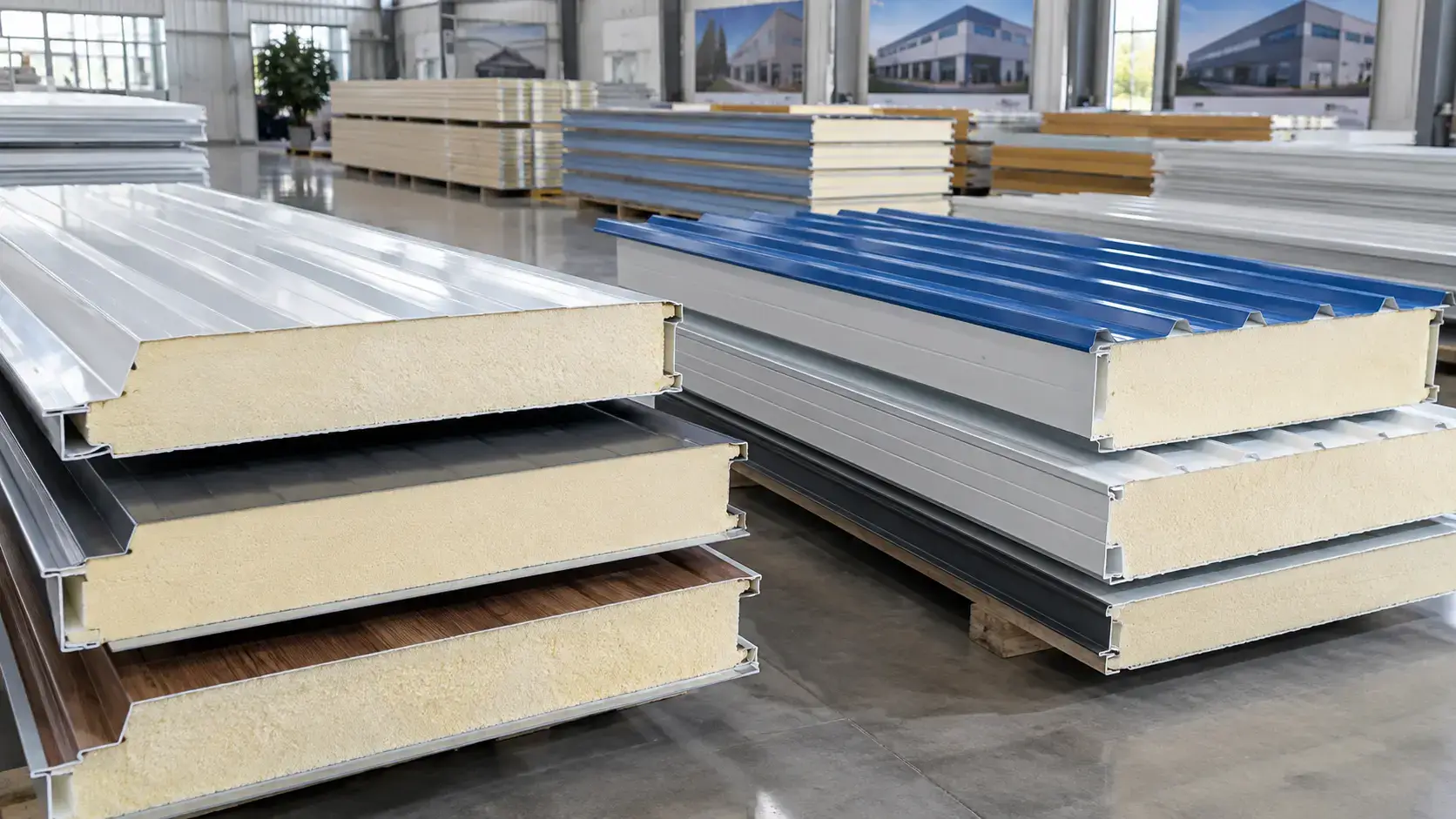
Both suppliers can call this a “100 mm PIR panel,” but the products are not the same.
For the steel facings, check:
- Outer base metal thickness
- Inner base metal thickness
- Thickness tolerance
- Steel grade or strength where required
- Metallic coating
- Paint system
- Paint thickness where specified
Also ask whether “0.50 mm” means the base metal thickness or the total thickness after coating.
On a 10,000 m² order, changing both facings from 0.50 mm to 0.40 mm can lower the quotation because less steel is being supplied. That is a different specification, not simply a cheaper price for the same panel.
Coating Check
| Site | What to Check |
|---|---|
| Dry warehouse | General corrosion resistance |
| Coastal site | Salt exposure |
| Food plant | Humidity, washing, cleaning chemicals |
| Cold room | Condensation and internal surface durability |
| Chemical plant | Chemical compatibility |
| Exterior roof | UV, rain, corrosion, temperature cycling |
Ask the supplier to state the metallic coating, paint system, coating thickness where relevant, and the environments it is meant for.
Then read the warranty exclusions. Coastal exposure, chemicals, cleaning methods, and maintenance can all affect what the coating warranty actually covers.
Core QC Check
If density is part of the PO, write both the nominal value and the tolerance into the specification.
Example:
| Requirement | Measured Value | Result |
|---|---|---|
| 40 kg/m³ ±2 kg/m³ | 39 kg/m³ | Pass |
| 40 kg/m³ ±2 kg/m³ | 36 kg/m³ | Fail |
The ±2 kg/m³ tolerance here is only an example of an agreed purchase requirement. It is not a universal PIR or PUR tolerance.
Depending on the product and project, core data may also include:
- Thermal conductivity
- Compressive strength
- Shear strength
- Tensile properties
- Dimensional stability
- Closed-cell content
ASTM E1730 is a useful example. Within its specific scope for PUR/PIR structural sandwich-panel cores used in shelter construction, it covers more than density, including thermal conductivity, compressive strength, shear strength, closed-cell content, and dimensional stability.[7]
Joint and Bonding Check
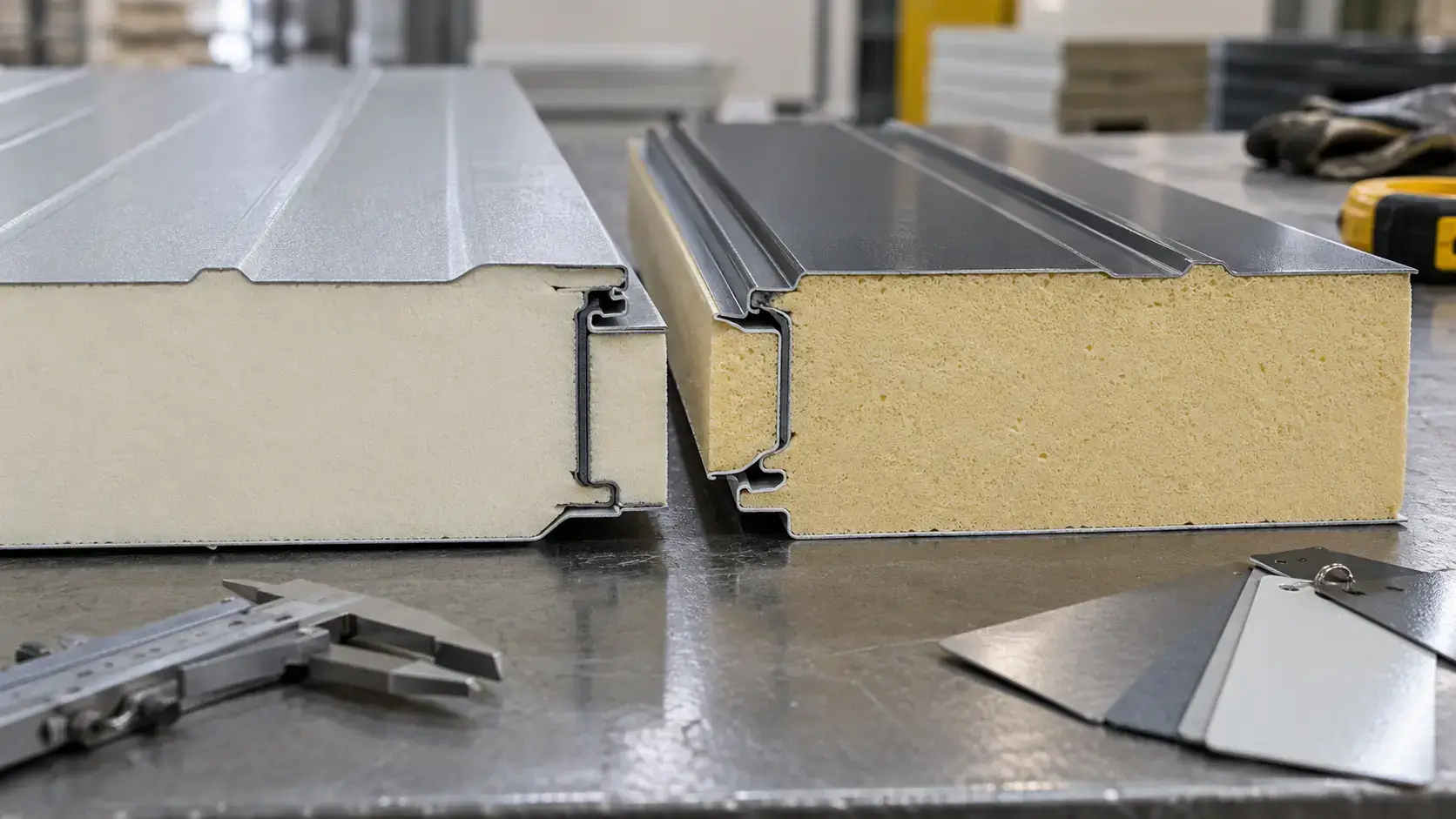
Ask for a panel cross-section before ordering. It should show:
- Tongue and groove
- Main seal
- Fastener position
- Roof overlap where used
- Water path
- Thermal bridge
- Allowed installation gap
On finished panels, look for:
- Loose steel skins
- Delamination
- Blistering
- Foam voids
- Damaged tongues
- Uneven grooves
- Open edge bonding
For cold rooms, the seals around corners, floors, ceilings, doors, pipes, and cable openings matter just as much as the main panel joint.
For roofs, also check side laps, end laps where used, ridge details, eaves, and roof penetrations.
Dimensional Check
Do not wait until inspection day to argue about tolerances. Put them in the PO first.
Example:
| Item | Agreed Requirement | Measured | Decision |
|---|---|---|---|
| Panel thickness | 100 mm ±2 mm | 99 mm | Pass |
| Panel thickness | 100 mm ±2 mm | 96 mm | Fail |
| Outer steel | 0.50 mm BMT | Measure by agreed method | Verify |
| Inner steel | 0.40 mm BMT | Measure by agreed method | Verify |
| Length | Drawing requirement | Measure sample | Compare with PO |
The ±2 mm panel tolerance shown here is only an example. Use the applicable standard or the tolerance agreed in the purchase specification.
Cold-Room Check
- Air seal around every joint
- Vapor seal continuity
- Wall-to-floor connection
- Wall-to-ceiling connection
- Door frame detail
- Pipe and cable penetrations
- Internal surface coating
- Condensation risk
- Ceiling support design
Do not assume a cold-room ceiling can carry workers, pipes, cables, or other loads unless the design says it can.
The UK Health and Safety Executive reported a fatal cold-store ceiling failure involving insulated polyurethane sandwich panels and their supports. The alert points to support failure, corrosion, fatigue, and maintenance as issues that need proper engineering checks.[8]
Structural Data Check
Ask for the load-span table for the exact panel you are buying.
| Data | What to Confirm |
|---|---|
| Panel type | Roof or wall |
| Span | Single or multi-span |
| Steel | Same thickness and grade as quote |
| Load | Pressure and suction where relevant |
| Supports | Same arrangement as project |
| Deflection | Limit used in the table |
| Fixings | Quantity, type, and arrangement |
A brochure saying “maximum span 6 m” tells you very little on its own. That 6 m figure only makes sense together with the load, fixing, support, steel, and panel conditions used to produce it.
Final structural selection should be checked by the project engineer.

Factory QC Check
During a supplier audit, check whether the factory actually records and controls:
- Incoming steel
- Foam chemical batches
- Panel dimensions
- Density where specified
- Joint dimensions
- Bonding
- Surface defects
- Production settings

For each item, ask:
- How often is it checked?
- Who signs the record?
- What measuring tool is used?
- When was it last calibrated where calibration is required?
- What happens if the result is outside the limit?
For example, if five thickness checks in a row are outside tolerance, the factory should be able to show which panels were affected, what was adjusted, what was rechecked, and what happened to the suspect panels.
ISO 9001 can show that a company has a documented quality-management system. It does not prove that one particular panel has a certain fire rating, U-value, or load capacity.[9]
Traceability Check
The factory should be able to link the finished goods back to the production records.
That can include:
- PO number
- Production date
- Steel coil batch
- Polyol batch
- Isocyanate batch
- Inspection record
- Production batch
Bundle labels can show:
- Panel type
- Thickness
- Length
- Quantity
- Bundle number
- Order number
If 40 panels out of a 500-panel shipment show the same problem, good traceability should help the supplier work out whether those panels came from the same steel coil, chemical batch, shift, or production period.
Supplier Identity Check
| Role | Company to Verify |
|---|---|
| Quotation | Company issuing offer |
| Contract | Company signing PO or contract |
| Payment | Company receiving funds |
| Manufacturing | Actual factory |
| Certificates | Company shown on product documents |
Different company names are not always a problem, but the relationship needs to make sense.
If Factory A is on the test report, Company B signs the contract, and Company C receives payment, find out who is responsible for manufacturing, quality, export, warranty, and claims before you pay.
This is part of normal supplier due diligence.
Quote Normalization
| Item | Supplier A | Supplier B | Supplier C |
|---|---|---|---|
| Core | PIR | PIR | PIR |
| Thickness | 100 mm | 100 mm | 100 mm |
| Outer steel | 0.50 mm | 0.45 mm | 0.50 mm |
| Inner steel | 0.50 mm | 0.40 mm | 0.40 mm |
| Effective width | 1,000 mm | 1,000 mm | 1,100 mm |
| Coating | Specified | Unclear | Specified |
| Fire report | Matches | Scope unclear | Matches |
| Packing | Export | Basic | Export |
| Incoterm | FOB | EXW | FOB |
Do not rank these quotations by price until the steel, coating, fire documents, accessories, packing, effective width, and Incoterm have been put on the same basis.
For building-material sourcing, also check whether flashings, profiles, fasteners, sealants, and other installation items are included or quoted separately.
Total Cost Check
Example:
| Cost | Supplier A | Supplier B |
|---|---|---|
| Purchase price | USD 100,000 | USD 94,000 |
| Replacement panels | USD 0 | USD 3,000 |
| Extra labor / delay | USD 0 | USD 5,000 |
| Total | USD 100,000 | USD 102,000 |
This is only an example, not an industry cost benchmark.
When comparing total cost, include:
- Panel price
- Accessories
- Domestic transport
- Export charges
- International freight
- Import costs
- Unloading
- Damage
- Replacements
- Installation labor
- Rework
- Delay cost
Capacity and Lead-Time Check
Example order:
- Quantity: 30,000 m²
- Available production: 3,000 m²/day
30,000 ÷ 3,000 = 10 production days.
That is only the production time.
If the order also needs:
- 5 working days for raw materials
- 10 production days
- 2 working days for inspection and packing
the factory schedule is already 17 working days before allowing for rework, holidays, or shipping space.
Ask the supplier to confirm:
- Raw-material lead time
- Production start date
- Available daily output
- Expected completion date
- Inspection date
- Packing date
- Loading date
The same issue comes up in other manufacturing projects in China: the factory’s maximum capacity is less useful than the capacity actually available for your order.
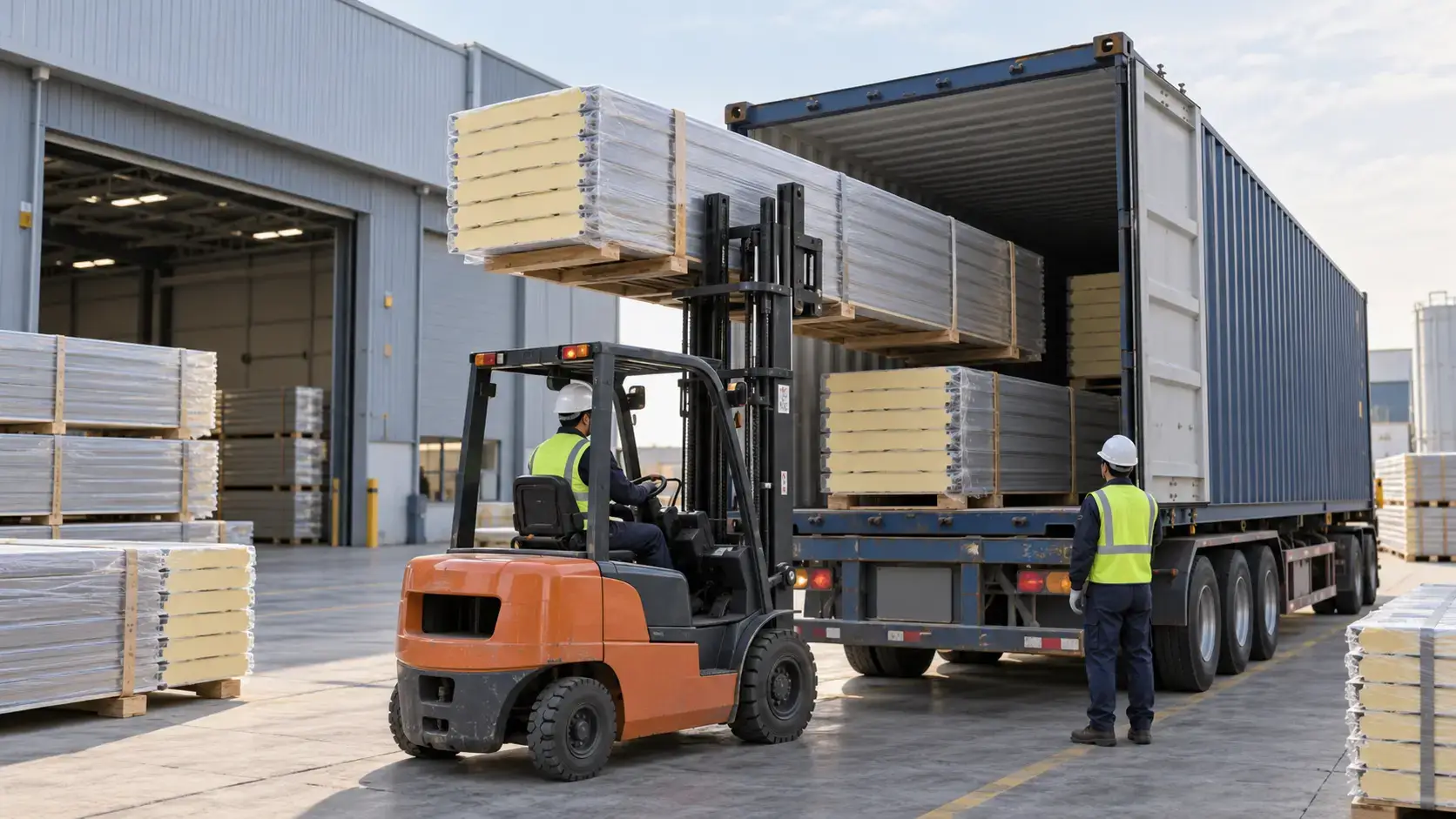
Packing and Unloading Check
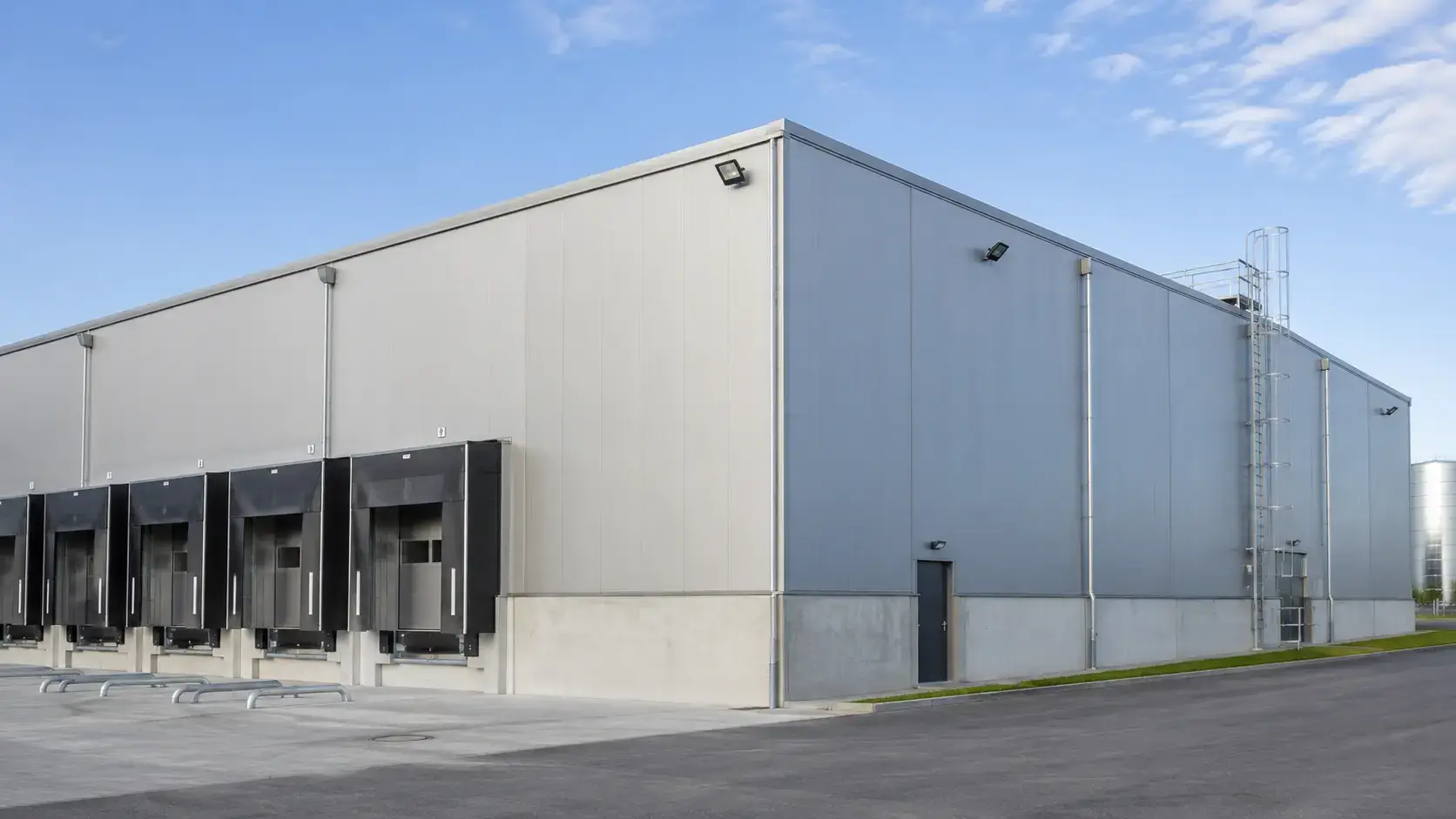
For each bundle, record:
- Bundle number
- Panel quantity
- Panel lengths
- Bundle dimensions
- Bundle weight
- Order number
Example:
| Bundle | Data |
|---|---|
| Number | 01/20 |
| Quantity | 10 panels |
| Panel length | 8,000 mm |
| Weight | Supplier to state |
| Reference | PO / project number |
Check edge protection, bottom supports, top protection, strapping, and water protection before loading.
Also confirm:
- Whether a forklift can be used
- Required fork spacing
- Whether a crane is needed
- Whether soft straps are needed
- Whether a spreader beam is needed
- Maximum bundle weight
- Required support points
Inspection Plan
Before production:
- Approved specification
- Approved drawings
- Approved sample where required
- Approved materials
- Inspection criteria
During production:
- Steel specification
- Panel dimensions
- Core checks
- Joint shape
- Bonding
- Production records
Before shipment:
- Quantity
- Dimensions
- Surface quality
- Joint condition
- Labels
- Accessories
- Packing
If the shipment has 20 bundles, do not take every sample from Bundle 1.
If 10 panels are measured, spreading those checks across several bundles and production batches gives a better picture of consistency than measuring 10 panels from the same stack.
The actual sample size and acceptance rule should follow the inspection plan agreed for the order.
A multi-stage inspection can catch problems earlier, before all panels are finished and packed.
A final pre-shipment inspection can then check selected dimensions, quantity, workmanship, accessories, labels, and packing before loading.
Contract Acceptance Rules
Put the important product details into the PO or contract:
- Core type
- Panel thickness
- Core specification
- Steel thickness
- Steel grade where required
- Metallic coating
- Paint system
- Effective width
- Panel lengths
- Joint
- Thermal requirement
- Fire-report reference
- Structural requirement
- Accessories
- Packing
- Inspection method
- Delivery date
Also agree what happens when something fails:
- Production hold
- Rework
- Replacement
- Reinspection
- Approved price adjustment
- Rejection
A small surface scratch and a failure to meet a required fire classification are not the same type of defect and should not be handled the same way.
Warranty and Claim Check
| Question | What to Confirm |
|---|---|
| Coverage | Which defects are covered |
| Exclusions | Coastal, chemical, installation, maintenance limits |
| Start date | Production, shipment, delivery, or installation |
| Remedy | Repair, replacement, refund, or material only |
| Labor | Whether removal and reinstallation are covered |
| Claim process | Evidence, response, investigation, replacement |
Replacing 20 defective panels may involve much more than supplying 20 new panels. Flashings may need to come off, lifting equipment may be needed, installed panels may need to be removed, and nearby work may need repair.
That is why a material-only warranty can still leave the buyer with a large bill.
Final Supplier Comparison
| Area | Supplier Must Show |
|---|---|
| Technical fit | Panel matches RFQ |
| Fire | Correct report and application scope |
| Thermal | Required value on correct basis |
| Structural | Correct load/span data |
| Steel | Correct BMT, grade, coating |
| Factory QC | Records and failed-result handling |
| Traceability | Bundle → batch → materials |
| Delivery | Real available capacity |
| Packing | Safe transport and unloading plan |
| Warranty | Clear remedy and claim process |
| Cost | Normalized landed/project cost |
Red Flags
- Fire report cannot be verified
- Report covers a clearly different product
- Factory identity is unclear
- Payment company cannot be explained
- Steel thickness basis is unclear
- Technical values change during negotiation
- No written tolerances
- No joint drawing
- No batch traceability
- Production capacity does not match promised delivery
- Supplier refuses reasonable inspection
- Important raw materials can change without control
Documents to Collect
Before order:
- Final quotation
- Technical data sheet
- Panel drawing
- Joint drawing
- Steel and coating specification
- Thermal data
- Fire documents
- Structural data where required
- Installation instructions
- Warranty
Before shipment:
- Inspection report
- Packing list
- Bundle list
- Batch identification
- Required production records
- Accessory list
- Shipping documents
Before shipment, make sure the quotation, drawings, fire report, thermal data, PO, inspection report, and bundle labels are all describing the same panel.
Finally
Start by removing suppliers that cannot meet the required fire, thermal, structural, or market rules. Then compare the details that change the real cost: core thickness, effective width, steel thickness, coating, accessories, packing, and Incoterm. A 100 mm PIR panel with 0.50/0.50 mm steel is not the same as one with 0.40/0.40 mm steel. A 30,000 m² order at 3,000 m² per day also needs time for raw materials, inspection, packing, and loading. Before shipment, check that the PO, test reports, QC records, bundle labels, and inspected goods all match.