A wider range can increase revenue, improve customer retention and reduce dependence on one product. It can also turn a healthy business into a warehouse full of slow stock. Relying solely on the fact that your long time Chinese manufacturing partner tells you that this product is “trendy” does not necessarily mean that your stocks will sell fast. The decision how to expand your product portfolio with China suppliers is yours only. And you are in the best position to assess your market, retail or wholesale price, and all the key parameters that ensure the success of a new addition to your product range.
In short: To expand your product portfolio with China suppliers, start with proven customer demand, choose the right development and supplier route, calculate the full landed economics, qualify the manufacturing process, and use a pilot order before scaling. The supplier should support the product strategy. The supplier catalog should not define it.
What It Means to Expand Your Product Portfolio With China Suppliers
Product portfolio expansion means adding products that give customers a relevant new reason to buy. It does not necessarily mean entering a completely new industry. For most importers, the lowest-friction opportunities sit close to products that already sell.
A bottle importer might add another capacity, a replacement lid or an insulated food container. A hotel-furniture buyer might add matching bedside tables before trying to develop kitchen appliances. The customer, sales channel and parts of the supply chain remain familiar.
A larger catalog is not automatically a stronger portfolio. New products should reach another customer need, price point, use case or buying occasion. Otherwise, the business adds inventory and management work without creating a meaningful reason to buy.
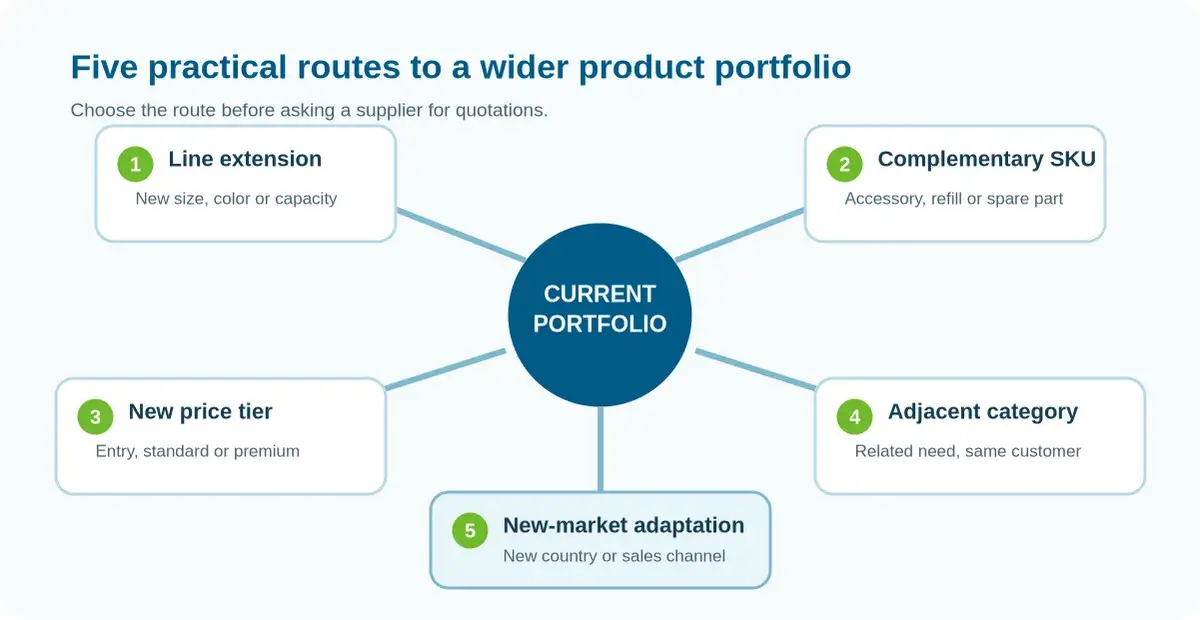
Five expansion routes
The route determines how much supplier research, tooling, testing, cash and time the project needs.
- Line extension: another size, color, material, capacity or model.
- Complementary SKU: an accessory, spare part, refill or product usually bought with the core item.
- New price tier: an entry, standard or premium version for a distinct buyer need.
- Adjacent category: a related product for the same customer or sales channel.
- New-market adaptation: a product adjusted for another country, customer group or sales channel.
Decide What to Add Before Contacting a Factory
Supplier catalogs are useful for discovering what already exists. They are poor substitutes for customer evidence. A factory naturally presents products it can sell. It does not know which one fits the buyer’s assortment, price architecture or inventory position.
Start with customer and sales evidence
Good product ideas often appear in ordinary operating data:
- sizes, materials or features requested more than once;
- accessories customers buy from another seller;
- site searches that return no product;
- products frequently bought together;
- a best seller that can support another capacity or price point;
- return or complaint data showing an unmet need.
Record the target customer, sales channel, selling price, expected monthly sales, key features and maximum landed cost. This becomes the commercial brief. A structured China product sourcing process can then test supplier availability against the same requirement rather than collecting unrelated quotations.
Find the catalog gap before choosing the product
Map the existing range by customer, use case, price, size, material, performance level and purchase frequency. The missing opportunity may not be another product near the current bestseller. It may be a useful accessory, a true premium model or an offer for a customer group the catalog does not yet serve.
Suppose a range already contains products at $29, $39 and $45 for similar mainstream buyers. Adding another model at $42 may create overlap. A $69 premium model with a clear performance advantage, or a sub-$20 accessory, may fill a more useful gap.
Give each new product a portfolio role
| Portfolio role | Commercial purpose |
|---|---|
| Hero product | Generates demand and makes the brand recognizable |
| Entry product | Gives new customers a lower-cost way to try the range |
| Premium product | Serves buyers who will pay for a meaningful improvement |
| Accessory | Raises basket value and makes the core product more useful |
| Replacement product | Supports existing customers and repeat purchases |
| Category bridge | Moves current customers into an adjacent category |
Not every SKU needs to become a bestseller. It does need a defined role. A product may serve several roles, but one should lead the commercial decision. Ask both “Will it sell?” and “What does it add to the portfolio?”
Check brand fit and price architecture
The target customer should intuitively understand why the brand offers the new product. Check whether it solves a related problem, fits the expected quality level, can be sold through existing channels and can be supported after the sale.
In product portfolio expansion, brand fit matters because customers should understand why the new product belongs in the range without needing a separate explanation.
Entry, standard and premium versions also need meaningful differences. Better material, useful capacity, stronger performance or longer service life can justify a higher tier. A new color or package alone rarely creates a credible premium offer.
If expansion targets another country or sales channel, treat that as a separate commercial route. Voltage, packaging language, warnings, labels, traceability, tariffs and channel rules may change even when the physical product looks similar.
Measure incremental sales, not only new-SKU sales
Suppose an existing product sells 1,200 units per month. After a new version is launched, the old SKU falls to 900 units and the new one sells 500.
900 + 500 = 1,400 total units
1,400 − 1,200 = 200 incremental units
The new SKU sold 500 units, but 300 came from the old product. This may still be acceptable if the new version has a better margin, lower return rate or stronger price position. The result must be assessed across the range.
Use attach rate for complementary products
If 1,000 customers buy a core product and 270 also buy an accessory, the attach rate is 27%.
270 ÷ 1,000 = 27% attach rate
An accessory does not need large standalone demand to earn its place. It may lift the average order value, reduce compatibility questions and keep customers from buying the missing part elsewhere.
Choose the Right China-Supplier Expansion Route
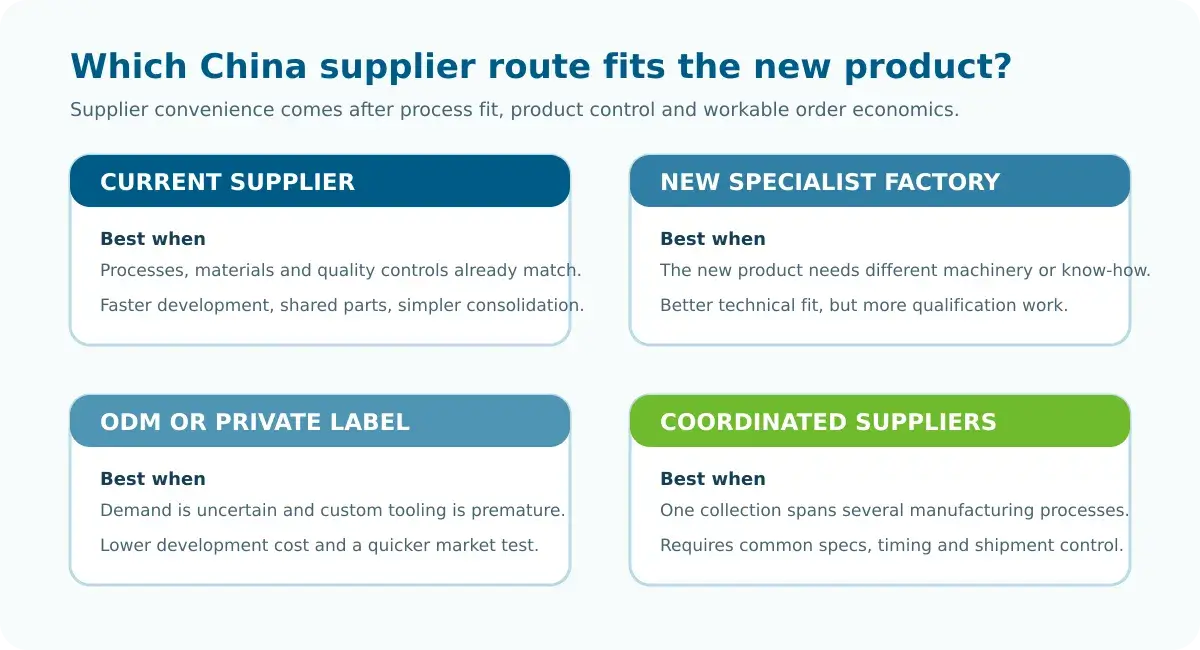
The current supplier is often the first place buyers look. That can save time, but a familiar sales contact is not evidence that the factory has the right process. Some suppliers display hundreds of products while making only part of them in-house. The supplier choice is therefore part of product portfolio expansion itself: it determines which products can be developed reliably, at what minimum quantity and with how much operational control.
Use the current supplier when the process already fits
A current supplier is a logical choice when the new SKU uses similar materials, machinery, tolerances, finishes and quality controls. Shared components can reduce drawings, component stocks, spare-parts complexity and purchasing minimums. The same approved lid, charger, fastener or packaging format may support several products.
Use a specialist factory when capability changes
A supplier that assembles aluminum products may outsource casting, machining, anodizing or polishing. A furniture factory may sew covers but subcontract metal frames. The buyer needs to know who controls the critical operation and which step limits output.
When the required process is outside the current supplier’s core capability, a broader search is needed. Finding factory-direct Chinese manufacturers with the right production setup is safer than forcing the existing relationship to fit. The guide on how to choose a China supplier explains the commercial and operational checks in more detail.
Use private label or ODM to test uncertain demand
| Route | Typical setup | Development work | Useful when |
|---|---|---|---|
| Private label | Existing product with buyer branding or packaging | Low | Testing demand quickly |
| ODM | Existing supplier design with selected changes | Medium | Creating some differentiation without full development |
| OEM / custom | Product made around a buyer specification or design | High | Building a controlled, defensible product |
Factories do not use these terms consistently. Confirm what is actually included: existing mold, new mold, structural changes, new components, drawings, testing, packaging work and ownership of the final files.
Coordinate several suppliers when the collection spans processes
A new collection may involve one factory for the main products, another for accessories and a third for retail packaging. This route can widen capability without asking one factory to pretend it makes everything. It also adds coordination work. Specifications, colors, labels, completion dates and shipment planning must follow one control system.
Prioritize second sources where a disruption would hurt the business most. They matter most for high-revenue products, difficult materials, unique tooling, long lead times, limited capacity or strong seasonality. It is not necessary to duplicate every low-volume SKU.
Test the Economics of Product Portfolio Expansion Before Development
A factory price is not a commercial decision. The decision depends on what one sellable unit costs at the warehouse, how many units must be purchased and how quickly the stock can move.
Turn the quotation into landed cost
| Cost item | Per unit |
|---|---|
| Factory price | $6.20 |
| Packaging | $0.65 |
| Testing allocation | $0.20 |
| Inspection | $0.08 |
| China transport | $0.15 |
| Ocean freight | $0.90 |
| Duty and tariff | $1.10 |
| Warehouse receiving | $0.25 |
| Expected defects | $0.17 |
| Total | $9.70 |
In this example, a $6.20 quotation becomes $9.70 before normal selling expenses. Tools, electronics, appliances and machinery may also need spare parts, warranty shipping and after-sales support.
Find the origin of the MOQ so you can find a workaround
The finished-product assembly is not always the constraint. A custom zipper, battery, printed carton, color batch or raw-material purchase may set the minimum.
| Item | Example MOQ |
|---|---|
| Finished-product assembly | 500 units |
| Custom zipper | 3,000 units |
| Printed retail box | 2,000 units |
| Custom battery | 5,000 units |
A 500-unit pilot is not a low-risk test if it requires the buyer to purchase 5,000 custom batteries. Stock colors, standard parts, existing molds and simple labels can reduce the cash and inventory exposed in the first order.
Compare margin with months of inventory
First calculate the contribution available to recover development costs. Suppose the selling price is $39. Product, packaging, freight, duty, fulfillment, payment fees, expected returns and advertising total $26. The contribution is $13 per unit.
If tooling, testing, design and packaging setup cost $9,000, the project must sell about 693 units before those fixed development costs are recovered.
$9,000 ÷ $13 = about 693 units
Now compare that result with the actual purchase commitment. If the factory MOQ is 2,000 units, the batch could produce $26,000 of contribution if every unit sells. At 80 units per month, however, it represents 25 months of inventory.
2,000 × $13 = $26,000 potential contribution
2,000 ÷ 80 = 25 months of inventory
Margin may be acceptable while the order quantity is not.
Test more than one demand scenario
| Scenario | Monthly sales | Inventory coverage |
|---|---|---|
| Best case | 200 units | 7.5 months |
| Expected case | 120 units | 12.5 months |
| Downside case | 60 units | 25 months |
A product can look attractive in the best case and consume cash for more than two years in the downside case. The order should remain manageable if sales fall below forecast.
Find out about import duties and taxes before making any decision on costs
Do not automatically reuse the Chinese export code. The first six digits of the Harmonized System are internationally harmonized, while later digits and duty rates can differ. The USITC tariff-classification guidance explains that U.S. importers must identify the correct HTS provision and remain responsible for the entry.
Verify the Supplier and Lock on Product Specifications
We have assessed that the produc has commercial potential. It is now the international buyer’s task to translate its product portfolio expansion into hard data that manufacturers can understand and quote upon. At this stage of , the commercial idea must become one measurable product standard that every shortlisted factory can quote and reproduce.
Verify the manufacturing process, not the online catalog
Confirm which operations are in-house, which components come from outside suppliers and which processes are subcontracted. Then verify the available equipment, whether similar products are running and which process limits monthly output.
The full method for finding, questioning and comparing factories is covered in our guide to sourcing products from China. The purpose here is narrower: confirm that the chosen factory route can support the new SKU without introducing hidden process risk.
Give every supplier the same specification
Include dimensions, weight, material grade, thickness, finish, tolerances, components, logo method, packaging, accessories, labels, performance requirements, quantity and destination market. “High-quality stainless steel” and “strong packaging” are not measurable requirements.
Use a BOM for important internal parts. Give drawings, specifications, artwork and approved samples a version number. State that no important material, component, process, package or subcontractor may change without written approval.
Compare like-for-like quotations
Every supplier should quote the same specification, quantity, packaging and shipping term. EXW $5.80 and FOB $6.10 do not include the same costs. Better make sure you know which term is used, its impact on costs, before you place an order. For example: FOB Yantian Port, Incoterms® 2020. The official Trade.gov Incoterms guidance explains how the main transport tasks, costs and risks are divided.
Approve one production standard
This step is especially important when development new products in China. Whether it is a custom packaging, laser engraving, or even more: a brand new product, record your conclusions at each development stage. I.e: Version 1 = rejected, Version 2 = revised, Version 3 = approved for production. When possible, keep a golden sample of the approved sample. And issue a final specification sheet of your product, as basic as it may be, that lists materials, components, color, logo, accessories, labels and packaging. This is simply good practice, and will prove useful if you need to seek a new supplier in the future.
A pre-production inspection in China is one of the most relevant quality inspections in China for a preseries batch. The inspector dispatched onsite can assess whether the factory has the materials in stock, tooling, documents and approved sample before mass production starts.
Check compliance and ownership before paying for tooling
Confirm the destination market, product category, testing rules, labels, warnings, traceability and importer obligations before committing to molds or custom materials. U.S. consumer products may require a General Certificate of Conformity or a Children’s Product Certificate. From July 8, 2026, importers of most regulated consumer products are subject to the CPSC electronic certificate filing requirement. See the current CPSC certificate guidance.
For tooling, state who owns it and where it is stored. The agreement should also cover maintenance, transfer and whether the supplier may use it for another customer. Control access to CAD files, formulas, product drawings and packaging artwork. The USPTO China IP toolkit provides a practical starting point.
Place a Test Order first
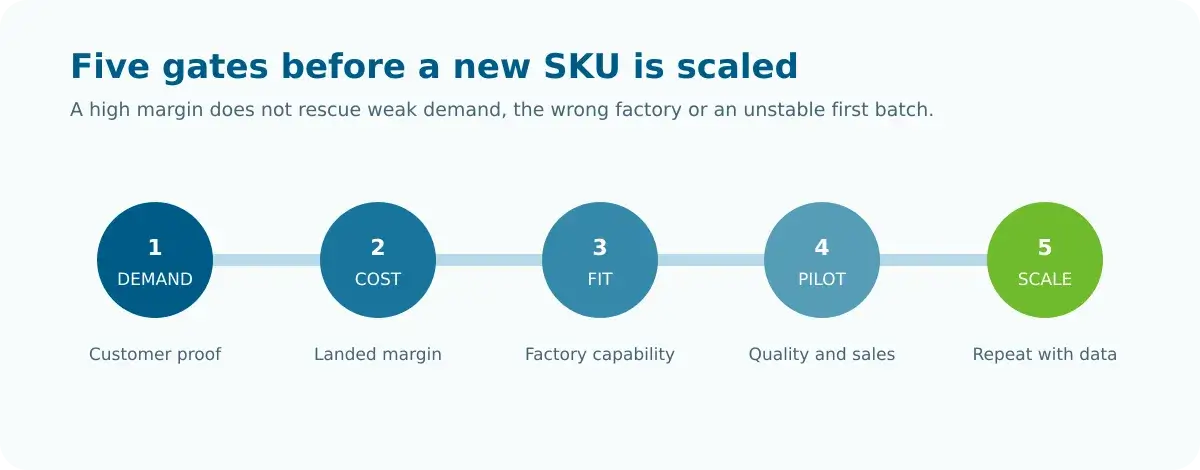
The first commercial batch should answer two questions: can the factory reproduce the approved product, and will customers buy it at the expected margin?
Beware the pitfalls of lead time when setting your launch date
A supplier saying “35 days production” is not promising warehouse arrival in 35 days. Tooling, sample changes, production, inspection, shipment preparation, international transport and customs all add time before the product reaches the warehouse.
| Stage | Example duration |
|---|---|
| Tooling | 25 days |
| Sample changes and approval | 15 days |
| Production | 35 days |
| Inspection and shipment preparation | 5 days |
| Ocean shipping and handling | 35 days |
| Total | 115 days |
Check Chinese New Year, major holidays, peak production periods and long-lead materials against the actual factory schedule.
Cap first-order exposure
At a $9 landed cost, a 10,000-unit launch ties up $90,000 in stock. A 2,000-unit pilot ties up $18,000. The $72,000 difference buys room to learn, provided the pilot quantity remains economical to manufacture and ship.
$90,000 − $18,000 = $72,000 less first-order inventory exposure
Set an inspection plan before production
State what will be checked, how it will be measured, the sample size, what counts as a defect and what result causes rejection. Different quality inspection services in China answer different questions before, during and after production.
An AQL sampling plan may be used for lot inspection. ISO 2859-1:2026 defines acceptance-sampling schemes indexed by Acceptance Quality Limit. It does not mean every unit has been inspected, and it does not define which product defects are critical, major or minor. Those definitions must come from the buyer’s product and market requirements.
Convert defects into a decision
A 7% defect rate picked up during a QC in China, for an order of 5,000 kynesio tape rolls means at least 350 affected units. Money wise, the cost isn’t the main issue, made in China paraffin gauze is rather cheap. The issue is rather about potential complaints and potential damage to your business reputation. If you can’t make a decision by yourself yet, ask your third party inspection company in China about their experience.
Now, what an inspection company can not tell you is that :
- the closer the product gets to your market, the higher its cost (i.e: purchasing cost is smaller than its landed cost). Thus, the higher the losses.
- Processing complaints should be included in your cost of quality equations. Time spent to discuss with your supplier how to manage risks, and settle a dispute about defective products that reached your customers, has a monetary value, it is a cost of quality.
- depending on your order volumes, sales representatives in China may judge it not worthwile to spend time and effort to settle a dispute with your company.
Scale, Measure or Remove the SKU
Portfolio expansion continues after the shipment arrives. A new product deserves further investment only when the sales and operating data justify the next order.
Set inventory and reorder limits
Replace launch assumptions with actual sales data as soon as it becomes available. A simple reorder starting point is:
Reorder point = demand during lead time + safety stock
If sales are 300 units per month, replenishment takes three months and the safety stock is 300 units, the reorder point is 1,200 units. The safety-stock level should reflect actual demand variation and supplier reliability.
Watch SKU multiplication
Five colors × four sizes × two packaging options creates 40 SKUs. At 300 units per SKU, the order becomes 12,000 units. At an $8 landed cost, that is $96,000 in inventory.
5 × 4 × 2 × 300 × $8 = $96,000
Each variation needs a commercial reason. “The factory can make it” is not enough.
Track supplier and product performance separately
| Supplier performance | Product performance |
|---|---|
| On-time completion and delivery | Incremental sales and sell-through |
| Inspection pass rate | Contribution per unit |
| Critical and major defects | Return and complaint rate |
| Corrective-action closure time | Inventory cash and turnover |
| Responsiveness to specification changes | Attach rate and repeat demand |
Define each metric. “On-time delivery” can mean factory completion, port handover or warehouse arrival. Use the same definition every time.
Stop weak SKUs before they consume more cash
A product with higher revenue is not automatically the better use of cash. Product A may earn $8,000 annually while keeping $40,000 tied up in inventory. Product B may earn $7,000 with only $10,000 tied up. It produces almost the same profit with one quarter of the inventory cash.
Remove products that no longer justify their MOQ, inventory, packaging, compliance work, supplier management and support costs. Portfolio expansion includes pruning. Otherwise every launch becomes permanent overhead.
Conclusion : smooth product Expansion with Chinese suppliers depends on how efficiently you control it
We have seen that expanding a product portfolio with China suppliers starts with a clear catalog gap, not with the number of products a factory can offer. And have established that line extensions, complementary products, new price tiers, adjacent categories and new-market adaptations create different commercial and sourcing requirements. In addition, we have set that a supplier route is strongest when manufacturing capability, MOQ, landed cost and compliance fit the product’s intended role.
We have also seen that a pilot order must test both repeatable production and real customer response. Cost-wise, we have listed a number of parameters that impact heavily on costs, and margins, that should lead you, as a decision maker, to decide upon review as a whole, instead of measuring the new SKU in isolation.
Finally, we have gone other the fact that portfolio expansion creates lasting value when successful products are scaled, problems are settled and weak SKUs are removed before they become permanent overhead. We have established that disciplined product portfolio expansion strengthens the range only when each added SKU continues to justify its cash, margin and operating workload.
Frequently Asked Questions
Should new products come from an existing China supplier?
Use the existing supplier only when its machinery, materials, quality controls and subcontractor network fit the new product. A familiar commercial relationship does not replace technical capability.
How many new products should be added at one time?
Add only the number that can be funded, specified, inspected and replenished without weakening the core range. A small pilot across one or two closely related SKUs is often more informative than a broad launch.
Can a Chinese supplier reduce its MOQ for a first order?
Sometimes. First identify whether the minimum comes from assembly, a custom component, packaging, material purchasing or color. Stock components and simple packaging can reduce first-order exposure.
When should a new SKU be scaled?
Scale after the pilot confirms product quality, landed margin, sell-through, returns, delivery performance and compliance. Sample approval alone is not enough evidence.