If you work in sourcing, you have surely heard about landed cost.
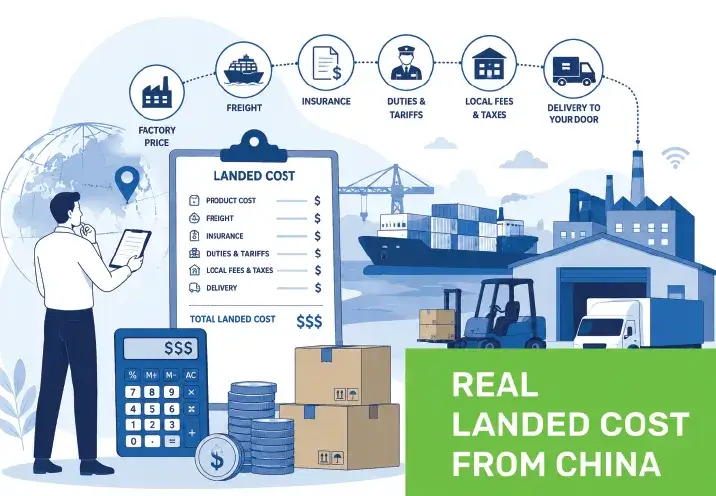
Total Landed Cost (TLC) is one of the first numbers to get right in any sourcing project. Securing a competitive landed cost is, after all, what sourcing work is largely about. The most capable sourcing teams do not stop at showing that they secured the lowest EXW price. They take pride in demonstrating how they reached the best possible landed cost once the goods are packed, shipped, cleared, and delivered. That is where the real comparison starts. A supplier may look cheaper at factory level, but the final decision should be based on what the goods actually cost by the time they reach the buyer’s door.
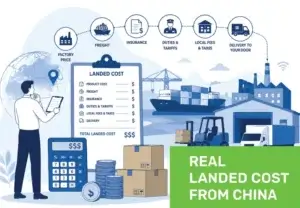
That gap is common when buyers compare only the product price and ignore freight, cargo insurance, duties, port charges, customs clearance, final delivery, and the way each Incoterm allocates cost and risk. The International Trade Administration describes landed cost as the total price of a product once it has arrived at the buyer’s doorstep, including the original product price, insurance, freight, tariffs and taxes, and other fees.[1]
| Cost segment | Main cost items | Why it matters |
|---|---|---|
| Factory and China-side costs | Unit price, export packaging, China inland transport, export documents, VAT invoice and export refund impact, exchange bank fees, cross-border payment charges | Small missing items can raise the real cost before the goods even leave China. |
| International movement | Ocean freight, cargo insurance, carrier surcharges, origin and destination terminal charges, CFS consolidation/deconsolidation fees for LCL | Freight rates and carrier charges can change quickly, so they need to be checked before each shipment. |
| Import and door delivery | Tariffs, customs clearance, inland trucking, warehouse delivery, demurrage, detention, accessorial fees, local import VAT/GST, regional levies, inspection & compliance certification fees | This is where many importers finally see whether the order still makes money. |
Factory and China-Side Costs
Unit Price Plus Packaging
Factory quotes often cover only the bare product cost. Export packaging can be included, excluded, or listed separately depending on the quotation and Incoterm. Before comparing suppliers, ask whether the quoted price includes export cartons, inner protection, palletization, container loading, labeling, moisture protection, and any required packaging test.
Back in 2018, we helped an Italian company secure hardware factory prices. I now still remember that client chose a hardware factory in Zhejiang based on its EXW price. The unit price was $1.80. Once we got to talk about the finer details to drive shipping cost per unit down, the factory eventually told us that they hadn’t included any packaging. They’d quoted their best price, their sales representative had omitted to signal the unit cost was bulk packaging, in order to win the bid. In the end, if I remember correctly, the unit price rose to $2.15. It included export cartons, pallets, and lashings. That is a 19.4% increase. This is a specific example, not a universal rule. The cheaper a product is, the more packaging will weigh on its total landed cost.
| Packaging cost example | Amount | Impact |
|---|---|---|
| Quoted unit price | $1.80 per part | Bare product cost only |
| Price after export packaging | $2.15 per part | About 19.4% higher |
| Common packaging range in our audits | 3% to 8% of product value | Ordinary consumer or industrial goods |
| Higher-risk goods | 12% to 20% of product value | Fragile, heavy, precision, oversized, or moisture-sensitive products |
| $500 industrial machine example | $75 for a treated wooden pallet plus shock-proof liner | 15% of product value in this case |
Do not treat ISTA 3A as a mandatory standard for every export shipment. ISTA identifies Procedure 3A as a test for individual packaged products shipped through a parcel delivery system at 150 lb / 70 kg or less.[2] This does not make 3A the right choice for every pallet, LTL, retail distribution, or full-container shipment. Note: Many large overseas retail chains mandate ISTA 2A / 3E testing for full pallet loads, so confirm buyer packaging test requirements before production.
For LTL cargo, palletized or skidded freight, unitized truckload cargo, mixed retail pallets, heavy machinery, or buyer-specific distribution chains, consider the appropriate ISTA procedure, ASTM method, or customer test protocol.
For wooden pallets, crates, or dunnage entering the United States, solid wood packaging material normally needs to meet ISPM 15 treatment and marking requirements.[3] However, packaging made wholly from processed wood materials such as plywood, pressboard, oriented strand board, hardboard, or similar engineered wood products may be exempt, so the material composition should be checked before assuming that every wood-based package requires ISPM 15 treatment.
Always make sure you get a written confirmation from your supplier that the price quote includes packaging and how many CBM the order will occupy. Asking the supplier to clearly state whether palletization, loading, or truck pickup cost is included helps you get a better idea of your TLC.
- If packaging is excluded, ask for it to be included, or get a packaging quote before confirming the order.
- If the goods are fragile, work with the supplier to define the packaging method, drop-test or vibration-test plan, moisture-control method, and maximum stack height. Critical note: Damage caused by insufficient packaging is excluded from standard marine cargo insurance coverage.
- One of our clients reduced packaging cost from 8% to 4% after we came up with a better, less bulky packaging solution.
- The client confirmed the change from heavy pallet protection to a lighter and smaller palletization that still protected the goods during transport.
- In another case, a glassware importer cut the damage rate from about 12% to under 2% after switching to custom foam inserts.
- The packaging upgrade cost $0.30 per unit but saved about $1.20 per unit in replacement and reshipping costs.
Further reading: Direct Sourcing from Chinese Manufacturers.
China Inland Transport and Export Handling
China-side inland costs depend on the factory location, export port, place of loading, packaging type, pickup schedule, and whether the shipment moves by road, rail, barge, or rail-sea intermodal service. That is a lot of parameters to cover, which require time. Also, the Incoterm matters because it sets which party pays for each step and when risk transfers.
Under FOB, the seller normally delivers the goods on board the vessel at the named port of shipment. Under FCA, the seller delivers the goods to a carrier or another named place. ICC Academy explains that FCA is the appropriate rule when goods are transported in containers or pallets and multiple modes of transportation are used.[4] In our China sourcing practice, EXW and FOB are still commonly used in supplier quotations, but FCA may be more precise for containerized or multimodal shipments. Buyers using EXW should confirm who will handle export clearance, loading, export documentation, truck pickup, and the China-side inland leg, because EXW places very limited obligations on the seller. When calculating TLC for FCA terms, add full origin inland haulage, loading and terminal handling fees to your cost sheet separately, as FCA delivery point is often the inland carrier warehouse instead of seaport.
| China-side logistics item | Working quote range | Notes |
|---|---|---|
| Yiwu to Ningbo Port, 40-foot container | RMB 3,600 to 7,200 | Container pickup, loading coordination, and return of the loaded container |
| Chongqing or Chengdu to Shanghai/Ningbo by intermodal route | RMB 6,000 to 8,000 in recent quote examples | More realistic for rail-sea or river-sea solutions than for direct long-haul trucking |
| China export customs declaration service | RMB 200 to 500 per shipment in many routine cases | Varies by commodity, port, documentation quality, and service provider |
| Local handling and document fees | RMB 300 to 800 in many routine cases | Should be included in the China-side logistics quote |
We often get emails from clients contacting us because they need help with solving a costing dispute with their Chinese suppliers. A recent example: a Brazilian importer secured an EXW deal with a supplier in Xi’an. The buyer had not budgeted for the inland leg before shipping from China. My colleague’s understanding of the situation was that the extra China-side transport resulted in a $0.11 increase per unit and wiped out the negotiated 3% margin.
Critical US Customs Valuation Rule (19 CFR 152.103): China inland haulage paid separately by the EXW buyer may be required to be added to the dutiable transaction value, unlike international ocean freight and marine insurance which can be excluded with separate documentation. Do not assume origin inland costs are automatically non-dutiable.
- Ask whether the supplier’s price is EXW, FCA, FOB, CIF, DAP, or DDP.
- If the quote says FOB, confirm the exact named port and whether container loading, export customs declaration, and terminal handling are included.
- For inland factories, compare road transport with rail-sea or river-sea intermodal transport. Intermodal can be cheaper, but transit time may extend by several days.
- One client overlooked the 120 km trucking fee from Dongguan to Yantian Port and paid an extra RMB 3,200 per shipment.
- Build separate TLC calculation line items for FOB and FCA shipments to avoid underbudgeting inland multimodal costs.
Further reading: How to Streamline Your Shipping Process from China.
VAT and Export Refund Impact
China’s VAT and export refund system affects the supplier’s real cost and therefore the quotation you receive. For general VAT taxpayers, China’s main VAT rates are 13%, 9%, and 6%, depending on the goods or services. For exported goods, the refund rate must be checked by HS code, product category, and the current policy period. It may be 0% for some goods and can be as high as the statutory VAT rate for other goods, commonly up to 13%; the refund formula also means many exported goods do not receive a full refund of input VAT. Because export refund catalogues and product-specific adjustments can change, the applicable HS-code refund rate should be verified again at order time, not copied from an old quote.[5]
| VAT and refund item | Correct range or rule | Procurement impact |
|---|---|---|
| Main VAT rates in China | 13%, 9%, or 6% | Depends on goods or service category |
| Export refund rate for goods | HS-code specific; 0% for some goods and commonly up to 13% for others | Must be checked by HS code, product category, and current refund catalogue |
| Who normally claims export VAT refund | Chinese exporter/general VAT taxpayer only | Foreign importers are not eligible to claim China export VAT refunds, only a Chinese company is |
| Quote comparison risk | Supplier-dependent | A supplier without export refund capability may quote higher, quote “no tax invoice,” or hide the VAT cost elsewhere |
Before accepting a quotation, confirm whether the supplier is a VAT-compliant exporter and what export refund rate applies to the HS code.
- Ask whether the supplier is a general VAT taxpayer.
- Ask what VAT invoice type will be issued.
- Confirm the export refund rate by HS code.
- Ask the supplier to state the VAT invoice type and assumed export refund rate in the sales contract.
Further reading: Cost Advantages of Manufacturing in China.
International Movement Costs
How to Check Ocean Freight
Ocean freight is often the most volatile cost in the chain. The Freightos Baltic Index tracks 40-foot container prices across major trade lanes, including China/East Asia to North America West Coast, and Freightos describes FBX as a daily benchmark based on aggregated market data from carriers, forwarders, and shippers.[6]
| Freight item | Practical figure | Budget note |
|---|---|---|
| China/East Asia to North America West Coast, 40-foot container | Must be checked by week | Rates can change sharply during peak season, port disruption, tariff frontloading, or carrier capacity adjustments |
| December 2024 reference point | Asia to North America West Coast rates closed December 2024 at $4,825/FEU after dipping below $4,000/FEU earlier that month | Use historical index data only as a benchmark, not as a guaranteed booking rate |
| LCL shipments | Quoted per cubic meter or per weight/measure unit | Always compare the ocean quote with origin CFS, destination CFS, document, and handling charges |
| Budget buffer | 10% to 20% above the recent quote or index level | Helps absorb PSS, BAF, equipment imbalance, and blank-sailing changes |
Freightos reported Asia-U.S. West Coast prices at $4,825/FEU on December 30, 2024, while the Baltic Exchange’s December 2024 FBX summary noted that the same lane had dipped below $4,000/FEU earlier in the month before rebounding.[7][8] That movement shows why a single freight quote can become outdated quickly.
For recurring orders, we usually compare three numbers before booking: the current spot quote from the forwarder, the relevant FBX or comparable index lane, and the 4- to 12-week trend. A quote that is far below market can hide destination charges; a quote that is far above market may simply reflect a bad booking week.
- For stable monthly volume, ask the forwarder whether a 6- to 12-month rate agreement is available.
- For smaller volume, compare LCL with consolidation into a shared container.
- If the monthly volume exceeds about 5 cubic meters, calculate whether consolidation or a partial FCL strategy reduces the per-unit cost.
- Use weekly index data before each shipment because the same route can move by hundreds or thousands of dollars per FEU over a short period.
Further reading: How a Sourcing Team Manages Supply Chain Disruptions.
Route and Import Tax Differences Outside the United States
The examples above are mainly built around China-to-U.S. sourcing, but landed cost changes significantly when the same goods are shipped to Europe, South America, or Africa. The cost model should therefore be adjusted by destination region instead of copying a U.S. duty and freight formula into every market. Ocean freight may be booked on a similar FOB China basis, but destination taxes, import VAT, port practices, customs valuation, free-time rules, and inland delivery conditions are different in each region.
| Destination region | Main China export lanes | Typical landed-cost difference from U.S. model | What to verify before quoting |
|---|---|---|---|
| Europe | China/East Asia to North Europe or Mediterranean ports such as Rotterdam, Hamburg, Antwerp, Felixstowe, Valencia, Genoa, or Piraeus | Import VAT cash flow and EU product compliance often matter as much as the customs duty rate; DDP sellers bear full tax compliance liability | EU TARIC duty, import VAT rate by member state, EORI/importer setup, customs broker fee, inland delivery from port/bonded warehouse, temporary €3 low-value parcel tariff rules |
| South America | China to Brazil, Chile, Peru, Colombia, or other Pacific/Atlantic gateways, often with transshipment | Longer transit time, higher customs complexity, and layered cascading tax systems can make the final cost much higher than the freight quote suggests; avoid DDP without full local tax registration review | Country-specific VAT/IVA/ICMS rules, import duty by HS/NCM code, port storage, customs broker fee, recoverable input VAT eligibility, state-level tax surcharges |
| Africa (split sub-regions for separate TLC templates) | China to West Africa, East Africa, South Africa, or North Africa, usually through major gateway ports and sometimes through hub transshipment | Port dwell time, documentation quality, inland delivery risk and long transit inventory carrying cost are bigger cost drivers than ocean freight alone; separate costing sheets required for West / East / Southern Africa | Import duty, VAT/GST, regional levy or surcharge, destination handling, free time limits, inspection risk, inland road transit fees, local import license requirements |
Europe
For Europe, do not treat import VAT as the same thing as customs duty. The European Commission explains that VAT is charged on goods imported from outside the EU and that the rate varies by member state.[9] EU VAT rules also require every member state to apply a standard VAT rate of at least 15%, although the actual standard rates are set nationally.[10] For landed-cost work, this means a shipment entering Germany, France, Spain, the Netherlands, or Poland may face the same EU customs framework but a different import VAT cash-flow impact.
| Europe cost item | Working rule | Landed-cost impact |
|---|---|---|
| Ocean freight | Check China/East Asia to North Europe and Mediterranean index levels before each booking. Freightos publishes FBX lanes for 40-foot container prices such as China/East Asia to North Europe.[11] | Use a weekly rate rather than a fixed annual estimate, especially during peak season or Red Sea/Suez-related disruption. |
| Import duty | Usually determined by the EU TARIC code, product origin, and customs value. | Many industrial products have low single-digit duties, but textiles, footwear, bicycles, consumer goods, and trade-remedy cases can be materially higher. |
| Import VAT | Charged at the member-state VAT rate and usually calculated on customs value plus customs duty and certain import-related costs. | VAT-registered importers may recover or defer VAT in some structures, but it still affects cash flow, working capital, and DDP quotation risk. |
| Low-value e-commerce parcels | From July 1, 2026, the EU applies a temporary €3 customs duty to individual goods with value ≤€150 imported from outside the EU until July 1, 2028.[12] The duty applies per tariff line item rather than per full shipment parcel. For customs purposes, an item generally means one or more goods in a consignment sharing the same tariff classification, description and, where relevant, origin. | This policy exclusively covers B2C small parcel shipments with single item value under €150; standard B2B full-container FCL imports almost never qualify and are unaffected by this flat tariff. |
For Europe, the first landed-cost question is not only “what is the duty rate?” but also “who is the importer of record, who finances import VAT, and can VAT be recovered or deferred?”
South America
South America cannot be modeled as one simple tax zone. Brazil, Chile, Peru, and Colombia all calculate import costs differently. For example, Brazil’s import structure can include import duty, IPI, PIS/COFINS, ICMS, AFRMM, and customs system fees, and PwC lists PIS/COFINS import rates for goods at 2.1% and 9.65%, or 11.75% combined in many standard cases.[13] Brazil’s IPI is also commonly charged on the CIF value plus import duty, with general IPI rates often ranging from 0% to 15% according to the International Trade Administration’s Brazil guide.[14]
| South America market | Common tax points to check | Costing warning |
|---|---|---|
| Brazil | Import duty by NCM/HS code, IPI, PIS-Import, COFINS-Import, ICMS by state, AFRMM for ocean freight, SISCOMEX fee, broker and port charges | Taxes cascade across multiple calculation bases, so a simple “duty + VAT” formula will drastically understate the real landed cost; avoid DDP terms without full local tax registration validation. |
| Chile | General customs duty, VAT/IVA, FTA preference and certificate of origin eligibility | PwC notes Chile’s general customs duty rate is 6% and VAT is generally 19%, but reduced or zero duty may apply under free trade agreements.[15] |
| Peru | Ad valorem duty, VAT/IGV, excise tax for selected products, anti-dumping or compensatory duties where applicable | PwC lists common Peru ad valorem customs duty rates at 0%, 6%, and 11%, with VAT at 18%.[16] |
| Colombia | Customs duty, VAT/IVA, product-specific restrictions, customs broker and port handling | PwC lists Colombia’s general VAT rate for imported goods at 19% and customs duties generally between 0% and 20%, with possible higher rates in some cases.[17] |
Freight also behaves differently. China-to-South America often has longer transit times than China-to-U.S. West Coast shipments, more transshipment exposure, and greater inventory carrying cost. Shanghai Containerized Freight Index route data includes South America, Africa, and other destination routes by TEU, which can be used as one directional market reference when comparing forwarder quotations.[18] Because SCFI is a Shanghai export spot-market reference and FBX uses a different global methodology and 40-foot-container lane structure, do not directly mix the two numbers in the same cost model without normalizing lane, container size, included surcharges, and quotation date. For South America, always check whether the quote is to the main port only or includes destination handling, port storage, customs clearance, and final inland delivery.
- For Brazil, avoid DDP pricing unless the importer-of-record role, tax registration, NCM code, ICMS state, and creditability of taxes are fully confirmed.
- For Chile and Peru, the tax calculation may look simpler than Brazil, but certificate of origin, product category, and customs documentation still affect the final duty outcome.
- For Colombia and other Andean markets, confirm whether product registration, import license, or technical standard approval is needed before shipment.
- For all South America shipments, include a 25%+ cost buffer for customs delay, port storage, and inventory financing because longer transit and clearance times can turn into real cost.
Africa
Africa should also not be treated as one freight or tax market. The landed-cost profile of a shipment to South Africa is different from Nigeria, Kenya, Ghana, Tanzania, Morocco, or Côte d’Ivoire. South Africa’s VAT rate is 15%, and SARS explains that import VAT is calculated on an added tax value that includes customs value, a 10% uplift surcharge applicable to goods originating outside the Southern African Customs Union (SACU), plus non-rebated duties. The 10% uplift surcharge is fully waived only for goods with country of origin as BLNS states: Botswana, Lesotho, Namibia, and Eswatini (Swaziland). Goods merely transiting BLNS countries with Chinese origin still incur the 10% uplift.[19] Nigeria’s customs duties are typically 5% to 35% by HS code according to PwC, while the International Trade Administration notes that supplemental levies and duties can push effective duty burdens much higher for selected products.[20][21] Because Nigeria approved 2026 Fiscal Policy Measures and Tariff Amendments, importers should recheck the current HS-code treatment before quoting, especially for agricultural goods and products affected by import adjustment taxes.[22]
| Africa market | Common tax points to check | Costing warning |
|---|---|---|
| South Africa | Customs duty by tariff heading, 15% VAT on SACU-adjusted tax value, anti-dumping duty for selected goods, port and inland drayage charges | Do not calculate VAT only on invoice value; the SARS 10% origin-based uplift modifies the entire VAT calculation base. |
| Nigeria | Customs duty, 7.5% VAT, ECOWAS-related charges, product levies, inspection and port charges | Effective duty can be much higher than the base tariff for selected products, and documentation delays can trigger storage and demurrage. Check 2026 fiscal-policy updates for products affected by import adjustment taxes. |
| Kenya / East Africa | EAC Common External Tariff duty, 16% VAT, Import Declaration Fee, Railway Development Levy, product-specific excise or standards inspection | Kenya Revenue Authority states import duty rates are commonly 0%, 10%, or 25% under the EAC CET, with sensitive items above 25%.[23] The International Trade Administration states Kenya import VAT is 16% and is levied on CIF plus duty and other applicable taxes.[24] Also check the Import Declaration Fee and Railway Development Levy, because Kenya Revenue Authority commonly lists IDF at 3.5% and RDL at 2% of import value, subject to current law, exemptions, and product-specific treatment. |
| West Africa / other African markets | Import duty, VAT/GST, port authority charges, customs broker fee, local inspection, inland trucking, and possible regional levies | Port dwell time, lack of appointment control, road conditions, and inland security can make final delivery cost exceed the original ocean freight saving; allocate minimum 30% cost buffer for unexpected delays and surcharges. |
For African destinations, ocean freight may look manageable at booking stage, but the true delivered cost often depends on destination execution. SCFI publishes route categories including West Africa, South Africa, and East Africa, which can help teams compare directionally whether a forwarder’s quote is aligned with the China export spot market.[25] However, SCFI should not be treated as identical to FBX or to a door-to-door quotation, because index scope, container unit, lane definition, surcharges, and data collection methodology differ. A low ocean rate should not be accepted without checking destination THC, container free time, port storage, customs inspection probability, container deposit rules, and the inland route from port to warehouse or project site.
- For Africa, build separate landed-cost templates for at least West Africa, East Africa, and South Africa instead of using one Africa-wide assumption.
- Ask the forwarder to quote destination THC, documentation, inspection handling, container deposit, storage, demurrage, detention, and final delivery separately.
- Confirm whether the consignee has the correct import license, tax registration, product certificate, and local broker before cargo departs China.
- For project cargo, oversized goods, machinery, or construction materials, check anti-dumping, standards inspection, escort requirements, and inland route constraints before confirming the supplier.
The safest global landed-cost model therefore has one base template and several destination modules. The China-side cost and FOB export logic may be similar, but the destination module should change for the United States, Europe, South America, West Africa, East Africa, and Southern Africa.
Cargo Insurance
Marine cargo insurance is inexpensive compared with the value at risk, but it should not be considered as blanket protection for every problem. Institute Cargo Clauses A covers broad physical loss or damage, but still excludes items such as ordinary leakage or wear, insufficient or unsuitable packing, inherent vice, delay, war risks, and strike risks unless separately covered.[26]
| Insurance item | Typical figure or rule | Reason |
|---|---|---|
| Marine cargo insurance premium | Often around 0.1% to 0.6% in recent general-cargo quotes, depending on cargo, route, packing, deductible, and loss history | High-value, fragile, temperature-sensitive, or theft-prone cargo can cost more |
| Insured value | Often CIF value or invoice value plus 10% | 110% cover is commonly used to include invoice value and a small uplift for related costs |
| U.S. COGSA carrier liability limit | $500 per package or customary freight unit (only valid if the carrier’s bill of lading provides clear space to declare higher cargo value before shipment) | Carrier liability can be far below commercial value; cargo insurance is still needed for meaningful protection. If the BL lacks formal value declaration fields, courts often void this $500 limit. |
| Common exclusions to review | Delay, insufficient packing, inherent vice, ordinary leakage or wear, and war/strike risks unless separately covered | Read the policy terms before assuming a loss is covered; pure financial loss from shipment delay has zero insurance coverage under standard ICC A. |
CIF and CIP insurance discussions often use a 110% insured value benchmark.[27] For U.S.-governed ocean carriage, the Carriage of Goods by Sea Act can limit carrier liability to $500 per package or customary freight unit unless the nature and value of the goods are declared before shipment and inserted in the bill of lading.[28] In practice, relying on a higher declared value may involve carrier acceptance and extra charges, and it still should not be confused with a separate cargo insurance policy.
- For high-value electronics, machinery, precision parts, or fragile goods, ask for broad cargo coverage and review exclusions.
- For shipments exposed to geopolitical disruption, ask whether war, strikes, riots, civil protests, terrorism, or similar risks require separate clauses.
- For moisture-sensitive goods, document packaging, container condition, desiccant usage, humidity indicators, and loading photos before departure.
- Do not assume that delay alone is covered; many cargo policies exclude loss or expense caused by delay even if the delay follows an insured event.
Further reading: Why Sourcing from China Is a Smart Choice.
Destination Port Charges
After the vessel arrives, the destination side can include terminal handling charges, terminal security charges, document fees, telex release or surrender fees, chassis-related charges, exam fees, storage, demurrage, detention, and forwarder handling fees. These charges vary by carrier, terminal, port, equipment type, and contract.
| Destination charge | Reference figure (example data only, confirm live quotes) | Where it appears |
|---|---|---|
| Los Angeles terminal handling, 40-foot dry container | $650 in Hapag-Lloyd’s North America schedule valid from January 1, 2025 until further notice | Carrier/terminal handling charge |
| Los Angeles terminal security, 40-foot container | $12 in the same Hapag-Lloyd schedule | Terminal security charge |
| Document or release fees | Often quoted separately by carrier or forwarder | Documentation and release process |
| Customs exam, storage, demurrage, or detention | Event-dependent, allocate region-specific cost buffers | Triggered by exam, late pickup, terminal congestion, or missed free time |
For example, Hapag-Lloyd’s North America terminal handling and security schedule lists Los Angeles terminal handling at $500 for a 20-foot dry container and $650 for a 40-foot dry container, plus a $12 terminal security charge per 40-foot container.[29] Another carrier or forwarder may quote a different all-in destination package, so the safest approach is to compare fee schedules line by line.
Ask for an all-in destination quote before booking, not after the vessel arrives.
- Itemize THC, document fee, security fee, release fee, chassis fee, exam fee, storage, demurrage, and detention terms.
- Confirm free time at the terminal and free time for container detention separately.
- Comparing forwarder destination-fee schedules for recurring lanes helps increase shipping cost efficiency.
- In a $60,000 order we were involved with sourcing, the client shared with us that destination-side port and forwarder charges reached $4,800, equal to 8% of cargo value.
Further reading: Cost Benefits of Sourcing from China.
Import and Door Delivery Costs
Verify Tariffs with the Correct HS or HTS Code
Tariff calculations depend on product classification, country of origin, import country, customs value, and any additional trade-remedy tariffs. For U.S. imports, the U.S. International Trade Commission maintains the Harmonized Tariff Schedule of the United States, which sets tariff rates and statistical categories for goods imported into the United States.[30]
| Tariff control point | What to check | Risk if ignored |
|---|---|---|
| HS/HTS code | Confirm the correct product classification via licensed customs broker written ruling | Wrong duty rate, customs delays, monetary penalties, back-duty assessments |
| Customs value | Confirm mandatory items added to dutiable base (buyer packaging cost, applicable China inland haulage for EXW shipments) | Underpayment or overpayment of duties, customs audit liabilities |
| Section 301 tariffs for Chinese-origin goods | Check whether the HTS code appears on a USTR list; tariff effective dates apply to US entry filing date, not factory shipment date | Additional tiered duty may apply retroactively for misclassified goods |
| Destination country | Check local tariff treatment, VAT/GST rules, customs valuation basis and cascading regional taxes | The identical product can face 10–30% variance in total landed cost across different import markets |
Do not copy a duty formula from one country to another. The International Trade Administration notes that many landed-cost estimates use a CIF value for foreign tariffs and taxes, while U.S. customs valuation rules generally exclude separately identified transportation, insurance, and related services incident to the international shipment from the country of exportation to the U.S. place of importation from the price actually paid or payable.[31][32] For U.S. entries, packing costs incurred by the buyer must be added to the transaction value when they are not already included in the price paid or payable.[33] Foreign inland freight needs more care. If the buyer pays an ex-factory price and the seller’s price does not include foreign inland freight, those inland charges are not automatically excluded from the dutiable value; customs officers will review supporting documentation to judge inclusion eligibility. If the seller’s FOB, CFR, CIF, or other non-ex-factory price already includes foreign inland freight or export-side movement, the amount can remain part of transaction value unless it is separately identified and meets the regulatory conditions for treatment as transportation incident to the international shipment, such as evidence of sale for export and placement for through shipment to the United States.
For Chinese-origin goods entering the United States, many legacy Section 301 additional duties are 7.5% or 25% depending on the list and HTS code. In September 2024, USTR finalized modifications to the Section 301 actions for selected strategic sectors after the statutory four-year review. The effective dates are phased: some increases apply to entries on or after September 27, 2024, while other tariff increases apply on or after January 1, 2025 or January 1, 2026, depending on the product category and HTS code.[34] Separately, USTR proposed additional increases in September 2024 for five HTSUS subheadings covering certain tungsten products, wafers, and polysilicon, then finalized those five additional subheadings in December 2024 with a January 1, 2025 effective date.[35] Therefore, do not assume that every named sector moved to the higher rate on the same date, and do not treat every September 2024 item as final if it was part of a later request for comments. Use USTR’s Section 301 tariff-action page[36], CBP guidance, and the current HTS schedule before finalizing the landed-cost sheet.
One of our clients used the wrong heading between HS 8467 and 8508 for a motorized product. The classification difference changed the duty outcome and caused the company to overpay about $150,000 annually on $2 million in purchases. If a product could fall under multiple headings, use CBP’s Customs Rulings Online Search System or ask a licensed customs broker for a written classification opinion.[37]
- Review classifications at least annually for recurring import programs.
- Keep product photos, specifications, material composition, use case, and supplier technical sheets with the classification file.
- Check the HS code not only for import duty, but also for China export VAT refund treatment.
- For U.S. entries, separate product value, packing costs, international freight, insurance, and inland freight clearly on the commercial documents.
- For Europe, South America, and Africa, rebuild the tax base by local customs valuation rules instead of reusing the U.S. transaction-value approach.
Further reading: How Sourcing Agents Help Companies Source from China.
Destination Inland Trucking
After customs clearance, the inland leg from the destination port to the warehouse can be the last major cost item. U.S. trucking rates vary with distance, equipment availability, fuel, chassis supply, appointment windows, and whether the move is local drayage, intermodal rail plus drayage, or over-the-road trucking. DAT publishes current trucking market trend data based on a large database of actual freight payments, which is useful for checking whether a quote is in line with market conditions.[38]
| Last-mile item | Working quote range | Cost control note |
|---|---|---|
| Los Angeles to Chicago | Low-to-mid thousands of dollars per container in many quote environments | Compare truck-only with rail intermodal plus drayage |
| Los Angeles to New York | Often several thousand dollars per container, depending on mode and timing | Longer distance raises linehaul and equipment risk |
| Europe inland delivery | Market quote required by port, warehouse country, customs status, and whether delivery uses truck, barge, rail, or multimodal service | Rotterdam-to-Germany and Hamburg-to-Central Europe can be very different from Mediterranean port delivery. |
| South America inland delivery | Often highly dependent on port congestion, customs release timing, local trucking availability, and distance from port to warehouse | Brazil and Andean markets can require larger buffers for storage, waiting time, and inventory financing. |
| Africa inland delivery | Must be quoted by corridor and consignee location, especially for inland cities and project sites | In some African routes, inland transport and delay cost can exceed the apparent savings from a low ocean freight rate. |
| Lift-gate fee | $150 to $300 per truck in many routine U.S. quotes | Applies when the warehouse lacks a dock, forklift, or proper unloading support |
| Detention after free time | $50 to $150+ per day depending on carrier and contract | Avoid by planning pickup and unloading inside the free-time window |
Long-distance trucking rates should be treated as market quotes, not fixed rules. Government producer price index data for long-distance truckload freight also shows that prices can move materially over time, so using outdated rates can distort landed-cost calculations.[39]
- Ask for a door-to-door quote before placing the order.
- Check whether the quote includes chassis, pre-pull, storage, waiting time, residential or limited-access delivery, and lift-gate service.
- Use the terminal and carrier free-time window properly to avoid demurrage and detention.
- For multiple delivery points in the same region, consider a deconsolidation warehouse near the port instead of separate direct-to-door deliveries.
- For Europe, South America, and Africa, ask the broker and forwarder to confirm whether inland delivery can start before tax payment, after customs release, or only after full inspection clearance.
Further reading: Top Benefits of Global Sourcing for Your Supply Chain.
Only After Adding It Up Do You Know If You Are Losing Money
Here is a corrected landed-cost example from a mid-2024 hospitality FF&E sourcing project. We sourced 50,000 hotel supplies from Foshan. The product value was $2.80 per set, or $140,000 total. We label it as product value rather than FOB value because packaging and the China inland/export leg are listed separately below.
| Cost line item | Amount | Cost impact |
|---|---|---|
| Product value | $140,000 | 50,000 sets × $2.80 |
| Packaging | $9,500 | Export-ready packaging |
| China inland/export leg | $1,200 | China-side logistics and export handling; assumed separately billed under an ex-factory-style sale |
| Ocean freight | $5,800 | International shipping; excluded from U.S. transaction value if properly identified as international freight |
| Insurance | $420 | Marine cargo insurance; excluded from U.S. transaction value if properly identified as international insurance |
| Destination charges | $2,100 | Port and document charges |
| Tariffs | $11,213 | 7.5% applied to $149,500 product value plus packaging |
| Destination trucking | $2,800 | Destination inland leg |
| Customs clearance | $850 | Broker and clearance cost |
| Delivered cost | $173,883 | About 24.2% above the product value |
The tariff line was corrected because U.S. customs valuation rules add buyer-incurred packing costs to the transaction value when they are not already included in the price paid or payable.[39] In this example, applying 7.5% only to $140,000 would understate duty by about $713. The example also assumes that the China inland/export leg is separately billed and not part of the seller’s price. If a seller’s FOB price includes foreign inland freight or export-side handling, a customs broker should confirm whether those amounts are included in or excluded from the U.S. transaction value.
A reusable landed-cost sheet should include product value, packaging, China-side logistics, ocean freight, insurance, destination charges, dutiable value, tariff rate, customs clearance, destination trucking, detention risk, exchange rate, and payment fees. After running the full calculation, you may find that a supplier with the lowest unit price is not the lowest delivered-cost option.
For non-U.S. markets, the reusable landed-cost sheet should also include local import VAT/GST, recoverable versus non-recoverable tax treatment, country-specific import levies, customs broker charges, port storage risk, local compliance certificates, and estimated customs release time. This is especially important when quoting DDP, because the exporter or sourcing company may accidentally absorb taxes and clearance costs that should have been priced into the buyer’s landed cost.
- Build a landed-cost template and apply it to every order before selecting the supplier.
- Separate internal experience data from externally verifiable market data.
- Update freight, tariffs, exchange rates, and port charges before each shipment.
- Use the completed landed-cost sheet as a negotiation tool when a supplier’s total delivered cost is higher than a competitor’s.
- Create separate destination modules for the United States, Europe, South America, West Africa, East Africa, and Southern Africa instead of using one global landed-cost percentage.
Further reading: Key Steps to Successful Global Sourcing, How a Professional Sourcing Agent Maximizes Cost Savings.