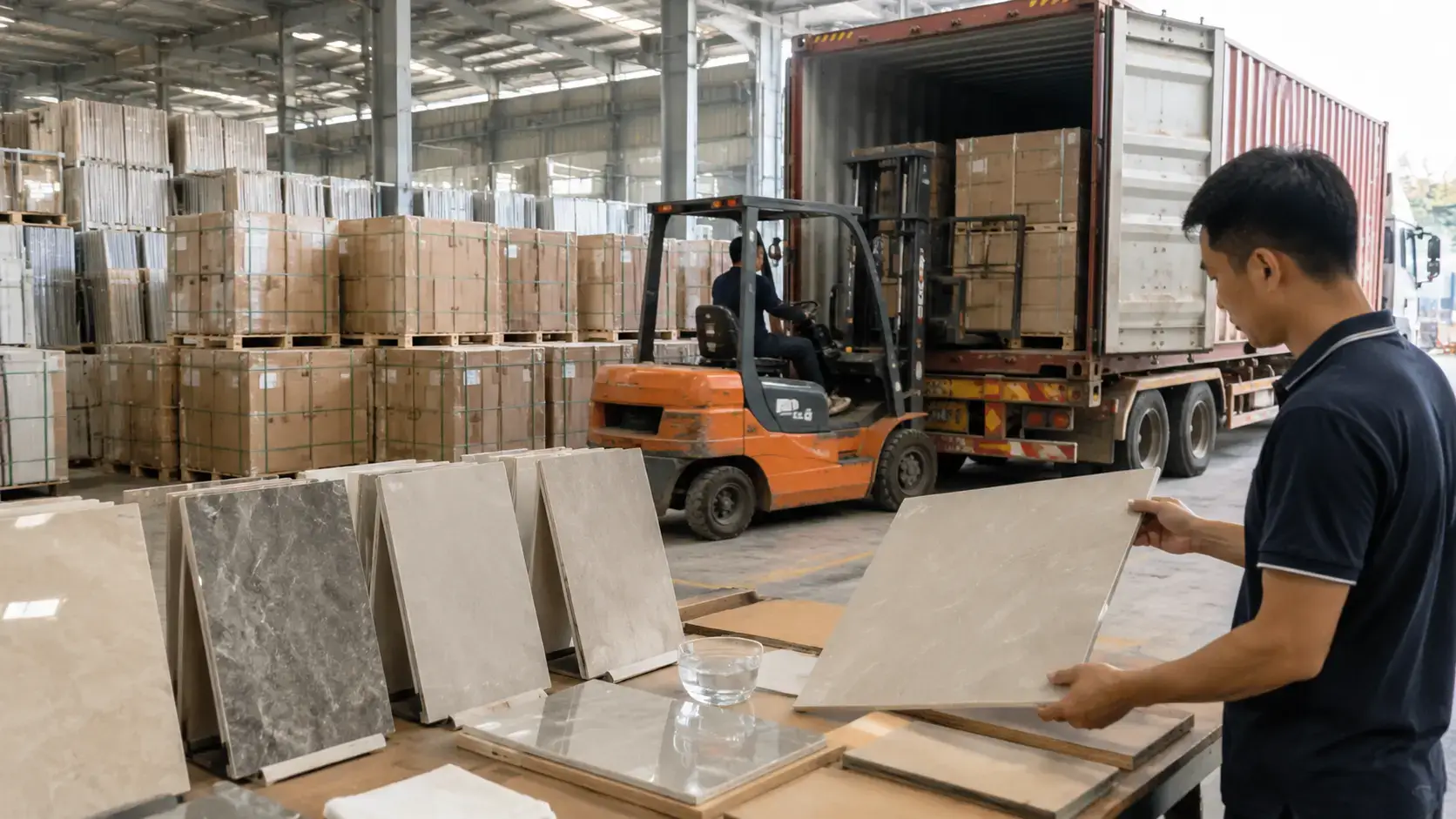
If you don’t know where to import ceramic tiles from, look no further: China is the absolute most obvious choice. Why? I’ll give you a number : 421 million USD in value, exported in 2024. That’s just 10 times what the second ranking exporter, Germany, did in 2024. And I’ll even give you a second number for free : between 2018 and 2024 China’s ceramic flooring products exports have grown by 110 million USD. Neat! But why Foshan then? Easy, when you know that Mona Lisa, DongPeng and HuaPeng are all based in Foshan, speculating that there’s a dense ceramic manufacturing hub there can’t be far from the truth.
But talking only about the great prospects that China offers as a ceramic flooring sourcing destination would not be fair, or honest. A standard 20ft shipping container from China can only hold around 800 to 1900 square meters of tiles depending on thickness, material and size. And yet, it may be subject to carrier limits, verified gross mass rules, and local road weight limits[1].
Other impacting parameters on total ownership cost are ceramic tile grade, color fastening, or packaging. In the last decade, based on the information I gathered from our Quality Supervisor, we have recorded a little less than 1/3 of shipments as non-compliant. Some of these orders even triggering disputes between suppliers and clients.
China is one of the best ceramic tiles sourcing hotspots in the world. But it is really profitable only when buyers look closely at the numbers, and enforce quality standards and inspections before shipment.
So today, whether you are a young importer, a purchaser working for a big construction group, or construction project manager, we will answer to “How to Import Ceramic Tiles from Foshan China” and aim at giving you the most comprehensive information on parameters that truly impact the success of sourcing flooring tiles or wall tiles from Foshan.
A Practical Foshan Tile Import Process
Import Steps Before You Contact Suppliers
Before asking for a quotation, the buyer should define the tile in a way that a factory, a trading company, and a third-party inspector can all understand.
- Tile type: porcelain, ceramic, glazed porcelain, polished porcelain, rectified tile, or wall tile.
- Size and thickness: for example, 600x600mm, 800x800mm, or 1200x600mm.
- Surface finish: polished, matte, glazed, textured, anti-slip, or stone-look.
- Edge type: rectified or non-rectified.
- Application area: wall, floor, bathroom, hotel lobby, mall corridor, apartment project, or retail stock.
- Technical standard: water absorption class, abrasion class, color tolerance, size tolerance, flatness, and warpage.
- Commercial detail: MOQ, carton weight, pallet type, packing method, destination country, and order quantity.
Without these details, two suppliers may quote the same 600x600mm porcelain tile but actually offer different body quality, surface finish, carton strength, and grade tolerance.
- Define the product specification.
- Screen suppliers.
- Approve samples.
- Compare quotations under the same RFQ.
- Confirm contract and payment terms.
- Track production.
- Arrange pre-shipment inspection.
- Supervise loading when the order is high-risk.
- Review shipping documents.
- Handle customs clearance and warehouse inspection.
- Prepare evidence if a claim is needed.
Many first-time buyers start with a price request and only think about inspection after the container is already packed. That order is risky.
The inspection standard, defect allowance, pallet type, breakage allowance, and dispute method should be written before the first deposit is paid.
Factory, Trading Company, or Sourcing Agent
| Supplier Type | Best For | Main Risk | What to Confirm |
|---|---|---|---|
| Direct factory | Large orders, repeat products, stronger production control. | Higher MOQ and fewer mixed-design options. | Production line, grade standard, batch report, and packing method. |
| Trading company | Mixed products and smaller combined orders. | Less transparency over the actual factory. | Which factory makes each product and who accepts quality claims. |
| Sourcing agent | Multi-factory orders, inspection coordination, and mixed container loading. | Unclear service scope or responsibility. | Service fee, inspection role, supplier control, and claim support. |
Foshan tile suppliers are not all the same. A direct factory may offer better unit pricing and more control over production, but it may also require a higher MOQ.
A trading company may combine several tile categories and help with small mixed orders, but the buyer must confirm whether the company controls production or only collects samples from different factories.
A sourcing agent can help when the buyer needs several factories, mixed container loading, independent inspection, supplier comparison, and shipping coordination.
For a first container order, the buyer should not judge the supplier only by showroom samples or catalog photos.
- Ask for recent export packing photos.
- Ask for production line photos.
- Ask for test reports for the same product family.
- Ask for past container loading records.
- Ask for carton markings and pallet photos.
- Ask for sample batch information.
A supplier who can show a beautiful showroom tile but cannot explain water absorption, shade number, carton weight, pallet load, or inspection tolerance is not ready for a serious import order.
What to Put in the RFQ
A Foshan tile RFQ should be specific enough to prevent the supplier from quoting a lower-grade alternative.
- Tile size, thickness, surface finish, body type, and edge type.
- Use area, color, order volume, and required grade.
- Water absorption, abrasion class, and anti-slip requirement when relevant.
- Carton weight limit and pallet type.
- Trade term, destination port, and required documents.
- Private-label packaging requirements, if needed.
If the buyer is comparing several suppliers, each supplier should quote against the same RFQ.
Otherwise, the cheapest supplier may simply be quoting a thinner tile, a looser grade, a weaker carton, or a different pallet.
| Quotation Item | Why It Matters |
|---|---|
| Price unit | Confirm whether the price is per square meter, per piece, or per carton. |
| Packaging cost | Check whether export cartons, pallets, labels, and private packaging are included. |
| Local charges | Confirm whether FOB local charges, loading cost, and document cost are included. |
| Inspection cost | Clarify who pays for inspection and re-inspection. |
| Breakage rule | Confirm whether compensation is by refund, credit, replacement, or next-order discount. |
For a building-material distributor, the landed cost matters more than the factory price.
A tile that is cheaper at the factory but has higher breakage, heavier cartons, weaker pallets, or missing documents can cost more by the time it reaches the warehouse.
Sample Approval and Sealed Reference Samples
Sample approval should not stop at visual appearance.
- A showroom sample is useful for design selection.
- A stock sample shows what the factory currently has available.
- A pre-production sample helps confirm whether the new order can match the buyer’s standard.
- A production sample is the most useful reference for bulk-order control.
A showroom tile does not prove that the bulk order will match the same shade, thickness, water absorption, or flatness.
For a container order, the buyer should ask the factory to keep one sealed reference sample, send one to the buyer, and make one available to the inspector.
The contract should say that the production lot must match the sealed sample within the agreed tolerance.
For project orders, buyers should also approve the color shade, batch number, surface gloss, back pattern, carton marking, and packing layout before mass production.
If the order will be used for a hotel corridor, mall floor, apartment project, or retail chain, the buyer should request production-run samples instead of relying only on showroom samples.
Payment Terms and Contract Clauses
The common payment structure for tile imports is a deposit before production and a balance before shipment, often based on TT payment.
The risk is that many buyers pay the final balance before seeing a proper inspection report.
- Tie the balance payment to pre-shipment inspection approval.
- Ask for packing photo approval before shipment.
- Review shipping documents before the vessel leaves.
- Use staged payment or LC for larger orders when needed.
The contract should avoid vague wording such as “top quality”, “AAA quality”, or “same as sample” unless the sample and standard are clearly defined.
| Contract Clause | What It Should Name |
|---|---|
| Product identity | Tile code, size, thickness, surface finish, and edge type. |
| Quality standard | Grade, defect allowance, water absorption, abrasion class, color tolerance, and dimensional tolerance. |
| Packing standard | Carton weight, pallet type, pallet load, stretch wrap, straps, and corner protection. |
| Inspection rule | Inspection body, sample size, test method, and re-inspection responsibility. |
| Claim rule | Breakage allowance, evidence requirement, claim period, and compensation method. |
Incoterms rules can help define buyer and seller responsibilities for transport, costs, and risk transfer, but they do not replace product quality clauses or inspection clauses[3].
If the buyer expects the factory to accept a third-party report, the contract should say so before production begins.
Quality Grades Explained
First-grade vs. Premium-grade Tiles
In our experience, the wording on a Foshan pro-forma invoice is rarely enough to tell premium-grade from first-grade product.
The same batch code can carry a 4 to 7 percent price gap without any visible difference at the container door.
ANSI A137.1 is widely used as a ceramic tile specification reference because it lists ceramic tile types, physical properties, grading procedures, marking, and testing requirements for ceramic tile[4].
Premium-grade lots should usually show 95 percent or more of tiles free from visible defects. First-grade lots may allow a limited share of tiles with minor surface or edge imperfections, and the buyer’s inspection should sample enough tiles to test that benchmark.
We have encountered lots labeled “AAA” by the factory that still contained 8 percent of tiles with glaze pinholes or chipping on the corners. The supplier then classified those problems as cosmetic-only rather than defective under the agreed spec.
Tile surface defects should be judged under defined viewing conditions, not only by casual warehouse observation. TCNA explains that ANSI A137.1 uses a defined visual examination method for determining defects in Standard Grade tile[5]. Buyers who want a QC category reference can use a published grading standard as the spine of the agreement.
| Factory Wording | Buyer Risk | Better Contract Wording |
|---|---|---|
| AAA quality | May be only a sales label. | Name the defect percentage and inspection method. |
| Top quality | Too vague for a claim. | Define visible defect allowance and standard reference. |
| Same as sample | Unclear if sample is showroom, stock, or production sample. | Use sealed production sample with measurable tolerance. |
| First grade | Factory and buyer may define it differently. | State allowed defects, sample size, and dispute body. |
The practical problem is that “premium”, “first grade”, “AA”, and “AAA” are often used as selling words before they are used as inspection words.
A buyer may think “AAA” means the best export quality, while the factory may use it only as an internal commercial label.
- Surface pinholes.
- Glaze scratches.
- Corner chips.
- Cracked bodies.
- Uneven edges.
- Obvious shade difference.
- Wrong size.
- Mixed batch codes.
A small surface mark on a wall tile may be acceptable in one project. The same mark on a polished lobby floor may become a visible complaint.
A practical test is to count defects in two separate 100-tile samples per grade, then compare the percentages against the agreed ceiling.
We have seen a 4.2 percent first-grade lot rejected at 6.1 percent on re-count by the buyer’s third-party inspector. The supplier honored the result because the contract referenced a measurable inspection rule instead of the factory’s internal “AAA” notation.
We have seen one container of 1,260 square meters of 800x800mm polished porcelain downgraded after 7.3 percent of tiles showed micro-chipping along the long edge. The credit note covered both the tile value and the demurrage days spent in the inspection warehouse.
To prevent that outcome, importers can use a QC strategy checklist that names the grade, the standard, and the inspection body before the deposit clears.
Grade is not just a product label. It is a claim rule, a sorting rule, and a selling-risk control.
For ordinary importers, the easiest way to understand grade is to connect it with selling risk.
- A lower-grade lot may still be usable.
- It may require more sorting, more waste, more customer service, and a higher spare-tile allowance.
- A premium lot should reduce those problems only if the premium claim is backed by inspection rules.
If the buyer is importing for a retail warehouse, visible defects may lead to returns.
If the buyer is importing for a hotel or apartment project, defects may delay installation and force replacement after workers have already started laying the floor.
Documenting the grade in writing before the deposit is non-negotiable. Once a 30 percent TT deposit clears, the factory has little incentive to swap your lot.
We always ask for a one-page grade declaration that names the standard, the defect percentage allowed, and the inspection body.
For China-origin ceramic tile orders, buyers may also reference GB/T 4100 when the supplier and buyer agree to use a Chinese ceramic tile standard. China’s National Public Service Platform for Standards lists GB/T 4100-2015 as the national standard for ceramic tiles[6].
Across the 42 containers we measured in the last 18 months, 5 of the 6 grade disputes were resolved faster when the contract referenced a third-party inspection body as the dispute arbiter rather than the supplier’s QC department.
The buyer should also make sure the grade declaration matches the carton label, packing list, commercial invoice, and inspection report.
If the pro-forma invoice says premium grade but the factory’s internal packing list uses another grade code, the buyer should ask for clarification before loading.
Moisture Absorption: 0.5 percent vs. 3 percent
Water absorption helps decide whether a tile is porcelain, vitreous ceramic, semi-vitreous ceramic, or a higher-absorption wall tile.
The 0.5 percent threshold is commonly used to separate porcelain-type tile from many ordinary ceramic bodies. TCNA explains that porcelain tile is defined by standards as an impervious tile with water absorption of 0.5 percent or less, as measured by ASTM C373[7]. ISO 10545-3 specifies methods for determining water absorption, apparent porosity, apparent relative density, and bulk density of ceramic tiles[8].
| Water Absorption | Common Trade Classification | Typical Buying Meaning |
|---|---|---|
| ≤ 0.5% | Impervious / porcelain-type body | Commonly preferred for higher-performance floor use and wet-area projects. |
| > 0.5% to 3% | Vitreous | May suit many indoor uses, but should not be sold as low-absorption porcelain unless the value supports it. |
| > 3% to 7% | Semi-vitreous | Often more suitable for walls or lighter-use interior areas. |
| > 7% | Non-vitreous / higher-absorption ceramic body | Usually needs careful use-area control, especially around wet areas and floors. |
For a buyer, water absorption is not only a laboratory number. It helps decide where the tile can be used.
A low-absorption porcelain tile is usually the safer choice for floor areas, wet areas, commercial traffic, and projects that need tighter performance control.
A higher-absorption ceramic body may be suitable for interior walls or light-use areas, but it should not be sold or declared as porcelain if the test value does not support that claim.
Low water absorption does not automatically mean high slip resistance or high abrasion resistance.
The surface finish, glaze, texture, abrasion class, and installation environment still matter.
In our experience, a 0.3 percent measured absorption on the pre-shipment sample can drift to 0.6 percent on the production run if the factory changes its kiln temperature profile or its body mix.
The only way to catch that drift before the container leaves the port is to ask the lab report to list the actual reading, not just “pass” or “fail”.
ASTM C373 is another recognized test method for determining water absorption, bulk density, apparent porosity, and apparent specific gravity of ceramic tiles and related products[9].
We have seen lots labeled “E ≤ 0.5 percent” arrive with an average of 0.7 percent on a 5-tile retest at destination. The credit was only honored because the lab report listed the numeric value.
ISO 13006 defines terms and establishes classifications, characteristics, and marking requirements for ceramic tiles, including classification by manufacturing method and water absorption group[10]. A factory pre-shipment building supplies category check should always include the lab report with the actual numeric reading, not just a pass-or-fail box.
- Ask whether the report belongs to the exact production batch.
- Ask whether it belongs only to the same product family.
- Ask whether it is only an old sample report.
- Ask whether frost resistance, slip resistance, or surface durability is needed for the destination use.
The 3 percent to 7 percent range covers many semi-vitreous interior wall or light-use ceramic tiles. Higher-absorption wall tile should not be used as wet-area flooring without checking the full application requirement.
We have seen a 12 percent absorption wall tile specified for a hotel bathroom project, and the installer returned the container because the tiles spalled within 6 months of grouting in the steam-room corners.
Specifying the absorption class in the contract, along with the test method, reduces the risk of a higher-absorption body being substituted when raw-material cost rises[11].
Importers who want a building supply wholesale overview should map each absorption class to a suitable end-use before talking to any factory.
PEI Abrasion Rating
The term “PEI rating” is widely used in the tile trade, but a more precise technical name under ASTM C1027 is visible surface abrasion resistance.
The test evaluates visible surface abrasion on glazed tile surfaces. It does not measure the breaking strength of the whole tile, and it does not measure slip resistance[12].
| Common Class | Typical Use Meaning | Buyer Note |
|---|---|---|
| Class I | Very light use or wall-focused areas. | Not suitable for demanding floors. |
| Class II | Light residential use. | Use only in low-traffic floor areas. |
| Class III | Most residential living areas. | Check finish and cleaning conditions. |
| Class IV | Light commercial use. | Suitable for offices, hotel rooms, and similar spaces when other specs match. |
| Class V | Heavy commercial use. | Commonly specified for malls, airports, supermarkets, and similar high-traffic public floors. |
PEI-style abrasion classification is useful because many buyers understand traffic level more easily than laboratory wear cycles.
A tile for a bedroom floor does not face the same surface wear as a tile for a supermarket aisle.
However, abrasion class should not be used alone.
- For commercial flooring, check water absorption.
- Check breaking strength.
- Check slip resistance.
- Check cleaning-chemical exposure.
- Check wheel traffic.
- Check whether the surface is polished, matte, textured, or glazed.
A high abrasion class does not automatically make a tile safe for a wet entrance area if the surface is too slippery.
We have seen lots labeled “PEI 4” by the factory that tested out lower on a third-party re-test. The importer had to renegotiate the unit price or face premature replacement on a school project.
ASTM C1027 measures visible surface abrasion by rotating an abrasive load on the tile surface and visually comparing abraded and non-abraded specimens[13].
Specifying both the abrasion class and the standard, with a copy of the report attached to the contract, has saved our buyers the cost of replacing entire floors in three separate projects over the last 24 months.
A supplier evaluation framework that asks for the PEI report before deposit has prevented two of those replacement scenarios on our own orders in the last 12 months.
When the buyer imports for a project instead of inventory, the abrasion requirement should be matched to the actual area.
A hotel guest room, a restaurant entrance, a school corridor, and an airport floor should not be treated as the same use case.
Color and Dimensional Checks
Color Consistency Within One Batch
Color consistency is commonly evaluated with color-difference measurement. ISO 10545-16 describes methods for using color-measuring instruments to quantify small color differences between plain-colored ceramic tiles when that requirement is important by specification or agreement[14].
The acceptable delta-E value should be defined by the buyer, supplier, and inspector before production, because different markets and projects may use different acceptance levels.
We have seen a 1,400-square-meter container of warm-grey polished porcelain rejected at destination because the average delta-E between the first 50 cartons and the last 50 cartons reached 1.2. The factory attributed the issue to raw-material color drift in the body mix.
Color consistency is not just a lab number. It decides whether the finished floor looks like one project or several mixed batches.
- Ask for shade number.
- Ask for batch number.
- Ask for production date.
- Compare cartons from the beginning, middle, and end of the production run.
- Keep sealed samples for future dispute checking.
Warm grey, cream, white, beige, and stone-look surfaces can show visible shade difference under natural light, showroom light, or raked light.
In our inspected shipments, batches fired at different kiln conditions sometimes showed visible tone drift. A 5 to 10 degree Celsius swing can be enough to make a light neutral color look warmer or cooler to the eye.
We have seen one batch of 1,800 square meters of cream-glazed tile split into two visually distinct sub-batches. The buyer’s project lost 3 weeks of installation time while the supplier re-fired a replacement lot at no extra charge.
The safest practice is to draw the color sample from the production run itself, not from the showroom tile the factory shows on day one. That sample should be locked as a sealed reference before signing off the production lot[15]. Importers who want a sourcing-in-china category can use the sealed-sample rule as the spine of the QC protocol.
| Project Type | Color Risk | Best Control Method |
|---|---|---|
| Retail inventory | Customer returns if cartons vary by shade. | Mark cartons by shade and batch. |
| Hotel project | Visible mismatch across corridors or rooms. | Use one production batch whenever possible. |
| Large apartment project | Future repair tiles may not match. | Keep spare tiles from the same batch. |
| Marble-look tile | Natural-looking variation may become uncontrolled variation. | Approve production-run samples and shade range. |
Across the 42 containers we measured in the last 18 months, the median color drift within a single batch was a delta-E of 0.6.
Five containers exceeded 1.0, and every one of those 5 had to be either re-sorted by shade at destination or written off.
We have seen one large hotel project absorb a 1.1 percent wastage on a 22-container order because the inspector caught the drift in the third container and the factory agreed to halt the run.
Pairing the sealed sample with a product-sourcing category overview is the cheapest insurance against re-sorting losses on multi-container orders.
The buyer should also make the color approval method clear. A photo sent through a phone is not enough for final approval because camera settings, screen brightness, and lighting can change the visible tone.
Diagonal and Thickness Tolerance
Dimensional tolerance should be checked with a recognized test method. ISO 10545-2 specifies methods for determining dimensional characteristics such as length, width, thickness, straightness of sides, rectangularity, surface flatness, and surface quality of ceramic tiles[16].
For premium-grade pressed tile, many buyers set a tighter purchase tolerance than the broad limit printed on a general factory sheet, especially for rectified tile and large-format tile.
We have seen lots labeled “Calibrated” still vary by 1.0 mm on a 600mm side. That equals 0.17 percent and may be within tolerance, but the joint gaps on a 1.5mm spacer still looked uneven to the end client.
A small size difference on one tile can become a visible grout-line problem across hundreds of tiles.
- Narrow joints make size variation more visible.
- Rectified edges require tighter control.
- Large-format tiles expose small dimensional errors more easily.
- Staggered patterns make diagonal problems more obvious.
Third-party laboratory data in our reviewed orders show that a 0.3 mm variation in thickness across a 600x600mm tile can create visible lippage risk when the tile is laid with a narrow spacer.
We have seen a 12-container order of 800x800mm polished porcelain flagged for a thickness range of 9.4 mm to 10.1 mm.
The factory argued that it was within the 5 percent band, but the installer rejected it as too visible in raked light.
In our experience, the best way to keep thickness variation tight is to ask the factory for a calibration report, not just a dimensional report.
Calibration is the post-press grinding or sorting step that helps hold the tile to a tighter band than the press itself can guarantee. A uncategorized reference that asks for the calibration report by name has cut our re-installation losses on large-format tile to under 0.4 percent of order value across the last 12 months.
| Term | Simple Meaning | Buyer Question |
|---|---|---|
| Rectified tile | The edge is mechanically cut for more consistent joint width. | What joint width does the factory recommend? |
| Calibrated tile | The tile is sorted or processed for tighter size or thickness consistency. | What tolerance does the final lot meet? |
| Diagonal tolerance | The two diagonals should stay close in length. | Is the tile suitable for staggered-joint installation? |
| Thickness variation | Tiles in one lot should not vary too much in height. | Will this create lippage under raked light? |
Diagonal tolerance is rarely checked by the buyer, but it is a common cause of staggered-joint visual problems on large-format tile.
We have seen a 1,200x600mm rectified lot with a diagonal range of 1.6 mm across a 10-tile sample. The factory classified it as within its own internal tolerance, but the installer said it was the worst lot of the year.
Lots intended for staggered-joint patterns should use a tighter buyer-defined diagonal tolerance than a broad default tolerance. The inspection method should follow a recognized dimensional test method such as ISO 10545-2[17].
Importers who already use a flash-news category walkthrough should add diagonal tolerance as a separate item for any large-format or rectified lot.
Flatness and Warpage
Flatness is measured as the deviation of the tile face from a flat reference, and ISO 10545-2 includes methods for determining surface flatness, including center curvature, edge curvature, and warpage-related dimensional checks[18].
ASTM C485 provides a test method for measuring warpage of ceramic tile and calculates warpage as a percentage of the edge or diagonal length being tested[19].
For the buyer, flatness and warpage are important because they create the complaint that installers usually describe as a “wavy floor” or “lippage”.
- Polished surfaces make warpage more visible.
- Long rectangular sizes increase the risk.
- Narrow joints reduce tolerance for unevenness.
- Large open spaces make small problems easier to see.
- Strong side lighting can expose edge lift and corner lift.
In our inspected orders, a warpage of about 0.4 percent on a 600x600mm tile can translate into a visible diagonal lift under raked light.
We have seen a 4-container order of 600x600mm polished porcelain held at destination because the inspector measured 0.55 percent warpage on a 10-tile sample, even though the factory certificate claimed 0.25 percent.
In our experience, warpage is often linked to kiln-cooling control. One reliable prevention step is to require the factory to pre-sort the lot on a flat-table light box before packing.
Buyers can require the sort step in a global sourcing news audit that names the flat-table light box as a required tool before container stuffing.
- Place several tiles face-to-face during inspection.
- Place several tiles back-to-back.
- Check whether edges, corners, or centers lift away from each other.
- Record center curvature, edge curvature, and corner lift separately for large-format tile.
In our claim reviews, lots fired too quickly or cooled too fast at the back of the kiln tended to show edge-lift warpage.
Lots that sat too long on the cooling conveyor tended to show center-concave warpage, and the two patterns called for different corrective action at the factory.
We have seen a 6-container order of 800x800mm tile accepted only after the factory agreed to re-sort 8 percent of the lot that exceeded 0.4 percent warpage.
The cost of that re-sort was credited to the buyer.
Specifying the warpage limit on the contract, rather than accepting the factory’s “within standard” blanket statement, has saved our buyers the cost of re-installation on at least 3 large projects in the last 24 months.
A knowledge-center category audit is the cheapest way to confirm the kiln-cooling practice before signing a multi-container contract.
Inspection, Documents, and Import Cost Control
Pre-shipment Inspection Checklist
A pre-shipment inspection for Foshan ceramic tiles should cover more than surface appearance.
| Inspection Area | What to Check |
|---|---|
| Product identity | Product code, tile size, surface finish, color, batch number, and shade number. |
| Tile quality | Visible defects, color consistency, thickness, diagonal tolerance, flatness, and warpage. |
| Reports | Water absorption report, abrasion report, and whether each report matches the production batch. |
| Packing | Carton weight, carton marking, pallet type, pallet condition, straps, wrap, and corner protection. |
| Loading | Container number, seal number, pallet placement, loading photos, and container condition. |
If the order requires a test report, the inspector should check whether the report matches the product code and production batch.
A report for a similar product is not enough for a strict project order.
The inspection report should include photos of the sealed sample, randomly opened cartons, defect examples, measurement tools, carton labels, pallet labels, loading condition, container number, and seal number.
For high-value orders, the buyer should also request loading supervision.
Export and Import Documents
A ceramic tile import order normally needs several documents. The exact document requirement depends on the destination country, the trade term, and the buyer’s customs broker.
- Commercial invoice.
- Packing list.
- Bill of lading.
- Certificate of origin, if required.
- Test report, if required.
- Insurance document, if the buyer purchases cargo insurance.
- Pallet treatment or fumigation document when wooden packaging is used.
U.S. Customs and Border Protection explains that importers and customs authorities share responsibility for compliance with import laws and regulations, so buyers should confirm document requirements with their broker before shipment[20].
A buyer should not wait until the vessel has sailed to check the documents.
Errors in product description, HS code, quantity, weight, carton count, or consignee information can delay customs clearance.
| Document Detail | Common Problem |
|---|---|
| Product description | Too general, or inconsistent with the actual tile. |
| HS code | Not confirmed with the destination customs broker. |
| Gross and net weight | Does not match container or packing list data. |
| Carton count | Different between invoice, packing list, and warehouse receiving record. |
| Wooden pallet document | Missing ISPM-15 treatment mark or fumigation evidence where required. |
Landed Cost and Budget Planning
The factory price is only one part of the import cost.
A buyer should estimate the landed cost before confirming the order.
| Cost Item | Why It Should Be Checked |
|---|---|
| Sample fee | Needed before bulk-order confirmation. |
| Product price | Should be compared under the same specification. |
| Packaging and pallet cost | Can change damage risk and destination handling cost. |
| Inspection cost | Should be included before payment planning. |
| Inland trucking in China | May be included or excluded depending on trade term. |
| Export local charges | Important for FOB cost comparison. |
| Ocean freight and insurance | Can change quickly and affect landed cost. |
| Destination port and customs charges | Must be checked with the customs broker. |
| Warehouse handling | May increase if cartons are overweight or pallets are weak. |
| Breakage and spare stock | Should be planned before project delivery. |
Tile is heavy, so container weight and loading efficiency affect cost directly.
A tile that has a slightly lower unit price but wastes container space, uses weak cartons, or causes higher breakage may become more expensive than a better-packed tile with a higher factory price.
Customs, Duties, and Market Compliance
Before ordering, the buyer should ask a customs broker to confirm the HS code, duty rate, anti-dumping risk, product declaration wording, and any destination-market requirements.
Ceramic tile imports can be affected by country-specific rules, and the correct requirement can change by destination.
The supplier may know export documents from China, but the importer is usually responsible for destination customs compliance.
The product description on the commercial invoice should match the actual goods and the buyer’s declaration.
A tile described as porcelain on the invoice should be supported by the correct water absorption value if the destination classification depends on that distinction.
Packaging and Shipping
Wooden Pallets vs. Paper Pallets
Wooden pallets are the default for many ceramic tile exports from Foshan.
A standard fumigated wooden pallet for 600x600mm tile often carries 24 to 30 cartons weighing around 1,000 to 1,250 kg before stretch-wrap and steel strapping.
Wood packaging material in international trade is commonly regulated under ISPM 15, which describes phytosanitary measures to reduce the risk of pest movement through raw wood packaging material[21].
Paper pallets, often called honeycomb pallets, are gaining share in Europe and Australia because they avoid wood-packaging treatment requirements and can be recycled with the carton.
However, paper pallets have lower stacking strength and typically need tighter load control.
| Pallet Type | Advantages | Risks | Better Use Case |
|---|---|---|---|
| Wooden pallet | Stronger support for heavy tile and long routes. | May require ISPM-15 treatment and clear markings. | Large-format tile, heavy cartons, long transit, and transshipment routes. |
| Paper pallet | Light, recyclable, and avoids wood-packaging treatment issues. | Lower stacking strength and weaker moisture resistance. | Small-format tile, shorter transit, and controlled warehouse handling. |
The buyer should choose pallet type by tile size, carton weight, transit days, transshipment risk, destination warehouse handling, and claim responsibility.
The cheapest pallet is not always the cheapest choice after breakage and warehouse handling are included.
We have seen one container of 1,200x600mm rectified porcelain packed on paper pallets collapse during a 35-day ocean transit from Yantian to Hamburg.
Fourteen pallets lost the bottom row of cartons, and the resulting breakage claim was 6.2 percent of the shipment value.
In the ceramic tile shipments we reviewed, wooden pallets were still more common than paper pallets, especially for heavy and large-format tile orders.
In our experience, paper pallets are fine for small-format tile under 600x600mm and for shipments under 25 days transit.
Wooden pallets are still the safer choice for large-format tile and for any shipment that will be transshipped more than once.
Importers can plan pallet choice using a shipping process guide that compares transit time, destination regulation, and pallet type side by side.
- Confirm pallet footprint.
- Confirm fork entry direction.
- Confirm maximum pallet height.
- Confirm pallet load.
- Confirm whether the carton still looks retail-ready after transit.
The choice between wooden and paper pallets is partly a destination regulation issue, partly a transit-time issue, and partly a sustainability preference.
A buyer who specifies paper pallets in a contract that calls for a long transit route may be taking on avoidable breakage risk.
We have seen a 4-container order of 800x800mm porcelain arrive with a 1.8 percent breakage rate on paper pallets after a 32-day transit plus a 5-day rail move.
The supplier refused to honor the claim because the contract had specified “palletized” without naming the pallet type.
Adding a pallet-type clause to the logistics management plan is the simplest way to prevent that “palletized” ambiguity from blocking a future claim.
Single-Carton Weight Control
A standard export carton of 600x600mm porcelain usually holds 4 tiles and weighs around 28 to 32 kg.
An 800x800mm carton often holds 3 tiles and may weigh around 32 to 42 kg depending on thickness and body type. A 1,200x600mm carton often holds 2 tiles and usually weighs around 28 to 34 kg.
Single-carton weight matters because many warehouse safety guidelines use about 23 to 25 kg as a common one-person handling reference under ideal conditions. The NIOSH lifting equation uses a 23 kg load constant before task factors are applied, and HSE treats weight guidance as a risk filter rather than a fixed safe limit[22][23].
| Tile Size | Common Packing | Typical Carton Weight | Buyer Concern |
|---|---|---|---|
| 600x600mm | 4 pieces/carton | 28–32 kg | Often already above one-person comfort range. |
| 800x800mm | 3 pieces/carton | 32–42 kg | High risk of warehouse handling complaints. |
| 1200x600mm | 2 pieces/carton | 28–34 kg | Needs stronger carton and careful edge protection. |
Carton weight affects more than labor comfort.
It affects unloading speed, warehouse safety, retail handling, delivery damage, and whether the buyer needs extra workers at destination.
We have seen a container of 800x800mm tile packed in 42 kg cartons rejected at the buyer’s warehouse because the local handling rule only allowed single-person handling of 30 kg.
The buyer’s only option was to re-pack 38 percent of the cartons at destination, which added 11 days and roughly 2.4 percent of the shipment value in extra labor.
In our inspected shipments, carton weight was rarely controlled to within plus or minus 0.5 kg across a single shipment. We have seen lot-to-lot weight variation of 4 to 6 kg on a 1,200-square-meter container of the same product code.
In our experience, the most reliable weight-control practice is to specify the carton weight in the contract, ask the factory to record the actual weight on the packing list, and weigh 20 random cartons during pre-shipment inspection.
A FF&E category plan that names the handling limit and the weighing rule prevents the carton-weight issue from surfacing only at destination.
- Reduce the number of tiles per carton.
- Strengthen the carton.
- Change the pallet loading method.
- Add corner protection.
- Split the order by size or packing requirement.
In our inspected shipments, heavier cartons tended to show more corner damage, especially in the bottom layers of the pallet.
That damage tends to concentrate where the load is highest.
We have seen a 6-container order of 600x600mm porcelain packed in 26 kg cartons arrive with 0.4 percent breakage.
The same product in 31 kg cartons on the next order arrived with 1.6 percent breakage, all else being equal.
Lifting the handling-limit clause out of the contract and into a factory inspection checklist has cut our corner-damage claims by roughly a third across the last 18 months.
Damage and Breakage Allowance
A standard industry allowance for ceramic tile export breakage is often around 1 to 2 percent of the shipment value.
Many Foshan factories will quote breakage coverage up to 2 percent free of charge, with anything above 2 percent split between the factory and the buyer depending on the cause.
Breakage in transit is much easier to pursue against the carrier when loading condition, container condition, Bill of Lading notes, and third-party survey evidence are available.
That is why the pre-shipment inspection and loading supervision are non-negotiable.
| Responsibility Area | Possible Cause | Evidence Needed |
|---|---|---|
| Factory | Weak cartons, poor pallet design, broken goods before loading, or careless stuffing. | Pre-shipment photos, loading photos, inspection report, and packing evidence. |
| Carrier | Container damage, water ingress, mishandling, or transport accident. | Bill of lading note, survey report, arrival photos, and container condition. |
| Insurance | Covered loss under the cargo policy. | Policy wording, survey report, loss value, and claim documents. |
| Buyer warehouse | Damage during de-stuffing, moving, repacking, or storage. | Warehouse receiving record, unloading photos, and handling logs. |
In our experience, the 1 to 2 percent allowance is reasonable for wooden-pallet shipments under 25 days transit.
Breakage rates on large-format tile and on long-haul routes can run 2 to 4 percent even with good packaging.
We have seen a 12-container order of 1,200x600mm rectified porcelain arrive with 3.4 percent breakage after a 38-day transit plus inland trucking.
The factory honored 2 percent under the contract allowance while the ocean carrier covered an additional 0.6 percent based on the surveyor report.
In our claim reviews, most ceramic tile breakage tended to concentrate around three points: container stuffing at the factory, container de-stuffing at destination, and re-packing into retail packaging at the buyer’s warehouse.
Importers can plan supervision with a shipment tracking checklist that names the three high-risk points before the factory stuffs the first container.
The claim method should match the buyer’s business model.
- A free replacement may not help if the buyer needs the tile immediately for a project.
- A credit on the next order may work for a repeat distributor.
- A refund may be better for a one-time contractor.
- An insurance claim may need a surveyor report and complete photos.
For small breakage claims, the safest practice is to have the surveyor open the container at destination as soon as possible after discharge.
The buyer should document the damage with photos and submit a single claim that combines the factory allowance, the ocean carrier claim, and any insurance recovery.
We have seen some buyers lose a large share of claim value because they submitted separate claims to the factory and the carrier.
They ended up with a double-deduction on the same damaged cartons, which is why consolidating the claim under one document is worth the small extra administrative cost.
Pairing the single-claim document with an LCL shipping reference that explains the shared-claim logic has cut our admin overhead on damaged containers by roughly a third in the last 12 months.
| Claim Evidence | Why It Matters |
|---|---|
| Loading photos | Show whether goods were already damaged or poorly loaded. |
| Container and seal number | Connect the claim to the exact shipment. |
| Bill of lading | Supports carrier-side or shipment-related claims. |
| Packing list | Confirms carton count, pallet count, weight, and quantity. |
| Arrival photos and opening video | Show condition at destination before warehouse handling changes the evidence. |
| Survey report | Gives third-party support for loss value and cause. |
| Damaged carton and tile count | Turns the complaint into a measurable claim. |
Across 42 ceramic tile containers shipped from Foshan over the last 18 months, our average breakage rate has been 1.6 percent.
The best 12 containers were under 0.8 percent, and the worst 6 containers were over 2.8 percent. Every one of the worst 6 was either a long-haul route or a large-format tile lot.
We have seen a buyer credit the difference between the contract allowance and the actual breakage on the next order rather than filing a separate claim.
The factory accepted because the relationship and the repeat volume justified the small write-off.
The most reliable safeguard remains a shipment tracking checklist that names the contract allowance, the surveyor scope, and the single-claim rule, all in one document.
Common Import Mistakes to Avoid
Comparing Only the Price Per Square Meter
The most common mistake is to compare only the price per square meter.
A low price may hide a thinner body, weaker carton, looser grade, higher absorption, weaker pallet, or missing test report.
- Compare the product specification.
- Compare the grade.
- Compare the sample match.
- Compare the inspection standard.
- Compare the packaging.
- Compare document readiness.
- Compare shipment risk and claim responsibility.
A practical way to compare suppliers is to ask each supplier to quote the same RFQ and then mark differences one by one.
If one supplier is cheaper, the buyer should ask why.
Relying Only on Showroom Samples
Showroom samples are useful for choosing design, but they are not enough for container control.
A showroom tile may come from an older batch, a better-sorted batch, or a special display run.
- Confirm whether the showroom sample connects to the production batch.
- Request production-run samples.
- Keep sealed reference samples.
- Use the sealed sample for inspection and dispute handling.
This is especially important for marble-look tile, stone-look tile, wood-look tile, and light neutral colors.
These surfaces can vary between production runs, and the difference may not be obvious until many cartons are installed together.
Paying the Balance Before Inspection
Another common mistake is paying the balance before the inspection result is clear.
Once the full payment is made, the buyer has less leverage to ask for sorting, replacement, repacking, or compensation.
The balance payment should support quality control, not remove the buyer’s leverage before shipment.
If the inspection finds problems, the buyer should ask for a written corrective plan.
- The factory may sort defective tiles.
- The factory may replace cartons.
- The factory may strengthen pallets.
- The factory may issue a credit.
- The factory may agree to a price adjustment.
A small carton label issue is different from a water absorption failure, color drift, or serious warpage problem.
Ignoring Spare Tiles and Future Repairs
Many importers calculate only the exact project quantity and forget spare tiles.
This is risky because ceramic tile shade and batch can change later.
- Project size affects spare quantity.
- Tile size affects cutting loss.
- Installation pattern affects waste.
- Custom-made tiles need stronger spare planning.
- Future repair needs should be discussed before ordering.
Keeping spare tiles from the same batch is often cheaper than trying to solve a mismatch after the project is finished.
Final Buying Rule for Foshan Ceramic Tile Imports
Control the Standard Before You Control the Price
The safest way to import ceramic tiles from Foshan is to control the standard before controlling the price.
- Define the tile specification.
- Choose the right supplier type.
- Approve the correct sample.
- Write measurable quality clauses.
- Inspect before shipment.
- Supervise loading when risk is high.
- Check documents before sailing.
- Prepare claim evidence before the goods arrive.
This process does not remove every risk, but it turns vague disputes into measurable decisions.
A good Foshan supplier can produce strong export-grade tile, but the buyer still has to define what “good” means for the project.
For one buyer, good may mean low absorption and Class V visible abrasion performance for a commercial floor.
For another buyer, good may mean consistent shade, retail-ready cartons, and low breakage for a wholesale warehouse.
The best import result comes when the supplier, buyer, inspector, forwarder, and customs broker all work from the same written specification.